Gold and silver usually fall when inflation-adjusted interest rates rise, the dollar strengthens or investors sell to raise cash, while silver also faces swings from industrial demand and its smaller, less liquid market.
If precious metals are supposed to offer protection during uncertainty, why would investors sell them when prices elsewhere are already falling? Because protection, income and immediate cash are different needs. A buyer who wants long-term security can reach a different decision from a trader facing a margin call.
For someone selling a coin, a ring or a silver collection, there's another distinction: the market price isn't the same as the cash offer. Understanding both helps you decide whether to sell, use an item as collateral or wait without treating every decline as an emergency.
The Quick Answer on What Usually Pushes Gold and Silver Lower
| Signal You See | Likely Driver | Hardest Hit |
|---|---|---|
| Treasury and inflation-adjusted yields rising | Higher real yields make holding bullion less attractive compared with assets that pay interest | Gold |
| Dollar index climbing to a multi-month high | A stronger dollar can make metals more expensive for buyers using other currencies | Gold and silver alike |
| Strong GDP or hot inflation data | Markets may expect interest rates to stay higher or rise further | Gold |
| Stocks and tech sectors selling off | Investors may sell liquid metals to raise cash or meet margin calls | Silver |
| Factory and solar demand forecasts cut | Lower expected industrial demand can weigh on silver | Silver |
| Gold ETF holdings shrinking | Fund investors may be reducing their exposure to gold | Gold |
| Silver falling faster than gold | Silver's smaller, more volatile market can amplify price moves | Silver |
Use these signals as a diagnostic checklist, not proof of a single cause. When several point in the same direction, the explanation is more persuasive than when one indicator moves alone.
A headline price is a broad market signal. It does not tell a seller what a particular coin or piece of jewelry will bring, or how much a pawn loan might provide. Those outcomes depend on the item and the transaction, so the same market decline can affect bullion, jewelry and pawn customers differently.
Separate a trigger from a trend
A sharp move after economic news may reflect traders adjusting positions quickly. A decline that continues alongside changing rate expectations or shrinking fund holdings may point to a broader shift. Neither pattern, by itself, proves what caused every part of the move.
Political headlines can influence expectations, but they do not automatically explain a change in metal prices. Readers can track congressional trading disclosures, but those disclosures do not replace watching yields, currencies and metal-market flows.
> Practical rule: Identify the likely market driver, then assess your item and the type of offer separately.
A falling price screen can mean different things for a bullion holder, a jewelry seller and someone seeking a pawn loan. The headline is a starting point, not the offer.
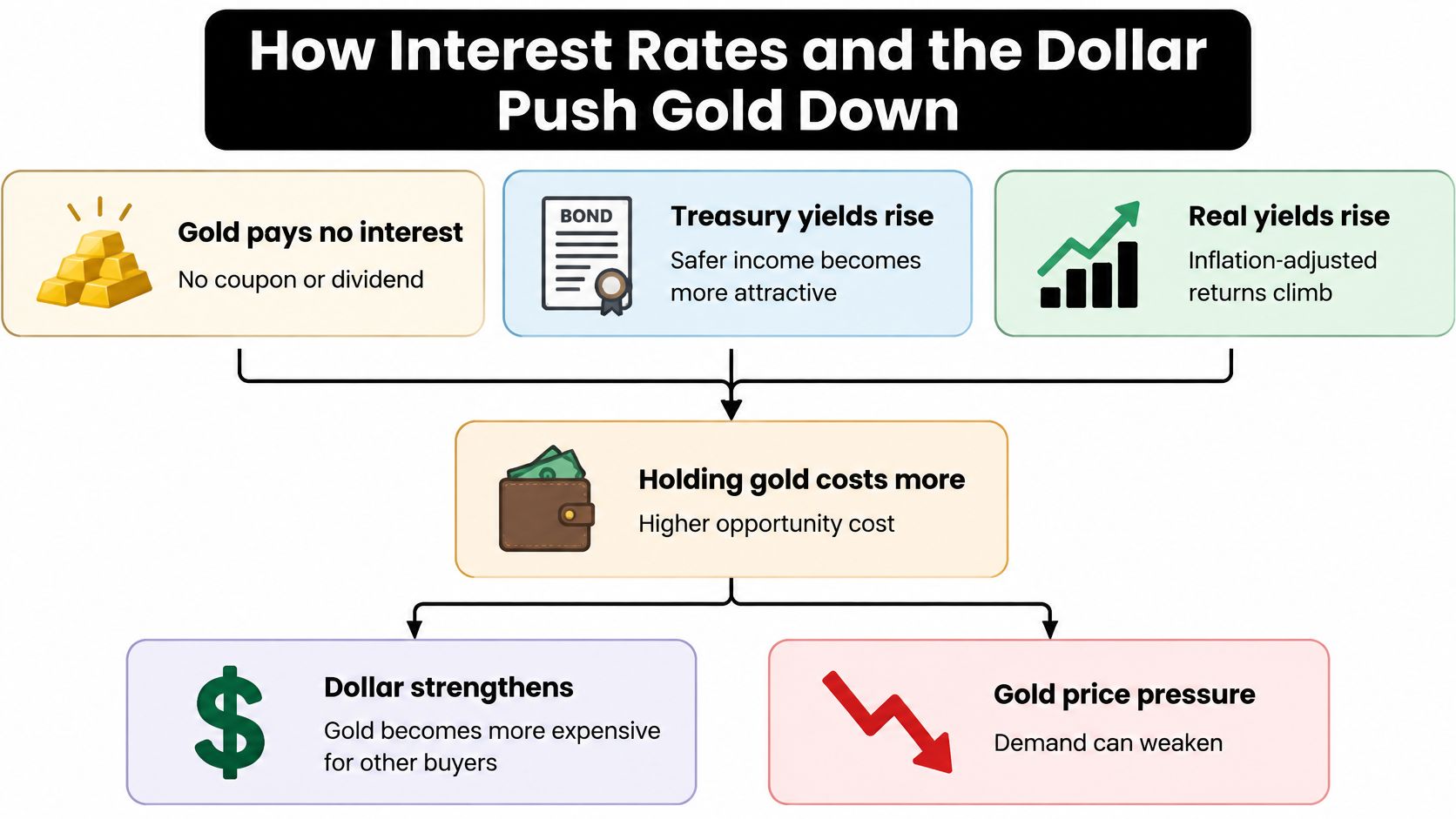
How Interest Rates and the Dollar Push Gold Down
Think about choosing between a gold bar in a safe and money in an interest-bearing savings account. The bar doesn't pay you for holding it. When available interest income becomes more attractive, keeping the bar means giving up more potential income.
That forgone income is opportunity cost. Gold doesn't need to become less useful for investors to prefer another asset. The alternative only needs to become more appealing.
The flowchart shows how income opportunities and currency changes can affect that choice.
Why inflation-adjusted returns matter
Real yield means the return after accounting for inflation. A higher advertised interest rate doesn't necessarily improve purchasing power if inflation rises just as quickly.
This helps explain a confusing outcome: gold can decline while living costs remain high. Investors compare the income available elsewhere with expected inflation, not just the latest grocery or gasoline bill.
J.P. Morgan Private Bank's historical analysis identifies an inverse relationship between gold and real yields, particularly from 1997 through 2022, and describes the pressure associated with the Federal Reserve's tightening cycle beginning in early 2022.
The relationship isn't a switch that guarantees a particular result. The same analysis describes gold rising during parts of the 1970s despite increasing rates and declining during portions of the 1980s despite falling rates. Investor fear, currency movements and portfolio choices can outweigh an isolated rate change.
Why the dollar changes the buying decision
International gold prices are quoted in dollars. If the dollar strengthens against a buyer's home currency, that buyer needs more local currency to purchase an unchanged dollar-priced ounce.
Think of an imported appliance whose overseas sticker price stays unchanged. A weaker home currency can still make it more expensive at checkout. Some customers delay buying, choose a smaller purchase or stop shopping.
Gold buyers can respond similarly. That doesn't mean every currency movement immediately changes physical purchases, but it helps explain why a stronger dollar can discourage demand.
For another explanation of the rates-and-gold relationship, this video offers a supplementary overview.
Use a paired check rather than watching Federal Reserve headlines alone:
- Check real yields: Are inflation-adjusted income opportunities becoming more attractive?
- Check the dollar: Are overseas buyers facing a less favorable currency conversion?
When both move against gold, continued inflation concerns don't automatically prevent a decline. Neither reading, however, tells you precisely when selling will stop.
Why Silver Can Fall Faster Than Gold
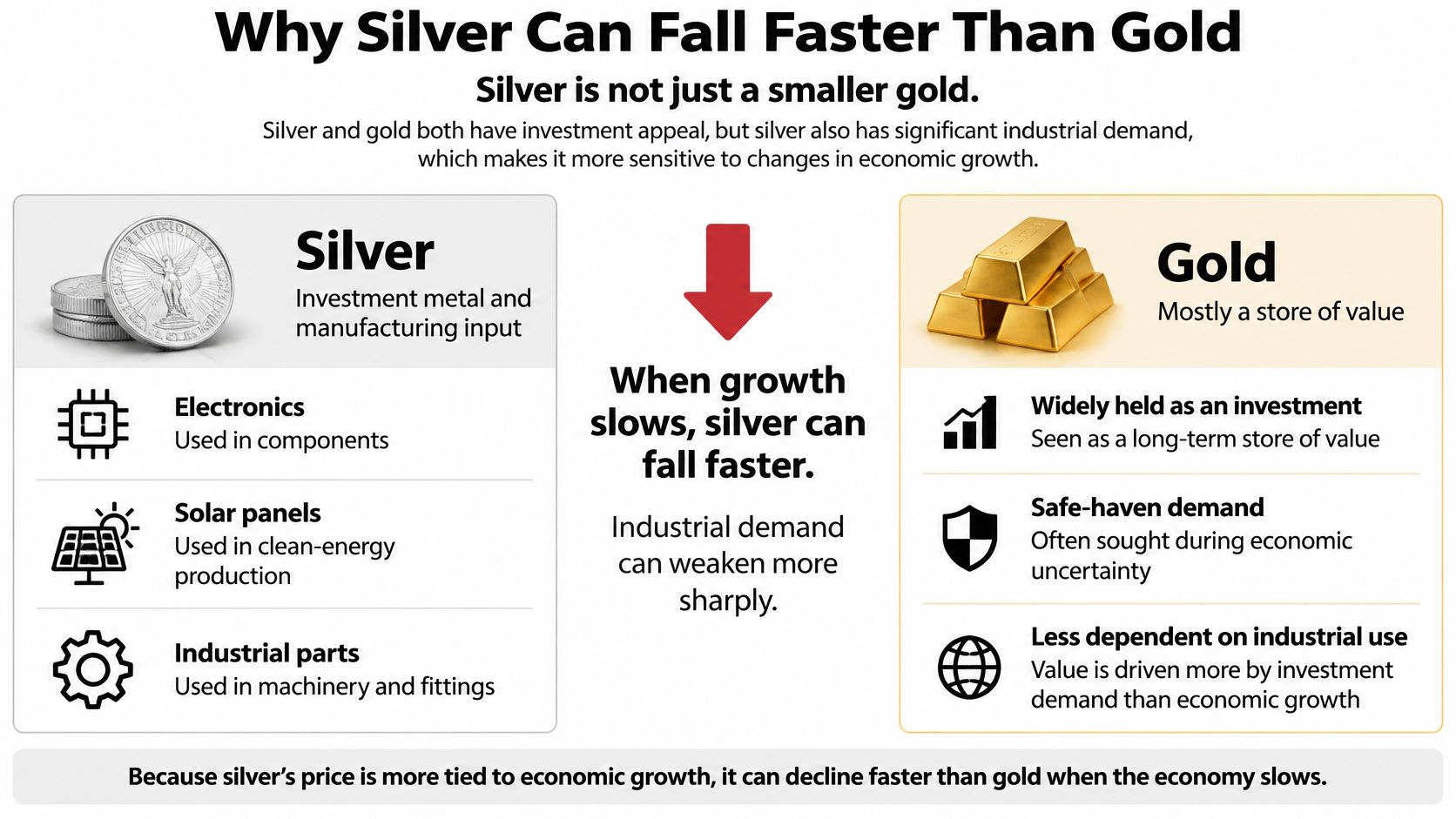
Silver isn't a less expensive version of gold. It's both an investment metal and a manufacturing input, used in electronics, solar equipment and industrial components.
That gives silver different groups of buyers with different priorities. A bullion investor might buy because they're worried about financial instability, while a manufacturer might reduce purchases because customers are ordering fewer products.
Strong factory demand can coexist with falling prices
The Silver Institute's industrial-demand report says industrial silver demand increased 4% to a record 680.5 million ounces in 2024, while the overall market recorded a 148.9-million-ounce structural deficit.
Those figures don't mean every category of demand strengthened. According to the Silver Institute's supply-and-demand overview, worldwide silver demand declined 3% to approximately 1.16 billion ounces in 2024, primarily as physical investment weakened and silverware and photographic demand decreased.
Think of a shop with busy commercial customers but fewer retail shoppers. Strong sales at one counter don't guarantee higher sales across the business. Silver's industrial and investment buyers can pull in opposite directions.
This comparison illustrates why silver's additional uses can increase its exposure to economic weakness.
| Factor | Gold | Silver |
|---|---|---|
| Share of demand that is industrial | Limited industrial exposure; jewelry and investment are important | Substantial exposure to solar, electronics and manufacturing |
| Market size and liquidity | Deeper and more liquid | Smaller, so forced orders can move prices more |
| Reaction to rate expectations | Strongly influenced by real yields and the dollar | Shares those influences, plus industrial sentiment |
| Typical signal to watch | Real yields and dollar index | Industrial forecasts and the gold-silver ratio |
A deficit isn't a guaranteed price floor
A structural deficit means annual demand exceeds annual supply under the report's accounting. It doesn't mean no silver remains available for sale.
Previously accumulated metal can enter the market. Investors can liquidate bars or fund holdings, and buyers can draw on inventories. Daily transactions therefore don't have to follow the direction implied by annual production and consumption totals.
Manufacturers also change how much silver they need. The Silver Institute's April 2026 outlook projects industrial fabrication declining 2% to roughly 650 million ounces in 2026, partly because photovoltaic manufacturers are reducing silver use and substituting other materials.
A factory can produce more finished goods without increasing silver purchases at the same pace if it uses less metal in each product. That's why solar installations alone aren't a complete silver-demand indicator.
> A shortage measured across a year doesn't guarantee that buyers will pay more today.
Silver's thinner trading conditions add another complication. Large orders, positions with borrowed funds, and hurried exits can create sharper movements than a casual comparison with gold suggests.
When silver underperforms, ask whether investors are selling financial positions or manufacturers expect to consume less metal. Those explanations can overlap, but they don't imply the same recovery path.
ETF Outflows, Forced Selling and Mining Supply
A falling price doesn't necessarily mean jewelers have stopped buying or bullion customers have disappeared. Investors can reduce exposure through financial markets without changing their opinion about a particular coin or jewelry item.
Physically backed exchange-traded funds, or ETFs, connect investment flows with bullion holdings. When investors withdraw money and fund shares are redeemed through the relevant mechanisms, the amount of metal held by the funds can decline.
The World Gold Council's full-year investment report records gold ETF holdings falling by 244 tonnes, or 7%, during 2023, while investors withdrew US$15 billion.
Selling because cash is needed
Voluntary fund withdrawals differ from forced selling. A trader using borrowed money or contracts that amplify exposure may have to provide additional collateral after losses.
If the trader can't supply cash, positions may be closed. They might also sell a profitable gold holding to support an unrelated position that's losing money.
Reuters' reporting on gold and rate expectations describes analysts citing forced selling and margin calls after technology-stock declines as an additional source of pressure on bullion.
That's a different transaction from a household deciding gold no longer offers long-term value. The seller's immediate problem is collateral, not necessarily confidence in precious metals.
Supply moves on a different timetable
Mine production is less responsive than a trading account. Operators can't instantly redesign a mine, change its ore body or complete a development project because a price chart turns downward.
Silver production also comes from mines producing other metals. Decisions about those operations aren't based solely on the silver price, so lower silver prices don't guarantee an immediate reduction in available supply.
Read the evidence according to its timescale:
- Fund flows: Persistent withdrawals can indicate that investment managers are reducing precious-metals exposure.
- Collateral pressure: Abrupt selling across otherwise unrelated assets can suggest a need for immediate liquidity.
- Mining conditions: Operating changes and new output affect supply over a slower cycle.
Don't treat all three as interchangeable evidence of weak physical demand. A temporary cash scramble and a durable increase in production require different interpretations, even if both contribute to lower quotes.
Reading Indicators and Seasonal Patterns Correctly
A useful dashboard should help you interpret information, not produce an automatic sell signal. Record the date, the direction of each indicator and the price benchmark you're using.
Some indicators measure market conditions; others describe trading behavior. Mixing them together without that distinction can make a falling price look more predictable than it really is.
Build a dashboard you can repeat
| Indicator | Where to Check | What a Drop Usually Means |
|---|---|---|
| 10-year real yield through TIPS | Treasury data or FRED | Falling yields can ease pressure on gold; rising yields can add pressure |
| US Dollar Index, or DXY | Major financial data sites | A weaker dollar can ease currency pressure on metals; a stronger dollar can weigh on them |
| Rate expectations | CME FedWatch tool | Fewer hikes priced in can ease pressure; more restrictive expectations can increase it |
| Gold-silver ratio | Gold price divided by silver price | A falling ratio means silver is outperforming gold; a rising ratio means it's lagging |
| ETF holdings | World Gold Council and Silver Institute reports | Persistent reductions indicate investors withdrawing exposure |
| RSI in oversold territory | A charting platform | Weak recent momentum, not a guaranteed rebound |
| Open interest falling during a price drop | CME Group futures data | Outstanding contracts are being closed; this alone doesn't identify which side initiated the exit |
Open interest deserves particular care. Every futures contract has both a buyer and a seller, so falling open interest alone can't prove that only bullish traders are leaving. Combine it with price action and positioning information.
An oversold reading is also descriptive, not a promise. Prices can continue falling while a momentum indicator remains weak.
For readers learning chart interpretation, Colibri Trader's guide lets you explore supply and demand gold setups. Use technical setups to organize possible scenarios, not to replace authentication, valuation or a personal cash-flow decision.
Give seasonal explanations less weight
Festival, wedding and holiday buying can affect physical demand, but a familiar calendar pattern doesn't establish what buyers are doing now. Local premiums, purchase delays and dealer inventory provide more direct clues.
Reporting published by The Daily Star describes delayed Indian purchases and subdued Chinese demand as buyers anticipated lower prices, illustrating why expected seasonal buying needn't translate into immediate purchases.
> Keep a dated record: Compare the same indicators over time instead of choosing whichever reading supports the decision you already want to make.
For a local transaction, combine that dashboard with the practical considerations in this guide to the best time to sell silver. A favorable chart doesn't help much if the actual offer includes deductions you haven't understood.
Why Your Offer Differs From the Headline Price
Spot price is a wholesale market benchmark for metal, not a promise that every buyer will pay that amount for every object. A retail transaction involves an identifiable item, testing, handling and a buyer's resale or processing costs.
The World Bank's discussion of precious-metals price retreats provides the broader market context. For a seller, the practical distinction is between that global price signal and the valuation of the particular item on the counter.
What the buyer is actually valuing
| Quote Component | What It Means | Effect on Your Offer |
|---|---|---|
| Spot price | Live global benchmark for pure metal | Starting point, not the final payout |
| Purity, expressed as karat or fineness | The proportion of the item that is precious metal | Metal-based offers cover the pure metal content |
| Weight in troy ounces or grams | Metal weight measured on a calibrated scale | More precious-metal weight increases the metal-value calculation |
| Dealer spread | Gap between buying and selling prices | Usually places a purchase offer below the buyer's selling price |
| Refining or melt cost | Cost of processing scrap or mixed material | May reduce offers for items requiring processing |
| Condition and collectible value | Resale attributes beyond the underlying metal | Can add a premium, though condition can limit it |
Consider a hypothetical ring containing gold alloy and a gemstone. Multiplying its entire weight by the pure-gold price would count non-gold material as gold and could count the stone as metal.
A clearer calculation is:
Metal weight × verified purity × current price per matching weight unit = estimated gross metal value.
That estimate comes before any disclosed spread or processing adjustment. If the ring has a recognized maker or desirable resale features, ask whether the buyer is evaluating those separately rather than treating the entire object as scrap.
For an explanation of a common jewelry category, see how much 14K gold sells for.
Bullion, jewelry and pawn collateral behave differently
A recognizable bullion product may be quoted against a benchmark with an identifiable premium or discount. Jewelry requires a separate assessment of alloy, non-metal components and potential resale appeal.
A pawn loan is different again. The offered principal reflects the lender's collateral assessment and loan terms, rather than an outright purchase price.
Don't assume a market decline automatically changes an existing pawn agreement or requires an early repayment. Ask the lender how the written contract governs maturity, renewal and redemption.
Request a written breakdown showing the benchmark, weight, tested purity and deductions. That makes it possible to compare offers for the same item instead of comparing a headline price with an unexplained cash total.
Decide Whether to Sell, Pawn or Hold
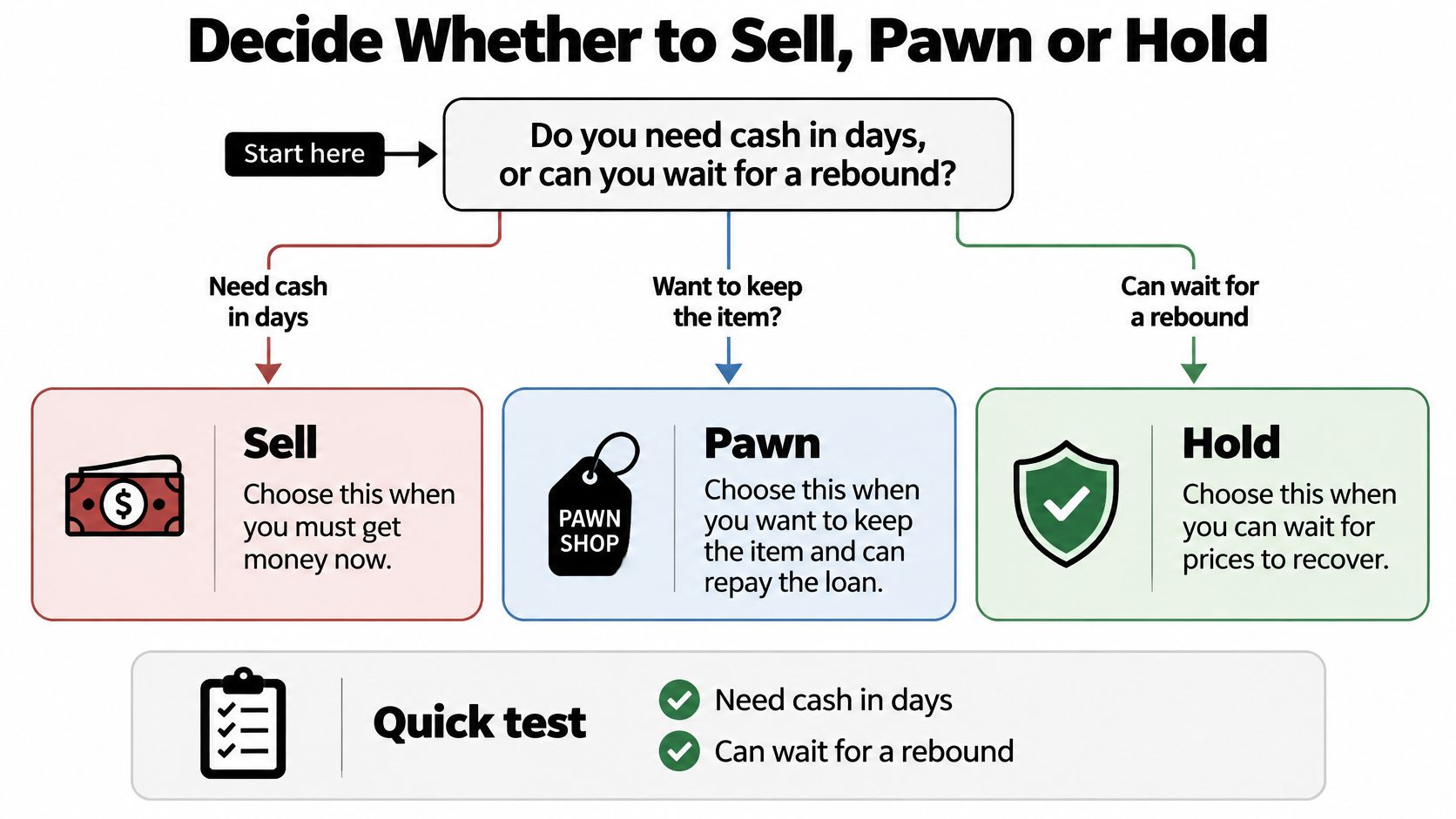
Start with your deadline: Do you need cash soon, or can you leave the item untouched? A market forecast is less useful than knowing the payment you need to make and whether you can repay a loan.
Sell when you need cash, accept permanently giving up the item and have compared the offer with reasonable alternatives. Don't let a hoped-for rebound become a plan for paying an unavoidable bill.
Pawn when keeping the item matters and repayment fits your budget. You retain the opportunity to redeem the collateral, but you shouldn't borrow on the assumption that a rising metal price will solve the repayment problem.
Hold when you don't need the money, still want the exposure and can tolerate further declines. Waiting is a financial choice, not a guarantee of recovery.
This decision flow keeps the immediate cash need separate from your view of future prices.
Prepare before accepting an offer
- Check identification marks: Note hallmarks and fineness stamps, but treat them as clues that still need authentication.
- Verify weight: Ask the buyer to explain which components are included and which are excluded.
- Compare written quotes: Use the same item description and ask when each quote expires.
- Set an acceptable outcome: Decide your minimum cash requirement before negotiating.
- Review loan obligations: Check charges, the redemption deadline and what happens if you can't repay.
If a pawn loan seems suitable, review how pawn shop loans work before committing. Compare the total repayment obligation with an outright sale, especially if your future income is uncertain.
For bullion you intend to keep long term, reconsider the reason you own it rather than reacting only to today's movement. For an immediate cash need, prioritize a clear quote and a manageable transaction.
You don't have to identify the exact market bottom to make a sensible decision. You need an authenticated item, an understandable valuation and terms that fit your finances.
---
Idaho Pawn & Gold Exchange offers precious-metal buying, item authentication and pawn loans for customers in Boise, Meridian and Nampa. Bring your bullion, jewelry or silver items in for authentication and request a written quote that separates metal value from adjustments, then compare selling with a pawn loan before deciding.