
Gold averaged $3,431 per troy ounce in 2025, according to the World Gold Council's full-year 2025 demand review. A 14K piece sells for a fraction of that figure, because only 58.33 percent of its weight is pure gold.
The math always runs in one order. Spot times 0.5833 gives melt value, which at that 2025 average comes to roughly $64 per gram. Straightforward scrap then brings about 60 to 90 percent of melt after testing, so two shops reading the same spot price can hand you very different cash.
A record spot price does not lift every offer by the same percent. Melt value works like a wholesale price, and each buyer decides what share of it reaches your hand. Per-gram ads also go stale within hours. The numbers that reveal the actual bid are the tested grams, the karat confirmed, the spot used, the stated share of melt, and how long the quote stays open.
What 14K Gold Actually Sells For
There is no fixed price for 14K gold. A buyer pays a share of melt value. Clean scrap commonly lands in that 60 to 90 percent band once purity is confirmed. A piece that still sells as jewelry can clear more.
Every row below is a published spot times 0.5833, divided by 31.1035 grams per troy ounce. That is the 14K melt per gram. The 70 percent and 85 percent columns are a typical cash range on scrap, not a promise.
| Spot benchmark | 14K melt per gram | 70% cash | 85% cash |
| --- | --- | --- | --- |
| $2,000 per troy oz example | $37.50 | $26.25 | $31.88 |
| $2,200 per troy oz, up 10% | $41.26 | $28.88 | $35.07 |
| 2025 annual average $3,431 | $64.34 | $45.04 | $54.69 |
| 2025 Q4 average $4,135 | $77.55 | $54.29 | $65.92 |
These are published benchmarks, not a live quote. Walk them in order. A $2,000 spot gives about $37.50 per gram of 14K, so a 70 to 85 percent payout is about $26.25 to $31.88. A 10 percent rise to $2,200 lifts melt to $41.26 and that same band to about $28.88 to $35.07.
Record highs and a weaker jewelry market
The World Gold Council's full-year 2025 demand review reported that the LBMA gold price reached 53 all-time highs in 2025, with an annual average of US$3,431 per troy ounce, 44 percent above 2024, and an average fourth-quarter price of US$4,135. At those levels the table's melt figures are about $64.34 and $77.55 per gram. A quote built on yesterday's print can already be wrong.
Record spot does not raise the cash offer by the same percent. The payout depends on tested grams and the buyer's percent of melt. The same review found global jewelry volume fell to a five-year low of 1,542 tonnes in 2025 even as jewelry value rose 18 percent to a record US$172 billion. High headlines and softer resale demand can sit side by side.
> Practical rule: Compare the buyer's stated share of tested melt, and how long that quote stays open. Don't shop advertised per-gram prices.
Rerun the same math on today's spot, then ask what percent of melt is on the table.
How Melt Value Is Calculated
A 14K chain isn't a lump of pure gold. It's a blend, like a drink that's a bit more than half gold and the rest stronger metals. Those other metals are there for strength, color, and durability.
The U.S. Federal Trade Commission jewelry guidance explains that 24K represents pure gold and that a 14K item contains 14 parts gold mixed with 10 parts of other metals. Divide 14 by 24 and you get 58.33 percent, written 0.5833. The other 41.67 percent is alloy.
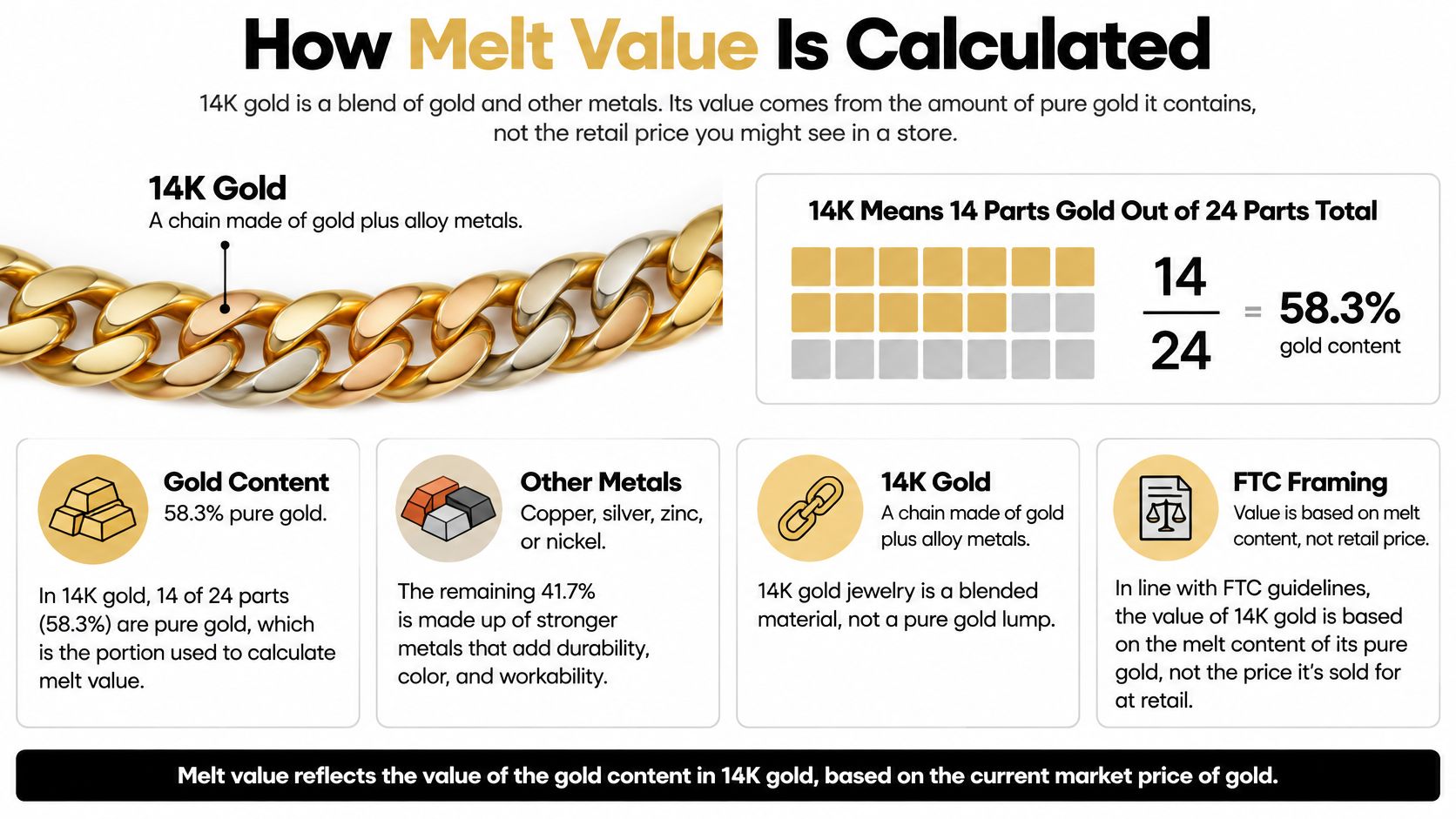
Two conversions, then the scale you actually use
Per troy ounce of 14K, melt equals spot times 0.5833. At $2,000, that's about $1,166.60 per troy ounce of 14K, before refining, dealer spreads, labor, gemstones, and profit margins. At $2,200, the same step is about $1,283.26.
Jewelry is weighed in grams. Divide by 31.1035. Those ounce figures become about $37.50 and $41.26 per gram. The scale a seller uses is simpler than it looks: tested grams of 14K times that per-gram melt.
Say the scale reads 12 grams of confirmed 14K and melt is $37.50 a gram. Theoretical melt is 12 times $37.50, or $450. That number is the metal, not the check.
What the formula leaves out
The formula doesn't include refining, the buyer's spread, labor, stones, clasps, solder, or dirt. A karat stamp is a claim, not a scale reading. Buyers may check fineness with acid, an electronic tester, or X-ray fluorescence, then pull non-gold parts off the weight.
The same purity math applies in any currency. The cash number still moves with the market, the test, and whether the piece is scrap, jewelry, or a collectible. If spot moves and weight and purity stay put, theoretical melt moves in proportion. A small slide in spot is a small slide in melt. It isn't a new karat.
You'll hear three prices. Spot is pure gold. Melt is the 14K alloy before costs. The cash offer is what's left after deductions. If you want the benchmark side of that story, see how gold prices are set before you compare two counters.
Why Two Buyers Quote Different Prices
The gap between melt and the offer is the buyer's real bill. Assay, refining, rent, and staff all have to be paid. So does the risk that spot falls before the metal is sold, plus a margin.
Gold prices are quoted on benchmarks such as the LBMA Gold Price. The World Gold Council's gold price data carries historical averages in major currencies back to 1978. A 1 percent rise in the gold price produces about a 1 percent rise in theoretical 14K melt when weight and purity stay constant. The cash offer usually sits below that figure because of assay, refining, operating costs, price risk, and resale or refining margins.
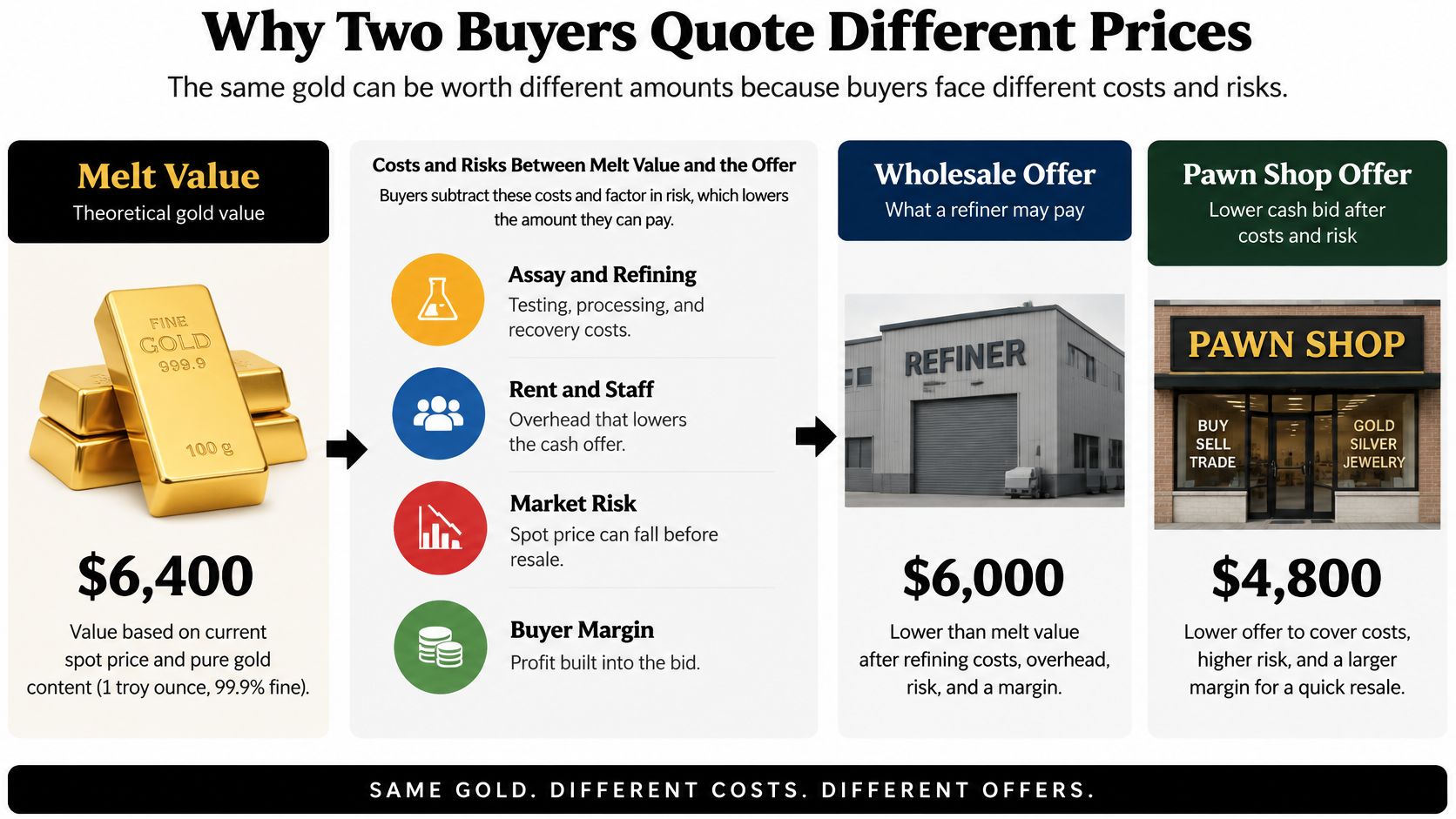
Three paths off the same scale
Broken chains, single earrings, and unmarked scrap usually clear as melt, often in the 60 to 90 percent band once stones and steel are out. A plain worn 14K band can sit toward the high end of that band because it's easy to refine and easy to resell as a simple ring.
A piece with a recognized maker, solid craftsmanship, diamonds, historical weight, or steady secondhand demand can sell above melt. The buyer expects to resell it as jewelry. Damaged lots and mixed-metal lots go the other way.
Lookalikes fool a stamp-only seller. Gold-filled, gold-plated, and stainless with a gold wash hold little or no fine gold. A 14K stamp on one clasp doesn't make a whole mixed lot 14K. Hollow pieces weigh less than they look. Gemstones come out of the gold weight unless the shop buys the stone on its own. White 14K is still 14K. The color comes from the alloy, not from a lower payout by itself.
> If two offers don't match, ask for tested fine-gold content times the current market price, then a line for every deduction.
Shops that buy jewelry for resale, not only for the melt pot, are worth a second stop. A plain guide to a pawn shop that buys jewelry shows what that counter is looking for before you walk in.
This short walk-through shows how a buyer turns a live price into a cash figure you can check.
Worked Examples You Can Recalculate
Use the 2025 average, about $64.34 per gram of 14K, only as a teaching price. Swap in the live spot before you trust a dollar figure.
A four-line calculator
- Write down today's spot per troy ounce and the clock time on the quote.
- Multiply by 0.5833, then divide by 31.1035. That's 14K melt per gram.
- Multiply by tested grams after stones and non-gold parts are out.
- Multiply by the buyer's stated percent.
At $64.34, a 10-gram broken chain is about $643 of melt. Eighty percent of that is about $515. A 5-gram plain band is about $322 of melt, and 85 percent is about $273. The band pays a higher percent because it's intact and easy. The chain pays a lower percent because it's scrap.
| Piece | Tested 14K grams | Offer |
| --- | --- | --- |
| Broken chain at 80% | 10 g | about $515 (melt about $643) |
| Plain band at 85% | 5 g | about $273 (melt about $322) |
| Ring after stone removed at 80% | 6 g | about $309 (melt about $386) |
| Mixed lot, half tests 14K, at 75% | 10 g of 20 g | $483 |
| Designer piece resold as jewelry | 10 g | above melt |
What changed the check
An 8-gram ring isn't 8 grams of gold if a stone and setting come off. If testing leaves 6 grams, melt is about $386, and 80 percent is about $309. The diamond may be priced apart, or it may stay with you. Don't let the gross weight do the talking.
A 20-gram mixed lot that tests half 14K and half non-gold is 10 grams of 14K, not 20. At 75 percent, that offer is about $483. Averaging the whole bag as 14K is how sellers overestimate.
A designer piece at the same 10 grams can clear above the $643 melt if it resells as jewelry. Melt is the floor for a desirable piece, not the ceiling. For a snapped chain, melt is the ceiling.
> If two shops disagree, compare tested grams and percent of melt, not the per-gram headline on the sign.
Ways to Raise the Offer on Your Gold
Preparation protects fine-gold weight and the resale path. It doesn't polish a higher karat into the metal.
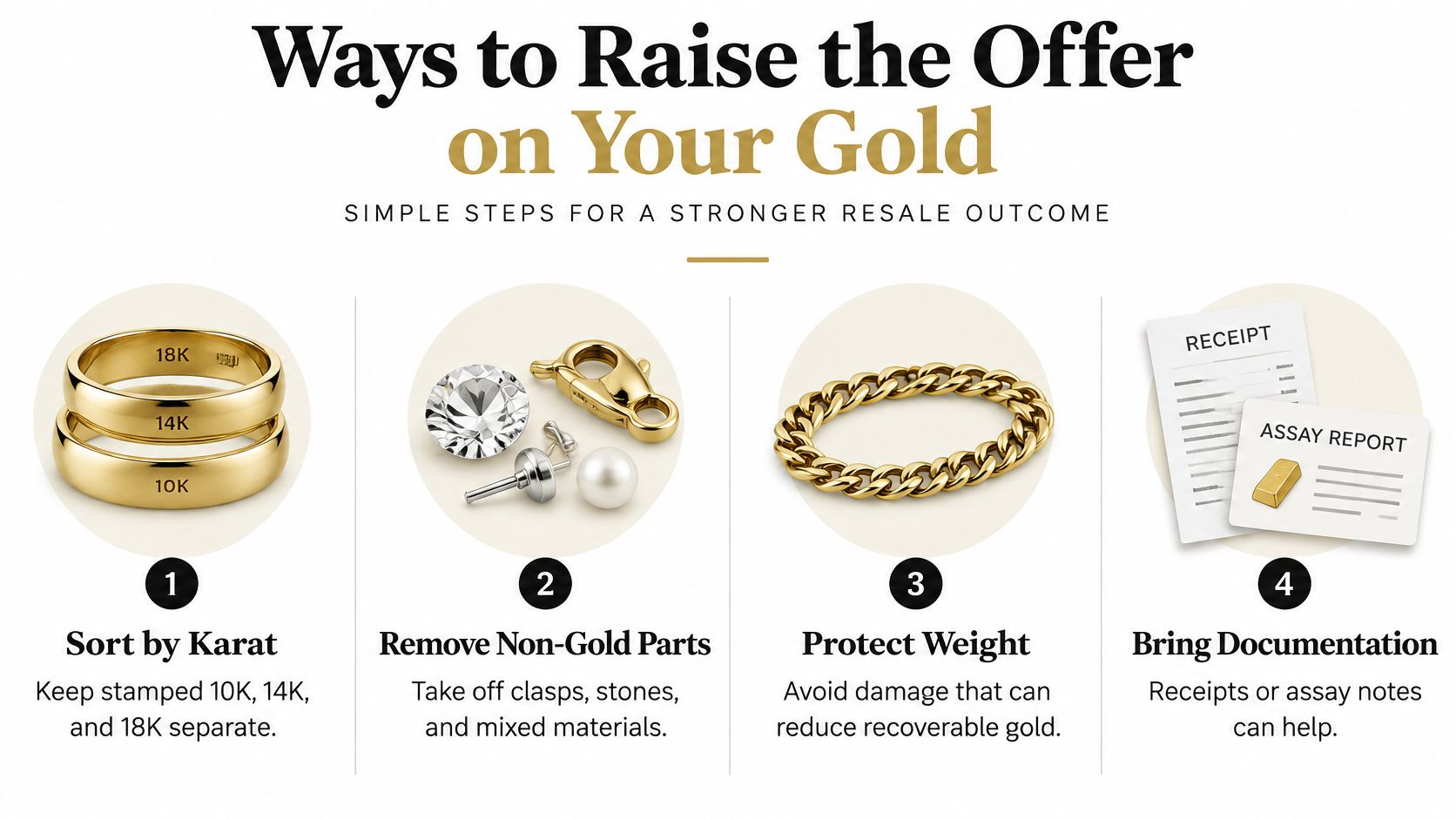
Sort, don't strip
Keep stamped 10K, 14K, and 18K in separate piles. Pull out gold-filled, plated, magnetic, and steel pieces so they don't drag a mixed-lot discount across the good metal.
Leave small stones in place unless a jeweler has already unset them. Prying can wreck a piece that might have sold above melt, and you can lose the stone. A rinse for lotion and dirt is enough. Don't file a stamp, and don't try to melt gold at home.
Proof, weight, and the clock
Photograph maker marks, diamond grades, and matching sets. A complete pair or a known designer is the usual reason an offer beats melt. A home scale is only a rough check. The shop weight, after non-gold parts, is the one that counts.
Write down the spot and the clock time before you walk in. Ask each buyer for tested grams, karat, and percent of melt while that quote is still open.
- Same-day quotes: Fair to compare.
- Last week's quote: Not fair, after a year full of record highs.
- Broken singles and snapped chains: Sell as scrap.
- Intact rings and branded pieces: Ask for a jewelry bid first.
- Mailed melt kits: Skip them when you want to watch the test.
How to Sell 14K Gold at a Pawn Shop
If you're in the Treasure Valley, you can finish this in person in Boise, Meridian, or Nampa instead of shipping metal. Watch the test. Leave with numbers you can read.
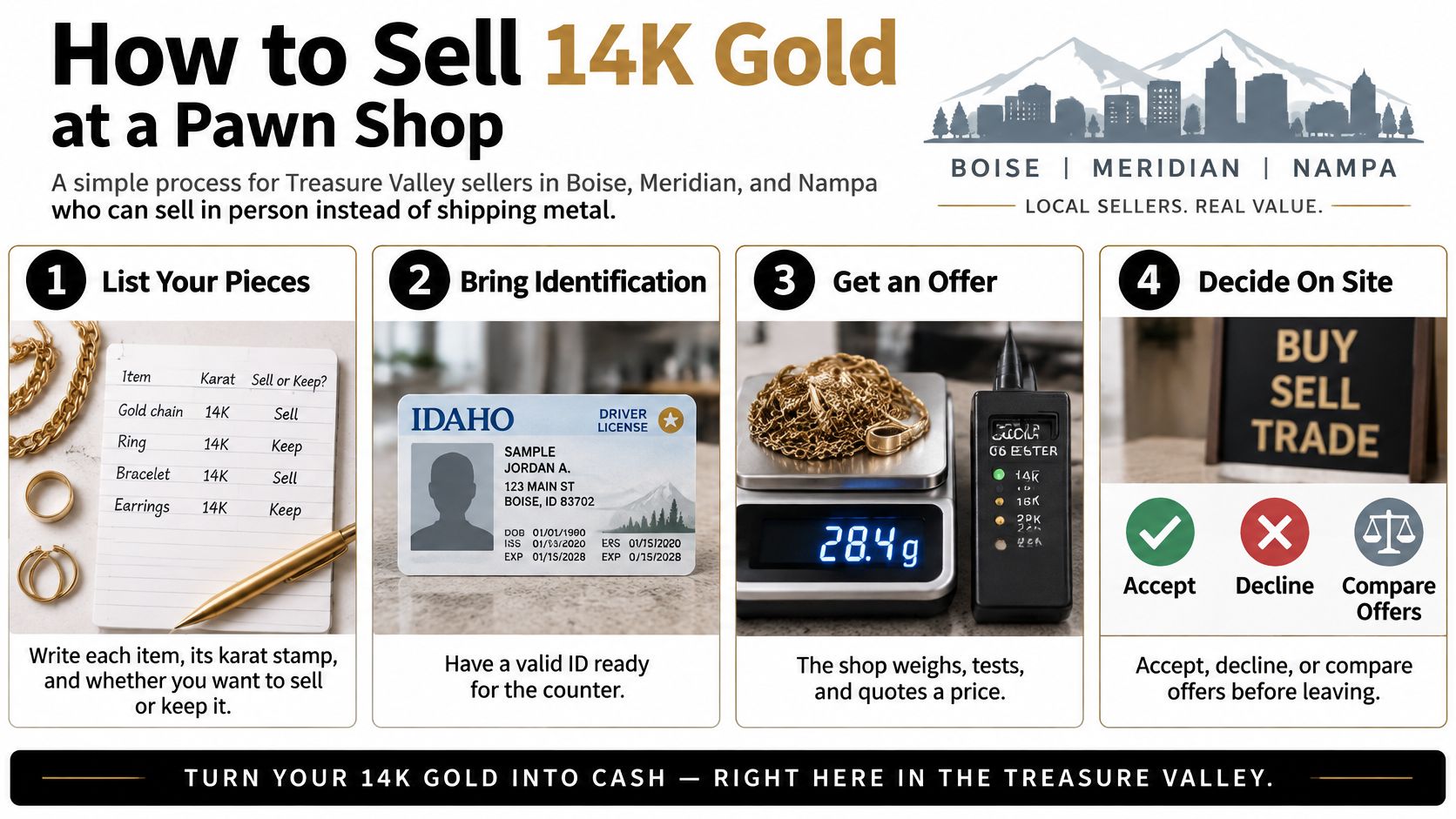
The visit, in order
- List each piece, its karat stamp, and whether you want an outright sale or a short-term pawn loan.
- Bring a government photo ID. Pawn shops record who sells precious metal. A purchase receipt or appraisal helps, but ordinary jewelry doesn't require one.
- Ask for the live spot and the clock time. Watch the test, whether acid, electronic, or X-ray fluorescence, and watch stones and non-gold parts come off the scale.
- Read the offer as tested grams, karat, the spot used, percent of melt, and any separate stone value.
- Choose a sale or a loan. A sale is full cash with nothing to repay. A loan lets you redeem the piece, so ask the loan amount, the finance charge, and the last day to redeem before you sign.
- Get the figures in writing and collect payment before you leave. Decline any offer that won't show weight and percent of melt.
Scrap, jewelry, or a loan
For broken chains and scrap, take a tested melt offer. For intact rings, branded pieces, or diamonds that might resell, ask for a jewelry price first and treat melt as the fallback, not the opening. Choose a pawn loan only if you want the piece back.
Idaho Pawn & Gold Exchange, with counters in Boise, Meridian, and Nampa, buys and pawns gold and can authenticate pieces that might be worth more than scrap. Ask how that shop's hold period and loan terms work rather than assuming them. A closer look at selling scrap gold at a pawn shop covers what the counter needs from a melt lot.
Leave with a written offer you understand, or with your items still in hand. How much does 14K gold sell for on that visit is the tested grams times today's melt times the percent they will put in writing.
---
Idaho Pawn & Gold Exchange buys and pawns 14K gold in Boise, Meridian, and Nampa, and the counter can show you tested weight against the day's spot before you decide. Bring the pieces, a photo ID, and the questions from this page, and compare a jewelry bid with a melt bid on anything that's still intact. Visit Idaho Pawn & Gold Exchange when you're ready for a same-day look.