You're standing at your kitchen table with a gold necklace, a diamond ring you no longer wear, or an inherited piece you don't want to keep, and you need cash without a credit application or a week of online listings. A pawn shop can solve that problem today. It can also cost you money if you walk in without knowing how the offer is built. Finding the best pawn shop for jewelry means finding a shop that tests, weighs, explains, and documents in front of you.
Decide Before You Walk In Whether You Want to Pawn or Sell
Confusing a pawn loan with an outright sale is the mistake I see most often. They're different transactions with different paperwork, different math, and different consequences. Decide which one you want before anyone quotes a number, because a shop should price and document each path separately.
A pawn loan gives you short-term cash while your jewelry stays as collateral. You repay the loan plus interest and any disclosed fees by the redemption deadline to get the piece back. If you don't repay, the shop keeps and can sell the item. That's the risk, and any honest broker will state it plainly before you sign.
An outright sale is simpler and final. Ownership transfers immediately, you walk out with cash, and there's no deadline or interest to track. A sale usually makes sense for broken chains, outdated styles, or pieces with no sentimental pull. A loan makes sense when the item matters to you and the cash need is temporary.
What Changes the Cost of a Loan
- Term length: Ask exactly when redemption expires and whether an extension is possible.
- Interest and fees: Get every charge in writing, not a verbal estimate at the counter.
- Storage security: Ask where collateral is kept and how your specific item is identified in their records.
- Repayment amount: Confirm the total due to reclaim the piece, not just the amount you receive today.
Context helps here. National Pawnbrokers Association industry figures show pawn transactions average **less than $180** nationwide, with many loans below **$50**. Most pawn customers aren't moving estate collections. They're covering a short gap, which is exactly why clear terms matter more than a headline quote.
Run the numbers before you go. A pawn loan calculator lets you model the loan amount and repayment side by side so the counter conversation starts from facts. If a shop pushes you toward a quick sale when you asked about a loan, that's a tell. The best pawn shop for jewelry walks you through both options and lets you choose.
Five Marks of a Trustworthy Jewelry Pawn Shop
Star ratings tell you whether people liked the parking. They don't tell you whether the person behind the counter can test gold. Judge a shop on what you can observe in the first few minutes.
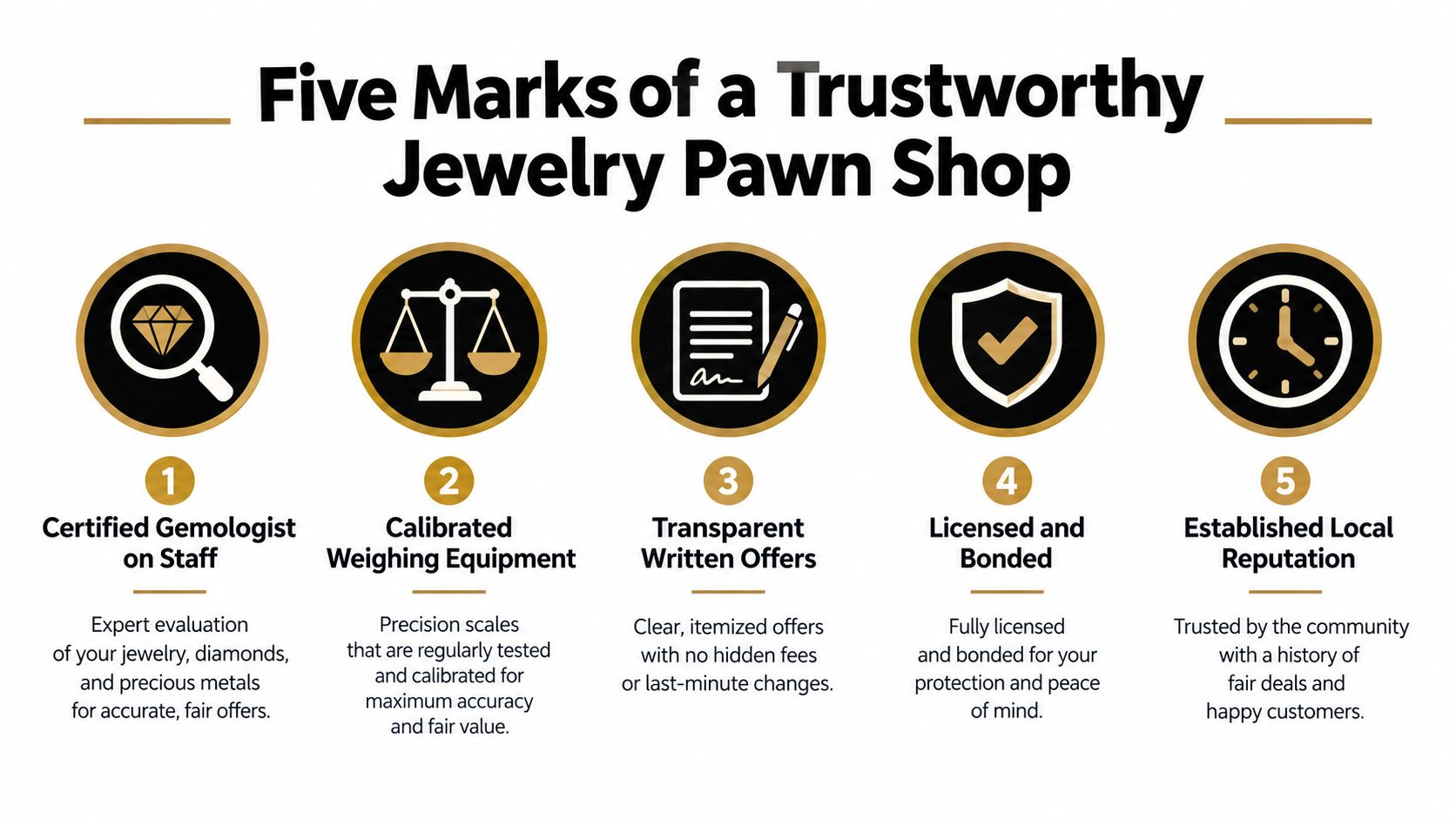
First, licensing should be visible. Look for posted state licensing and clear operating hours. A shop that's careless about displaying its credentials is often careless about records too. Second, look for real testing equipment. Electronic gold testers or X-ray fluorescence screening on site signal a shop that verifies metal content instead of trusting a stamp. Eyeballing is not authentication.
Third, written terms come before the transaction. Loan amount, interest, fees, redemption date, and item description should be on paper you can read and keep. Fourth, the offer should be itemized. A credible broker separates metal weight, stone value, and deductions so you can see how the number was built. Fifth, specialization matters. A shop focused on precious metals and gemstones will evaluate jewelry differently than a generalist storefront that mostly moves electronics and tools.
Why Disclosure Standards Back This Up
These marks aren't personal preference. The FTC Jewelry Guides require truthful representation of **type, grade, quality, metal content, weight, cut, color, treatments, origin, and value**, including for laboratory-created and imitation stones. A shop that documents material details is following federal consumer protection standards, not doing you a favor.
> If a shop won't write down what your piece is, don't trust what it says your piece is worth.
Pressure tactics are another useful signal, whether you're pawning a bracelet or buying a ring. This overview of Dallas engagement ring warning signs covers sales behaviors worth recognizing in any jewelry transaction. The best pawn shop for jewelry earns the deal with documentation. Tourist traps earn it with urgency.
The Four-Stage Verification Workflow Behind a Real Offer
A real offer is built, not guessed. When I watch an appraiser work, I want to see four distinct stages. If any stage gets skipped, the number on the counter is an opinion dressed up as a quote.
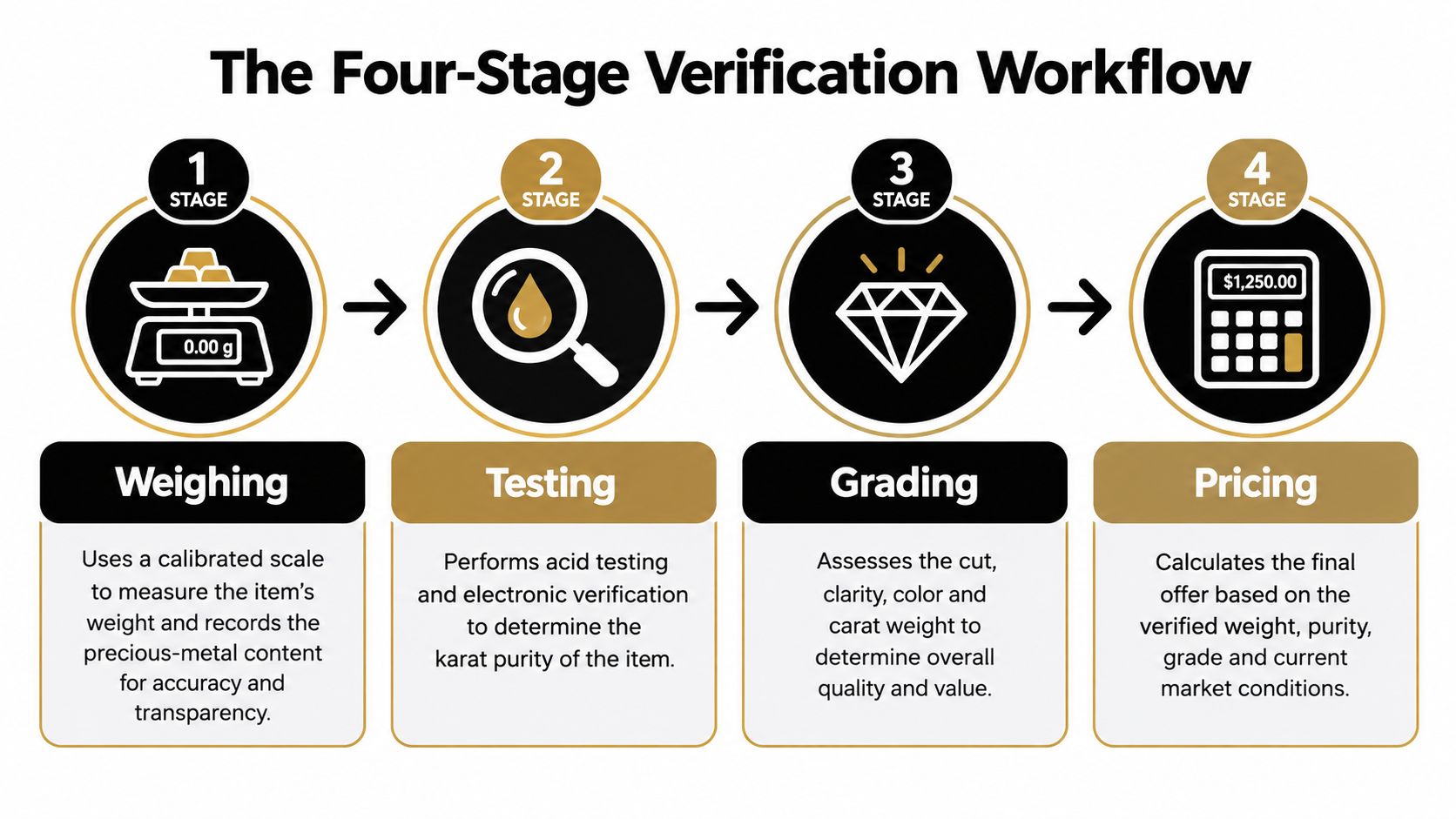
Stage One Weighing and Separation
The item goes on a calibrated scale and the weight is recorded. Precious metal content should be tracked separately from stones, springs, and nonprecious findings. A heavy clasp mechanism or a large synthetic stone can inflate total weight without adding precious metal value. Ask what's included in the quoted weight.
Stage Two Verifying Gold Content
A hallmark is a claim, not proof. A **14K** mark indicates a stated fineness of approximately **58.5% gold**, but it does not establish present condition, plating, solder content, or whether all components are included in the quoted weight. Competent shops verify beyond the stamp with electronic or X-ray fluorescence screening, and they use confirmatory assay for higher value transactions. Plated pieces and heavy solder joints are exactly where visual checks fail.
Stage Three Identifying Stones Independently
Diamonds and colored gemstones get identified apart from the mounting. That means checking whether a stone is natural or laboratory-created, noting any treatments, and matching it to any grading report provided. This is also where many customers overestimate what they have. If you're unsure what your eyes can tell you, read up on how to tell a real diamond by eye before assuming a sparkle test settles anything. It doesn't.
Stage Four Pricing Against Reality
Only now does pricing happen. The shop compares verified melt value, documented comparable market prices, and the specific loan or sale terms. Understand three different numbers. Melt value is the intrinsic metal worth. Retail replacement value is what a new equivalent might cost in a jewelry store, and it's almost never your payout. Resale value is what the shop can realistically recover, which is what drives the offer. The best pawn shop for jewelry explains which number it's using and why.
Questions Smart Customers Ask at the Counter
A ring comes out of a velvet box, the appraiser picks up a loupe, and the customer goes quiet. It happens constantly. People who researched for an hour at home forget everything once someone starts writing numbers down. Don't recite a script. Have a conversation, but cover these points.
Questions About the Item
- How are you weighing this: Ask to see the scale reading and what's excluded from the weight.
- How did you verify purity: Electronic or X-ray fluorescence testing beats a glance at the hallmark.
- Is there a laboratory report: For diamonds, ask whether a GIA or equivalent report accompanies the stone and whether the report number matches it.
- What treatments are disclosed: Get treatments, laboratory-created status, repairs, weight, and origin claims in writing.
Diamond grading deserves a specific question about fluorescence, because most customers either ignore it or panic over it. GIA grades clarity under **10x magnification** on a **D-to-Z** color scale, and roughly **25%-35%** of submitted diamonds show fluorescence, with about **10%** of those showing enough to affect appearance. Fluorescence is a disclosure to evaluate, not an automatic defect. Ask the appraiser to show you the stone under controlled lighting and explain any price adjustment.
Questions About the Deal
- What's the interest rate and total repayment: The headline loan amount is only half the transaction.
- When does the redemption period end: Get the exact date and ask what happens if you're late.
- Where will my item be stored: Your piece should be identified, recorded, and held securely.
- Is this quote for a loan or a purchase: Confirm you're comparing the same type of offer across shops.
> Practical rule: Every answer that matters should end up on your paperwork. Verbal reassurance has no redemption value.
A sharp customer isn't confrontational. You're asking the shop to show its work. The best pawn shop for jewelry expects these questions and answers them without rushing you.
Why the Posted Gold Price Is Not Your Payout
Customers walk in pointing at a gold price on their phone, expecting that number to become their offer. It won't, and that gap isn't automatically a rip-off. The posted price reflects pure gold in a global market. Your ring is an alloy, at a specific karat, with stones, wear, and resale risk attached.
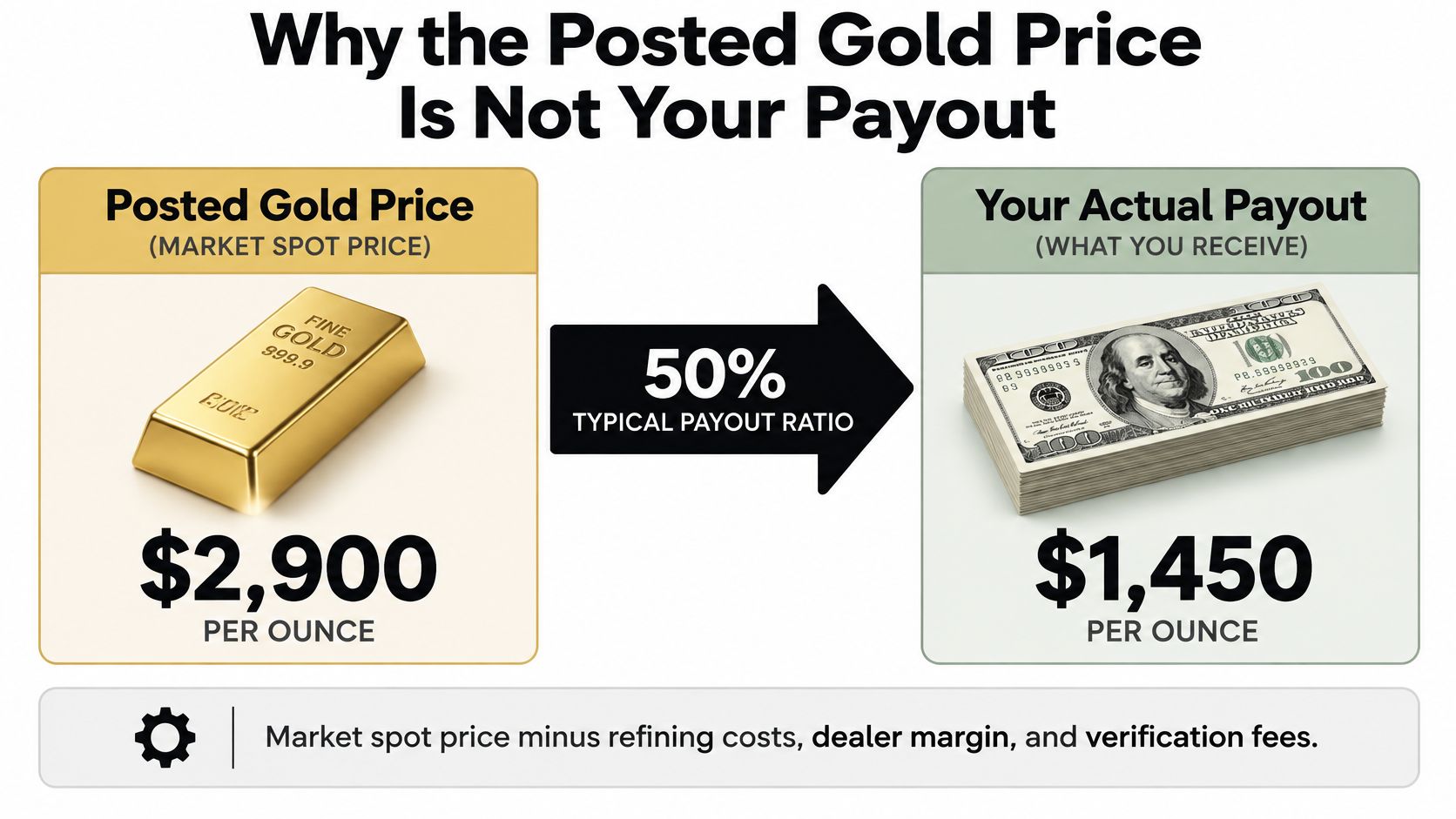
Market data shows why price alone misleads. In Q2 2025, global jewelry demand volume fell **14%** year over year to **341 tonnes** while demand value rose **21%** to **$36 billion** because gold prices were substantially higher. Buyers purchased less jewelry by weight even as prices climbed. A pawn shop pricing your piece has to think about who buys it next, not just what the metal is worth today.
How to Read an Itemized Offer
- Karat and gram weight: These drive melt value, and both should be stated separately.
- Stone value: Diamonds and gemstones should be priced on documented characteristics, not lumped into metal weight.
- Brand and condition: Designer pieces and luxury handbags can carry value well beyond metal content if authenticity, serial numbers, and condition check out.
- Deductions: Refining, repair, and resale risk are legitimate categories, but each one should be explained rather than hidden inside a single low number.
If you want broader context on how resale pricing gets structured, the ScanFlip AI pricing guide breaks down comparable based pricing in plain terms. For gold specifically, learning how gold prices work helps you separate spot price from the melt value of your actual karat and weight.
Here's my test. Ask the shop to re-verify any number you don't understand. A good broker reweighs, retests, and explains. A weak one just repeats the offer louder. That reaction tells you whether you're in the best pawn shop for jewelry or just the nearest one.
Negotiating a Fair Deal on a Pawn Loan or Outright Sale
Negotiation at a pawn counter isn't a fight. It's two people working from the same facts toward a number both can live with. You negotiate better when you remove the shop's uncertainty about your item.
Watch how a proper hands on appraisal looks before your piece is examined.
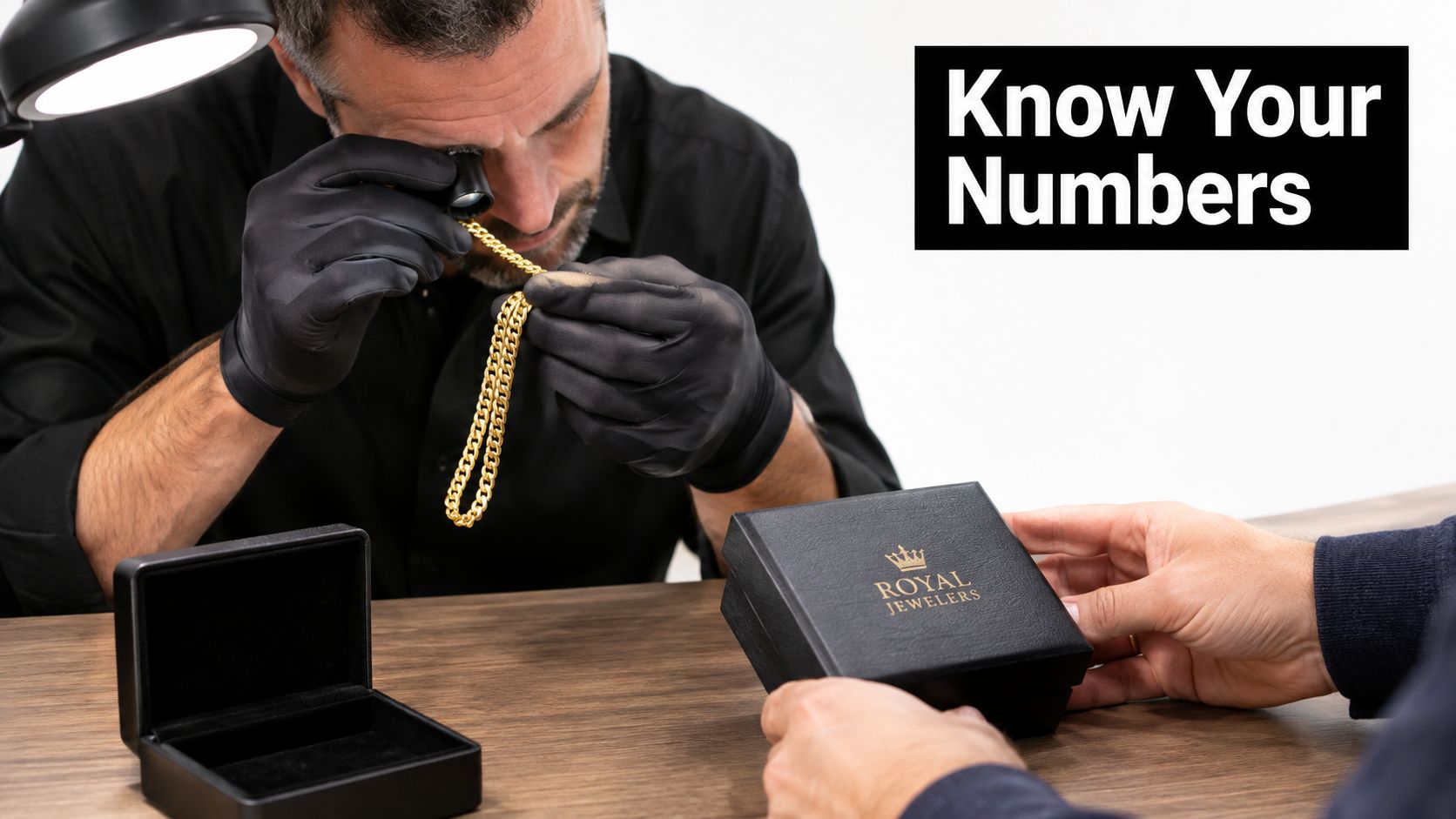
Bring everything that documents the piece. Original boxes, grading reports, prior appraisals, receipts, and repair records all reduce guesswork. A report that matches the stone in front of the appraiser strengthens your position because the shop doesn't have to discount for unknowns. Clean the jewelry, but don't attempt repairs yourself. Amateur fixes create questions instead of value.
Ask for testing and weighing in plain view. Then get the offer in writing and, when the piece justifies it, compare at least two written offers. Comparable offers only help if both shops evaluated the same item description and the same transaction type. A loan quote and a purchase quote aren't interchangeable, and presenting one as the other kills your credibility fast.
The video below shows the kind of documented, in person evaluation you should expect during a serious appraisal.
Choose the structure that fits your situation. A loan suits a short, defined cash gap when you fully intend to redeem. A sale suits a piece you won't miss, or a situation where interest and fees over a long window would erode the benefit of keeping it. In the Treasure Valley, Idaho Pawn & Gold Exchange evaluates gold, diamonds, and luxury items for both loans and purchases at its Boise, Meridian, and Nampa locations, which gives local customers a concrete comparison point when gathering quotes.
Walk away from any offer you can't get explained item by item. Walking away isn't burning a bridge. Shops see it daily, and a fair offer will still be fair tomorrow.
Your Take-Home Checklist and Quick Answers
Screenshot this section. Everything above condenses into checks you can run in any shop, in order, before money changes hands.
The Counter Checklist
- Decide loan or sale first: Know which transaction you want before requesting a quote.
- Confirm licensing: Posted credentials and clear hours are the baseline, not a bonus.
- Watch the testing: Electronic or X-ray fluorescence verification should happen in front of you.
- Demand itemization: Karat, gram weight, stone value, and deductions stated separately.
- Ask about treatments and reports: Laboratory-created status, treatments, and grading reports belong in writing.
- Compare written offers: Two documented quotes beat five verbal ones.
- Read the redemption terms: Interest, fees, storage, and the exact deadline, all on paper.
Resale thinking belongs on that list too, especially if you're buying rather than selling. By 2025, **47%** of consumers consider resale value before buying luxury goods, and yellow gold retained **47%** of original retail value compared with **39%** the prior year. The cheapest piece on the tray isn't the best buy if missing documentation or undisclosed repairs make it hard to resell later. The best pawn shop for jewelry sells you evidence along with the item.
Quick Answers
What documents should I bring? Bring government identification, plus any grading reports, appraisals, receipts, original packaging, and repair records you have. Documentation reduces the discount a shop applies for uncertainty.
How long does a pawn loan run? Terms are set in your written agreement and governed by state regulation, so get the exact redemption date from the shop before signing. Never rely on a verbal estimate of the timeline.
Is my jewelry safe while it's pawned? Ask directly how collateral is stored, recorded, and identified as yours. A legitimate shop explains its storage and recordkeeping without hesitation, and your paperwork should describe the item in detail.
Can I buy back something I sold outright? Only if the shop still has it and agrees to sell it, at the shop's asking price. A completed sale transfers ownership. If there's any chance you'll want the piece back, choose the loan structure instead.
Why is my offer below my old appraisal? Appraisals typically state retail replacement value for insurance purposes. Pawn offers are built on melt value, verified stone characteristics, comparable resale prices, and the terms of your specific transaction.
None of this requires gemology training. It requires a shop willing to weigh, test, itemize, and write things down while you watch. If a broker does all four without being asked twice, you've likely found the right counter. If you have to fight for any of them, keep your jewelry in your pocket and keep looking.
---
If you're weighing a pawn loan against an outright sale on gold, diamonds, or a luxury piece, bring it in for a documented, in person evaluation with testing and weighing done in front of you and every term explained before you commit. Visit Idaho Pawn & Gold Exchange to find the Boise, Meridian, or Nampa location nearest you and get a written offer you can compare.