
The best time to sell silver is when a sharp price move, a favorable dealer spread, and your personal tax situation all line up at the same moment, not on a fixed calendar date. If only one of those three is working for you, you're usually leaving money on the table or taking a risk you don't need to take.
You've probably seen this setup before. A price alert hits your phone, silver's jumped, and suddenly that box in the closet feels urgent. Don't sell on urgency. Sell when the conditions are right, and sell in stages so one bad day can't wreck the whole decision.
When Selling Silver Actually Makes Sense
A seller in Nampa walks in with a grocery bag of inherited sterling, a few old coins, and a screenshot of the spot price. She doesn't need cash today. She just doesn't want to watch a strong price disappear while the flatware sits in a drawer for another year.
That's the normal decision in the Treasure Valley. It's not a trading desk call. It's a household call, made with imperfect information and a price chart that won't sit still.
The Three Lenses That Matter
Stop asking for the perfect day. Ask whether three conditions are true at once.
- Market timing: Is spot high compared with its recent range because of a real move, or are you chasing one green morning?
- Seasonal pattern: Are you in a period that's historically tended to be stronger, and is the live price confirming it?
- Personal tax position: Will selling now, versus waiting past a holding period threshold, change what you keep?
If the market lens says sell but the tax lens says wait two weeks, wait. If you need cash this week, the seasonal lens becomes irrelevant. The best time to sell silver is personal, even though the price is public.
> Working definition: A good selling window is a strong live price, a spread you can verify, and an after tax result you've already estimated.
Sell in Tranches, Not in One Bet
The smartest sellers I see don't dump everything at once. They sell a portion into strength, keep the rest, and reassess. That approach cuts regret both ways. If price climbs, you still own some. If it drops, you already locked in part of the move.
One lump sale feels decisive. It's usually just concentrated timing risk. A staged sale is boring, and boring is what protects you here.
Market Indicators That Actually Matter
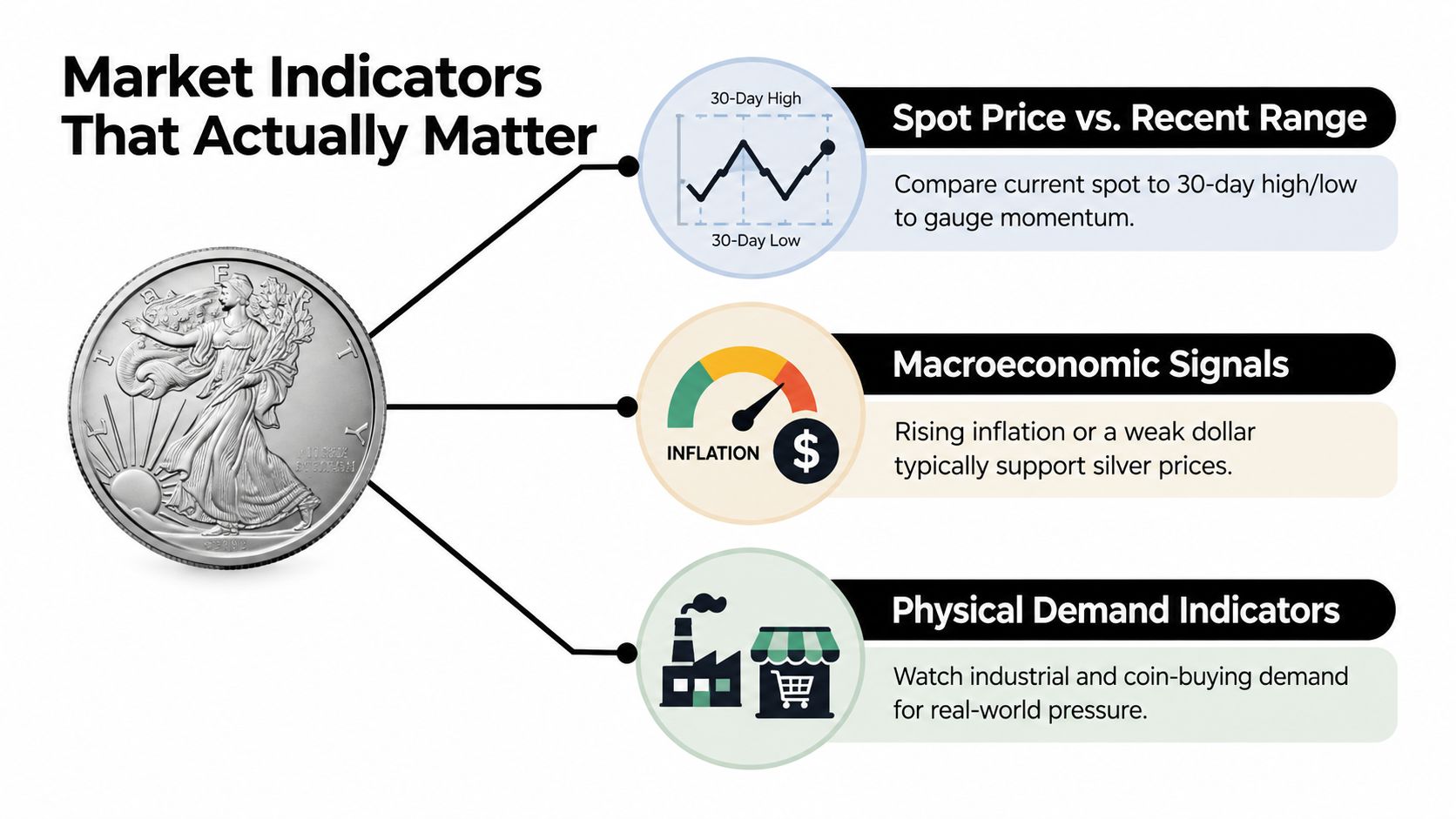
Forget most headlines. Three indicators do the work for a physical seller.
The visual below maps those three branches so you can check them in order before you drive anywhere.
Spot Price Against Its Own History
A high number means nothing without context. Compare today's spot with recent averages and with the long range. During the Hunt brothers episode, silver reached a London Bullion Market Association fix of $49.45 per troy ounce on January 18, 1980, while the 1980 annual average was about $20.98 per ounce, according to inflation adjusted silver price history from Money Metals. On April 28, 2011, it reached approximately $48.70 per ounce. In both cases, a single day high sat far above what most sellers could have captured for long.
That's your lesson. Peaks reverse fast. If you're staring at a price far above recent averages, that's a selling signal, not a reason to get greedy.
Demand Can Fall While Price Rises
Don't assume a rising price means everyone is buying more metal. The Silver Institute's reported 2025 data showed the annual average silver price rising 42% year over year to just above $40, while total demand fell 2% to 1.13 billion ounces, with coin and bar demand up 14% and industrial demand down 3% to 657.4 million ounces, per the Silver Institute April 2026 market summary.
Investment flows and tight inventories can overpower weaker fabrication demand for a while. For you, that means standard bars and recognized government coins usually move easily in that environment. Worn jewelry doesn't get the same benefit.
If you're weighing silver against gold exposure, the gold price guide from MyFundedCapital is useful context for how the larger metal drives sentiment. For a broader local framing, see this guide to navigating the precious metals market with silver.
Watch inflation concerns, dollar strength, and rate expectations because they shape investment demand. Ignore any headline that doesn't change one of those three.
Seasonal Patterns Worth Watching
Yes, some months have historically looked better. No, that doesn't give you a guaranteed peak.
Start with the chart, then check it against the live price before you act.
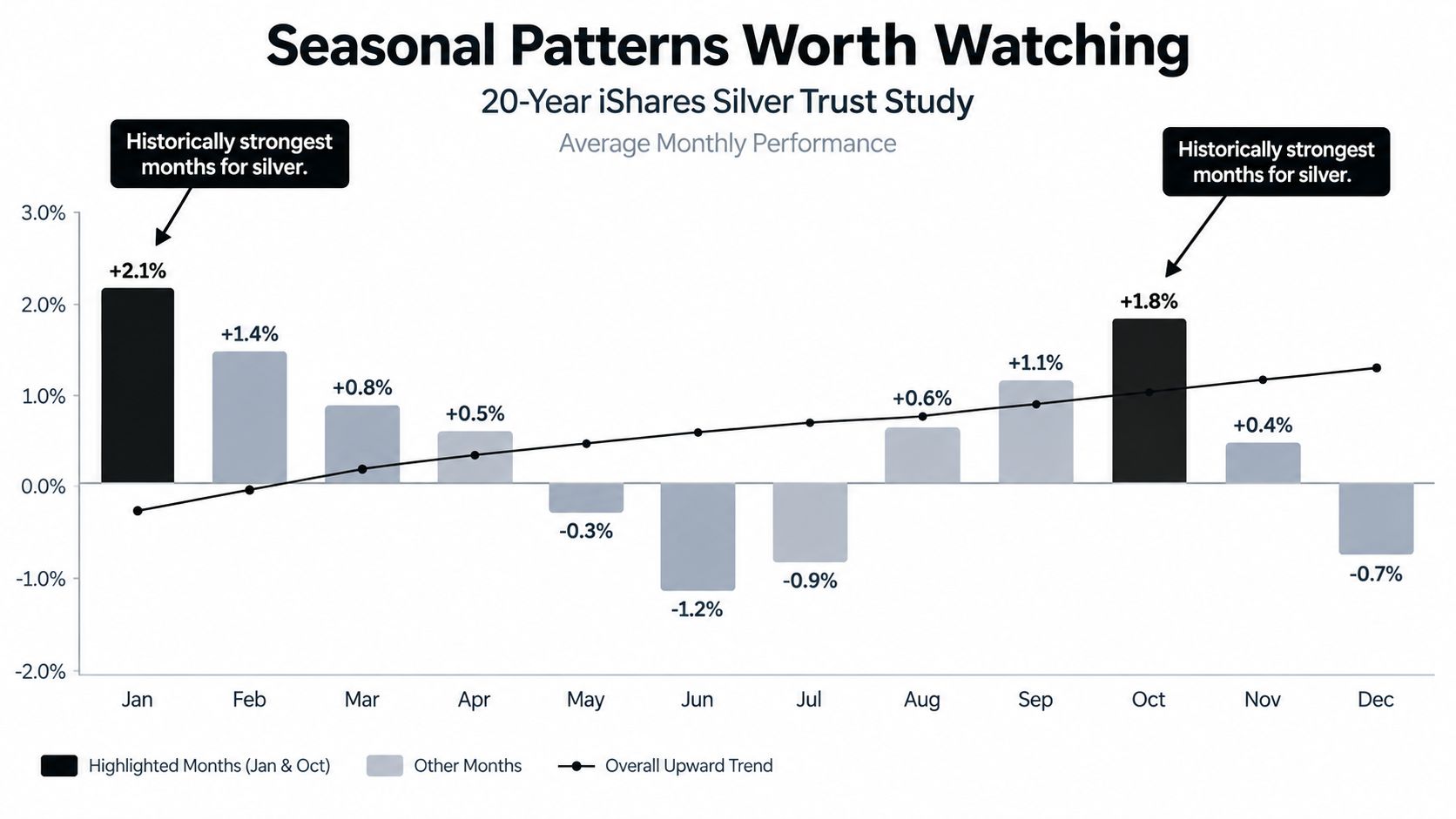
A 20 year analysis of the iShares Silver Trust found January was strongest by average return, producing an average gain of 4.44% and closing higher in 70% of observed years, while July ranked second at 3.10% with positive closes in 67% of years, August showed 1.94% and 62%, and February recorded 2.17% but was positive in only 55% of years, according to the StockCharts 20 year seasonality analysis for silver.
What That Means at the Counter
- January: Put it on your watch list every year. It's the clearest historical signal in that data set.
- July: Treat it as a second check in point, not an automatic sell date.
- February and August: The averages are positive, but February's win rate is much weaker, so demand confirmation from the live price.
Academic work backs up the caution. Analysis of 3,172 London silver observations from October 2003 through December 2013 found statistically detectable seasonal effects, but some results conflicted with earlier studies, as reported in peer reviewed research on seasonal effects in the London silver market. A longer COMEX study covering 1982 to 2002 found weak evidence for a consistently higher return on particular days and a negative Monday effect.
The short video below is a useful refresher on watching price action rather than trusting the calendar alone.
Use January and July as triggers to get quotes. Don't sell just because the month changed. If spot isn't confirming the pattern, the pattern isn't paying you.
Premiums, Spreads, and What Your Buyer Actually Pays
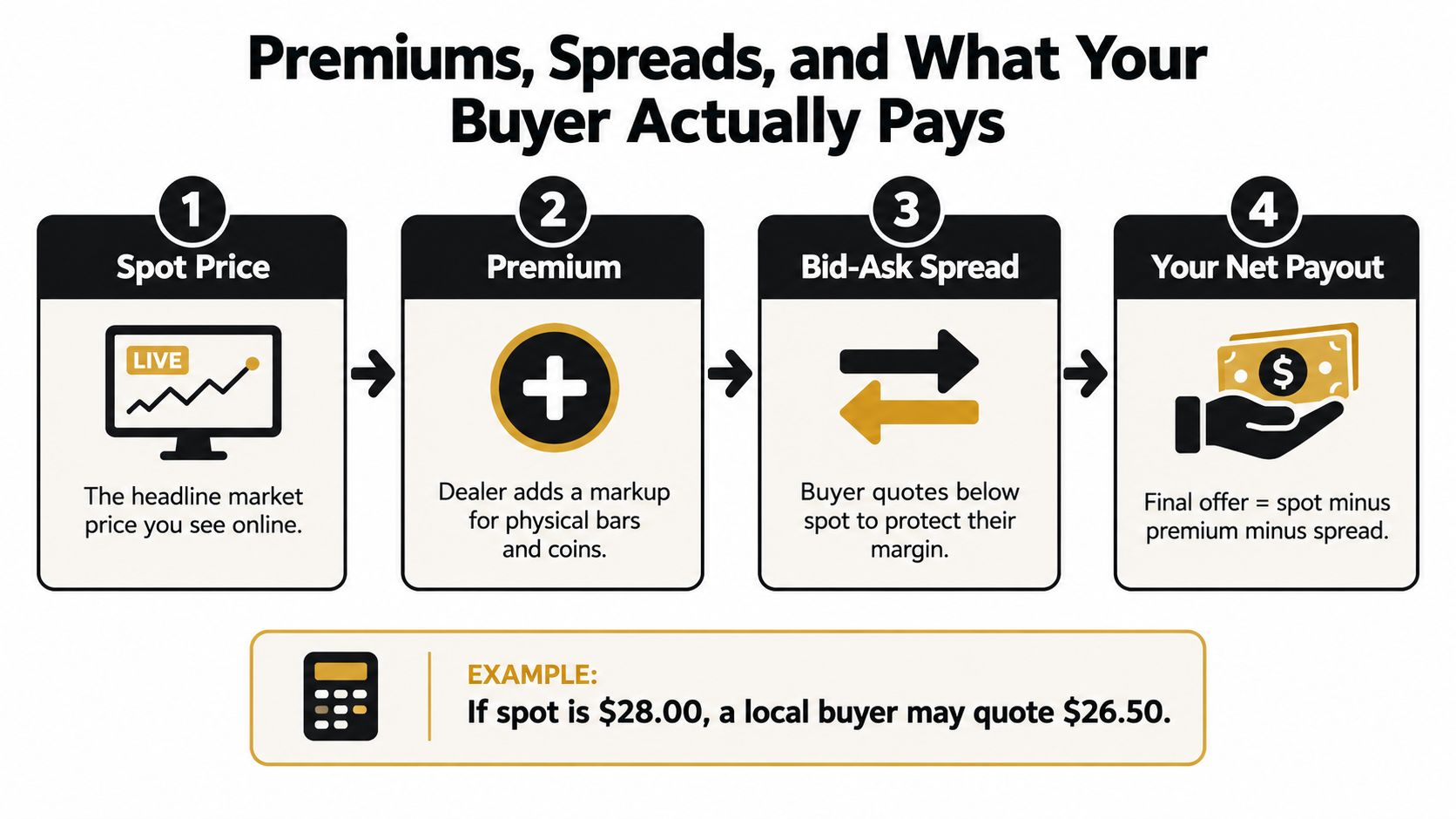
Spot is not your payout. If you remember one thing, remember that.
The flow below shows where the gap between the headline price and your check comes from.
Do the Fine Metal Math Yourself
Before you accept any offer, convert what you own into fine ounces. The formula is simple. Fine ounces equal gross weight multiplied by fineness, divided by 31.1035 grams per troy ounce, a conversion method described in the academic source cited in the earlier section.
Take a sterling piece as an example. Sterling is marked 925, so you multiply its gross weight in grams by its fineness, then divide by 31.1035. That gives you the pure silver content a buyer is pricing. Multiply that by live spot and you have melt value before any spread, assay risk, or refining deduction.
If a quote doesn't make sense against that math, ask why. A good buyer will show the work.
Why Identical Ounces Pay Differently
- Government coins: Recognized specifications and easy verification usually mean tighter spreads and faster resale.
- Generic rounds and bars: Still liquid, but brand recognition and condition affect how confidently a buyer can move them.
- Sterling flatware: You're selling melt value minus refining friction. Weight helps, ornate patterns usually don't.
- Worn or mixed metal jewelry: Expect the largest deductions. Stones, solder, and uncertain purity all raise the buyer's risk.
> Ask whether the quote is based on fine metal weight or gross weight. That one question exposes most bad offers.
Get multiple same day offers so you're comparing quotes against the same spot price. Ask if the price can be locked before shipment or a longer appraisal. For local pricing context, review how gold and silver pricing works in Boise and Nampa before you go in.
Timing a rally means nothing if you hand the gain back through a wide spread. Verify the math, then decide.
Two Selling Strategies for Different Goals
Most sellers fail because they use the wrong playbook for their actual goal. Pick yours first.
The Quick Cash Playbook
You need money for a bill, a repair, or a purchase that can't wait. Your priority is certainty and speed, not squeezing the last bit from the chart.
Sell what's most liquid first, usually recognized coins and standard bars. Get same day quotes, compare them against your fine ounce math, and take the best verified offer. Don't mail metal across the country hoping a refiner pays more next week while your deadline passes.
Accept that speed costs something. A slightly tighter payout today beats a theoretical better price after a late fee.
The Maximize Return Playbook
You don't need the cash. You want the best after fee, after tax result you can reasonably get.
Sell in tranches after sharp rallies. Keep a spread log so you know which buyer consistently quotes closest to spot. Separate any piece with possible collectible value from melt material before you get quotes, because those are two different sales. If you're still building a position rather than exiting one, this overview of investing in silver and ways to profit covers the buy side logic that affects resale demand.
Patience only works if you're monitoring. Set a price level where you'll sell the next tranche and honor it.
Matching Your Selling Goal to the Right Strategy
| Goal | Quick-Cash Strategy | Maximize-Return Strategy |
|---|---|---|
| Emergency bill due now | Sell liquid coins or bars same day for the best verified quote | Not appropriate, delay increases the cost of the emergency |
| Planned purchase in coming months | Sell enough now to cover the known amount | Stage sales into strength until the target is funded |
| Long held inheritance with no deadline | Sell only damaged or unwanted melt pieces now | Get collectible items assessed separately, then sell in tranches |
| Unsure whether to keep exposure | Sell a small portion to reduce pressure | Keep the balance and set a written trigger for the next sale |
Don't mix the two. A quick cash seller who waits for a seasonal peak isn't being patient. He's speculating with money he already needs.
Why Tax Timing Often Beats Price Timing
Most sellers obsess over the chart and ignore the calendar that matters, their holding period.
The checklist below puts the tax questions in the order you should ask them, before you negotiate price.
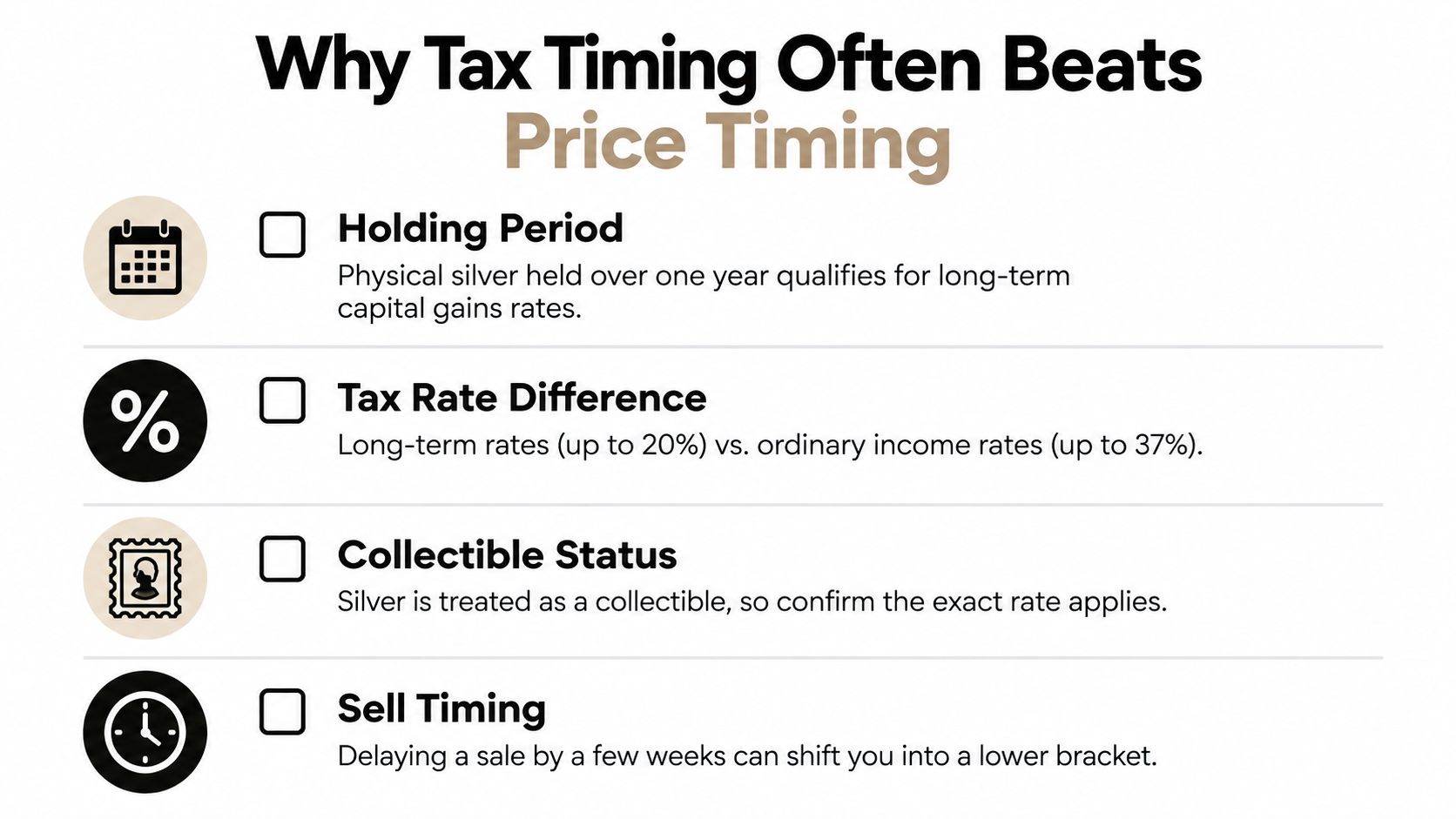
In the United States, physical silver is generally treated as a collectible, so gains on holdings kept more than one year can face a maximum federal long term rate of 28%, while gains on holdings kept one year or less are generally taxed as ordinary income, according to Investopedia guidance on taxes for physical gold and silver investments.
Run the After Tax Number
Your real result is sale proceeds minus dealer spread, minus shipping or assay costs, minus estimated taxes. A modest price gain from waiting can be wiped out, or amplified, by which side of the one year line you land on.
Keep records of purchase price, fees, and dates. Inherited pieces, collectible coinage, and bullion can each change the calculation, so don't guess your basis from memory. If you're exploring legitimate ways to reduce a gains bill, Allied Tax Advisors on tax avoidance outlines planning concepts worth discussing with your own professional.
> Contrarian rule: Don't chase a small spot move across a tax threshold until you've priced both outcomes.
A pawn loan is different from a sale. Borrowing against silver may defer a taxable disposal, but it adds interest and repayment risk, and you can lose the item if you don't repay. That's a financing decision, not a free way around taxes.
Confirm any final tax decision with a qualified tax professional. I'm telling you where the lever is. Your tax professional tells you whether to pull it.
Tools and Triggers for Monitoring the Market
You don't need a trading terminal. You need four tools and a short weekly routine.
- Live spot feed: Check the current price on the day you get quotes, not the price from last weekend.
- Multi month chart: Use it to judge whether today is high against the recent range or just noisy.
- Calendar alerts for January and July: Let the historically stronger months prompt a quote check, as covered in the section above.
- Spread log: Write down the date, spot price, item, fine ounces, and each buyer's offer. Patterns show up fast.
Spend ten minutes once a week updating that log. When spot jumps, you'll already know which buyer quoted tightest last time and what your melt value should be.
Set written triggers, too. Decide in advance what price makes you sell the first tranche, what spread you'll accept, and what tax date you won't cross without advice. Idaho Pawn & Gold Exchange provides current silver market price references and buy and sell estimates for coins and bullion, which is one local input you can compare against other same day quotes.
Triggers beat feelings. Write yours down before the market moves.
Selling Silver in Boise, Meridian, and Nampa
Bring the right items and the right expectations, and a local sale is straightforward.
Bring a photo ID, any original receipts or provenance you have, and your own fine ounce estimate. Separate recognized coins and bars from sterling and jewelry before you arrive. That speeds up authentication and keeps collectible questions from getting buried in a melt quote.
Your Final Decision Checklist
- Market: Is spot strong against its recent range today?
- Season: If it's January or July, is the live price confirming the pattern?
- Spread: Does the offer match your fine metal math?
- Tax: Have you checked your holding period and estimated the after tax result?
- Goal: Are you following the quick cash playbook or the maximize return playbook?
If you need cash today, walk in, get competing quotes, and close. If you want maximum value and have a larger or mixed lot, a planned visit gives the buyer time to assess collectible pieces properly instead of pricing everything as scrap.
Don't bring a bag of metal and hope. Bring a plan.
---
If you're ready to test your silver against a live local offer, bring your coins, bars, sterling, or jewelry to Idaho Pawn & Gold Exchange in Boise, Meridian, or Nampa for authentication, weighing, and a transparent same day quote. Whether you want a quick cash sale, a staged sale into strength, or a pawn loan instead of selling, our team will show you the math behind the offer so you can decide with confidence.