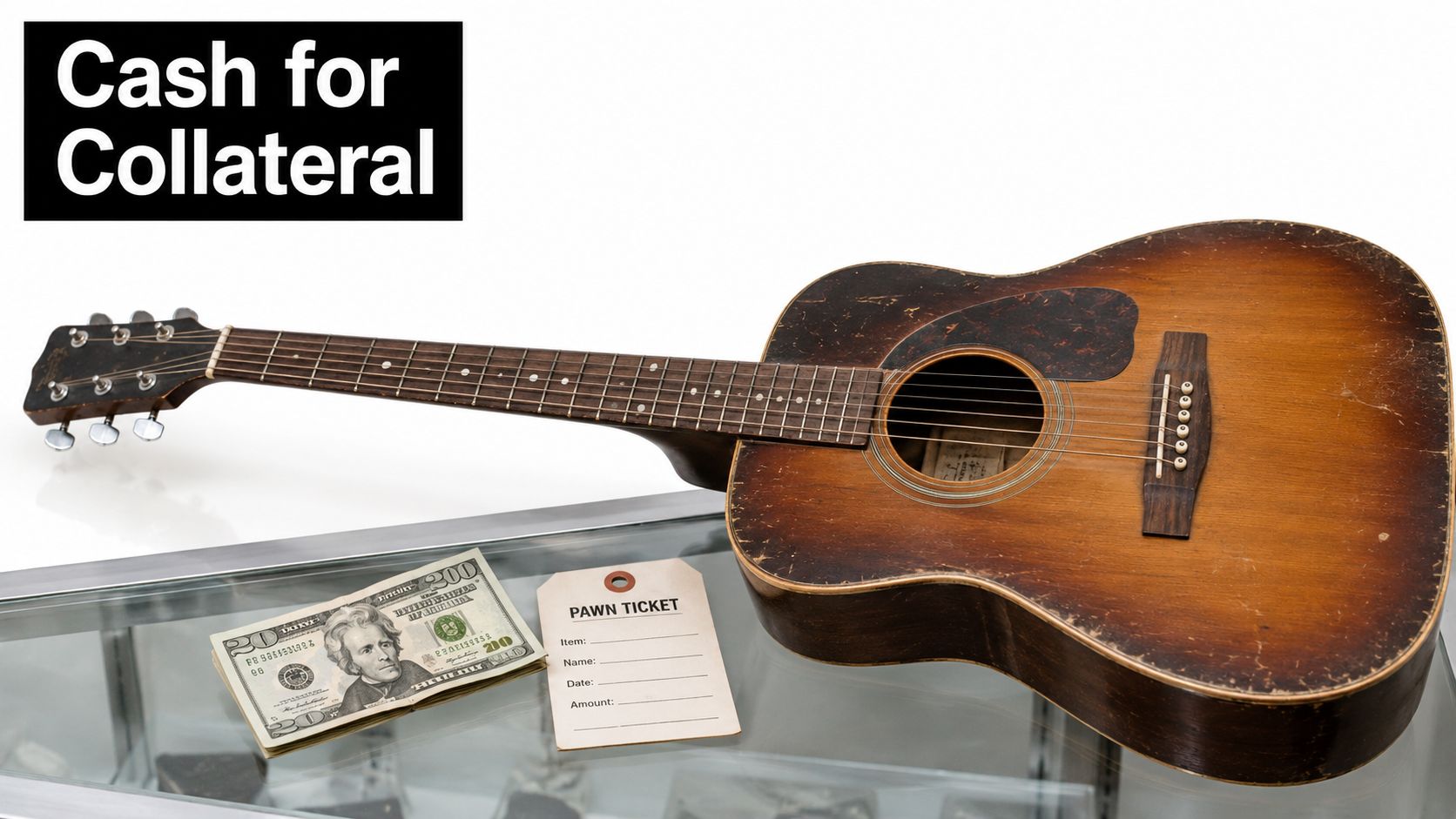
You're looking at a bill that's due Friday, your paycheck lands next week, and there's a guitar in the closet you haven't played in months. That's the exact gap a pawn loan fills, and understanding How Do Pawn Shop Loans Work comes down to tracking three things from the start. You'll hand over an item, get cash now, and decide later whether redeeming it is still worth the total you'll have paid.
What a Pawn Loan Is and How It Differs From Bank Credit
A pawn loan is simple in plain language. You leave a valuable item with the shop, the shop lends you cash based on what it thinks it could resell that item for, and you get the item back when you repay. If you don't repay or renew, the shop can sell it.
Three words explain most of what follows. It's small, secured, and non-recourse. The Federal Reserve pawn lending study reports that the typical U.S. pawn loan is approximately $75 to $100 and usually lasts about one month, with lenders typically advancing about 25% to 65% of expected resale value. Secured means your item is the collateral, so the shop judges the object, not your credit score. Non-recourse means the shop's remedy is generally limited to the item itself, rather than a lawsuit for an unpaid shortfall.
How the Three Loan Types Compare
| Feature | Pawn loan | Bank personal loan | Vehicle-title loan |
|---|---|---|---|
| Collateral | Item you hand over, such as jewelry, electronics or tools | Usually none; approval rests on credit and income | Your vehicle's title; you usually keep driving the car |
| Credit check | Generally not required | Usually required | Often not required |
| Typical size | About $75 to $100 for a typical U.S. pawn loan | Set by lender underwriting based on credit and income | Tied to the vehicle's value |
| Typical term | About one month | Months to several years | Often about one month |
| If you cannot repay | Shop may sell the item; no shortfall lawsuit in most cases | Unpaid balance can go to collections and hurt credit | Lender may repossess the vehicle |
That last row is why the distinction matters. If a title loan goes wrong, you can lose the car you drive to work, and readers in that situation may want to find a Georgia title pawn lawyer for state-specific help. With a pawn loan, the risk stays with the pledged item.
Before you accept any offer, ask one question. What exactly happens to this item or car if I miss the payment date?
How Pawn Shops Set Your Loan Amount
A pawn offer has little to do with what you paid. The shop lends a portion of what it could recover by selling the item if you never return, and the gap between those two numbers is deliberate. That buffer pays for testing and storage, absorbs the risk that resale prices fall while the item sits, and leaves room for the discount a quick liquidation demands.
Federal Reserve research on small-dollar credit describes the loan amount as negotiated below the item's expected recoverable sale value, with the difference acting as a risk buffer for authentication uncertainty, resale costs, price volatility and possible liquidation discounts. Pawn loans are small-dollar, short-term loans secured by personal property, so the item itself, not your pay stubs, gets the scrutiny.
The offer also sets your first repayment choice in motion. Every dollar you borrow comes back due with its fee attached, so the amount you accept today becomes the payoff you owe on the due date. A larger loan is a larger redemption bill.
What Drives the Loan Offer by Item Type
| Item | How it is valued | What lowers the offer |
|---|---|---|
| Gold jewelry | Weight and karat against the current gold price | Low karat, heavy damage, missing stones |
| Silver and bullion | Melt value from weight and purity | Low purity, dealer buy-back margin |
| Luxury handbags and watches | Authentication first, then specialist resale comparisons | Doubtful authenticity, missing papers, heavy wear |
| Electronics | Model, storage, condition and price guides | Age, cosmetic damage, missing accessories |
| Power tools and instruments | Model, condition and recent sold listings | Missing batteries or cases, visible wear |
Staff check catalogs, price guides, online sold listings and computerized valuation systems. For metal, they weigh the piece and test its purity. Say you bring a 10-gram 14-karat chain. Since 14-karat gold is about 58% pure, it holds roughly 5.8 grams of pure gold, and the offer tracks that melt weight at today's price minus the shop's buffer.
Bullion and plain metal price quickly because buyers are everywhere. A unique watch or handbag takes longer: the shop needs authentication and a specialist buyer, so its offer sits further below the prices you see online. Notice which prices the shop trusts. Sold listings show what a buyer really paid, while an asking price is just a hope until someone meets it, which is why staff lean on the former. If you are deciding what to bring, a guide to the best items to pawn for strong loan offers points you toward pieces with liquid resale demand.
> Ask for the valuation breakdown in writing before you agree. You want the weight, purity or model comparison the shop used, not just a final number.
Step-by-Step Pawn Loan Process From Pledge to Payoff
The whole transaction usually happens in one visit, but each step creates a paper trail you'll need later. Follow the sequence below and watch for the slip people make at each stage.
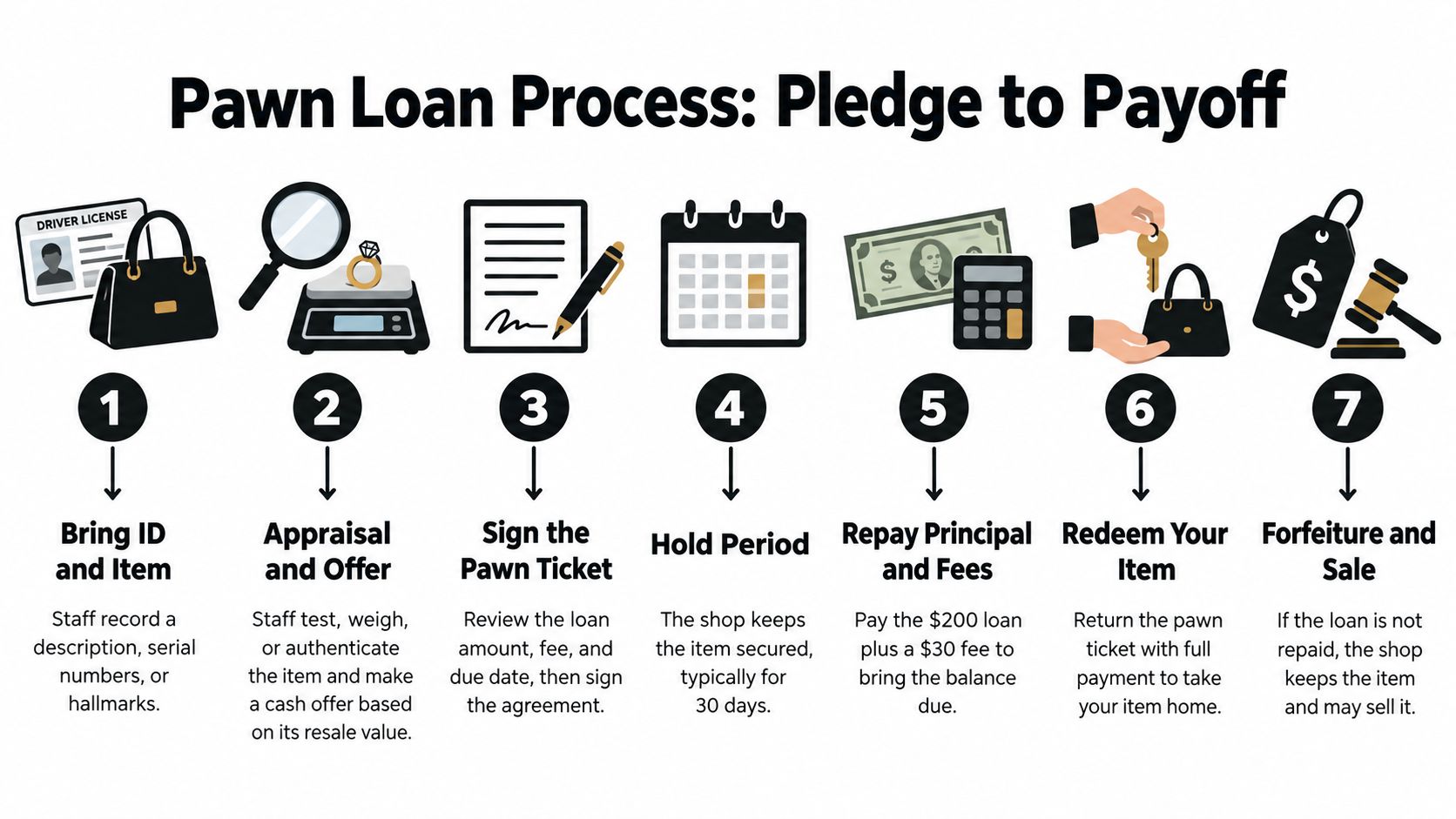
Here's a visual map of the journey from pledge to payoff.
The Seven Steps
- Bring ID and the item. Bring a valid government photo ID along with the piece itself. Staff record your details plus a description, serial numbers, or hallmarks, which protects both you and the shop if ownership is ever questioned. Forgetting ID is the simplest reason a visit ends with no loan.
- Appraisal and offer. Staff test, weigh, or authenticate the item, then quote a loan amount. This is your moment to ask how they reached the figure and whether a smaller loan is possible. Don't treat the first number as the amount you must take.
- Agree on terms. Confirm the principal, the fee or interest, the maturity date, renewal rules, and the exact redemption amount. Say the ticket shows a $200 loan with a $30 fee as a worked example. Your payoff on the due date would be $230, and that total, not the $200, is the number to plan around.
- Sign the ticket and take the cash. You sign the pawn ticket and usually receive cash on the same visit. Read the ticket before you leave the counter, because it is the contract. Check that the item description matches what you handed over.
- Holding period. The shop stores your item in a secured area while you keep the ticket as your claim. Put the maturity date in your phone calendar the same day. Most losses start with a forgotten date, not a refused payment.
- Redeem or renew before maturity. To redeem, you pay principal plus fees and take the item home. To renew, where the contract and state law allow it, you typically pay only the fee to extend the term. Renewing doesn't reduce the principal, which is the most common misunderstanding.
- Default and sale. If you do neither, the shop waits through any grace period the contract or law provides, then may sell the item. At that point the loan ends, but so does your ownership.
If you'd rather watch the process than read it, this short walkthrough shows the same pledge, hold, and redemption sequence.
Guard the ticket like cash. If you lose it, you'll generally need to prove ownership with ID and details of the item before the shop can release anything, and that takes time you may not have near the deadline.
What a Pawn Loan Really Costs Over Time
Shops usually quote a monthly charge as a percentage of the loan, and that number sounds small until you renew it or annualize it. A scholarly survey of U.S. pawn finance charges reports that average monthly pawn finance charges in the United States have ranged from 2% to 25%, with historical state ceilings often translating into annual percentage rates between 36% and 240%.
Do the math yourself. A 20% charge for 30 days multiplied by 12 gives a 240% simple annual rate, before compounding or extra fees. Borrowers who can't reach conventional credit often end up in this pricing tier, because pawn loans and other small-dollar alternatives generally carry high costs. The gap between a friendly monthly figure and a steep annual one is why total dollars out matter more than the advertised percentage.
Cost of a $200 Loan at Each Renewal Stage
| Scenario | Amount borrowed | Fees paid | Total you pay | Simple annual rate |
|---|---|---|---|---|
| Redeem after 30 days | $200 | $40 | $240 | 240% |
| Renew once, redeem at 60 days | $200 | $80 | $280 | 240% |
| Renew twice, redeem at 90 days | $200 | $120 | $320 | 240% |
| Two-week loan at $15 per $100 | $100 | $15 | $115 | About 390% |
Read the middle rows as a series of separate decisions, not one ongoing loan. Each renewal buys 30 more days for $40, and the $200 principal never shrinks because that payment covers fees only. After two renewals you've paid $120 in fees and still owe the full $200 to take the item home. Walk away at that point and you've lost both the fees and the collateral. At each maturity date, the key question is whether another $40 for this item is still worth paying.
The two-week row shows the same effect in miniature. A $15 fee feels minor, yet the short term pushes the annualized cost near 390%.
Storage, late, or handling charges can sit on top of these figures, so ask for every charge in writing. Run your own numbers with a pawn loan calculator for total redemption cost rather than trusting the monthly percentage alone. If you're weighing a pawn loan against other fast-cash products, Lein Law Offices on payday loan safety reinforces the same habit: compare total dollars out, not advertised speed.
> Cycle test: After each renewal, compare everything you've paid plus the payoff still due against what replacing the item would cost. When the running total passes replacement value, renewing stops making sense.
What Happens If You Fall Behind and Your Rights in Idaho
Here's the part that surprises people. If your item sells for less than you owe, the shop generally can't chase you for the difference, because the debt ends with the collateral. The trade is the other way too. Say you borrowed $200 against a ring worth $450. Default doesn't just cancel a $200 loan, it costs you a $450 item, plus any fees you already paid trying to keep it.
Default also isn't the clean all-or-nothing event that people typically imagine. An experimental study of pawn borrowing and repayment design reported a 44% default rate in its partner-lender data, and 29% of defaulters had made payments before default, so they lost both those payments and the collateral. The same study found structured-payment contracts reduced financial cost by 19% and default probability by 17.5%, although only 11% of borrowers voluntarily selected that option. Ask whether the shop offers structured payments that chip away at principal, because the answer changes your risk.
Complaints and Credit Effects
The CFPB research brief on payday, auto title and pawn loan use has documented complaints involving unexpected fees or interest, property being sold, and damaged or destroyed pledged property. It also notes that a fee of $15 per $100 borrowed for only two weeks equates to an APR of nearly 400%. Two lessons follow. No credit check doesn't mean low cost, and you need the total dollar payoff figure, not a rate quote.
Default usually costs the item rather than creating a credit-bureau event or continuing deficiency debt. That's a real advantage over unsecured borrowing, and the Superior Credit Repair payment history guide explains why avoiding a reported late payment matters for future borrowing. The protection only helps if the item you risked was worth less to you than the credit damage you avoided.
Questions to Confirm in Idaho Before You Sign
- Hold and grace period: What's the minimum time the shop must hold the item before sale, and is there a grace period after maturity?
- Notice method: How will the shop warn you before selling, and to what address or number?
- Partial payments: If you pay part of the balance, does it reduce principal or only cover fees?
- Surplus proceeds: If the item sells for more than you owe, do you get the excess back, and how do you claim it?
- Disputes: How do you challenge a fee, a damaged item, or a sale you believe happened too early?
Idaho pawnbrokers operate under state licensing, and the Idaho Department of Finance can answer rule questions if the shop's answers don't match your ticket. Get every answer above in writing on the ticket itself, not as a verbal promise.
Pawn or Sell and How to Get Better Terms
Pawn when the loan is a bridge you can actually cross. Sell when it isn't. That verdict sounds blunt, but running three quick checks makes the choice clear.
When Pawning Makes Sense
- You can repay by maturity: You have a specific paycheck, refund, or sale coming that will pay the full redemption amount, not just the principal.
- The item is replaceable: Losing it would sting financially, but it carries little sentimental weight and you could buy another.
- Redemption beats the alternative: The total you'll pay is less than the late fees, overdraft charges, or utility reconnection costs you're avoiding.
When Selling Is the Better Call
Sell instead if you're unlikely to redeem, because a sale usually brings more than a loan against the same item and you won't pay fees on money you'll never repay. Sell too if the item has strong resale demand and you don't need it back. Renewing twice on something you could have sold outright just converts your equity into fee payments.
You can compare both paths side by side on the pawn or sell decision page before you commit to either one.
Levers That Improve Your Terms
Borrow less than the maximum offer. Every dollar of principal carries the monthly fee, so taking $150 instead of $200 cuts every future charge and lowers the payoff you need to hit. Shops will usually write a smaller loan if you ask.
Get a second appraisal on gold and high-value pieces. Metal prices move daily, and two shops can weigh, test, and buffer the same chain differently. A second quote takes minutes and tells you whether the first offer was fair.
Pledge the replaceable item, not the heirloom. The math of default treats both the same, but you won't. Keep wedding rings and family pieces out of a transaction where a missed date ends your ownership.
Compare against a credit union small-dollar loan. If you qualify, that loan's total cost over the same period can be far lower, and your item stays home. The pawn loan only wins when speed or approval certainty matters more than price.
One option for that comparison locally is Idaho Pawn & Gold Exchange, which writes pawn loans and buys gold, silver, and luxury items outright, so you can price both a loan and a sale on the same visit.
Your Pre-Signing Checklist
- Written redemption amount: The exact payoff for a specific date, including storage and handling charges.
- Renewal terms: The renewal fee, how many renewals are allowed, and whether partial payments reduce principal.
- Sale protections: The grace period, how you'll be notified of sale, and how surplus proceeds are returned.
- Payment structure: Whether a structured-payment contract is available instead of fee-only renewals.
Bring the item and your photo ID, ask for the valuation breakdown and written payoff quote, then compare it with a second quote before signing anything. Three facts decide whether the loan works for you. The ticket terms, the maturity date, and the total redemption amount. If all three are clear and the payoff fits a date you can name, the loan is doing its job. If any one is fuzzy, slow down.
---
Bring your item and a valid photo ID to Idaho Pawn & Gold Exchange in Boise, Meridian, or Nampa, and ask for a written valuation breakdown and payoff quote for your exact repayment date. The staff can price a pawn loan and an outright sale on the same gold, jewelry, or luxury item, so you can compare both totals before you sign. Stop by or reach out today and leave knowing exactly what redeeming your item will cost.