
A Boise homeowner needs cash today and has three obvious candidates on the table: a gold chain, a laptop, and a cordless drill set. The chain may look old, the laptop may have cost more at retail, and the tools may still be useful, but none of that tells you which item will produce the strongest pawn loan.
A pawn offer depends on measurable value drivers. Metal weight and purity, brand recognition, age, condition, completeness, authentication effort, and current resale demand all matter. The best items to pawn are usually the ones a lender can test, price, and resell without much uncertainty.
This list ranks ten practical categories by how offers are commonly calculated. You'll see what strengthens each item, what reduces its value, how to prepare it, and which details can improve an offer at Idaho Pawn & Gold in Boise, Meridian, or Nampa.
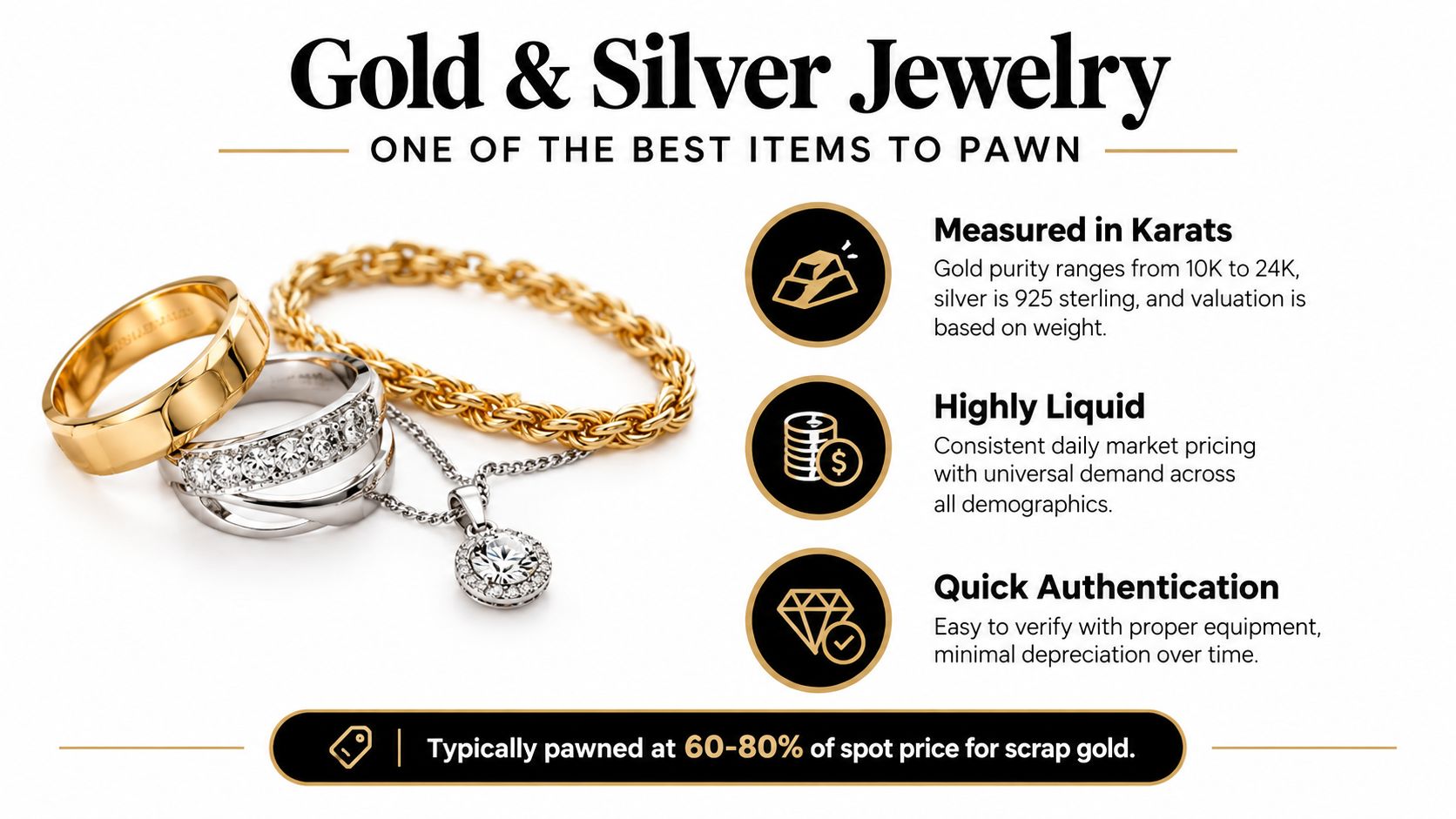
1. Gold and Silver Jewelry
Gold jewelry remains one of the strongest pawn categories because the lender can anchor much of the offer to weight, purity, and the current spot price. Rings, necklaces, bracelets, earrings, wedding bands, and some dental gold can all qualify. Silver flatware, serving pieces, and sterling jewelry may also be accepted, although silver usually produces less cash per ounce than gold.
Gold demand has a globally traded foundation rather than depending only on local fashion preferences. The World Gold Council's 2025 gold demand report recorded worldwide gold demand at 5,002 metric tons, with total demand value at approximately $555 billion. That doesn't mean a pawn loan equals retail or replacement value. The lender still accounts for testing, price movement, storage, and the amount likely to be recovered if the loan isn't redeemed.
How the offer is calculated
A piece marked 10K, 14K, 18K, 22K, or 24K contains a different proportion of pure gold. The appraiser weighs the item, verifies the marking with testing, separates non-gold components where necessary, and considers whether the piece has a recognizable designer or collectible premium.
A plain chain is usually valued mainly as metal. A Cartier bracelet or a documented Tiffany & Co. piece may receive additional consideration if the maker's marks, condition, and authenticity are clear.
> Practical rule: An insurance appraisal reflects replacement cost. A pawn offer reflects collateral value and likely resale or melt value.
Before visiting, clean the item gently, gather appraisals or certificates, and check the current metal market. Bring several pieces together if you want to discuss a larger loan, but don't assume sentimental value transfers into the offer.
2. Diamond and Gemstone Rings
Diamond and gemstone rings require more judgment than plain gold because the stones and setting must be assessed separately. A diamond's carat weight, color, clarity, and cut influence value, while the mounting, maker, condition, and buyer demand affect the final offer. Rubies, sapphires, and emeralds can matter substantially, but origin claims and treatment history need reliable documentation.
An engagement ring may have a high original purchase price and still produce a more conservative pawn offer. Retail margins, insurance valuations, sentimental expectations, and the price a lender can realistically obtain on resale are not the same thing.
What strengthens a ring
A respected laboratory report can reduce uncertainty, particularly for a larger or unusual stone. Original receipts, prior appraisals, designer paperwork, and clear photographs of the ring's condition also help. Ask how the shop verifies stones and whether a qualified gemologist or specialized testing equipment is involved.
The setting matters, too. Bent prongs, loose stones, worn shanks, chips, and heavy scratches can reduce confidence. Don't have a ring aggressively polished or altered just before appraisal. Cosmetic work may hide condition issues or create questions about whether the piece remains original.
Bring the ring in its current state, along with every document you have. Request a written description of the stone specifications used in the valuation so you can compare the offer with your records.
3. Luxury Designer Handbags
A designer handbag earns its offer through a combination of brand, model, authenticity, condition, and observable resale demand. Hermès, Louis Vuitton, Chanel, Gucci, and Prada bags are easier to evaluate when the style is recognizable and the secondary market has enough comparable examples.
The lender isn't only asking what the bag cost new. The practical question is whether the bag can be authenticated, priced against current resale activity, and sold to enough buyers after the loan period. A classic Louis Vuitton Speedy or Chanel Classic Flap may be easier to move than an obscure seasonal piece with a higher original price.
Documentation can change the conversation
Bring the receipt, authenticity card, dust bag, box, care materials, and any authentication record. Keep hardware, zippers, handles, and straps together. Missing accessories don't automatically disqualify a bag, but they add uncertainty and may reduce marketability.
The wider resale market supports this category. ThredUp's resale market report projects the global secondhand apparel market will reach $393 billion by 2030 and says it's growing twice as fast as the overall apparel market. The same source reports that 53.8% of luxury retailers offered pre-owned or trade-in programs in 2026, with the luxury resale market estimated at $34 billion that year and projected to grow at an 8.9% compound annual rate through 2035. Those figures describe the broader resale environment, not a guaranteed value for your bag.
Clean leather gently, but don't use an unsuitable product that changes the finish. Photograph existing wear before you hand it over, then ask what authentication process the shop uses.
4. Luxury Watches
Luxury watches are compact, valuable, and potentially liquid, but they're not interchangeable. The offer depends on the brand, reference number, serial system, movement, condition, provenance, service history, and completeness. A Rolex Submariner, Omega Seamaster, Cartier Tank, or Patek Philippe calendar can attract specialist attention, while an undocumented or heavily modified watch may receive a much more cautious valuation.
A lender may inspect the movement, compare serial and reference details, check the dial and bezel, review recent secondary-market transactions, and look for aftermarket parts. Refinished dials, replacement bezels, missing links, water damage, aftermarket diamonds, and undisclosed repairs all complicate authentication and resale.
Preserve the evidence of ownership
Bring box and papers, warranty cards, service receipts, spare links, and purchase records. Make sure the serial number matches the documents. Clean the crystal and bracelet carefully, but don't polish the case before appraisal. Polishing can remove material and alter the original profile.
The broader Swiss watch market shows why selective valuation matters. The Federation of the Swiss Watch Industry's 2025 report lists Swiss watch exports at CHF 25.6 billion, including CHF 24.4 billion for watches. It also reports a 1.7% decline in export value and a 4.8% fall in unit volume to 14.6 million watches. That isn't a price forecast for an individual Rolex or Omega. It does show why a lender should identify the exact model rather than assume every luxury watch commands the same advance.
> An authentic watch with complete records is easier to finance than a more expensive watch with an uncertain history.
5. Laptops and High-End Electronics
Electronics are valued on a depreciation curve. The appraiser looks at the exact model, processor, memory, storage, graphics capability, screen, battery condition, operating status, warranty, and current demand. A recent MacBook Pro, Dell XPS, Microsoft Surface, or ASUS ROG gaming laptop can be more financeable than an older machine that originally cost more.
Completeness affects the offer immediately. Include the original charger, power cable, accessories, box, and purchase or warranty documents. A missing proprietary charger makes testing harder and creates an added cost for the next buyer.
Prepare the device before testing
Back up personal files, sign out of cloud accounts, remove activation locks, and perform a factory reset. Don't leave passwords or private information on the machine. If the laptop has a removable storage drive, ask how the shop handles data security before surrendering it.
Clean the screen and keyboard, but don't conceal damage. Record the model and serial number, note the battery health if the operating system displays it, and photograph the exterior and screen while the device is working.
A pawn offer won't track the original retail receipt dollar for dollar. Used electronics lose value as newer specifications appear, and the lender must account for resale speed, testing time, and warranty risk. A current, functional device with a complete accessory set usually gives the appraiser fewer reasons to discount the offer.
6. Smartphones and Mobile Devices
Smartphones can move quickly when they're recent, free of carrier locks, functional, and clean. The offer depends on the exact model and storage capacity, carrier status, battery condition, screen, cameras, biometric functions, charging port, and account status. An iPhone Pro or Samsung Galaxy Ultra free of carrier locks generally gives the lender a wider resale audience than a carrier-locked or damaged phone.
Remove barriers to resale
Before you visit, back up your data, disable Find My or equivalent device locks, sign out of accounts, and reset the phone. Bring the box, charger, cables, and proof of purchase if available. Have the IMEI ready for verification, and disclose any repairs or replaced screens.
A cracked screen is obvious, but less visible defects matter too. Test the cameras, speakers, microphones, cellular connection, Wi-Fi, Bluetooth, charging, buttons, and fingerprint or face recognition. The phone must be available for a proper functionality check, so don't arrive with an account lock that prevents testing.
> Before you reset: Save your contacts, photos, authentication codes, and backup keys. A pawn transaction shouldn't leave you locked out of your own accounts.
Smartphones depreciate faster than bullion or established luxury goods because manufacturers release newer models and buyers compare specifications closely. Research the exact model rather than relying on the phone's original purchase price. A clean, SIM-free device with its accessories can be easier to price than a newer phone with damage, missing credentials, or uncertain ownership history.
7. Musical Instruments
Guitars, keyboards, amplifiers, and professional instruments earn offers through brand, model, age, originality, condition, and local resale demand. A Fender Stratocaster, Gibson Les Paul, Martin acoustic guitar, Yamaha synthesizer, or vintage Fender tube amplifier can attract knowledgeable buyers, but the details matter more than the category label.
A modified instrument needs careful explanation. Upgraded pickups, replacement tuners, refinished bodies, repaired necks, and non-original parts may improve playability for one musician while reducing collector interest for another. Provide photographs and service notes instead of allowing the appraiser to guess.
Bring a complete working setup
Include the hard case or gig bag, cables, foot pedals, power supplies, straps, original pickups, manuals, and other model-specific parts. Test every input, output, key, knob, pickup, switch, and control before the appointment. For acoustic instruments, look for neck problems, bridge separation, cracks, and humidity damage.
The lender's calculation changes depending on the likely buyer. A professional instrument with a known model number can be priced against comparable used examples. A generic beginner instrument may have a lower ceiling because more competing inventory exists and buyers have less reason to choose that particular unit.
Show maintenance records when you have them. A recent setup or documented repair won't guarantee a higher loan, but it can reduce concerns about hidden problems. Clean the instrument without using products that damage lacquer, wood, keys, or original finishes.
8. Power Tools and Professional Equipment
Power tools are practical collateral because buyers understand what drills, saws, grinders, compressors, nail guns, and related equipment do. The offer usually follows brand reputation, model, working condition, battery ecosystem, completeness, and professional demand. DeWalt 20V, Makita, Milwaukee M18, and comparable systems tend to be easier to explain and resell than unmarked or incomplete tools.
Cordless tools need special attention. A drill without its battery and charger isn't equivalent to a complete kit, and a battery that won't hold a charge can materially reduce the value. Bring every battery, charger, case, blade, bit, guard, and attachment that belongs with the tool.
Demonstrate function, not just appearance
Clean sawdust, grease, and jobsite residue from the equipment. Test the trigger, speed settings, brakes, lights, chucks, blades, and safety features. For an air compressor, demonstrate that it powers on and holds pressure. Don't hide worn cords, cracked housings, missing guards, or intermittent switches.
A professional tool can have strong resale potential even when it shows ordinary jobsite wear, provided it works correctly. Cosmetic damage is less serious than a failed motor or missing safety component. The lender will also consider whether the item fits a recognizable system that local contractors and do-it-yourself buyers already use.
Bring purchase records and manuals if you have them, but don't delay a visit because the original box is gone. Functionality and completeness usually matter more than packaging for tools. State exactly what was repaired or replaced, and let the shop test the item before discussing the loan.
9. Silver Bullion and Precious Metal Collectibles
Silver bullion offers a clearer valuation path than many consumer goods. The appraiser can consider purity, gross weight, current spot price, form, condition, and any recognized collectible premium. American Silver Eagles, Canadian Silver Maple Leafs, refinery-marked bars, constitutional silver, proof sets, and other documented pieces may all receive consideration, but bullion value and numismatic value shouldn't be confused.
A standard bar or widely recognized coin is usually easier to price than an obscure collectible whose premium depends on grading, rarity, mint history, and buyer interest. Packaging and certificates can help, but the metal content remains central for ordinary bullion.
Separate metal value from collector value
Organize coins by type and keep mint packaging intact. Note fineness markings, weights, mint names, certification numbers, and any grading information. Ask whether the appraisal is based on melt value, a market premium, collector demand, or a combination of those factors.
Gold bullion illustrates the same principle even more clearly. The World Gold Council's investment data for 2025 reports global gold investment demand of 2,175 metric tons, an 84% year-over-year increase, while bar-and-coin demand rose 16% to a 12-year high. The report also places annual investment value above US$240 billion. Those figures support the importance of transparent commodity pricing, but a pawn loan still sits below theoretical melt value because the lender covers price volatility, testing, storage, and liquidation costs.
> A rising spot price can improve the metal basis without creating a matching increase in every collectible or branded item.
Check the current silver market before visiting and ask which spot price and purity assumptions the appraiser used. Keep government-issued identification available where required, and don't clean collectible coins in a way that damages their surfaces.
10. Cameras and Photography Equipment
Professional camera equipment earns value through brand, model, sensor condition, shutter count, lens quality, completeness, and current demand among working photographers. Canon, Nikon, and Sony bodies can be easier to price when the model is current or well established. Premium lenses, especially fast professional zooms, may hold attention better than generic accessories because buyers often purchase lenses for a specific system.
A complete kit can produce a stronger result than a loose camera body. Bring lenses, caps, batteries, chargers, memory cards, straps, cases, manuals, boxes, flashes, tripods, and lighting equipment. The appraiser needs to know whether each component works and whether the pieces are compatible.
Prove condition with records
Provide the shutter count when available. Test autofocus, manual focus, image stabilization, card slots, displays, buttons, ports, flash connections, and video functions. Inspect the sensor and lenses for dust, fungus, scratches, haze, and impact damage. Don't attempt an aggressive sensor cleaning immediately before appraisal.
A professional body with high use may still have value if it functions correctly, while a lightly used camera with a damaged sensor can be difficult to finance. Lens mounts, battery doors, screens, and weather seals deserve close inspection because small faults can affect resale.
Photograph the equipment while powered on and record serial numbers before you go. Research comparable used listings for the exact model, but treat asking prices as reference points rather than guaranteed sale prices. The pawn offer must allow room for testing, storage, market movement, and resale.
Top 10 Items to Pawn, Comparison
| Item | 🔄 Complexity | ⚡ Resource requirements | ⭐ Expected outcomes | 📊 Ideal use cases | 💡 Key advantages |
|---|---:|---|---:|---|---|
| Gold & Silver Jewelry | Low, simple weight/purity checks | Scale, acid/test kit, polishing cloth, certificates | ⭐⭐⭐⭐, high liquidity; stable value vs spot | Quick collateral for reliable loans; scrap gold sales | Universal demand; fast, accurate valuation |
| Diamond & Gemstone Rings | High, gemological grading required | Loupe, spectroscope, GIA/AGS certification, expert appraiser | ⭐⭐⭐⭐, high value but variable by certification | High-value loans; certified engagement/estate pieces | Premium pricing for certified stones; strong resale |
| Luxury Designer Handbags | Medium, authentication expertise needed | Serial/date code checks, dust bag/receipts, condition inspection | ⭐⭐⭐, good resale; brand/style dependent | Pawn for classic, in-demand designer models | Brand prestige; collector demand; some appreciate |
| Luxury Watches | Medium–High, technical & provenance checks | Watch specialist, serial/papers, service history, boxes | ⭐⭐⭐⭐, highly liquid; some models appreciate | Collector loans; high-value collateral (discontinued models) | Strong collector market; precious-metal value |
| Laptops & High‑End Electronics | Medium, functional testing straightforward | Charger, original box, spec sheet, factory reset | ⭐⭐⭐, moderate value; rapid obsolescence | Recent-generation devices for quick loans/resale | High initial price → sizable loans; easy testing |
| Smartphones & Mobile Devices | Low, fast diagnostics | IMEI, charger, original box, factory reset, passcode | ⭐⭐⭐, very liquid but fast depreciation | Quick short-term cash; high-turnover inventory | High demand; small storage; rapid resale |
| Musical Instruments (Guitars & Keyboards) | Medium–High, quality and sound evaluation | Case/accessories, play-test, brand/model knowledge | ⭐⭐⭐, variable; vintage can outperform | Musicians needing short-term funds; vintage sales | Niche collectors; emotional redemption; vintage premiums |
| Power Tools & Professional Equipment | Medium, functionality tests simple | Batteries/chargers, cases, proof of purchase | ⭐⭐⭐⭐, steady demand; slower depreciation | Contractors/DIY resale; tool-kit pawns | Durable demand; easy to test and resell |
| Silver Bullion & Precious Metal Collectibles | Low, commodity valuation | Scale, purity verifier, mint packaging/certs | ⭐⭐⭐⭐, highly liquid; near‑spot pricing | Investors needing cash; bullion trades | Straightforward pricing; minimal expertise for bullion |
| Cameras & Photography Equipment | Medium–High, technical inspection required | Lenses, shutter-count info, boxes, sensor/lens cleaning | ⭐⭐⭐⭐, good retention for pro gear; niche demand | Professionals upgrading gear; high-end body/lens loans | High initial cost; specialist buyers; durable value |
Turn Your Next Visit Into a Stronger Offer
The strongest pawn offers start with the same principle across every category: identify what creates value, then remove uncertainty before the appraisal. Gold and silver depend heavily on verified purity, weight, and spot pricing. Luxury handbags and watches depend more on authentication, provenance, model identification, condition, and completeness. Electronics, tools, instruments, and cameras depend on working condition, current demand, and whether the next buyer receives a complete usable package.
“Highest appraisal” also doesn't automatically mean “best item to pawn.” Academic research describes pawn loans as commonly around 50% of collateral value, often maturing in about three months, with loans in the United States frequently under $100. The same research notes interest and fees can range from 2% to 25% monthly. Review the academic discussion of pawn loan terms before you pledge anything, and calculate the total redemption cost, not only the cash you receive on the day.
Use this preparation sequence before visiting Idaho Pawn & Gold in Boise, Meridian, or Nampa:
- Check the value basis: Review current spot prices for gold and silver, then identify whether your item has a brand or collector premium beyond its metal content.
- Gather identifying details: Write down serial numbers, model names, reference numbers, storage capacity, lens specifications, or tool system details.
- Collect the complete package: Bring original boxes, chargers, batteries, cables, cases, warranty cards, receipts, dust bags, certificates, and service records.
- Document condition: Take dated photographs of each item, including existing scratches, wear, serial numbers, and working screens or displays.
- Prepare devices securely: Back up personal data, remove account locks, reset electronics, and make sure phones and computers can be tested.
- Ask direct appraisal questions: Find out how authenticity is checked, which comparable resale information is considered, whether the offer is based on melt value or resale value, and what fees and redemption deadlines apply.
A useful comparison is to place likely loan amount beside total repayment cost, sentimental-loss risk, transport and storage burden, authentication difficulty, and resale probability. Standardized bullion may be simple to price, but it can still produce less cash than expected because a pawn advance is not the same as retail value. A luxury watch or handbag may have a higher potential resale value, but missing papers, modifications, or uncertain authenticity can narrow the offer quickly.
For location details and current services, visit Idaho Pawn & Gold. Bring the item clean, complete, and accurately documented, then ask the staff to explain how the offer was built before you decide whether to pledge it, sell it, or keep it.
---
Idaho Pawn & Gold Exchange evaluates pawnable items including precious metals, diamonds, newer electronics, tools, luxury handbags, and fine watches at its Boise, Meridian, and Nampa locations. Bring your best documentation and a clear understanding of the item's value drivers, then visit Idaho Pawn & Gold Exchange to discuss a pawn loan or sale.