In 2024, factories around the world used 680.5 million troy ounces of silver, a record for the fourth year in a row, and that single fact explains the true case for buying the metal. You're not just buying a shiny coin people may want tomorrow. You're buying a material that manufacturers consume, while investors still treat it as money. That combination, and what a dealer charges you to get in and out, is where why buy silver should start and finish.
Why People Still Buy Silver
Global silver demand reached approximately 1.16 billion ounces in 2024, even after declining 3% from the prior year, according to the Silver Institute's supply and demand summary. That scale points to a market with more than one kind of buyer: industry uses silver, while investors and households buy it as a tradable metal.
A household with a few hundred dollars to set aside can buy silver in smaller amounts than gold. A coin or other physical piece is easy to understand and can be sold later, though the resale price depends on the quote and the product's form.
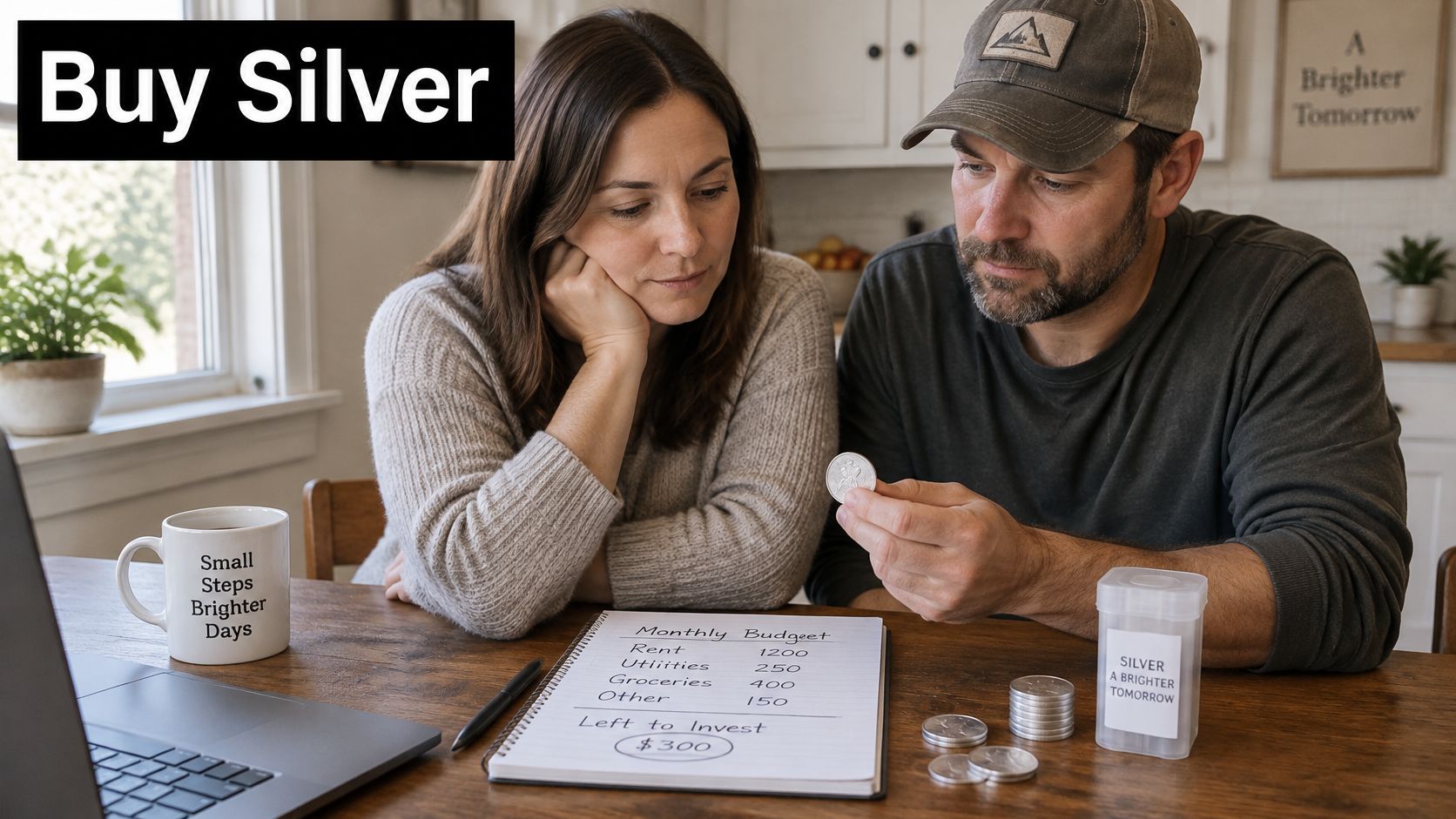
Silver can diversify an inflation-conscious portfolio, but it is not a guaranteed hedge. Its price can fall, and a physical purchase starts below break-even because the dealer's buy and sell quotes differ. If inflation protection is your main goal, explore inflation-protected securities as another option, then consider whether holding physical metal adds something you want.
The round trip matters. The premium over melt is the amount paid above the value of the silver content; the dealer discount is the amount deducted from the resale quote. Together, they set the hurdle silver's price must clear before a sale returns what you paid.
The decision comes down to purpose, form, and cost. Consider whether you want a physical asset, can accept price swings, and can leave the money invested long enough for a possible gain to outweigh the spread.
Industrial Use and the Supply Gap
In 2024, factories used 680.5 million troy ounces of silver, a record and a 4% increase from the year before, according to the Silver Institute World Silver Survey 2025. That demand came from electric vehicles, charging infrastructure, solar panels, telecommunications, grid investment, and electronics linked to artificial intelligence.
Silver has two kinds of demand sharing one supply. Investors and mints hold it as coins and bars; manufacturers use it in products such as electrical contacts, solar panels, solders, and electronics. Some industrial silver can be recovered, but silver dispersed in products may be costly or impractical to reclaim.
Why silver demand is more than investor mood
| Measure | Figure | What it means for a buyer |
|---|---|---|
| Industrial demand in 2024 | 680.5 million oz, up 4%, fourth consecutive annual record | Manufacturing uses included vehicles, solar, grid investment, and electronics |
| Total demand in 2024 | About 1.16 billion oz | Industrial and investment buyers draw on the same market |
| Supply shortfall in 2024 | 148.9 million oz | Recycling and existing stocks helped meet demand |
| Electrical and electronics | A major industrial use | Silver serves a range of electrical and electronic applications |
| Other industrial uses and photography | Additional demand categories | Factory demand extends beyond solar power |
| Photovoltaics | A source of industrial demand | Solar-panel production uses silver |
| Physical investment bars | Part of silver demand | Buyers also hold silver as an investment |
| Coins and medals | Part of silver demand | Silver continues to trade in monetary and collectible forms |
| Jewelry and silverware | Part of silver demand | Personal and household uses add another source of demand |
A vault metal that factories also use
Silver is both a traded monetary asset and an industrial material. That combination gives it a different demand mix from gold, which is more often held in jewelry, coins, or financial products. Silver used in manufacturing does not automatically return to the investment market: recovering small amounts from finished products can be uneconomical.
This dual demand is part of silver's investment case. Industrial buying can support demand even when investor sentiment changes, while monetary buying can add another source of demand beyond factory orders. Neither guarantees a rising price.
What a deficit doesn't prove
> A shortfall means demand exceeded newly available supply. It does not predict next month's price.
A market deficit can be met by recycling and by drawing on existing stocks. Higher prices may encourage more recycling, while a weaker economy can reduce factory orders. Mine supply and investor buying or selling also affect the balance.
Treat industrial demand as one reason silver may have a place in a diversified portfolio, not as a forecast. Its dual role does not remove price swings, and a supply shortfall does not make every purchase price worthwhile.
Bullion Coins Rounds and Junk Silver
Sort products by the job you want done, not by hype or design. The same ounce of silver can be easy to resell, cheap to buy, hard to divide, or priced mostly on collector taste, depending on the form you choose.
Bars and sovereign coins
Start with a 1-ounce .999 bar if your job is straightforward metal exposure. You'll usually get more ounces per dollar than you would from a government coin because you're paying less for minting and design. The trade-off is a larger check per piece as bar sizes rise, and a dealer may want to test or assay an unfamiliar brand before buying it back, which can slow the sale and widen the offer.
A sovereign 1-ounce coin solves a different problem. Pieces such as the American Eagle, Britannia, or Mexican Libertad cost more over melt because dealers and collectors recognize the design, weight, and fineness worldwide. You're paying for speed and confidence at resale. For a first purchase, that recognition can be worth more than squeezing out the last fraction of an ounce.
Rounds and small change
Private rounds look like coins but they're not legal tender and no government backs them. They're often .999 fine and carry a lower premium than a sovereign coin, so they appeal if you want recognizable weight without the government mint price. The drawback appears later. Fewer buyers know every private mint brand, so the resale spread can be wider, and a shop may pay closer to melt than it would for an Eagle.
Junk silver confuses beginners because the name sounds like scrap. It means circulated U.S. dimes, quarters, and halves struck at 90% silver, priced per dollar of face value. A typical $1 face of 90% coinage contains about 0.715 troy ounce of pure silver after accounting for normal wear, so ten worn dimes can be one small, divisible unit. You can sell a few coins instead of breaking a large bar, but you'll deal with mixed dates, worn designs, sorting, and face-value math that takes a minute to learn.
Which silver form fits which goal
| Product | Typical fineness | Best job | Main drawback |
|---|---|---|---|
| Bullion bar | .999 | Most metal per dollar | Bigger ticket, unfamiliar brands need testing |
| Sovereign coin | .999 | Easy recognition and resale | Higher premium than a bar |
| Private round | usually .999 | Cheaper than a coin | Wider dealer spread |
| 90% U.S. junk silver | 90% | Small, divisible units | Wear, sorting and face-value math |
| Sterling flatware | .925 | Turning household silver into cash | Priced as scrap, not as a stack |
| Collectible coin | Varies by issue | Collector premium above melt | Price can detach from the metal |
Don't confuse household silver with a stack. Sterling flatware is .925, and dealers usually price forks and spoons as scrap by weight and purity. It has melt value, but it isn't a standardized investment product anyone can verify at a glance.
Numismatic coins sit at the far end. Grade, mintage, and collector demand can push a rare coin far above melt, and that premium can shrink or vanish if collector taste cools, even while silver holds steady. Buying one is a collecting decision first and a metal decision second.
Pick one primary job before you spend: ounces, recognition, small change, or a collection. Mixing all four goals in one unplanned purchase is how people end up with pieces they like looking at but can't explain, value, or resell cleanly.
Silver Versus Gold Cash and Stocks
A 1-ounce silver coin costs a fraction of a 1-ounce gold coin. A new buyer can own real metal without a four-figure check, then add another coin later. Smaller checks do not mean a quieter price.
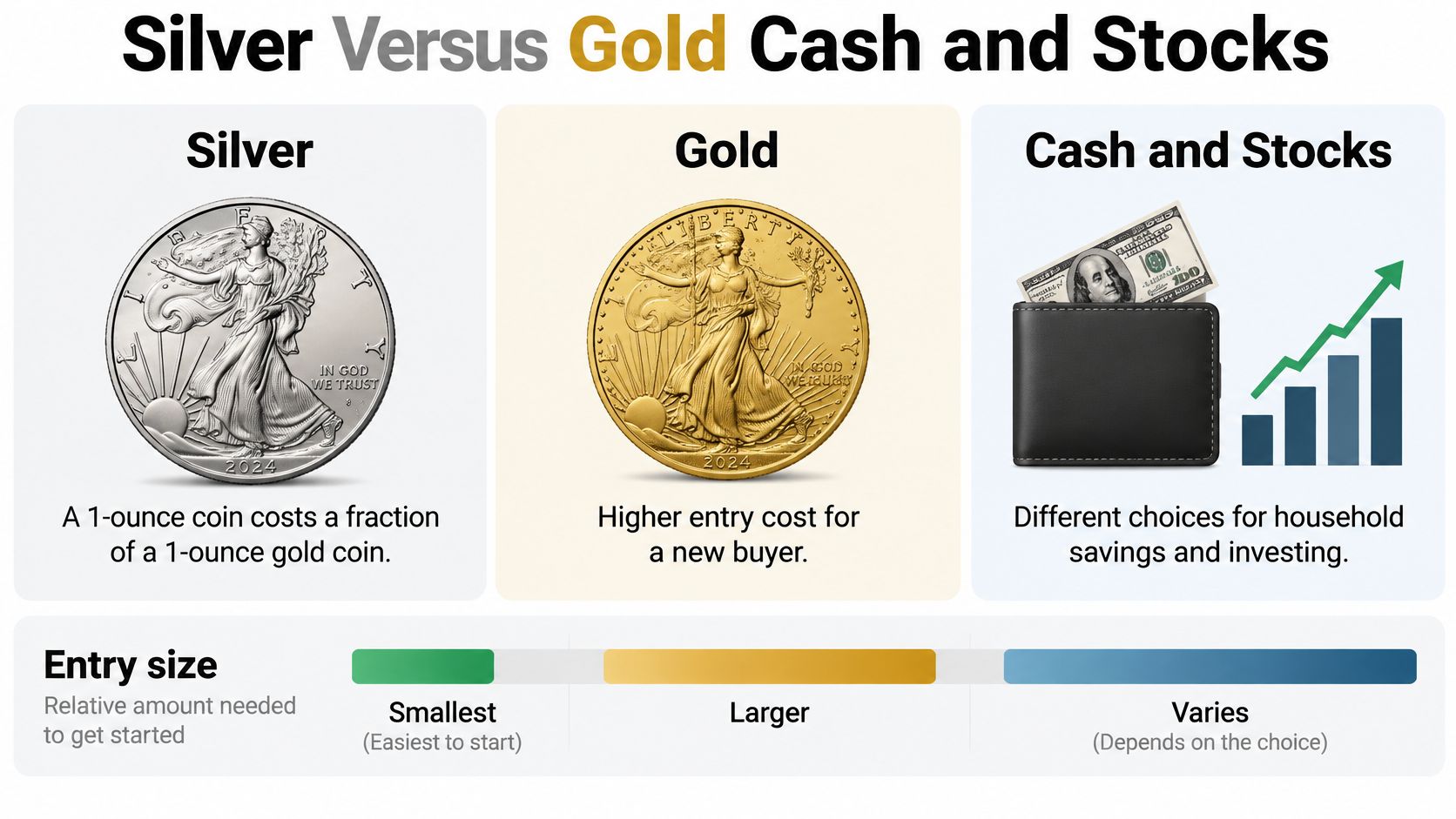
Silver has carried monetary trust for a very long time. The U.S. Geological Survey silver statistics and information page states that silver has been used for thousands of years as ornaments, utensils, trade goods and the basis of monetary systems. That history is why a silver coin reads as value without an app. Recognition is not a price guarantee.
Two kinds of demand pull on the same ounces. Factories use silver in goods that leave the coin market, while investors still trade it as something you can sell for cash. When both groups buy at once, the quote can jump. When investors step back, the quote can fall even though factories are still using metal and the old monetary role has not changed. Silver's market is smaller than gold's, so that mood shift usually hits harder.
Physical investment demand has surged in some years and reversed in others. Coin-and-bar buying can cool sharply after a rush. A slogan that calls silver a sure inflation hedge skips that swing, and it also skips the dealer spread you pay to get in and out.
> Practical rule: If a seller calls silver a sure inflation hedge, ask how coin and bar demand behaved after the last buying rush, and wait for the answer.
Worried buyers crowd in, then step back when the worry fades. The price shows that crowd plus factory use. If you want to read a down move instead of treating it as either a bargain or a reason to dump everything, read our guide to why gold and silver go down.
The video below walks through that comparison in plain terms, so you can hear the entry-cost argument before you look at the risk table.
Silver next to the assets people already hold
| Asset | Inflation role | Volatility | Entry cost | Liquidity | Main risk |
|---|---|---|---|---|---|
| Physical silver | Partial diversifier, not guaranteed | High | Low per coin or junk-silver roll | Local dealer, same-day possible | Premiums, spreads and price swings |
| Gold bullion | Classic monetary metal | Lower than silver | High per ounce | Strong dealer market | Still falls in risk-off or rate shocks |
| Cash savings | Purchasing power erodes | None | Any amount | Instant | Inflation |
| Broad stock fund | Growth, not a metal hedge | Medium to high | Brokerage minimum | Exchange days | Market drawdowns |
| Silver mining shares | Leveraged to the silver price | Very high | One share | Exchange days | Company and mine risk, no metal in hand |
Cash does not bounce. Rising prices still eat its purchasing power year after year. A broad stock fund settles on an exchange day, grows from companies rather than a bag of metal, and needs no safe. Mining shares add company risk, debt, permits, and management decisions on top of the silver price, so a share is a business claim, not ounces in a drawer.
The round trip belongs in that comparison. Buy a coin and sell it back the same day at an unchanged market, and you are down by the gap between the shop's sell price and its buy price. Silver has to rise enough to clear that gap, then absorb a sharper swing than gold, before any hedge story has paid you. Gold may suit a larger, calmer monetary holding. Silver suits a smaller start and pieces you can add one at a time, if you can stand that ride.
Some households look beyond listed funds and metal altogether. Wealth Collective outlines private equity and infrastructure investment options, which sit at the opposite end from a coin you can carry into a shop and sell the same day.
A practical silver slice is a modest diversifier held for years, not rent money and not a one-week trade.
What Buy and Sell Quotes Really Cost
A spot price on a screen isn't what you pay, and it isn't what you receive. Your return starts negative by the size of the round-trip spread, so learn that number before you learn any price target.
Do the afternoon test
Use a simple test. If you bought a piece this morning and sold it back this afternoon at unchanged market prices, how much would you lose? That loss is your hurdle, and silver has to rise enough to clear it before you've made a cent.
At Idaho Pawn & Gold, a 1-ounce .999 American Eagle is priced per item, with a buy price of $45.90 paid to the customer and a sell price of $52.90 charged to the customer. That's a $7.00 gap, about 13% of the sell price. Pay $52.90 today, receive $45.90 on a same-day resale, and the market needs to move in your favor by more than $7 per coin, plus any future change in the shop's spread, before you're ahead.
Junk silver shows the same math in face-value terms. 90% silver coins carry a reference buy price of $29.33 and sell price of $35.76 per $1 face value. The difference is $6.43 per face dollar before any spot move. Buy $10 face for $357.60 and sell it straight back for $293.30, and you've given up $64.30 to learn how the quote works.
- Ask for both numbers: Get the buy price and sell price on the exact item, on the same day, before you pay.
- Compare pure ounces: Divide the ticket by the pure silver content, not by the pretty design or package.
- Write the gap down: Record the spread in dollars and as a share of what you paid, so your break-even is visible.
Sterling flatware shows why form matters as much as weight. It's quoted per troy ounce at a buy price of $30.03 and a sell price of $46.20, a much wider gap than an Eagle. Forks aren't investment coins. A dealer has to weigh, test, refine, or resell them as scrap, and buyers know that, so the household piece you inherited won't trade like a standardized coin.
Why the two prices differ
A shop holds inventory with its own cash, tests metal, absorbs price moves while a piece sits in the case, and prices from a market reference. Our public product price sheet applies saved buy and sell adjustments to each product's pure-metal content, and those adjustments are either percentages or fixed amounts. The sell side also covers recognizing, guaranteeing, and standing behind the piece you take home.
If you want the mechanics explained separate from any shop's prices, The Coin Course on bid-ask spreads breaks down why a bid and ask exist on the same coin at the same moment. Timing matters on the exit too, and our notes on the best time to sell silver can help you separate a planned sale from a rushed one.
Treat every figure here as a snapshot that moves with the spot price, not a permanent tariff. Quotes change, premiums widen when demand surges, and they tighten when shelves are full. What shouldn't change is your habit. Never judge a purchase by the sell price alone.
How to Buy Store and Resell Silver
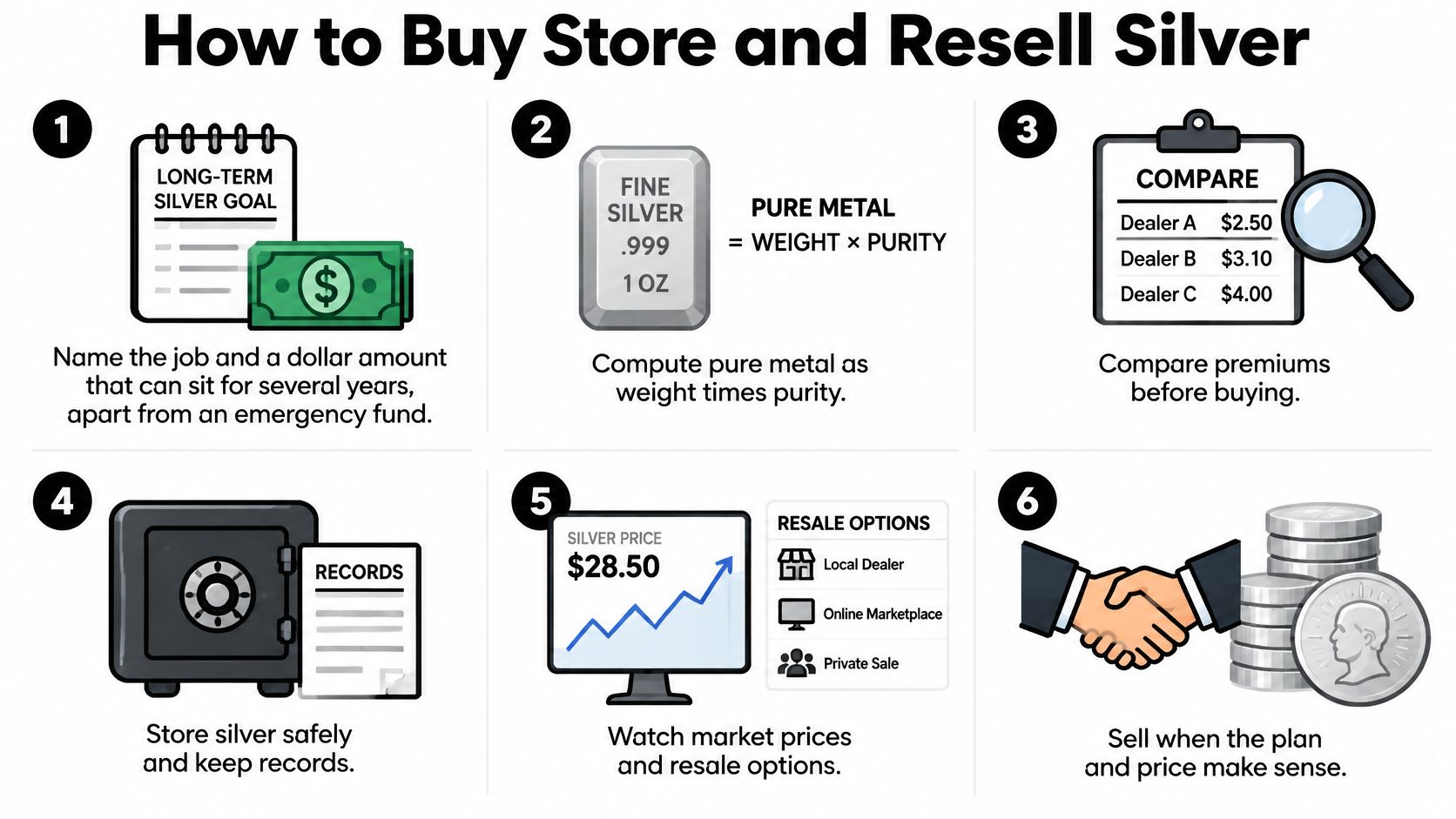
A silver purchase is easier to judge when you plan the exit before the entry. Work through these six steps with a small amount first. You'll see how product form, metal content, storage, and resale fit together.
- Name the job and the amount: Decide whether you want recognized ounces, small divisible units, or a collectible. Set a budget that can remain invested for several years without touching your emergency fund. Money needed for a car repair next month belongs somewhere more accessible.
- Compute the pure metal: Multiply weight by purity, then by the price per unit of pure metal. Compare that estimate with the asking price to see the premium in dollars.
- Get the metal tested: Idaho Pawn & Gold Exchange tests gold and silver with an XRF Analyzer that gives lab quality results. Precious metal scans are free. For a primer on the testing process, read this guide to testing silver purity.
- Buy a recognizable form first: Choose a standard .999 coin or bar for recognizable ounces, or 90% silver coins if smaller units matter more. Keep a receipt with the weight, fineness, date, and purchase price. Those details help document what you own and what you paid.
- Store it like cash, not clutter: Use a bolted-down home safe or a bank box. Limit who knows about the storage location, and check whether your insurance covers bullion before relying on it. Leave mint packaging intact when it helps identify the piece.
- Get more than one bid on a large lot: Ask how each quote is calculated before selling. Junk silver is quoted per face dollar and sterling per troy ounce, so a per-coin offer may not show the rate you're receiving.
Why staged buying fits silver supply
Buying in stages spreads your purchases across different prices. That can reduce the risk of committing all your money at one price, although it cannot prevent a decline. The Silver Institute's 2025 survey summary reports that mine production rose only 0.9% to 819.7 million ounces in 2024. It also projected another market deficit for 2025 of 117.6 million ounces, forecast total supply to rise 1.5%, and noted that silver is predominantly produced as a by-product of lead and zinc mining.
That by-product connection helps explain why a higher silver price may not quickly bring on new mine supply. Production decisions also depend on lead and zinc. When consumption exceeds newly mined output, recycling, existing inventories, and changes in demand can help fill the gap.
> Buy standardized products with transparent premiums, track the spot price and dealer spread, and keep records of weight, purity, and acquisition cost.
Tax, storage cost, and the exit
Include costs that can reduce your return: storage, insurance, shipping for an online sale, and any discount on resale. Selling physical silver also takes a different route from placing a brokerage order. You may need a dealer visit during business hours or an insured shipment and time for processing.
Physical precious metals are often taxed as collectibles, with a long-term federal rate that can reach 28%. This is general information, not tax advice. Your income, holding period, and state rules can affect the result, so keep purchase records and consult a tax professional before a large sale.
If the spread, storage, records, and tax treatment make sense to you, you have a clearer picture of the commitment. If any part is uncertain, start smaller or wait until you understand the trade-offs.
Choose a Silver Slice or Walk Away
Buy a modest slice if you want metal you can hold, you can ignore a sharp drop for several years, and you've already checked the sell quote so the spread is acceptable. That's the case that holds up. You're paying a known entry cost for tangible ounces, linked to industrial consumption, in a form a dealer recognizes.
Keep the slice small if this is your first precious metal. A few sovereign coins or a roll of 90% silver teaches you premiums, testing, storage, and resale without putting serious money at risk, especially if gold's ounce price is too high for a sensible start. You can add later at a different price instead of trying to be right once.
Walk away, or wait, if you'd need the cash inside a year, you have no cash reserve, or you want only exchange-hour liquidity. In that situation a stock fund fits better than a tube of coins, and there's no shame in that answer. Silver rewards patience and punishes forced selling through a spread.
Don't count what you already own as the same bet. Jewelry and flatware in a drawer are household silver with scrap value, not the same position as a .999 Eagle bought for ounces and resale recognition. Getting those pieces tested can still be a sensible first step, because you'll learn what purity and weight mean on metal you already have.
For readers in Boise, Meridian, or Nampa, make the next step a counter check rather than another hour of videos. Idaho Pawn & Gold buys and sells gold, silver, jewelry, coins, rounds and bullion, buys thousands of ounces of gold and silver a month, and determines precious metal values from current market dealer prices. Bring one coin or a piece you already own, ask for the buy number and the sell number on the same item, and only then decide how many ounces belong in your plan.
If both numbers make sense after you see them on paper, buy the slice. If they don't, you've spent a short visit instead of a few hundred dollars learning the same lesson.
---
Bring a coin, round, bar, or piece of household silver to Idaho Pawn & Gold Exchange and we'll test it, show you the buy and sell numbers on the same item, and explain the spread before you spend anything. If silver fits your plan, you can start with a recognized piece you understand, and if it doesn't, you'll leave knowing exactly why.