
Don't weigh a silver bar on your kitchen scale and trust the ounce reading. That's the most popular advice you'll hear, and it's the fastest way to misprice it. When you're asking how many ounces in a bar of silver, the stamp uses a different ounce than your scale does, and there's no single bar weight to learn.
Silver Bar Ounces at a Glance
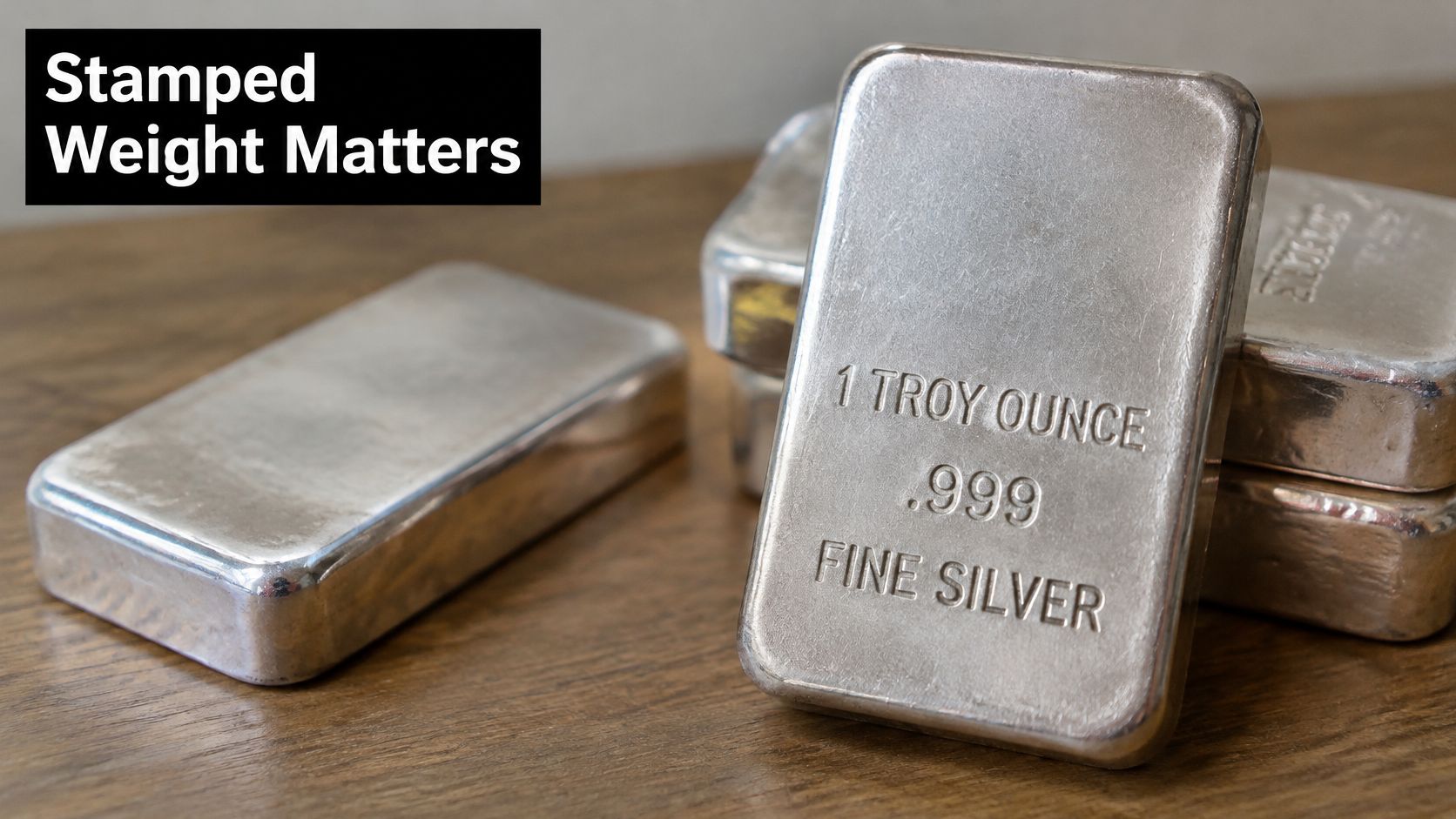
A silver bar doesn't have one ounce count. It has the count stamped on that bar, in troy ounces, and that stamp is what dealers price. Match your bar to a row below before you worry about anything else.
| Bar | Troy ounces | Grams | Typical market |
|---|---|---|---|
| 1 oz retail bar | 1 | 31.10 | Individual investors and small sales |
| 5 oz bar | 5 | 155.52 | Retail bullion |
| 10 oz bar | 10 | 311.03 | Retail bullion |
| 100 oz bar | 100 | 3,110.35 | Larger private holdings |
| 1 kilogram bar | 32.15 | 1,000 | Metric retail bars |
| Nominal 1,000 oz bar | 1,000 | 31,103.48 | London wholesale target, not a consumer bar |
The Bullion Standard guide to silver bar sizes puts 1 troy ounce at 31.1035 grams, while an everyday avoirdupois ounce is about 28.35 grams, making the troy ounce roughly 9.7% heavier. That's why the gram column matters more than any ounce reading from home.
Reading the Rows in Plain Numbers
A 1 troy ounce bar should weigh about 31.10 grams, which is about 1.10 avoirdupois ounces if your scale only shows household ounces. It isn't overweight. It's measured in a heavier unit.
A 5 troy ounce bar is about 155.52 grams, or about 5.49 avoirdupois ounces. A 10 troy ounce bar is about 311.03 grams, or about 10.97 avoirdupois ounces.
A 100 troy ounce bar weighs about 3,110.35 grams, or about 109.71 avoirdupois ounces. Bars of 100 ounces or less are the dealer products most individual buyers see, hold, and resell.
The Two Rows People Get Wrong
A 1 kilogram bar contains 1,000 grams, which works out to 32.15 troy ounces, not a flat 32. Rounding it down throws away real metal on paper. In household units it's about 35.27 avoirdupois ounces, which is a different number again and not the trading weight.
A nominal 1,000 troy ounce bar is about 31.10 kilograms, or 1,097.14 avoirdupois ounces. That's a London wholesale target for institutional settlement, not a consumer bar you'd carry into a shop in a capsule.
> Practical rule: Read the stamp first, find that row, then check grams. Don't start from a household ounce reading and work backwards.
You'll also see .999 fine on most investment bars. That means at least 99.9% silver, so gross weight and fine silver weight are nearly the same. That near match doesn't hold for jewelry alloys, where other metals make up a much larger share.
Packaging, an assay card, and light surface wear can move a scale reading a little without changing the stamped trading weight. A small gap in grams is a reason to recheck the setup. A gap that matches the troy to household difference is usually just the wrong unit.
Why the Silver Ounce Is Not a Kitchen Ounce
Two measuring cups can both be called a cup and still hold different amounts. The word ounce works the same way. The name stayed, the standard changed depending on what's being measured.
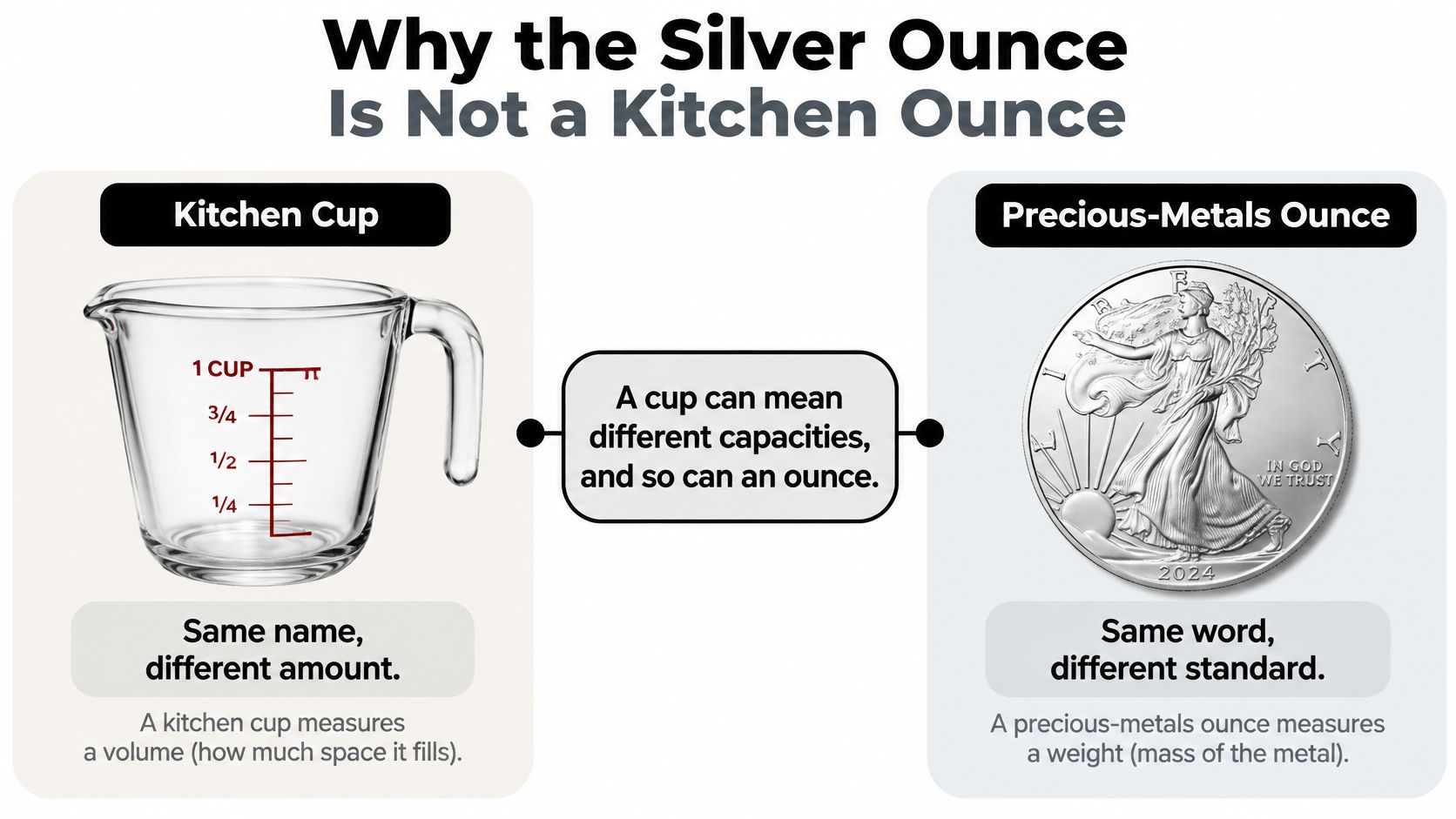
Silver uses the troy ounce. Groceries, postage, and most home scales use the avoirdupois ounce. They aren't interchangeable, and treating them as the same unit understates or overstates your metal every time.
The Grain and Gram Anchors
The National Institute of Standards and Technology handbook appendix defines one troy ounce as exactly 480 grains and approximately 31.103 grams, whereas one avoirdupois ounce is approximately 28.350 grams. The older grain count explains why the two ounces never lined up. One was built for precious metals, the other for everyday goods.
Put side by side, 1 troy ounce equals 1.0971428 avoirdupois ounces. That extra fraction is the roughly 9.7% gap that causes most home weighing confusion. It's built into the unit, not added by a dealer.
- 1 troy ounce: about 31.10 grams, not 28.35 grams
- 10 troy ounces: about 311.03 grams, not 283.50 grams
- 100 troy ounces: about 3,110.35 grams, not 2,835 grams
What That Looks Like on Your Scale
Say you own a genuine 10 troy ounce bar and set it on a scale that's reading household ounces. The display will show a number close to 11 ounces for the same piece of metal. You haven't gained an ounce of silver. Your scale is counting in smaller ounces, so it needs more of them.
Flip the mistake around and the loss appears. If someone treats 10 ordinary ounces as 10 troy ounces, they're pricing only about 283.50 grams of metal instead of 311.03 grams. That's a shortfall created by arithmetic, not by the bar.
> A bar that looks heavy in household ounces and right in grams is usually correctly marked.
Capsules, assay cards in sealed packaging, and light handling wear can also shift a gram reading slightly. None of that changes which unit the stamp uses. When the stamp says troy ounces and the purity checks out, the stamp is the starting point for price, and a mismatch is a reason to recheck your scale setting before you assume the bar is short.
How to Convert a Scale Reading to Troy Ounces
You don't need a bullion scale to get a useful number. You need grams, one division, and the discipline not to write down a household ounce reading as if it were a troy reading.
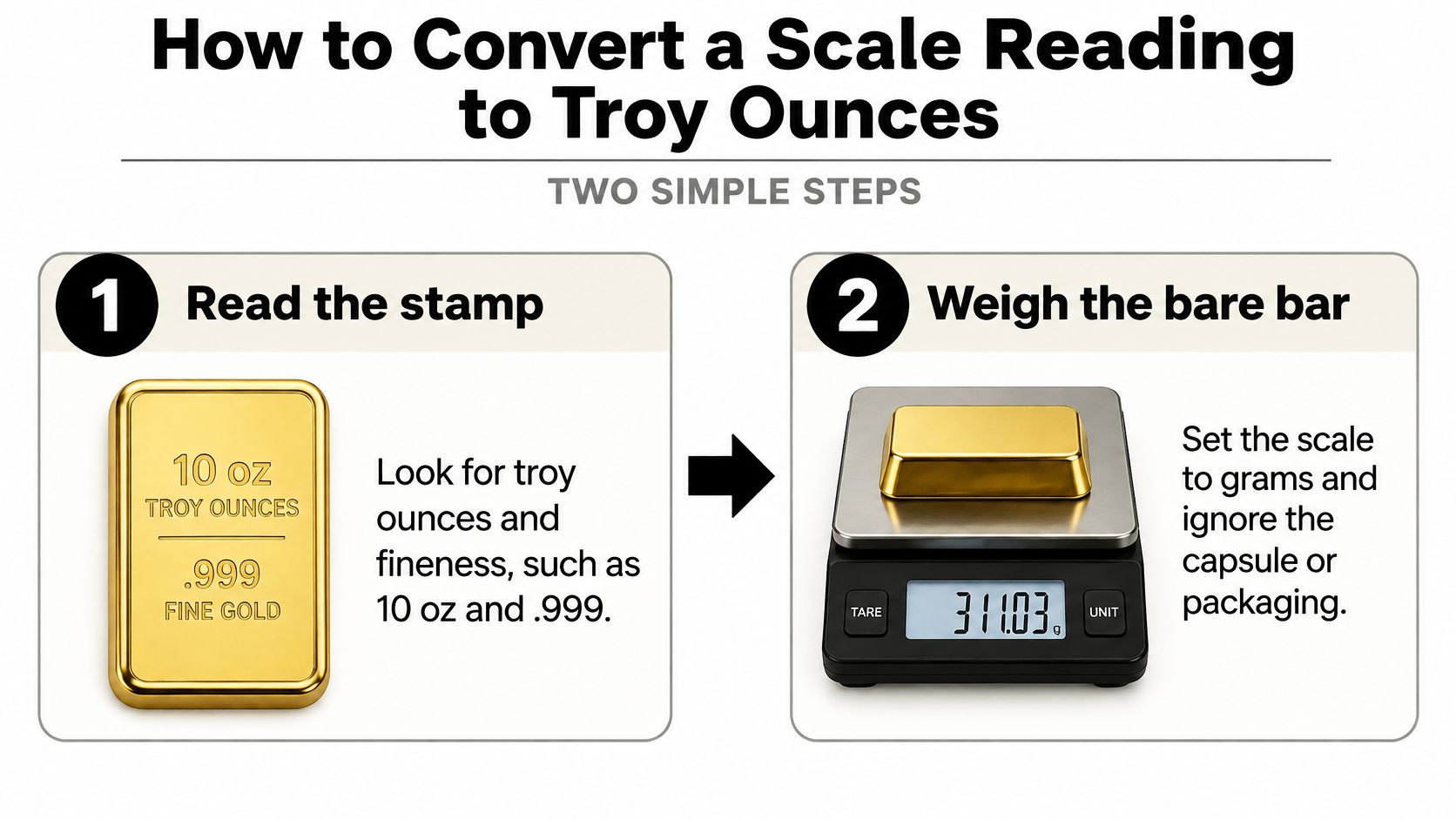
The Seven Counter Checks
- Read the stamp first: Look for the weight and fineness together, such as 10 oz and .999, plus the maker or hallmark.
- Weigh the bare bar in grams: Set the scale to grams and remove the capsule, card, and packaging so you're weighing metal only.
- Divide by the troy factor: Divide grams by 31.1034768 to get troy ounces.
- Convert through grams if stuck on ounces: Don't record a household ounce display as bullion weight, because 10 ordinary ounces is only about 283.5 grams.
- Compare with the stamp: Allow for light wear and rounding, not for a whole missing ounce.
- Apply purity, then price: Multiply troy weight by purity, so a .999 bar is 0.999 times gross troy weight, then multiply by the price per pure troy ounce.
- Stop if things disagree: If gram weight, dimensions, or hallmark don't line up, get a proper metal test instead of negotiating from a home scale.
One Worked Example
A bar weighs 311.0 grams bare. Divide 311.0 by 31.1034768 and you get about 10.00 troy ounces, which matches a 10 ounce stamp. The conversion confirms the bar instead of challenging it.
Now weigh that same bar on the avoirdupois setting and it shows about 11.0 oz. That's the same 311.0 grams described in smaller ounces. It isn't an extra ounce you can charge for, and a buyer who prices troy ounces won't pay for it as one.
> Counter habit: Grams divided by 31.1034768, every time. No shortcuts through household ounces.
Jewelry needs more care than a stamped bar. A ring or chain weighed in grams is usually an alloy, so you can't apply the price per pure troy ounce to its full weight. You'd first need its actual purity, then run the same weight times purity times price arithmetic.
Your estimate is only as good as three things lining up in the same unit. That's the gram weight, the tested purity, and a current dealer price quoted per troy ounce. Change any one of them without converting and the total stops meaning anything.
Real Bars That Do Not Use Round Ounces
Product names make bars sound like categories. The stamp is what you own, and the gap shows up whenever a maker skips the round numbers.
In 2024, the Royal Canadian Mint silver bar listing covered bars from 100 troy ounces to 1,000 troy ounces, with a 100-ounce bar weighing 3,110.3 grams. That sits a hair under the 3,110.35 gram calculator figure, because listing-level rounding changes the last digit, not the stamped troy weight.
A design name can hide a standard size. The Una and the Lion bullion bar listing at Chards lists a 10-troy-ounce silver bar, which is the familiar retail row wearing a distinctive design.
When the Stamp Breaks the Pattern
In 2025, Scottsdale Mint's Lucky Sevens silver cast bar product page listed 7.77 troy ounces of silver. In 2025, the SD Bullion listing for Scottsdale Mint's Lucky Dragon bar listed 8.88 troy ounces. Neither is a misprint, and neither should be rounded to 8 or 9 ounces.
The gram math makes the difference concrete. A 7.77 troy ounce bar is 7.77 times 31.1035 grams, roughly 241.7 grams. An 8.88 troy ounce bar is roughly 276.2 grams. If a seller assumes every bar must be 1, 5, 10, or 100 ounces and prices the Lucky Dragon as a plain 8 ounce piece, they hand over 0.88 troy ounces of metal. Fractional stamps are the trading weight.
Sealed packaging and assay cards can push a scale reading away from the fine silver stamp, so weigh the bare bar where possible. If the weight still disagrees with the markings, learn how to test silver purity before you settle on a price. Read the exact ounce figure and fineness on the bar, fractions included, and ignore the nickname on the box.
What a 1000 Ounce Good Delivery Bar Weighs
The biggest source of confusion about how many ounces in a bar of silver is a bar that is rarely handled. A London Good Delivery bar isn't required to weigh exactly 1,000 ounces, despite the name everyone uses for it.
| Rule | Troy ounces | Approximate kilograms | What it means |
|---|---|---|---|
| Target weight | 1,000 | 31.1 | Preferred wholesale size |
| Plus or minus 10 percent tolerance | 900 to 1,100 | 28.0 to 34.2 | Still acceptable around the target |
| Broader qualifying range | 750 to 1,100 | 23 to 34 | Current Good Delivery window |
| Recommended production band | 900 to 1,050 | 29 to 33 | Where refiners try to land |
| Not accepted in London wholesale | 100 or less | 3.11 or less | Traded in other markets instead |
The LBMA Good Delivery FAQs specify a target weight of 1,000 troy ounces, with an allowed tolerance of plus or minus 10%, so an acceptable standard bar can contain approximately 900 to 1,100 troy ounces. The same rules identify a broader permissible range of 750 to 1,100 troy ounces, equivalent to roughly 23 to 34 kilograms.
Why Refiners Aim Narrower Than the Rule
The recommended production range is 900 to 1,050 troy ounces, or approximately 29 to 33 kilograms, because refiners aim to keep bars near the market's preferred size. A bar at the edge of the wider window still qualifies, but it's less convenient for everyone downstream who has to store, move, and settle it.
Using the LBMA conversion of 1 troy ounce equal to 0.0311034768 kilograms, a true 1,000-troy-ounce bar contains about 31.103 kilograms of silver. The permitted tolerance span works out to roughly 28.0 to 34.2 kilograms, which is a wide physical difference between two bars that share the same label.
Minimum fineness for these bars is 999 parts per thousand, so at least 99.9% of that mass is silver. Even at that purity, the exact fine content depends on the individual bar's recorded weight, not the headline number.
Settlement Follows the Recorded Tenth
Each Good Delivery bar is individually weighed and its weight recorded in 0.1 troy ounce increments. Buyers and sellers settle on that recorded figure. Nobody pays for a flat 1,000 ounces and hopes the bar is close.
> On a large bar, the listed weight is the weight. The 1,000 ounce name is a target, not a promise.
That wholesale market also draws a floor. Bars weighing 100 ounces or less aren't accepted in the London wholesale market, although smaller formats trade freely elsewhere. So the retail bars in the first chart and these institutional bars live in separate systems, priced with the same troy ounce but handled very differently.
For any large bar you encounter, read the stamped or listed weight and price that number. Assuming 1,000 ounces can overstate or understate the metal by a tenth of the bar.
Choosing a Bar Size You Can Resell
Ounce count tells you how much metal a bar holds. It does not tell you who will buy it back, or whether you must sell the whole piece at once. Size decides that, and the stamped troy weight and fineness set the resale value, not a kitchen scale reading.
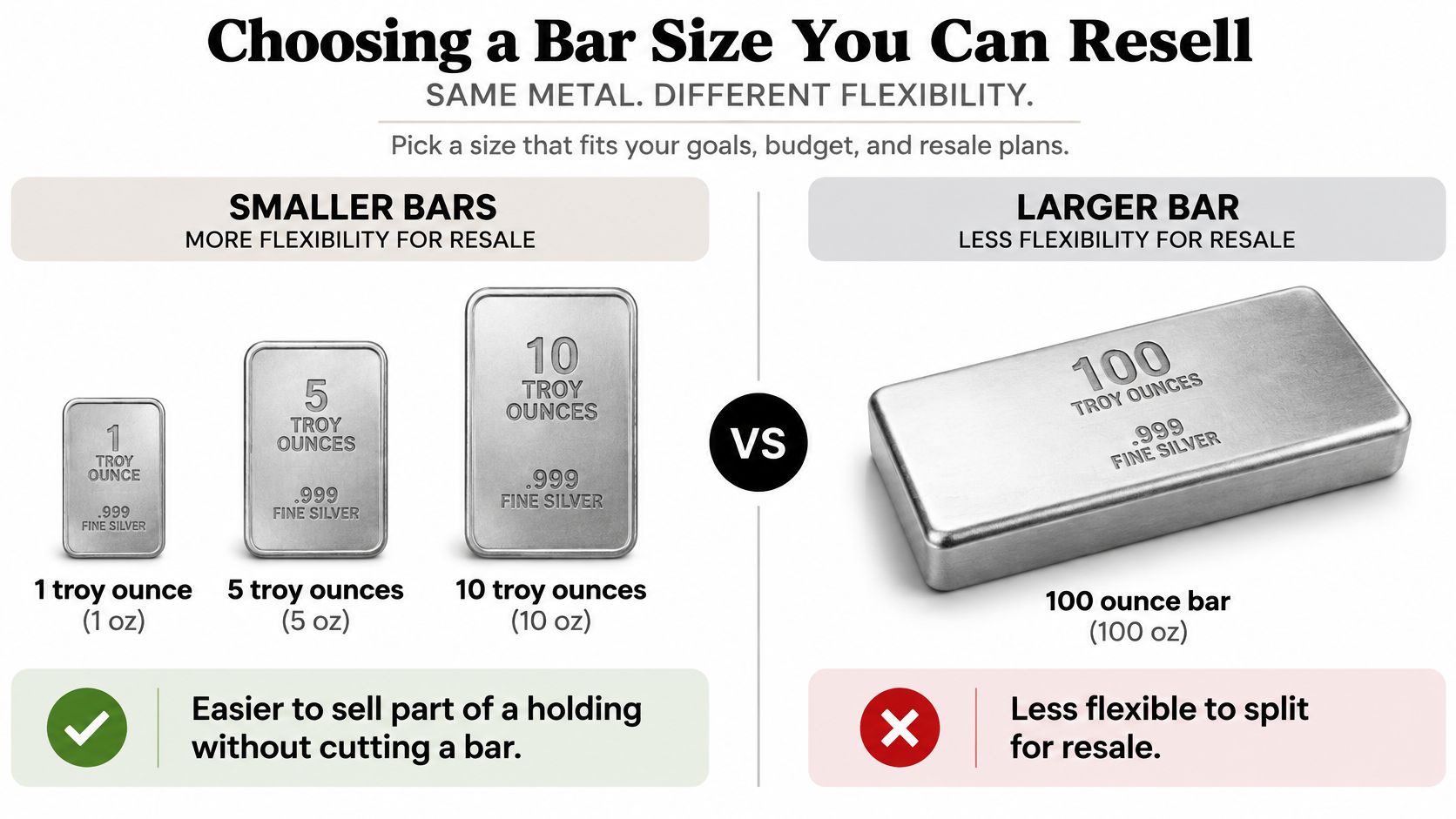
Wholesale bars answer to the LBMA Good Delivery weight list rules, which set weight lists for institutional metal. Retail bars are a separate market, commonly sized at 1, 5, 10, and 100 troy ounces, while a kilogram bar holds about 32.15 troy ounces. Interest in smaller bars stays steady because more buyers can afford one piece at a time.
Selling Part of a Holding
- 1, 5, and 10 troy ounce bars: You can sell one piece and keep the rest, which suits smaller cash needs and gradual exits.
- 100 troy ounce bars: Still a private investor size, but it is one lump, so a buyer must want the whole piece in a single transaction.
- 1 kilogram bars at 32.15 troy ounces: A middle option for buyers who think in metric weights, sitting between the 10 and 100 ounce rows.
- Nominal 1,000 ounce bars: Tighter premiums are possible, but the buyer must verify, store, and settle roughly 31 kilograms of metal.
Liquidity follows the buyer pool. More dealers and pawn counters will take a 1 ounce or 5 ounce piece quickly. Each step up in size narrows that pool and raises the amount of cash a single buyer must commit.
Premiums pull the other way. Larger bars usually carry a lower percentage premium over the metal value because making and handling one big bar costs less per ounce than making many small ones. You trade a better entry price for fewer exit options.
> Choose the smallest size you can sell in one transaction without paying a premium you dislike.
Do not buy a 1,000 ounce bar because the headline count looks efficient. Buy sizes matched to how you would sell, and compare offers on the same troy ounce figure. If you are weighing a first purchase, think through buying ounces of silver in resale chunks rather than total ounces alone. The stamp and purity tell the buyer what the piece contains, so a clear troy weight keeps the resale conversation simple.
Confirm Troy Weight Before You Buy or Sell
Before you pay or accept an offer, match three things. That's the stamped troy ounces, the gram weight divided by 31.1034768, and a tested purity. If all three agree, you have a figure in troy ounces of fine silver instead of a guess built on the word ounce.
Take the bar out of its capsule so the scale and any test see the metal itself. A simple metal content estimate is weight multiplied by purity, then multiplied by the price per unit of pure metal, and we test gold and silver with an XRF Analyzer that gives lab quality results. Jewelry and scrap shouldn't be priced as if every gram were pure silver, since alloys change that math.
You can submit an online evaluation request, choose Boise, Meridian or Nampa, and include item type, markings, and approximate weight if known. For an in person check, reading about a silver appraisal near me shows what to bring and what gets measured. Bring the stamp reading with you, and let the test confirm it.
---
Bring your bar in bare, with its stamp and any assay card, and we'll weigh it in grams, convert it to troy ounces, and test its purity so your offer is based on fine silver content rather than a household scale reading. You can start with an online evaluation request for Boise, Meridian, or Nampa, or visit Idaho Pawn & Gold Exchange to plan your visit.