
You're at a glass case looking at two one-ounce silver coins that look nearly identical, except one costs noticeably more than the other. The clerk mentions spot price, then a premium, then tax, and you realize you're not sure which number represents the metal and which represents everything else. That's the normal starting point for buying ounces of silver, and it's exactly where careful math prevents an expensive first purchase.
Why Buying Ounces of Silver Is Not a Simple Price Match
That two-coin moment happens every week at real counters. Both pieces may contain the same silver, yet one carries a higher tag because of who minted it, how it's packaged, whether it's in stock today, and how easily the next buyer will recognize it. You're not just buying metal. You're buying a specific product, from a specific seller, on a specific day.
Silver trades internationally by the troy ounce, and market data is commonly reported in U.S. dollars per ounce, which is why the practical benchmark for a purchase is usually the current spot quotation described in USGS silver market background on spot versus physical pricing. Spot is the reference price for the metal itself. It isn't the checkout total for a coin you can hold.
What sits between spot and your receipt
A physical ounce can include dealer premiums, fabrication costs, and transaction spreads on top of spot. The amount above spot reflects the product's form, availability, condition, and the seller's operating costs. A government coin in original packaging, a scratched private round, and a sealed bar don't move through a shop at the same cost, even when their fine silver content matches.
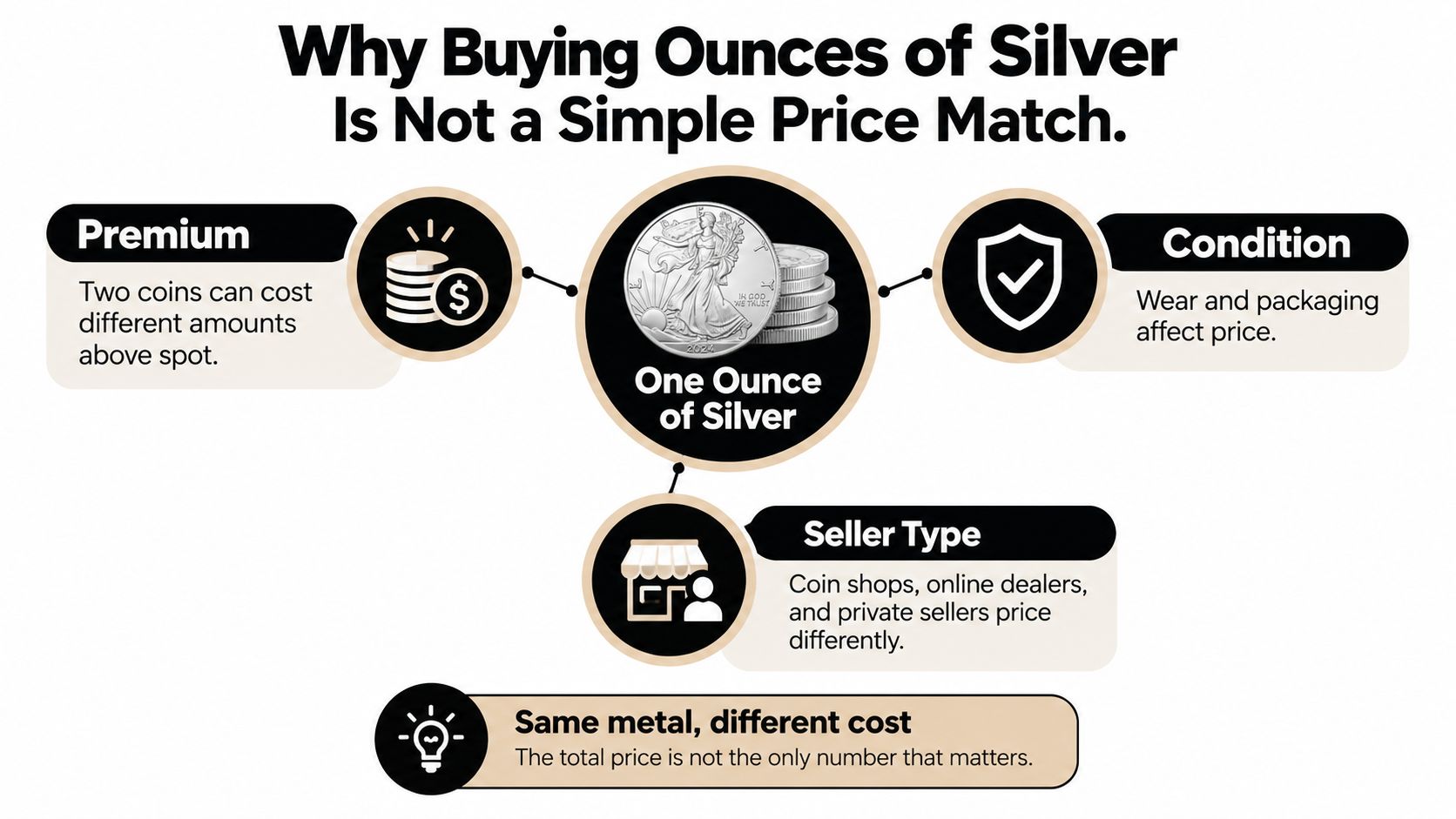
The gap isn't automatically a rip-off. Minting, shipping, insurance, rent, testing, and staff time are real costs, and a scarce product can command more because the seller can't replace it easily. The problem starts when you can't separate metal value from markup, because then you can't tell a fair premium from an excessive one.
> If a seller can't show you spot, premium, and fees as separate lines, you don't have a price yet. You have a total you're being asked to trust.
Timing matters too. The same one-ounce coin or bar can have substantially different market values depending on the purchase date, because the underlying per-ounce price moves. A buyer who paid during a sharp rally starts from a different break-even point than a buyer who purchased during a quiet month, even if both own identical pieces.
The question to ask at the case
Don't start with, "How much is this coin?" Start with, "How much is the metal, and how much am I paying above it?" Once you can answer that, you can compare two products, judge whether condition or packaging is worth extra money to you, and decide if you'd rather wait than pay today's availability premium.
How Spot Price and Premiums Shape What You Actually Pay
History explains why you shouldn't treat today's quote as permanent. During the Hunt brothers' attempted corner, silver reached roughly $50 per ounce on January 21, 1980, before collapsing within weeks. It climbed back to about $49.51 per ounce on April 28, 2011, according to USGS historical silver price context. Neither spike predicts the next move. They prove that the ounce stays standardized while its dollar value does not.
That is why every quote needs converting into fine-silver value before you compare sellers. Confirm the weight is in troy ounces, multiply fine weight by current spot, then list premium, shipping, taxes, assay charges, commissions, and buyback spread as separate lines. The CFTC advises obtaining the complete price and all fees in writing before payment, as detailed in its guidance on comparing metal value with retail price.
The buyback spread deserves its own line because it closes the loop on cost. Dealers rarely buy back at full spot, so your real expense is the premium going in plus the discount coming out.
Converting a Quote into Fine-Silver Value
| Product | Stated Weight | Fineness | Fine Troy Ounces | Typical Premium Over Spot |
|---|---|---|---|---|
| Modern bullion coin | 1 troy oz | .999 | 0.999 | Higher, for recognition |
| Private round | 1 troy oz | .999 | 0.999 | Moderate |
| Older 90% silver coin | 1 troy oz gross | .900 | 0.90 | Varies with condition |
| Larger bar | More than 1 troy oz | .999 | Weight times .999 | Lower per ounce |
The calculation is gross weight times fineness. A 90% item weighing 1.0 troy ounce contains 0.90 fine troy ounce, so it shouldn't be priced like a full fine ounce. Check too that "1 oz" means one troy ounce of silver rather than total product weight, especially on plated, clad, or novelty items that use ounce language loosely.
Where buyers overpay without noticing
Proof and collectible products are the common trap. They can be beautiful, and some do appreciate, but their premium isn't bullion value, and collectible products commonly carry higher markups and lower liquidity than bullion. If your goal is ounces of metal, a certificate, fancy box, or limited-edition story can't substitute for fine weight.
Your benchmark isn't a promised return. It's a documented break-even price: the level spot must reach to cover your purchase premium, resale discount, and transaction costs. Write that number down before you pay. If the required rise looks unrealistic for your time horizon, the product is wrong at that premium, no matter how good the sales pitch sounds.
Choosing Between Coins, Rounds, and Bars
Start by comparing the three forms on premium, recognizability, and how you'd sell them later. The visual below summarizes the trade-off you'll face at most counters.
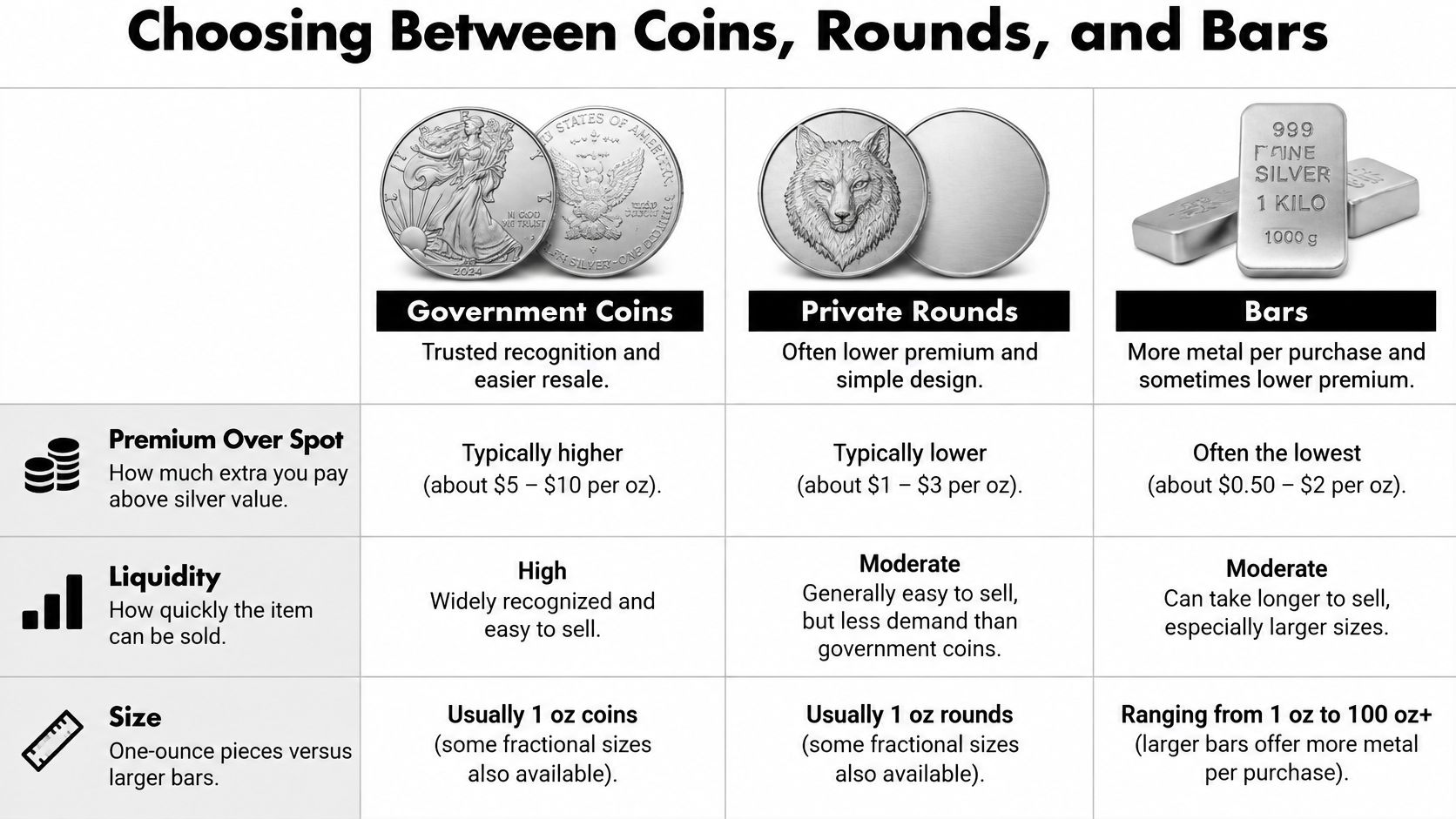
Government coins usually cost more above spot, but future buyers recognize them quickly and dealers can price them with less debate. That recognition helps when you sell locally, sell quickly, or sell to a buyer who doesn't know private mints well. You're paying for liquidity and trust, not extra silver.
Private rounds often deliver the same fine content for a lower premium. The trade-off is that an unfamiliar design may need more explanation or testing at resale. Bars spread fabrication costs over more ounces, so the per-ounce premium often falls as size rises, but each sale becomes a larger, less flexible transaction.
How shortages change the choice
This trade-off isn't static. Retail bar and coin demand rose 14% in 2025, while strong physical demand and tight inventories contributed to higher lease rates and regional constraints, and total 2026 supply is forecast to rise 1.5% to 1.05 billion ounces yet still post a 67 million-ounce deficit, according to Silver Institute reporting on 2025 demand and the 2026 outlook. In that kind of market, immediately available one-ounce pieces can carry premiums that erase their liquidity advantage.
Before you decide size is everything, watch how the premium and resale flexibility interact in this walkthrough.
- Choose one-ounce pieces when flexibility matters most: You can sell a small amount without liquidating a large bar.
- Choose larger bars when cost per ounce matters most: You'll likely pay less above spot, but you need a buyer for the full piece.
- Avoid unusual formats during shortages: Standardized, recognizable products stay more liquid than odd collectible pieces.
If you're tempted by extreme size for the lowest per-ounce cost, read this assessment of whether a 1,000 ounce silver bar fits a retail buyer before committing. A deficit doesn't guarantee easy profit. It can raise your entry premium, widen spreads, and leave you needing a bigger price rise just to break even.
Authenticating and Inspecting Silver Before You Pay
Don't authenticate by appearance. A clean design, sealed card, and confident seller can all surround a bad piece, and packaging can be counterfeited. Use a layered routine that creates evidence you can check again later.
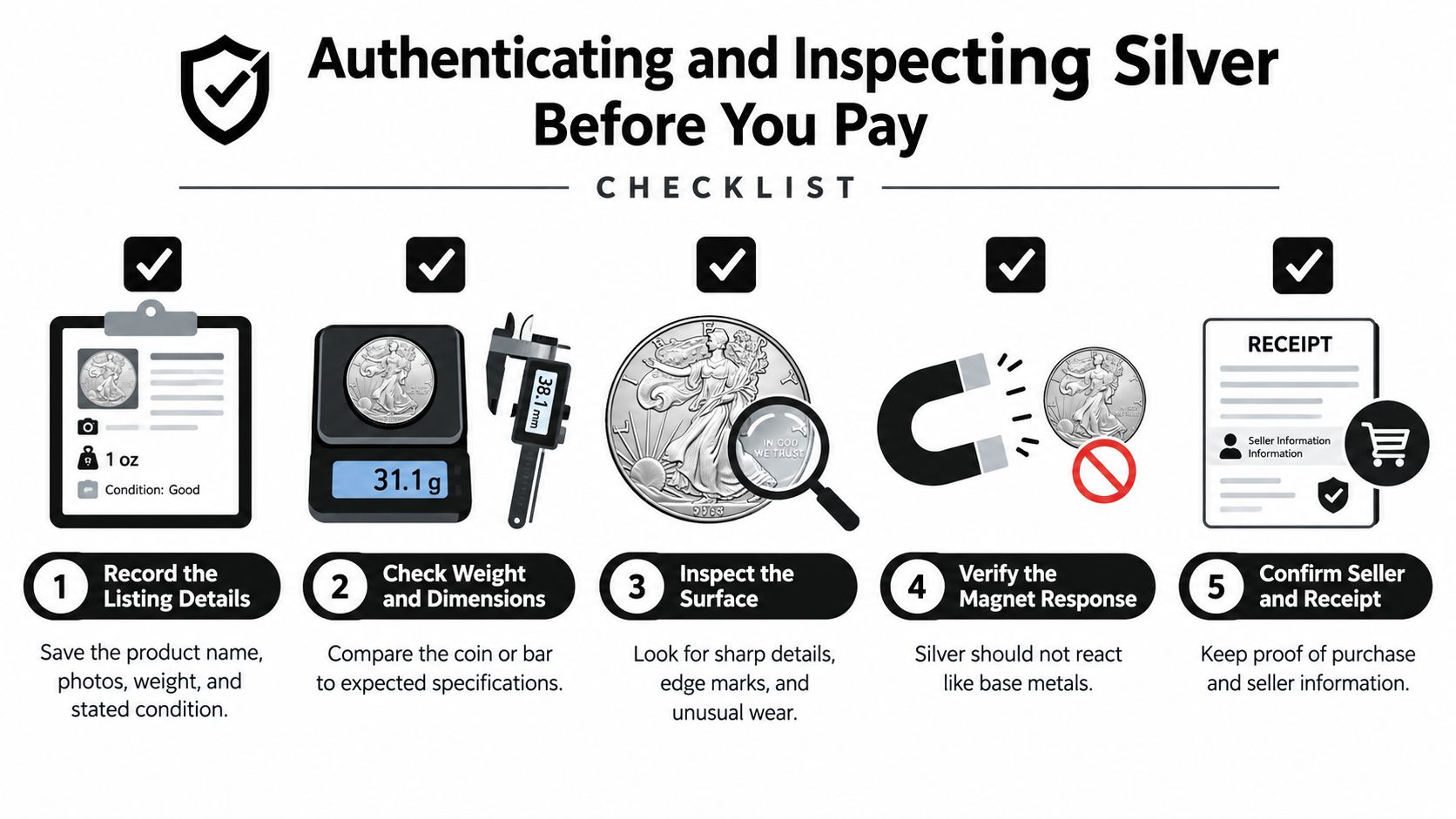
First, record the issuer, stated weight, fineness, dimensions, serial number or hallmark, and assay packaging. Then measure mass and dimensions yourself, or watch the dealer do it, and compare both against the issuer's specifications. A piece that's light, thick, or off-diameter needs an explanation before money changes hands, not after you get home.
Tests that add real information
Use non-destructive methods in order of practicality. A magnet response can flag some base-metal fakes, while electrical conductivity, ultrasound, and X-ray fluorescence testing can provide stronger verification when the value justifies the cost. If you want to understand shop-based equipment, this explainer on Thermo DXL and Sigma Metalytics testing at a local counter shows what those tools do.
Institutional standards show the principle clearly. LBMA silver Good Delivery bars must be approximately 1,000 troy ounces with minimum fineness of 999.0 parts per thousand, plus specified marking and quality requirements, under LBMA Good Delivery technical specifications for silver bars. Your one-ounce coin won't match those dimensions, but known mass, declared purity, consistent measurements, and identifiable provenance still apply.
> Counter rule: A certificate supports a test result. It doesn't replace one.
Plated or tungsten-filled items may pass a visual check, which is why written terms matter as much as hardware. Before buying, confirm the return policy, repurchase terms, testing responsibility, and what happens if a later assay disagrees. For broader warning signs around deceptive sales practices, Kons Law's guide to metals scams is useful background before you wire money to an unfamiliar seller.
Ask who pays for verification and how long you have to dispute authenticity. A legitimate seller may not promise to buy back at your purchase price, but they should state their spread and process clearly. If testing is refused on a higher-value piece, walk away.
Where to Buy and How to Negotiate a Fair Ounce Price
Compare sellers on numbers you can verify, not on atmosphere. A polished website, friendly shop, or urgent private listing tells you nothing about the round-trip cost.
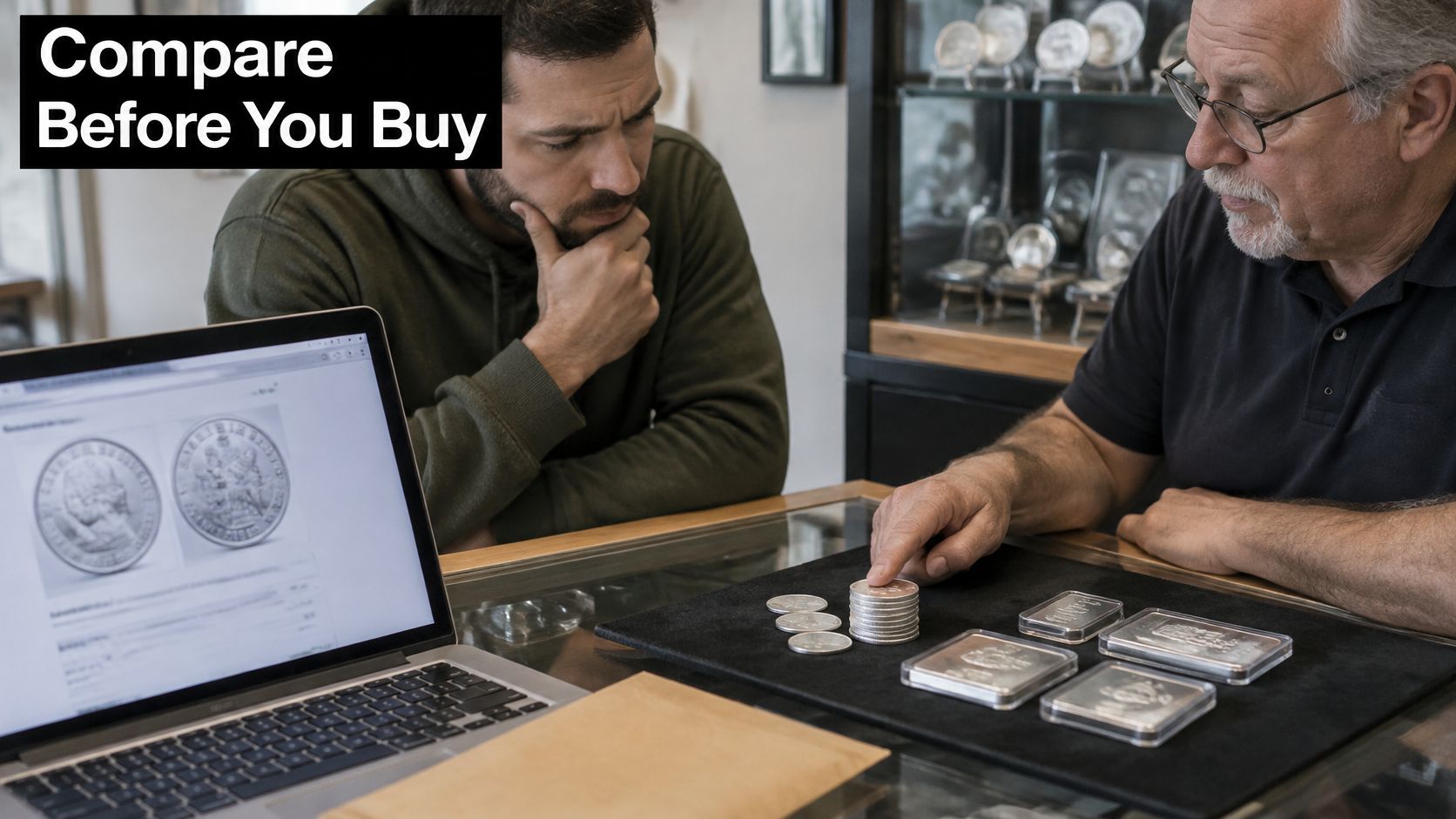
Use the same sequence with a coin shop, pawn shop, online dealer, or private seller. Calculate fine-silver value first, ask for the all-in price, then ask what the seller would pay to buy the same item back today. That last answer reveals the buyback spread you're accepting the moment you purchase.
A negotiation sequence that works
- State the product precisely: Name the issuer, weight, fineness, and condition you're pricing.
- Ask for itemized pricing: Request spot reference, premium, shipping, tax, and any assay or payment fee in writing.
- Compare at least two all-in quotes: Judge the final delivered price and stated buyback, not the advertised headline.
- Negotiate the premium, not spot: Spot is a market reference, while premium and fees are where sellers have discretion.
Local buying has practical advantages. You can inspect the piece in hand, watch it weighed or tested, and confirm repurchase terms face to face. Idaho Pawn & Gold Exchange, for example, evaluates silver coins, rounds, bars, junk silver, and bulk silver at its Idaho locations, which makes it one local option to include in a quote comparison. Online sellers may offer broader selection, but shipping, delivery risk, returns, and payment timing belong in the price.
Private sales demand the most caution. You may save a dealer premium, yet you also take on authentication, paperwork, and personal safety. Meet where testing is available, bring a scale and specifications, and don't let a below-spot asking price rush you. Genuine bargains exist, but a price that ignores metal value usually signals a purity, weight, or title problem.
A fair negotiation sounds calm. You present your fine-value math, cite a competing all-in quote, and ask whether the seller can narrow the premium or improve the buyback. If they can't, thank them and leave. Silver will still be traded tomorrow, and your break-even number matters more than winning today's conversation.
Payment, Taxes, Storage, and Planning Your Resale
Payment method changes both cost and evidence. Cash can be simple locally, while cards or electronic payments may add fees but create a cleaner paper trail. Whatever you use, keep an itemized receipt showing product, weight, fineness, price, seller, and date, because you'll need that record for resale, insurance, and tax questions.
Tax treatment varies by jurisdiction and transaction type, so confirm it before purchase rather than assuming bullion is exempt. If you're comparing jurisdictions or trying to understand when tax-free treatment applies, Smart Receipts guide to tax-free shopping helps frame the questions to ask locally. Don't let a seller's casual tax comment replace your own check with the relevant authority or adviser.
Holding costs belong in the math
Storage isn't free just because the silver is at home. A safe costs money, a bank box has rent and access limits, and a depository charges fees while adding counterparty considerations. Insurance, transport, and the risk of damage or loss also affect the true cost of owning each ounce.
- Home storage: Immediate access, but you carry security and disclosure decisions.
- Bank box: Separation from home risks, but access depends on bank hours and policies.
- Third-party depository: Professional storage, but fees and withdrawal terms need review.
Now put the round trip together. Add spot value, fabrication or dealer premium, tax, shipping, payment charges, storage, and insurance, then subtract the expected buyback discount when you sell. If that calculation requires a dramatic price rise, you're speculating on a rally rather than buying ounces at a workable cost.
Don't treat industrial demand as a promise
Silver is both a precious metal and an industrial commodity, but industrial use doesn't rise in a straight line. Industrial demand fell 3% to 657.4 million ounces in 2025, and 2026 industrial fabrication is forecast to decline another 2% to approximately 650 million ounces, according to the World Silver Survey 2026 press release on industrial demand. Solar use had reached 243.7 million ounces in 2024, up from 94.4 million in 2020, which shows scale, but higher prices also give manufacturers reason to thrift silver or substitute other materials. That's the counterpoint many sales pitches skip.
Plan the exit before the entry. Decide which local or online buyers you'd approach, what products they prefer, and what documentation they'd want, and review guidance on timing a silver sale and preparing to sell before you need cash quickly. Your next step is concrete. Bring a written quote and your target break-even price to a dealer, verify the piece, and complete the purchase only when the all-in number clears your calculation.
---
Bring your written quote, break-even calculation, or silver you're considering selling to Idaho Pawn & Gold Exchange for an in-person evaluation of coins, rounds, bars, and other silver items. The team can weigh and test your pieces, explain the offer in plain terms, and help you compare your options before you commit.