
The popular advice to hold a magnet against gold and trust the stamp isn't enough. Those checks can uncover reasons to be suspicious, but neither measures how much gold an item contains. Even a professional instrument can give a precise reading that doesn't represent the whole piece.
Learning how to test gold purity starts with choosing the right question. Are you checking an inherited ring out of curiosity, deciding whether to accept a purchase offer, or resolving a disputed valuation? The cheapest useful check and the strongest evidence aren't always the same test.
Gold Purity Test Methods Compared at a Glance
| Method | What It Tells You | Typical Accuracy | Cost and Equipment | Damages Item? |
|---|---|---|---|---|
| Visual inspection and hallmarks | Stamps and craftsmanship clues | Low as a standalone check, stamps can be faked or worn | Free, magnifier helpful | No |
| Magnet test | Whether the item responds to a magnet | Very low, screening only | Free if you own a strong magnet | No |
| Density or specific gravity | Overall mass relative to volume | Moderate for suitable solid pieces, hollow parts mislead | Low, precision scale and water-measuring equipment | No, if water-safe |
| Acid or touchstone test | Surface karat estimate | Moderate with trained use | Low, graded acid kit and touchstone | Yes, abrasion and possible acid damage |
| Electronic tester or XRF | Local surface response or elemental composition | XRF performs better on homogeneous metal than finished jewelry; electronic pens aren't equivalent | Testing instrument, often available professionally | Usually no |
| Fire assay | Fineness of a representative sample | Established laboratory reference method | Laboratory fee and sample preparation | Yes, sample is consumed |
A karat stamp is a claim to verify, not a result. These accuracy descriptions are practical comparisons, not guarantees for a particular item or instrument.
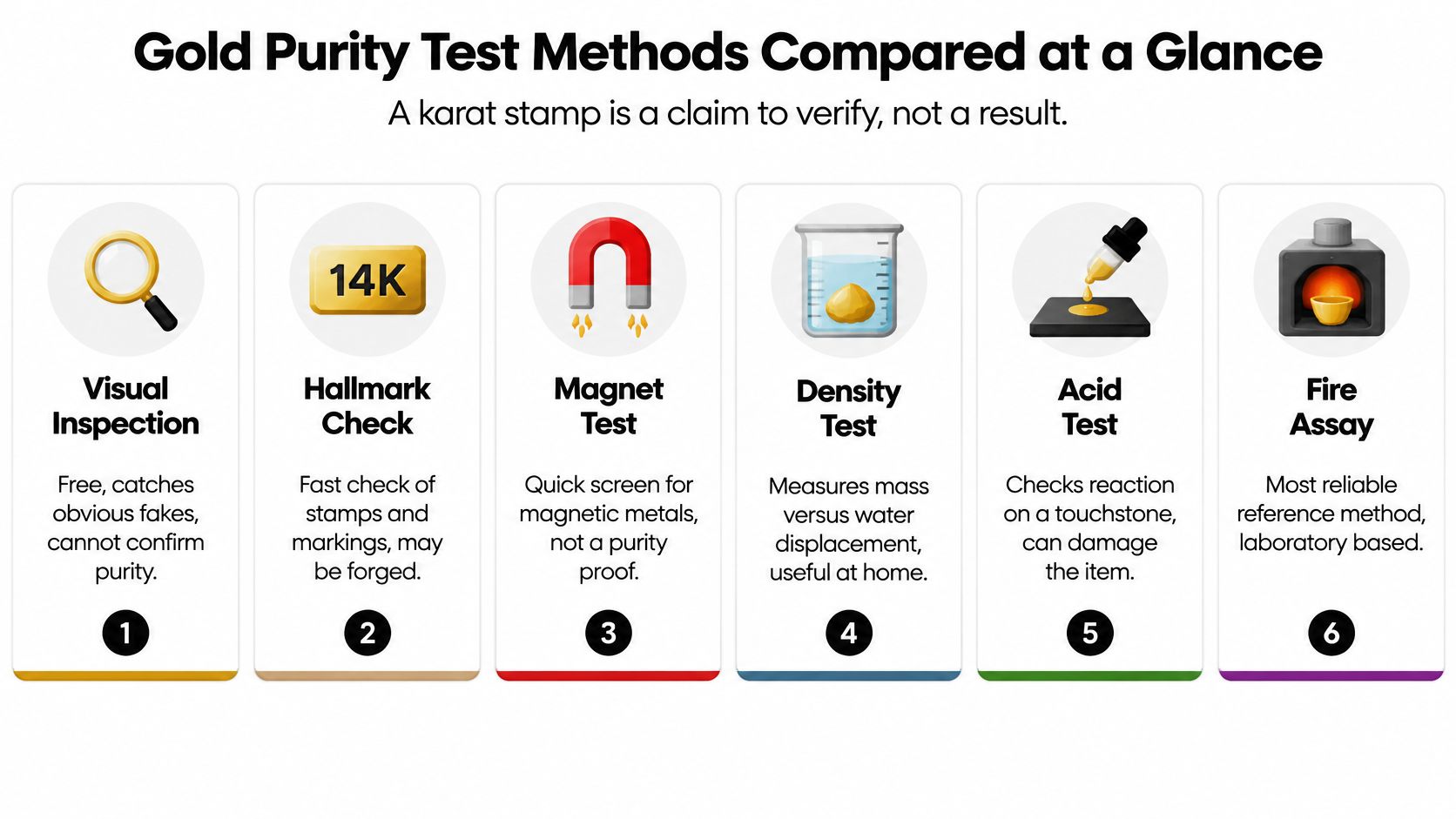
What each check can establish
- Inspection and marks identify what the item claims to be, not what it contains throughout.
- A magnet detects magnetic components, but a non-reaction doesn't establish purity.
- Density gives a useful whole-object measurement when the piece is solid, uncomplicated and accurately measured.
- Acid testing compares a transferred metal streak with a known reference.
- Electronic instruments need interpretation appropriate to their technology and the surface tested.
- Fire assay provides a reference result for the sample submitted, making representative sampling essential.
For necklaces, ECI Jewelers' guide to ways to verify genuine gold chains provides additional context for checking chain-specific features rather than relying on a clasp stamp alone.
Match the evidence to the stakes: inspection and suitable density checks can address casual uncertainty. Add professional scanning before a transaction, and consider laboratory confirmation when disputed purity could materially change the outcome.
Read Hallmarks and Karat Stamps Without Guessing
| Karat | Parts Gold of 24 | Fineness Stamp | Percent Gold |
|---|---|---|---|
| 24k | 24, the pure-gold reference | 999 when so marked | 99.9% for a 999 mark |
| 22k | 22 | 916 when so marked | 91.6% for a 916 mark |
| 18k | 18 | 750 | 75% |
| 14k | 14 | 585 when so marked | 58.5% for a 585 mark |
| 10k | 10 | Approximately 417, calculated and rounded | Approximately 41.7%, calculated |
| 9k | 9 | 375, calculated | 37.5%, calculated |
The table distinguishes nominal karat fractions from marked fineness: calculated entries use the karat fraction, while a fineness mark expresses gold content in parts per thousand, the system explained in the UK government's hallmarking guidance.
For example, 14k is nominally 14 parts gold out of 24, while 24k is the pure-gold reference. Rounded commercial marks and exact karat arithmetic aren't always identical, so don't treat a tiny numerical difference as evidence of fraud.
Read the mark, then verify its meaning
A fineness stamp states a purity grade. An independently applied hallmark adds evidence that an authorized body tested the article against the applicable standard.
In the UK system, hallmarking combines fineness information with identifying marks, including the sponsor and assay office. The United States and Canada don't have universal third-party hallmarking, so a North American karat stamp shouldn't automatically receive the same evidentiary weight.
Use this verification routine:
- Photograph every mark clearly, including marks on clasps, bails and separate components.
- Identify the hallmarking system relevant to the item's origin and check its official verification resources.
- Compare the claimed grade with an independent test appropriate to the item.
- Inspect solder seams, replacement components and repaired areas separately.
For Indian hallmarked jewelry, the official BIS CARE application provides a route to checking a Hallmark Unique Identification number. Verification should connect the identification to the article, not merely establish that a plausible-looking number exists.
If the wording suggests a coating rather than a solid alloy, compare gold-plated versus solid gold before interpreting the karat number.
> Practical rule: A genuine mark on an original component doesn't establish the composition of every later repair.
Karat markings are a starting point. Testing helps establish what the item contains today.
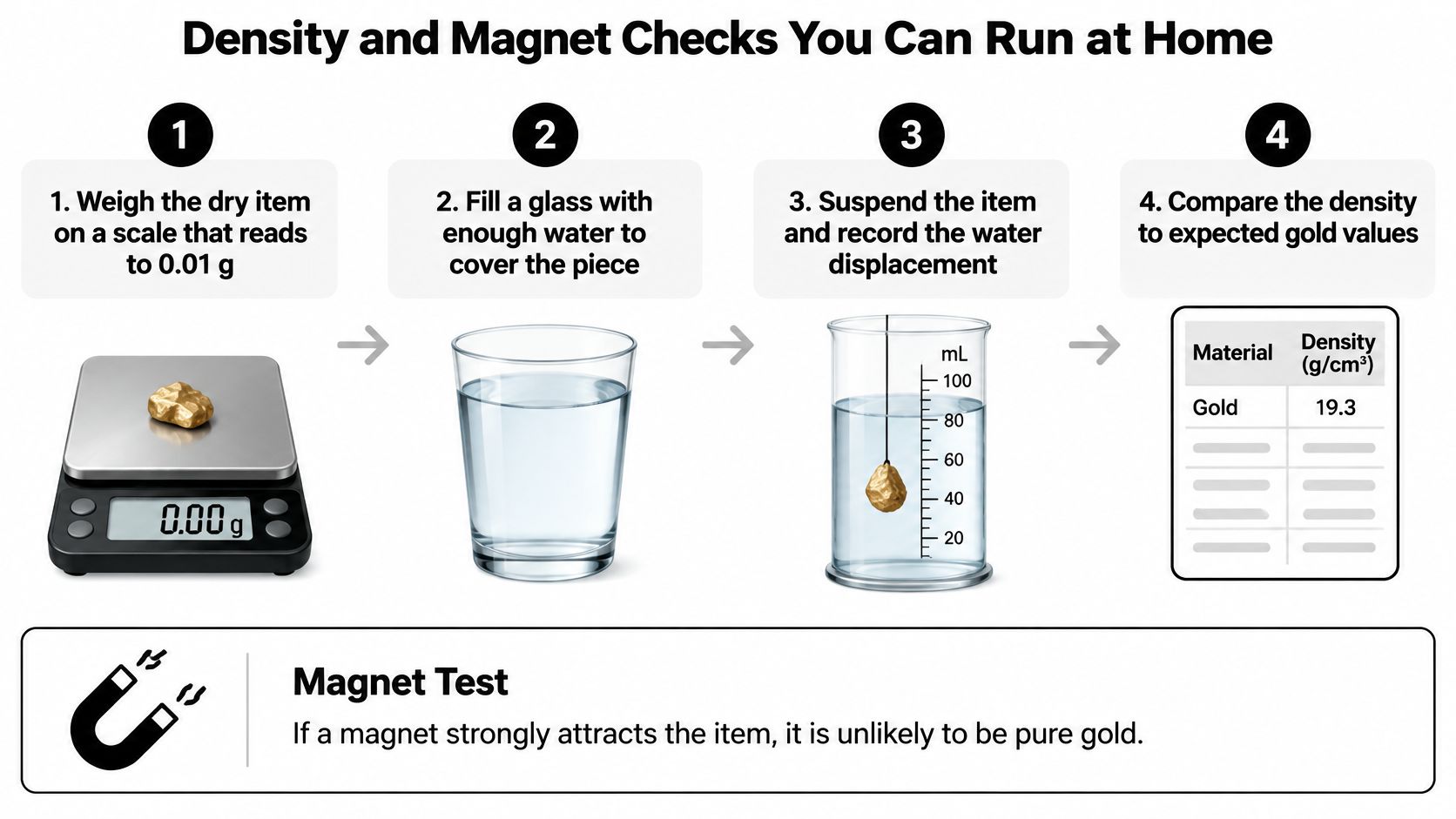
Density and Magnet Checks You Can Run at Home
Density testing measures mass divided by volume. It's most useful for a solid, stone-free item without enclosed cavities, absorbent materials or water-sensitive finishes.
A kitchen scale may be too coarse for a small ring, and an ordinary drinking glass doesn't provide a readable volume measurement. Use a sensitive scale and a narrow graduated vessel, or have a professional perform hydrostatic weighing.
Measure displacement carefully
- Weigh the dry item. Record its mass in grams, making sure the scale settles consistently before accepting the reading.
- Fill a graduated vessel with enough water to cover the piece and record the starting level. Read the water surface at eye level so your viewing angle doesn't change the result.
- Suspend the item using fine thread and lower it completely into the water. Keep it clear of the vessel's sides and bottom, and record the new level.
- Subtract the starting volume from the submerged volume. This difference is the volume displaced by the item.
- Divide mass by displaced volume. Using grams and cubic centimetres gives density in grams per cubic centimetre, which you can compare with a reliable reference for the relevant material.
Density and specific gravity are closely related but aren't strictly identical: specific gravity compares a material's density with water and has no units.
Interpret the result without assigning a false karat
The following reference guide is qualitative. Gold-alloy density changes with the metals used in the alloy, so there isn't a single universal density for every karat grade.
| Material or Karat | What a Reading Means |
|---|---|
| 24k pure gold | Agreement with a reliable pure-gold reference is consistent with pure gold, not proof |
| 18k gold | Compare with a reference appropriate to that alloy composition |
| 14k gold | A matching alloy reference supports consistency, not certification |
| 10k gold | Use an alloy-specific reference rather than a universal cutoff |
| Tungsten | Can mimic gold density, needs other tests |
| Brass | A brass-like density is inconsistent with pure gold, but doesn't identify the exact alloy |
Remove clinging air bubbles by gently rotating the suspended item. Bubbles increase apparent displacement and lower the calculated density; enclosed cavities can create a similar problem.
Stones and other components don't automatically count as gold weight. Their mass and volume can make a whole-item calculation unsuitable for estimating metal purity.
For the magnet check, bring a strong magnet close to the body and then the clasp separately. Attraction suggests a magnetic component, such as steel, but a clasp spring alone doesn't establish that the chain is fake.
A non-reaction proves nothing about karat. A density result that conflicts with the claimed material means you need a stronger test, not an immediate counterfeit verdict.
Acid and Touchstone Tests and How to Stay Safe
- Choose a discreet contact area, such as the inside of a plain ring shank, after reading the safety precautions below. Don't select a solder joint or decorative coating if you're trying to assess the main body.
- Rub that area across a clean touchstone to leave a visible metal streak. Make a comparison streak beside it with a known test needle or reference piece.
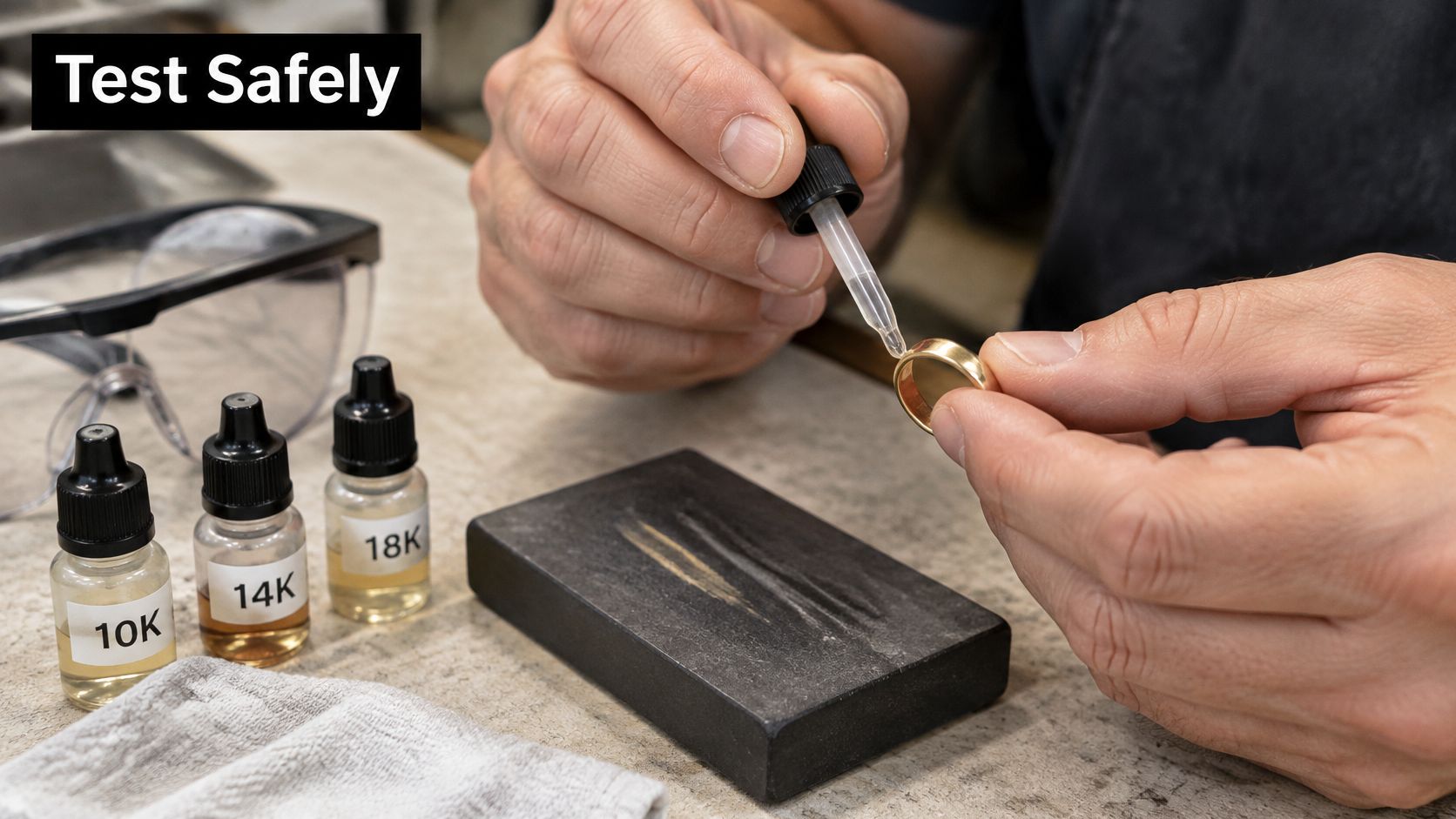
- Apply the appropriate solution from a graded gold-testing kit to the streaks, following the kit's directions. Keep the acid on the stone rather than applying it directly to jewelry.
- Compare how the unknown and reference streaks resist or dissolve under the same conditions. Record the solution used and your observation rather than writing only “passed.”
- Clean the stone and handle residue using the kit's specified neutralization and disposal procedure. Keep the item away from the work surface until all chemical residue is controlled.
Safety comes before opening the bottles
Testing acids can cause chemical burns and damage jewelry. Wear splash-resistant eye protection and chemical-resistant gloves specified by the kit's safety information; don't assume every disposable glove suits every solution.
Work in the ventilation conditions required by the manufacturer. Keep children and pets away, leave bottles sealed and labelled when not in use, and never mix test solutions or improvise a neutralizing mixture.
The touchstone keeps the reaction separate from the jewelry, as shown below.
Follow local requirements for chemical waste. If you can't provide the protective equipment, ventilation and cleanup arrangements the kit requires, leave this test to a trained professional.
> Never test a piece you can't afford to scratch.
What a matching streak means
A matching reaction suggests that the transferred surface metal behaves like the reference under those test conditions. It doesn't establish the average purity of the whole object.
Plating or a gold-rich surface can supply a convincing streak while concealing different metal underneath. A thin or incomplete streak can also disappear in a way that's difficult to interpret, particularly without a comparison sample.
Reaching beneath plating may require deliberate abrasion or filing, which is more destructive than a touchstone rub. Don't take that step on an heirloom or collectible without agreeing on the damage first.
Why Electronic and XRF Readings Can Mislead
An instant digital result looks conclusive because it displays a precise number. But precision on a screen isn't proof that the measurement represents the whole item.
X-ray fluorescence, or XRF, identifies elemental composition at and near the tested surface. Electronic testing pens use a different measurement principle and shouldn't be treated as interchangeable with an XRF analyzer.
The Bureau of Indian Standards' consumer jewelry-testing guidance describes XRF as preliminary testing and reports that 93% of melted-strip samples differed from fire assay by no more than 3 parts per thousand, while jewelry tested as received showed significant variation. The guidance cautions against basing a purity certificate on XRF alone.
Ask what the operator actually measured
- Test location: Was the instrument aimed at the main body, a clasp, a solder seam or a repair?
- Coverage: Were separate components and different areas checked?
- Surface condition: Was dirt removed without altering the underlying finish?
- Consistency: Do the readings agree with each other and with the item's construction?
- Documentation: Does the recorded result identify the tested article and locations?
Plating can mask a different core. Solder can produce a locally different reading, and mixed-metal jewelry can contain genuinely different compositions in adjacent parts.
For context on instrument choices, this explanation of Thermo DXL and Sigma Metalytics testing helps distinguish testing technologies rather than treating every electronic result as equivalent.
Resolve disagreement before discussing value
Suppose a chain's clasp matches its mark but the links produce inconsistent readings. Don't average the displayed numbers and call that the chain's purity.
Have the operator repeat measurements on suitable clean, flat areas and examine the construction. If disagreement remains material to a sale or settlement, arrange representative sampling through an appropriately accredited assay laboratory.
XRF is excellent for screening and locating inconsistencies. A settlement-grade conclusion requires a method, sample and report suited to the decision, not more digits on the display.
When Fire Assay Is the Only Answer That Counts
Fire assay, also called cupellation, is the established reference approach when a defensible gold-purity determination is necessary. It uses a relatively substantial sample and physically separates precious metal from much of the surrounding material.
The laboratory handles the separation under controlled conditions.
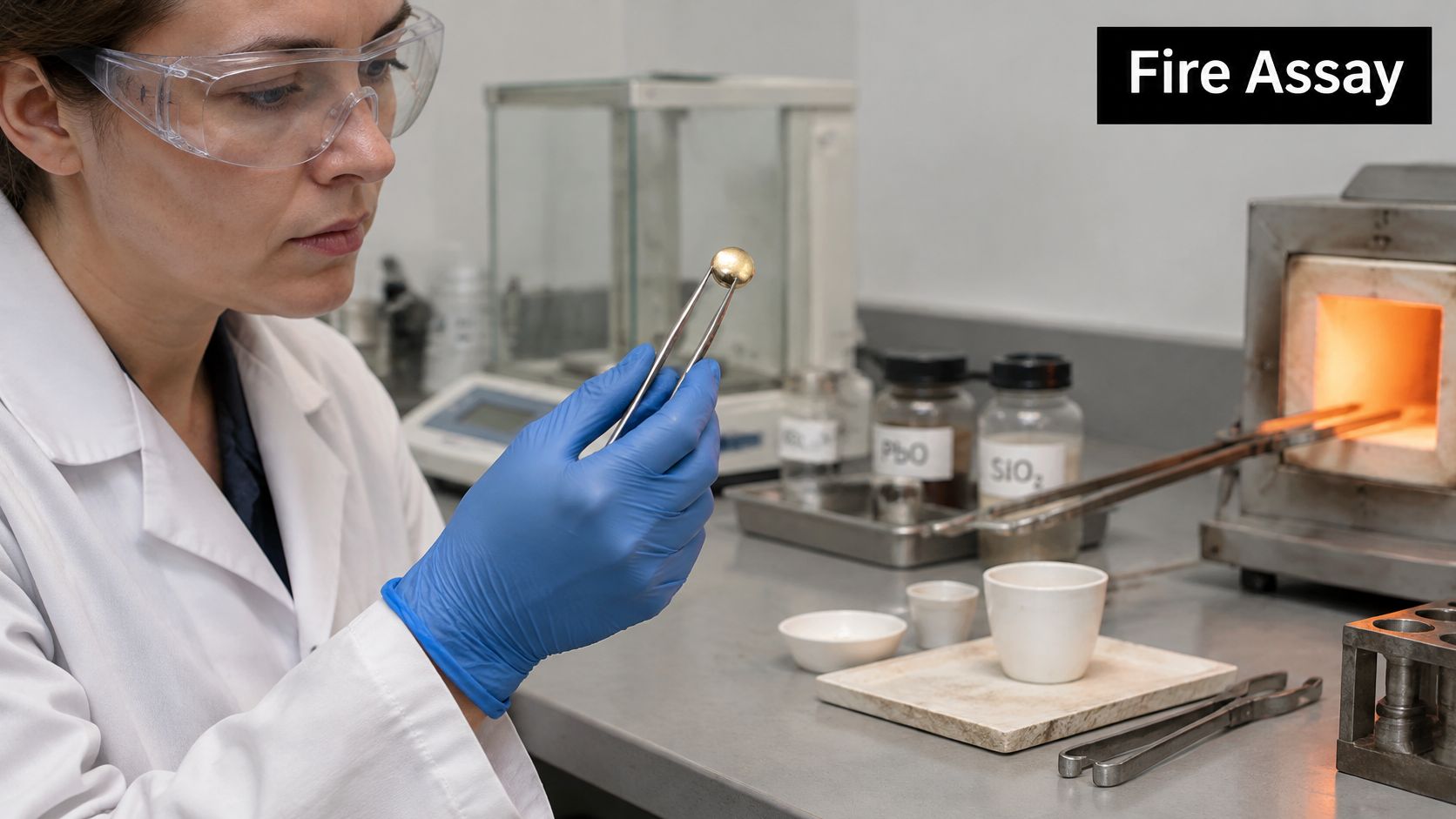
What the laboratory does
The ISO 11426 workflow discussed in the LBMA presentation on optimizing fire-assay conditions includes the following steps, typically using silver at roughly 2–3 times the estimated fine-gold mass.
- Obtain a representative sample, so the result addresses the material being valued.
- Weigh it using calibrated equipment to establish the starting sample mass.
- Add silver and lead to support separation during the subsequent treatment.
- Fuse the charge to combine the prepared materials.
- Cupel in an oxidizing furnace, allowing lead and base-metal oxides to be absorbed.
- Part the resulting gold-silver bead in nitric acid to remove silver.
- Anneal and weigh the remaining gold to determine the recovered gold mass.
- Calculate fineness in parts per thousand from the sample and recovered-gold measurements.
Controls matter as much as the furnace
The laboratory should process at least two certified reference samples alongside the unknown. Their satisfactory agreement with expected results helps check furnace conditions, balance performance, chemical treatment and operator technique.
The LBMA comparison reported fire-assay precision around 0.040‰ near 995‰, against about 0.008‰ for high-pressure ICP-OES. Those comparison figures don't establish a universal uncertainty for every laboratory, but they show why “reference method” doesn't mean “most precise instrument in every circumstance.”
This video provides a visual companion to the laboratory process.
> A highly accurate assay of an unrepresentative sample can still answer the wrong question.
For high-value sales, contested estates, insurance questions or bullion disputes, agree on the laboratory, sampling procedure and acceptable report before authorizing destruction. Confirm what will be removed and whether the resulting report meets the receiving party's requirements.
Confirm Your Result Before You Sell or Pawn
Treat your evidence as a ladder: preliminary checks establish whether the item deserves confidence, professional measurements support a transaction, and a reference assay addresses unresolved questions with significant consequences.
Before discussing an offer, write down what agrees and what doesn't. A discrepancy may concern the entire item, a replacement clasp or only a repaired area, and those situations shouldn't receive the same interpretation.
Bring a useful record
- The complete item: Include detachable components so they can be evaluated separately.
- Clear mark photographs: Bring close-ups when stamps are difficult to see.
- Existing paperwork: Include receipts, appraisals and assay reports without assuming they establish current metal content.
- Earlier results: Note the method, tested location and reported conclusion.
At Idaho Pawn & Gold Exchange, we offer free precious metal scans, testing gold and silver with an XRF Analyzer that gives lab-quality results. The reading still needs to be interpreted in relation to the tested surface and the item's construction.
Our selling process begins with an in-person evaluation, and you decide whether to accept the offer. We base gold and silver estimates on weight, tested purity and a market reference expressed in matching units.
For the valuation side, our explanation of how much 14k gold sells for helps connect purity with metal-content calculations. Jewelry weight isn't automatically gold weight, and a purity result isn't itself a purchase offer.
Choose a quick screen for curiosity, a professional evaluation before selling or pawning, and a reference assay when the conclusion must withstand scrutiny.
---
Bring your gold item, any paperwork and previous test results to Idaho Pawn & Gold Exchange for a free precious metal scan and an in-person evaluation. We'll assess the item's weight and tested purity, and you can decide whether to accept an offer.