
Most buying advice treats solid gold as the automatic winner and anything plated as a mistake. That shortcut skips the job the piece has to do. A gold color is not a gold body, and with bullion prices high, the expensive choice is not automatically the smarter one. You are choosing among years on the body, the look you want this season, and whether any cash remains if you sell.
Gold Plated vs Solid Gold at a Glance
Solid karat gold is an alloy all the way through. 24K is pure. 18K is 75 percent gold, marked 750. 14K is about 58.3 percent, marked 585, because 14 of 24 parts are gold. 10K is about 41.7 percent, marked 417. Gold plated jewelry is a thin coat over brass, copper, steel, or another base, so total weight times a karat stamp does not equal gold weight.
| Criterion | Solid karat gold | Gold plated |
| --- | --- | --- |
| Where the gold is | Alloyed through the whole piece | Thin surface layer over a non-gold base |
| Typical gold share | 10K about 41.7%, 14K about 58.3%, 18K 75%, 24K essentially pure | Coating often 10K or higher, but gold mass is tiny |
| How it fails | Scratches, dents, gradual thinning; color stays gold | Friction removes the coat and the base color shows |
| Repair and resizing | Polish, size, and solder usually safe | Heat and polishing can strip or burn the plate |
| What sets a cash offer | Karat, verified weight, condition, and demand | Brand, design, stones, and condition; coating rarely has melt value |
Where the gold is decides every later number. Solid karat gold keeps the same alloy from skin side to outside. Plate puts gold only on the surface, so the body can be a cheap industrial metal.
Typical gold share is a percentage of the whole object only when the piece is solid. A high-karat coating can still be a whisper of metal. Multiplying the item's full gram weight by 18K or 24K will invent gold that is not there.
How it fails splits the two in daily wear. Solid gold scratches, dents, and slowly thins, and the color stays gold. Plate fails at ring shanks, bracelet links, watch edges, and clasps, where friction rubs the coat off and the base color shows.
Repair and resizing follow that same split. A jeweler can usually polish, size, and solder solid karat gold without uncovering a different metal. Heat and abrasive polishing can strip or burn a plate and leave a patchy base.
What sets a cash offer is not shine. Solid pieces are priced from karat, verified weight, condition, and demand. Plated pieces, if they sell at all, ride on brand, design, stones, and condition, because the coating rarely has melt value.
Keep three lenses separate: years of wear, fashion or brand value, and melt or pawn value. Thickness rules, honest stamps, and a real cash offer are different questions, and a pretty piece can still be worth almost nothing as gold.
Solid Gold, Plating and Thickness Rules
Solid gold is defined by how much gold is in the alloy, not by the absence of every other metal. The World Gold Council explains that 24-karat gold is pure gold, while lower-karat jewelry mixes gold with metals such as copper or silver. An 18-karat item is 75% gold, usually stamped 750, meaning 750 parts gold per 1,000. A 14-karat piece is about 58.3% gold because 14 of 24 parts are gold, commonly stamped 585. 10K, or 417, is the same arithmetic: 10 of 24 parts, about 41.7 percent gold.
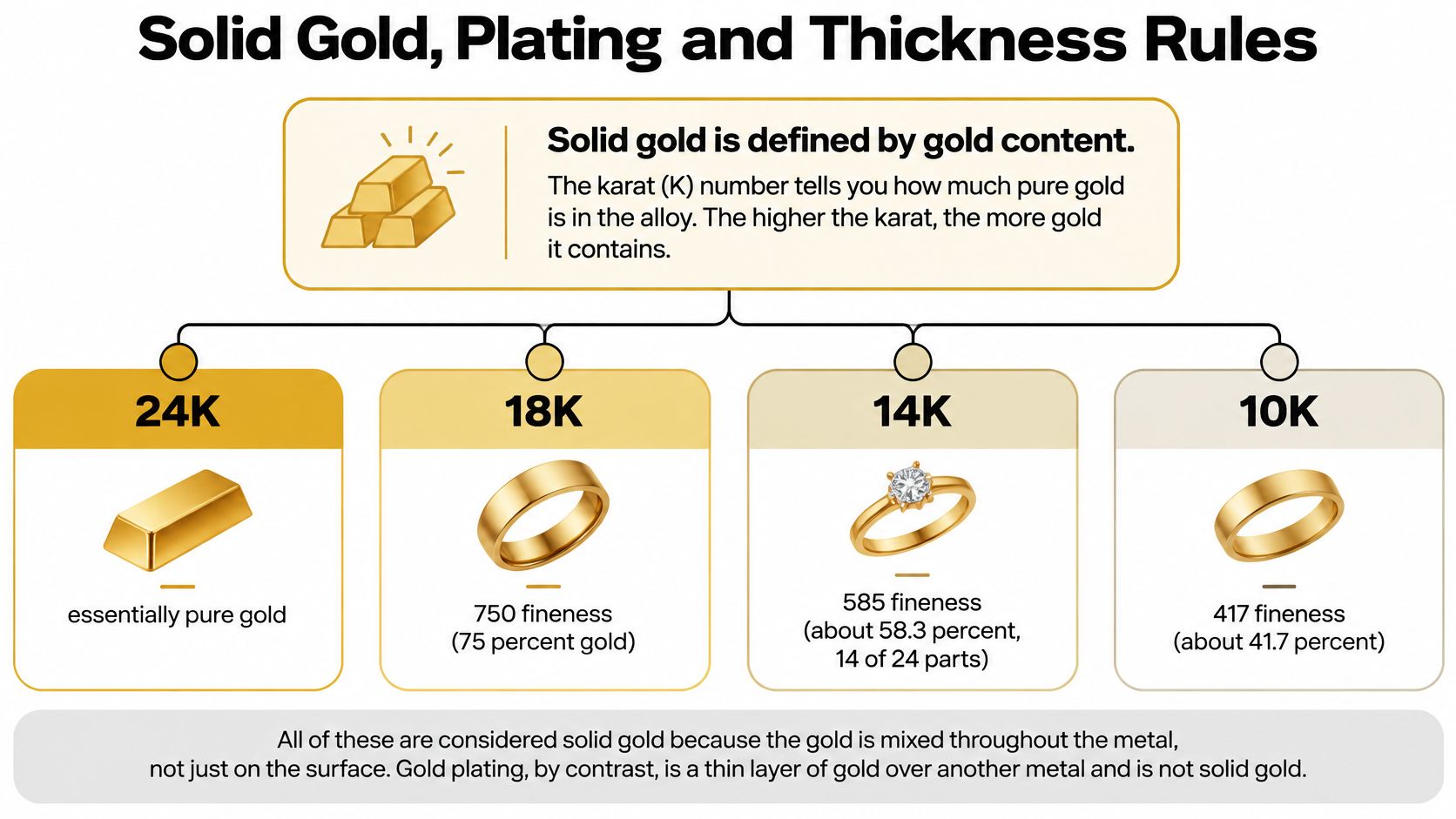
Karat math on one ring
Take one object. A 10-gram 18K ring holds about 7.5 grams of gold by mass. The same 10 grams in 14K holds about 5.8 grams, because 58.3 percent of 10 is 5.83. That gold is distributed through the object, so ordinary scratches do not expose a different base metal.
Jewelers alloy gold because pure gold is soft. Copper hardens rose and yellow pieces and warms the color. Silver or palladium lightens white gold. The stamp is the starting evidence of intrinsic gold, and 24K, 18K/750, and 14K/585 are materially different concentrations. A stamp alone does not prove the mark is honest or give you an exact gold weight. A scale, an acid test, an electronic tester, or a professional assay still has work to do.
What each thickness label allows
Gold plating is a surface layer over a non-gold base. You cannot value it by multiplying total weight by a karat percentage. Longevity tracks thickness, how the gold was bonded, and where the piece rubs.
| Label | How the gold is applied | Minimum spec | Wear implication |
| --- | --- | --- | --- |
| Gold electroplate | Electrolytic | At least 10K and 0.175 micron (7 millionths of an inch) | Legal floor; friction removes it |
| Gold plate | Electrolytic, heavier trade wording | About 0.5 micron in FTC guidance | Still a skin, not a gold body |
| Gold filled, overlay, or rolled gold plate | Mechanically bonded | At least 10K, about 4.3 microns, at least 1/20 of metal weight | Far more gold than flash plate; still a layer |
| Engineering electroplate (ASTM B488) | Electrolytic by class | Commonly about 0.25 to 5.0 microns | Life depends on thickness, hardness, porosity, rub points |
| Solid karat gold | Alloyed through the piece | Example: 14K is 14 of 24 parts gold | No coating to wear through |
U.S. Federal Trade Commission guidance states that jewelry described as "gold electroplate" must have gold of at least 10-karat fineness applied electrolytically at a minimum of 0.175 microns, equal to 7 millionths of an inch. The same guidance ties "gold plate" to a minimum equivalent thickness of about 0.5 micron. "Gold filled," "gold overlay," or "rolled gold plate" needs a mechanically applied layer of at least 10-karat gold, about 4.3 microns thick, equal to at least 1/20, or 5%, of the item's metal weight.
Those floors explain why two gold-colored rings can age differently. A daily band rubs the shank against a finger and a countertop. An earring post sees far less scrape, so the same thin coat can look fine on ears and fail on a ring. The FTC notes that plating wears away depending on thickness and how the jewelry is worn. Friction on rings, bracelets, and frequently handled pieces can reveal the base metal. Solid gold does not have that plating-failure mode, and it can be polished or resized without uncovering another metal.
Engineering coatings classified under ASTM B488 commonly run about 0.25 to 5.0 microns, with hardness and purity set by type and code. Thickness is not the whole story. Porosity and adhesion decide whether a coat lasts months or years. A porous plate lets moisture reach the base even while gold still shows.
A short walk-through of how karat alloys and surface coats behave on real jewelry makes the thickness gaps easier to picture.
> Before you pay: Ask whether the piece is solid karat gold, gold electroplate, gold plate, or gold filled. The karat mark starts the conversation. It does not finish it.
Hallmarks and Tests That Separate the Two
Read the stamp before you reach for acid. Solid pieces are typically marked 10K, 14K, 18K, 22K, 24K, or the fineness twins 417, 585, 750, 916, and 999. Plated and bonded pieces should carry a qualifier, not a naked karat claim.
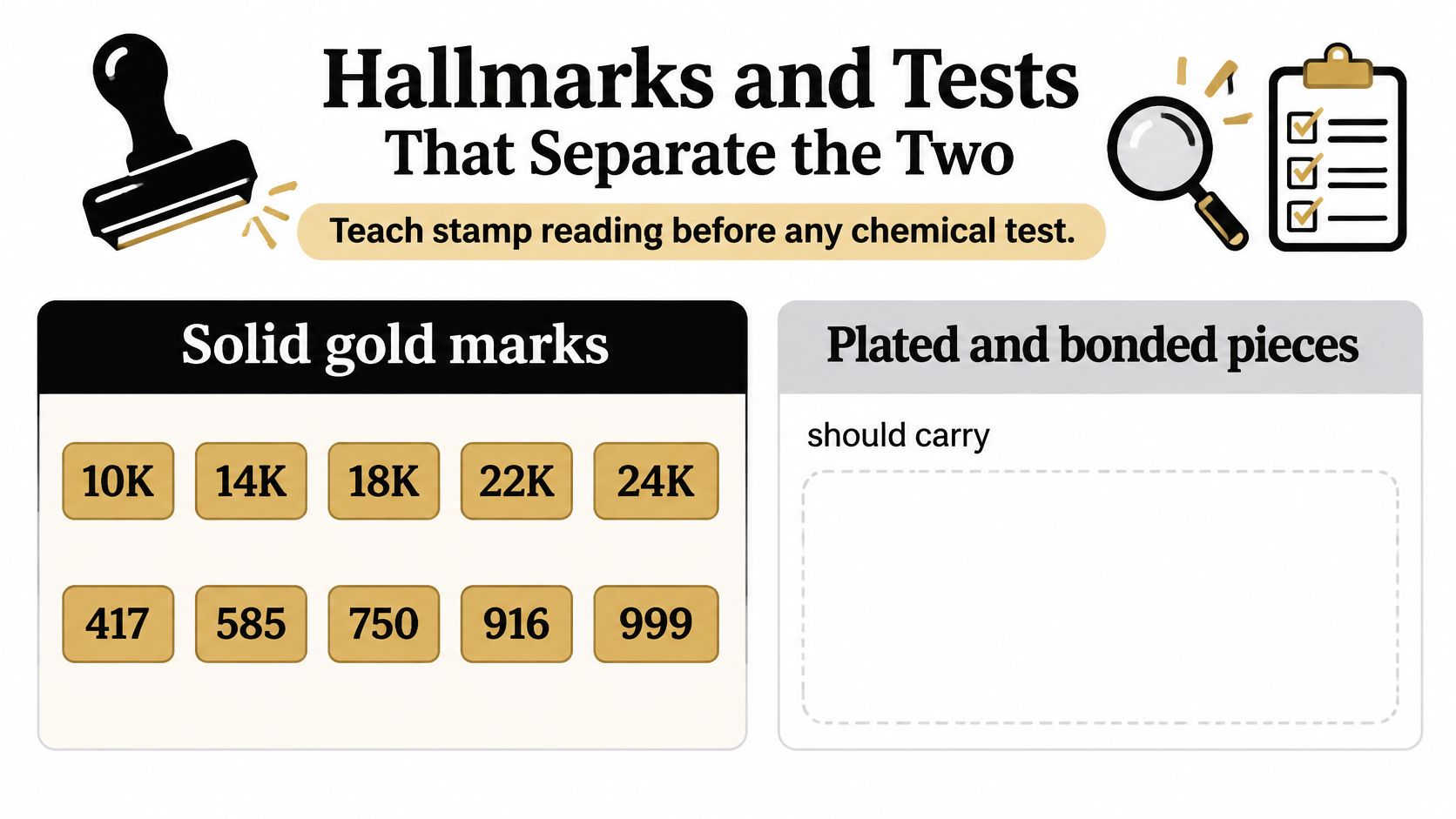
| Mark | Meaning | Gold share |
| --- | --- | --- |
| 10K or 417 | 10 of 24 parts gold | About 41.7% |
| 14K or 585 | 14 of 24 parts gold | About 58.3% |
| 18K or 750 | 18 of 24 parts gold | 75% |
| 22K or 916 | 22 of 24 parts gold | About 91.7% |
| GP, GEP, HGE, RGP | Plated qualifier, thin coat over a base metal | Not priced by karat |
| 1/20 14K GF | Gold filled, 14K layer at least 1/20 of metal weight | About 5% of metal weight |
GP means gold plated, GEP gold electroplate, HGE heavy gold electroplate, and RGP rolled gold plate. GF with a fraction, such as 1/20 14K GF, is a bonded layer, not a solid 14K body. An 18K or 24K stamp on a light, oddly colored, or magnet-grabbing piece is a claim, not an assay.
A home screen that stops short of damage
- Weigh it. Note whether it feels light for its size. Solid gold is dense, so a hollow or plated lookalike of the same outline often feels slight.
- Inspect rub points. Check edges, clasps, and engraving for a different color. A brass or copper line under a bright face is the coat giving up.
- Use a magnet only as a hint. Many gold alloys and some bases are non-magnetic, so no pull does not prove solid gold. Stainless or steel bases may stick.
- Stop before you file or acid-test anything you might still wear or resell. A notch is permanent.
What a counter should read past the surface
A pawn counter should not stop at the stamp. The usual kit is a scale for gross weight, acid or an electronic tester for karat screening, and a method that reads past the surface. Shops that publish their process, including how Thermo DXL and Sigma Metalytics testing fit a gold counter, are showing you the extra step. Idaho Pawn & Gold Exchange in Boise, Meridian, and Nampa is one place that treats the stamp as a starting claim and then tests.
Engineering guidance on gold coatings is blunt about why a surface reading can mislead. Comments filed on the FTC jewelry guides note that ASTM B488 classifies coatings by purity and thickness, and that plating performance is governed by surface thickness, adhesion, porosity, hardness, and wear exposure. Solid gold keeps its alloy through the cross-section and can generally be polished, resized, or repaired without exposing a base metal. A surface X-ray reading can overrepresent gold content when the coating is thick enough, so screening has to distinguish the skin from the metal underneath.
Ask for the plating method, thickness if known, the substrate metal, and any paperwork. Do not accept a verbal "it's 18K."
Price, Melt Value and a Real Pawn Offer
Shoppers collapse three prices into one. They are not the same number.
Retail is design, brand, labor, and store margin. Melt value is recoverable gold times the spot-based payout a buyer uses after karat and weight are verified. A pawn or buy offer is that metal floor plus whatever the piece can resell for as jewelry, minus the shop's risk.
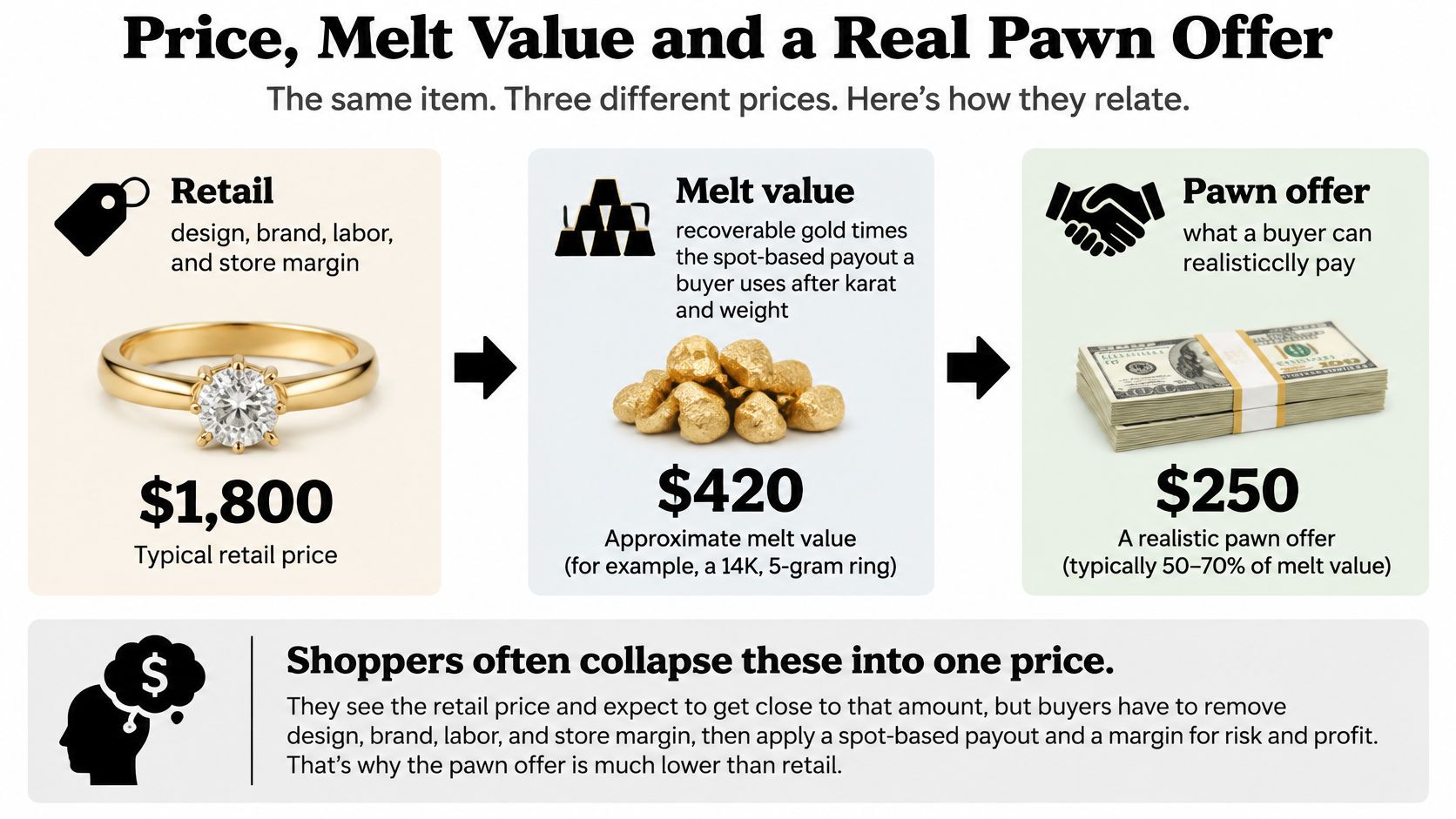
How each construction cashes out
Solid gold has gold in the alloy, so a verified 14K or 18K weight produces a calculable metal floor even when the style is dated. A clear walk-through of what 14K gold sells for is the right kind of question: karat and grams first, not the original tag. Plate usually has too little gold to melt. Any offer rides on name, condition, gems, and whether someone will wear it again. Gold filled sits between them. It holds more gold than electroplate and still is not priced like a solid piece of the same gram weight.
White-gold rhodium and gemstones change the offer without changing the gold math. A rhodium wash is a surface color, not extra bullion. A diamond can carry resale value the mount does not. Leave stones in their settings until a buyer has seen them.
Why high prices do not settle the choice
High gold prices make the "solid gold always wins financially" line too simple. The World Gold Council's Q2 2026 demand trends show the split: global gold-jewelry demand fell to 278 tonnes, its lowest quarterly volume since the pandemic, while consumer spending on gold jewelry rose 14% year over year to US$40 billion. Prices were up 37% year over year and recycling fell 13% year over year. Fewer grams changed hands at much higher dollars, and owners were slower to scrap.
> A strong receipt does not create a strong buyback. The counter pays verifiable metal and marketability, not the original tag.
Plated jewelry can be the rational buy for a trend piece, occasional wear, or anyone protecting cash while prices are high. Solid gold is the side with an exit value in metal. Compare expected years of use, replacement cost, sentimental weight, and exit value. Do not label plate as junk or solid gold as an investment by default.
Which Piece Fits How You Wear It
There is no single winner in gold plated vs solid gold. Match the metal to the knocks, the calendar, and the cash you may need later.
| Situation | Lean toward | Why |
| --- | --- | --- |
| Ring or bracelet worn daily | Solid 14K or 18K | Friction at bands and clasps outlasts a coating and leaves a metal floor |
| Trend earrings or occasional wear | Gold filled or clearly labeled plate | Fashion value matters more than melt, and cash stays out of a high spot price |
| Heirloom that may be resized | Solid karat gold | Polish and solder do not uncover a different metal |
| Raising cash from the metal | Stamped solid gold with stones intact | Offers follow verified karat and weight, not shine |
| Skin that reacted after wear | Solid alloy or a known substrate such as vermeil over sterling | A breached plate can expose a base you would not have chosen |
A wedding band takes hits on the shank every day. If you are browsing Italian wedding band inspiration for a profile you will not take off, 14K or 18K solid gold earns its cost in years of wear and in a metal floor if life changes and you sell. An everyday bracelet is the same story at the clasp.
Fashion hoops for one season are a different job. A clearly labeled gold-filled pair, or a heavier plate you already know is a coat, buys the look while bullion-linked jewelry prices are high. You are paying for fashion value, not for grams you expect back.
An heirloom that may be sized or re-tipped belongs in solid karat gold. Repairs should not open a base metal in the middle of a family piece.
Someone who needs cash this week should bring stamped solid karat pieces, with stones still in their settings. A plated chain will be judged as costume or as a branded object, not as bullion.
Skin is the quiet failure. A nickel-bearing base under a worn plate can irritate after the gold is gone. A known solid alloy, or vermeil over sterling, is a different risk because you can name what sits against the skin.
Reuse one line: expected years on the body, cost to replace, sentimental weight, and exit value. Plate is not fake. Solid gold is not automatically an investment. Each is fit or unfit for the job.
Buy Sell or Pawn With the Right Question
When you are buying
- Make the seller name the construction and show the stamp. You want solid karat, gold electroplate, gold plate, or gold filled, in those words.
- Match the metal to the job, not to the word gold. Daily friction wants a solid alloy. A season's look can live in gold filled or a clearly labeled plate.
- Walk away if the price is near solid-gold money and the description is still a plate. You would be paying for grams the piece does not contain.
When you are selling or pawning
- Do not polish through a worn edge or scrub a tired shank into a bald spot. You can erase the only clue a buyer has.
- Bring every piece, including broken chains. Solid scrap is still gold. Plate usually is not.
- Ask the buyer to state karat, weight, and the kind of offer. You want to hear whether it is melt, jewelry resale, or a short-term loan.
- Compare a pawn loan with an outright sale. A loan lets you repay and retrieve the piece. A sale fits when you do not want it back.
Readers in Boise, Meridian, and Nampa can take solid pieces to Idaho Pawn & Gold Exchange. Staff test gold and price it from verified content and demand rather than color alone, which is the standard worth using when you compare any pawn shop that handles jewelry. Pay for solid gold when you need the grams and the years. Pay for plate or gold filled when you need the look and can accept that the gold will not come back as cash.
---
Idaho Pawn & Gold Exchange tests gold, silver, and jewelry and prices pieces based on verified metal content and what the item can resell for, not just shine alone. If you are sorting solid karat gold from plate before a loan or a sale, bring the pieces in and ask for karat, weight, and whether the number is melt, resale, or a short-term pawn. Visit Idaho Pawn & Gold Exchange in Boise, Meridian, or Nampa when you want that answer on the counter.