
If a diamond ring comes with a certificate, what exactly have you proved about the ring, and what would someone pay you for it later? Those are different questions, yet buyers often treat a grading report, an insurance appraisal, and a resale offer as interchangeable.
A safer purchase starts with understanding the stone, then checking the documents against it. Whether your search starts with “buy diamonds ring” or a visit to a local pawn counter, your aim is the same: choose a ring you love, understand what you're paying for, and avoid relying on promises that never reach the invoice.
Read the 4Cs Before You Compare Rings
The 4Cs are color, clarity, cut, and carat weight, a shared vocabulary that makes diamond comparisons more objective. According to GIA's history and guide to diamond quality, founder Robert M. Shipley developed the framework in the early 1940s, and GIA introduced its D-to-Z color scale in 1953.
Before standardized grading, a seller's description could leave considerable room for interpretation. A report gives you defined observations to compare, but the grades still need to be read together.
What the grades describe
Color describes the presence or absence of body color within the applicable grading system. Clarity describes internal characteristics, called inclusions, and surface characteristics, called blemishes.
Cut concerns how a diamond's proportions and workmanship affect its appearance. Carat weight measures weight, not the width you see when you look down at the ring.
| Factor | Grade range (GIA scale) | What it means for a ring |
|---|---|---|
| Color | D-F colorless, G-J near colorless, K-M faint yellow | Compare the actual stone against the setting rather than choosing by letter alone |
| Clarity | FL, IF, VVS1-VVS2, VS1-VS2, SI1-SI2, I1-I3 | Assess the location and visibility of characteristics, not just the grade abbreviation |
| Cut | Excellent, Very Good, Good, Fair, Poor | For round brilliants, use cut quality to screen for light performance |
| Carat | Measured weight rather than a quality grade | Compare face-up measurements as well as weight |
Read that table as a vocabulary guide, not a shopping prescription. A clarity grade doesn't tell you everything about whether a particular inclusion will bother you, and a color grade doesn't decide whether you'll enjoy a warmer-looking diamond.
The word eye-clean creates particular confusion. It describes an informal visual impression, not a substitute for the laboratory's clarity assessment. Ask to view the stone without magnification first, then have the seller show you its identifying characteristics under magnification.
Start with appearance, then refine your targets
For a round brilliant, screen cut before becoming attached to weight. Brilliance means the return of white light, while fire means flashes of spectral color. A heavier diamond can carry weight in proportions that don't translate into the broad, lively appearance you expected.
Say you're comparing a heavier stone that looks dark through its center with a lighter stone that looks bright across its face. Don't let the larger weight settle the decision. Compare their measurements, their appearance in ordinary lighting, and the price of the complete rings.
> Practical rule: Buy the appearance you can verify, not the highest isolated grade you can afford.
Setting choice also belongs in the comparison. View candidate stones against the metal you intend to wear, because surrounding color can affect your impression. For help connecting the gem to everyday preferences, Jackpot Candles' guide to match a ring to your partner's style offers a useful starting point for discussing design.
Before visiting a shop, write down your preferred shape, acceptable color appearance, clarity expectations, and weight range. Add your budget for the finished ring, including any necessary sizing or setting work. Those targets let you compare offers without allowing a salesperson's strongest talking point to become your only criterion.
How to Verify the Stone Before You Pay
Appearance alone cannot identify a stone. The GIA diamond-buying guide supports comparing grading information with the actual diamond rather than relying on appearance or carat weight alone.
Use this sequence before committing payment.
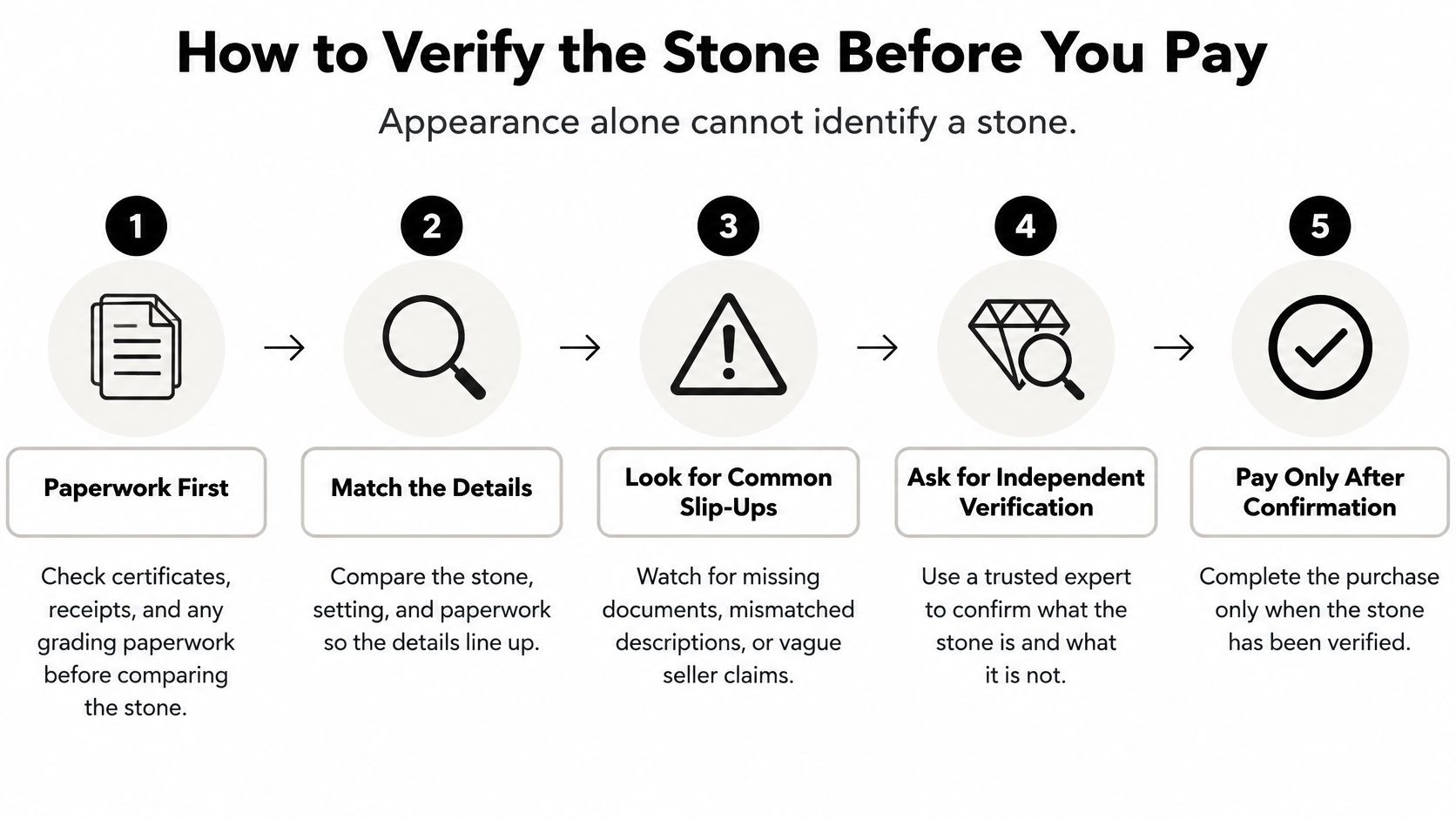
- Specify identity in writing. State whether you're buying a natural diamond, laboratory-created diamond, or imitation. A verbal description of diamond isn't enough.
- Require an independent report. Identify the laboratory. An in-house appraisal serves a different purpose from independent grading.
- Verify the report number. Check the laboratory's own records. Finding a valid number doesn't establish that the accompanying stone is the one described.
- Match physical details. Have a qualified examiner compare shape, measurements, weight, clarity characteristics, fluorescence, and treatment comments. Inspect under diffuse daylight, indoor spot lighting, and magnification rather than trusting a display case.
- Complete the invoice. Record the stone's identity, report number, and relevant disclosures. Don't leave important promises in conversation.
Get help with the match
Our explanation of whether you can identify a real diamond by eye helps clarify why visual shortcuts aren't enough. We provide free diamond authentication testing, and certified GIA gemologists inspect and appraise diamonds.
We can also help obtain a certified diamond report, which takes 10 days. Build that service timeline into your purchase plans rather than assuming documentation can be arranged at the counter.
Spot Disclosure Gaps and Vague Seller Claims
A seller calling a ring certified hasn't yet told you who examined it, what was examined, or whether the paperwork matches the stone. Ask for the laboratory's name and the report itself before treating that description as reassurance.
The highest-risk mistakes concern material identity and undisclosed treatments, not merely a disagreement over an adjacent grade. The FTC's gemstone-buying guidance warns that laboratory-created diamonds can be difficult to distinguish visually from mined diamonds and that moissanite can resemble diamond.
Translate the sales language
| Seller claim | What it usually means | What to request in writing |
|---|---|---|
| Eco-friendly or cultured | An environmental or origin description that doesn't establish material identity | Explicit natural versus laboratory-created status and support for environmental claims |
| Eye-clean | An informal visual statement, not a laboratory grade | Independent grading report, with a clarity plot when available |
| Certified | Someone has issued documentation, whose scope must be checked | Named laboratory and independently verifiable report number |
| Enhanced | May refer to laser drilling, fracture filling, or color treatment | Specific treatment disclosure on the report and invoice |
| Flawless | A technical clarity designation, not a synonym for attractive | The actual grade on the independent report |
Don't accept an environmental description as an answer to an identity question. A seller should explain separately what the material is, how it was produced, and what supports any sustainability claim.
The FTC's guidance for jewelry sellers addresses clear identification of laboratory-created stones as not mined. It also provides a useful basis for challenging ambiguous descriptions instead of guessing what a seller intended.
Ask about testing and inspection limits
- Material identification: Ask whether the stone is laboratory-created, imitation, or treated, and what equipment was used to distinguish those categories.
- Treatment details: Request explicit confirmation about laser drilling, fracture filling, and color treatment. Ask how any disclosed treatment affects care and the seller's valuation.
- Independent identification: Confirm that the laboratory's records can be checked directly and, where an inscription is present, that it matches the report.
- Mounting restrictions: Ask whether prongs or the setting obscure identifying features or limit treatment inspection. Get those limitations in writing.
A mounted stone may prevent an examiner from seeing everything they'd inspect in a loose diamond. That doesn't automatically make the ring unsuitable, but it does mean the report or appraisal should describe the limits of the examination rather than imply certainty.
We review each diamond for color, cut, clarity, and carat, then discuss the appraisal with the customer before a sale. Use that discussion to ask what was established by testing, what came from documentation, and what remains unconfirmed.
> A seller's verbal assurance should become a specific, attributable statement on the report or invoice before you rely on it.
Pricing, Resale and Pawn Shop Offers
Purchase price, replacement value, and resale value answer different questions. Purchase price is what you agree to pay; replacement value estimates the cost of obtaining a comparable replacement for the stated purpose; resale value concerns what a buyer will offer through a particular selling channel.
Ask the appraiser or buyer to identify which question they're answering. A high insurance figure isn't evidence that a dealer will pay that amount in cash.
Bring the complete ring and its documents to a valuation discussion.
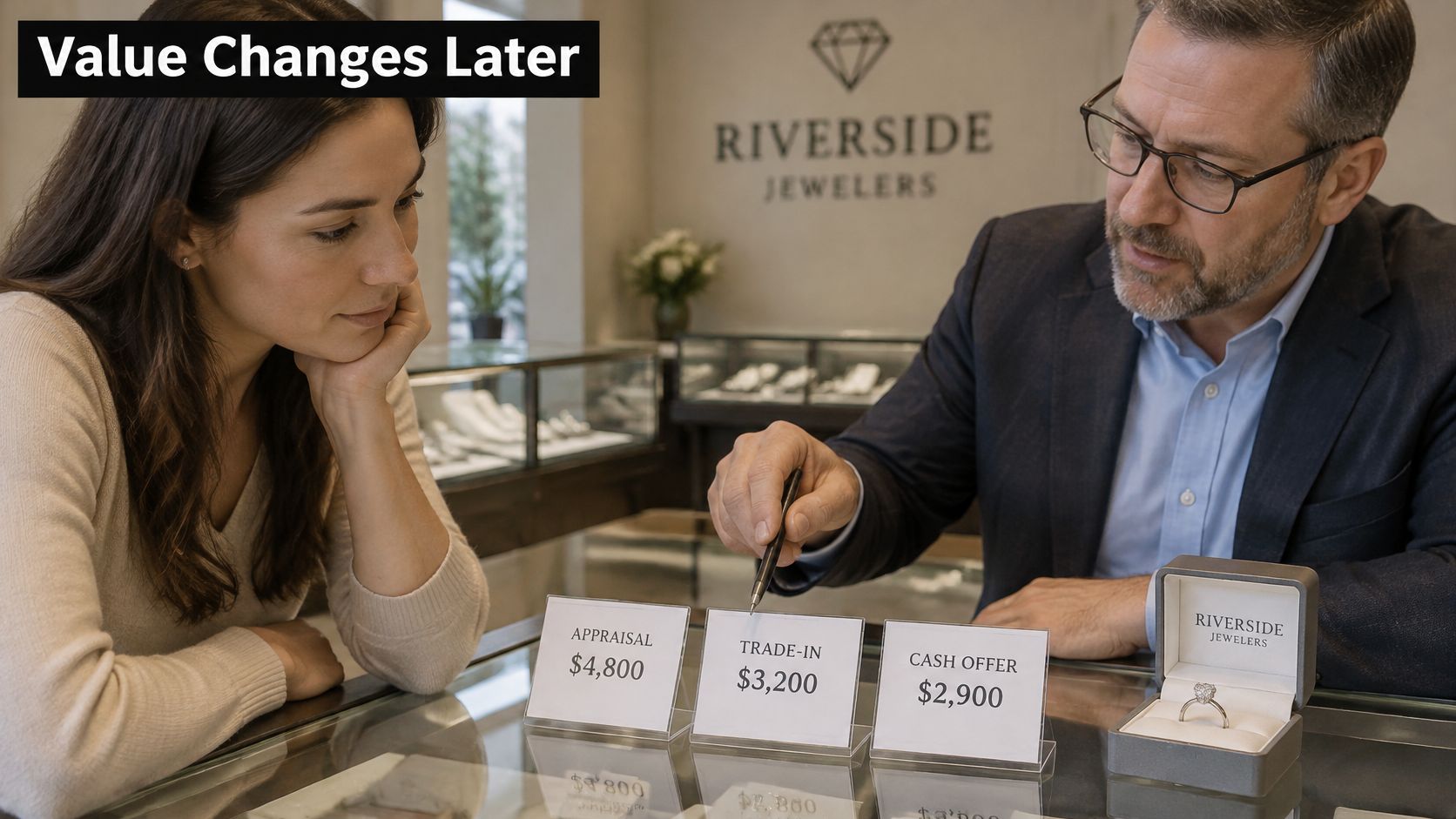
Test each kind of value
| Figure | A concrete question to ask |
|---|---|
| Insurance replacement value | What comparable replacement and assumptions support this amount? |
| Cash purchase offer | What will you actually pay me today, after any deductions? |
| Trade-in allowance | Does accepting this allowance change the price of the replacement ring? |
| Private resale estimate | What evidence supports the likely selling price, and what selling costs remain? |
Request separate assessments for the center stone, accent stones, and mounting. A buyer may value the diamond as a resalable gemstone while assessing the mounting primarily for its metal content.
We determine precious-metal and diamond values using current market dealer prices. Ask for a dated offer, because a previous valuation isn't a promise that today's offer will match it.
Jewelry is usually weighed in grams and is usually an alloy. You can't apply a quoted price per pure troy ounce to the entire weight of a ring, especially when that weight includes stones and non-gold alloy metals.
Understand the resale gap
CNBC's March 2025 coverage placed a one-carat lab-grown diamond at about $845 in the first quarter of 2025, compared with approximately $3,895 for a comparable natural diamond. Those purchase-market figures aren't resale guarantees, but they show why material identity belongs in any price comparison.
Falling lab-grown prices can make an earlier purchase price a poor benchmark for a current offer. Natural diamonds aren't automatically investments either: documentation, proportions, condition, brand, demand, and selling channel all affect what a buyer will offer.
For another perspective on the transaction, consider the valuation discussion in this video.
Estate jewelry deserves the same scrutiny as newly stocked jewelry. Our estate jewelry buying service includes expertise in diamonds, engagement rings, fine jewelry, watches, and broader estate collections.
For an estate or pawn-counter purchase, get the metal purity, weight, condition, and documentation status in writing. Compare the proposed valuation with an independent appraisal, and ask whether missing documents or necessary repairs account for part of the price difference.
A lower upfront price isn't automatically better financial value. It must be weighed against the ring's condition, identification confidence, and realistic future demand.
Pawn Loans and Financing Options Compared
Paying cash buys the ring outright. Financing spreads purchase payments over time, while a pawn loan is a short-term cash loan secured by an item you provide as collateral.
| Option | Cost | Risk to the ring | Best fit |
|---|---|---|---|
| Pay in cash | No borrowing interest | No lender claim arising from the purchase | Buyers with savings available |
| Pawn loan | Our homepage lists APR as low as 35%; confirm current terms | Pledged item is held as collateral | A short cash gap with a reliable repayment plan |
| Retailer financing | Contract interest and fees; check deferred-interest provisions | Read security and default terms | Buyers who can meet the repayment schedule |
| Layaway | Check service, cancellation, and storage fees | Seller holds the purchase until completion | Buyers willing to wait |
| Credit card | Issuer's interest and fees unless avoided under account terms | Usually no pledged ring, but debt remains | Buyers able to repay promptly |
Don't compare an advertised payment with another seller's cash price. Compare the complete amount you'll pay, including required fees, and identify what happens if you miss the due date.
Work out the total before signing
The following examples are hypothetical calculations, not quotes or promises about available terms. Use the actual written agreement to replace every assumption.
- Cash: Suppose the agreed ring price is $3,000 and documented sizing costs $100. Your acquisition cost is $3,100, before any applicable tax or other agreed charges.
- Pawn loan: Suppose you borrow $3,000 for 30 days at 35% APR. Using simple daily interest, the calculation is $3,000 × 0.35 × 30 ÷ 365, or about $86; repayment would be approximately $3,086 plus fees. If that borrowing funds the hypothetical ring and sizing above, acquisition and borrowing costs total approximately $3,186 plus fees, without counting principal twice.
- Retailer financing: Suppose a $3,000 purchase carries $200 in total scheduled interest and fees. The purchase costs $3,200, before extras; recalculate if missing a promotional deadline changes the charges.
- Layaway: Suppose the ring costs $3,000, with a $50 service fee and no interest. Total payments are $3,050, provided you complete the agreement without additional charges.
- Credit card: Suppose you charge $3,000 and repay under terms that produce no interest or fees. Total purchase payments remain $3,000; if the issuer charges $150, they become $3,150.
> Budget check: Loan principal is money you must repay, but it isn't an additional purchase cost when you've already counted the purchase it funded.
Match repayment to a dependable source
Our explanation of how pawn shop loans work helps distinguish borrowing from selling. Read the redemption deadline, extension conditions, charges, and consequences of nonpayment before pledging anything.
If you don't redeem the collateral under the agreement, you risk losing it; unclaimed items may become available for sale subject to applicable terms and law. Don't pledge a sentimental ring for a purchase unless you can meet the repayment date.
For a broader comparison, BadCreditMD's borrowing guidance for thin credit histories can help you identify questions to ask about competing loan types. Choose the route whose total payment, due date, and loss risk you can explain plainly.
Confirm the Report Matches Before You Sign
Proceed only when the stone, report, and invoice agree. Treat completed verification as a purchase condition, not something to resolve after taking the ring home.
The remaining decisions concern the seller, the written protections, and the purpose of the valuation.
Finish the purchase deliberately
- Compare equivalent offers. Use your target characteristics and disclosure requirements to compare sellers. Favor a seller who welcomes independent testing and explains the basis of the price without substituting an appraisal figure for evidence.
- Document care and return terms. Get treatment-related care instructions, return deadlines, exclusions, and any sizing implications in writing. A verbal promise won't help you understand a disagreement later.
- Separate insurance documentation. Request an appropriate replacement-value assessment, with the stone and mounting identified separately. Confirm what documentation your insurer needs rather than assuming a sales receipt is sufficient.
- Arrange independent review. Have an independent appraiser examine the ring and documents before paying the balance, under a written arrangement that allows the examination.
Our team buys quality diamonds in Boise, Meridian, and Nampa, and provides jewelry services with our established jewelry partner. If you're trading an existing ring toward another purchase, keep the sale offer and purchase price separate so you can judge each transaction clearly.
A sound decision doesn't require perfect grades. It requires a ring whose identity, condition, price, and payment obligations you understand, with the important details preserved in writing.
---
At Idaho Pawn & Gold Exchange, we offer free diamond authentication testing, diamond evaluations, and help obtaining a certified diamond report. Bring your ring and any existing paperwork to discuss its characteristics, or visit us to compare diamond jewelry with a clear understanding of grading, valuation, and payment options.