
The popular advice to demand a percentage of your jewelry's insurance appraisal starts with the wrong number. A higher insurance appraisal doesn't make estate jewelry buyers write a larger check. A buyer pays for what they can verify and resell today, not what a retailer might charge to replace the piece.
That doesn't mean you should accept the first scrap quote. An inherited box can contain ordinary gold, a desirable old-cut diamond, and a signed bracelet that shouldn't go anywhere near a melting pot. The useful question is whether the buyer has identified those differences and shown you what each contributes to the offer.
Which Estate Jewelry Buyers Fit Your Piece
What each estate jewelry buyer typically returns
| Buyer type | Cash speed | Typical seller net | Best for | Main tradeoff |
|---|---|---|---|---|
| Pawn buyout | Potentially during the visit | Agreed purchase price after testing and weighing | Unbranded gold and mixed lots when cash is needed now | May underrecognize desirable design |
| Pawn loan | Potentially during the visit; ownership retained if redeemed | Loan proceeds, with interest and fees payable to redeem | Heirlooms you may want back | Forfeiture if the loan isn't redeemed |
| Estate buyer | After evaluation and any authentication | Dealer offer reflecting materials and resale potential | Diamonds, signed jewelry, collections, luxury watches | Smaller audience than a national auction |
| Auction house | After acceptance, auction, and settlement | Hammer price minus contracted seller charges | Rare, signed, or high-estimate pieces | Uncertain sale price, fees, and waiting |
| Consignment | After the shop sells and settles | Sale price minus commission and agreed expenses | Attractive vintage pieces you can wait on | Shop controls presentation and much of the timeline |
| Online resale | After a completed sale and payment processing | Collected payment minus platform, shipping, and other costs | Branded pieces you can authenticate and ship | Fraud, damage, returns, and unpaid listing time |
Match the route to the jewelry
Pawn buyout: Say you bring a plain yellow-gold chain into a Boise shop. With no important maker or standout stone, the discussion should center on tested purity, usable metal weight, and the buyer's purchase calculation. A broken clasp may matter little if the buyer intends to recover the metal.
Pawn loan: A Meridian seller needs money but wants a family wedding band back. A loan preserves that possibility only if the seller can meet the redemption terms. Don't choose it because handing over an heirloom feels less final.
Specialist estate buyer: A Nampa household estate contains tangled chains, loose stones, watches, and mismatched earrings. A buyer who can evaluate the collection together may save considerable listing work. Ask for the important pieces to be identified separately rather than buried in a box total.
Auction house: A signed ring from a Meridian estate deserves a specialist opinion before a metal-only sale. Request a realistic estimate and a written settlement calculation. An impressive hammer price isn't your take-home amount.
Store consignment: A Boise seller has an attractive vintage ring and no immediate cash deadline. A shop may be able to present it to someone who wants to wear it, but the agreement needs a price-reduction policy, commission schedule, payment terms, and an unsold-item exit.
Online resale: A Treasure Valley seller has a recognizable bracelet with matching paperwork. Direct resale may reach interested shoppers, but the seller takes responsibility for accurate descriptions, payment verification, packing, and disputes.
Don't confuse old with unsellable
There's an audience beyond scrap buyers. Rapaport's reporting on estate and antique jewelry describes younger buyers seeking old mine-cut and old European-cut engagement rings for their individuality, craftsmanship, and sustainability. That makes preserving original details worthwhile until someone qualified has evaluated them.
Family agreement comes before channel selection. If relatives haven't settled who keeps what, the Law Office of Bryan Fagan, PLLC resource on dividing heirloom jewelry among heirs offers useful context for that conversation, though an Idaho estate may require local legal advice.
Choose a primary selling channel and a backup before cleaning, repairing, or mailing anything.
How to Prepare Pieces Before the First Offer
Your kitchen-table job is documentation, not restoration. You're making it easier to identify the pieces and harder to overlook something valuable.
Use this preparation overview before handling the collection.
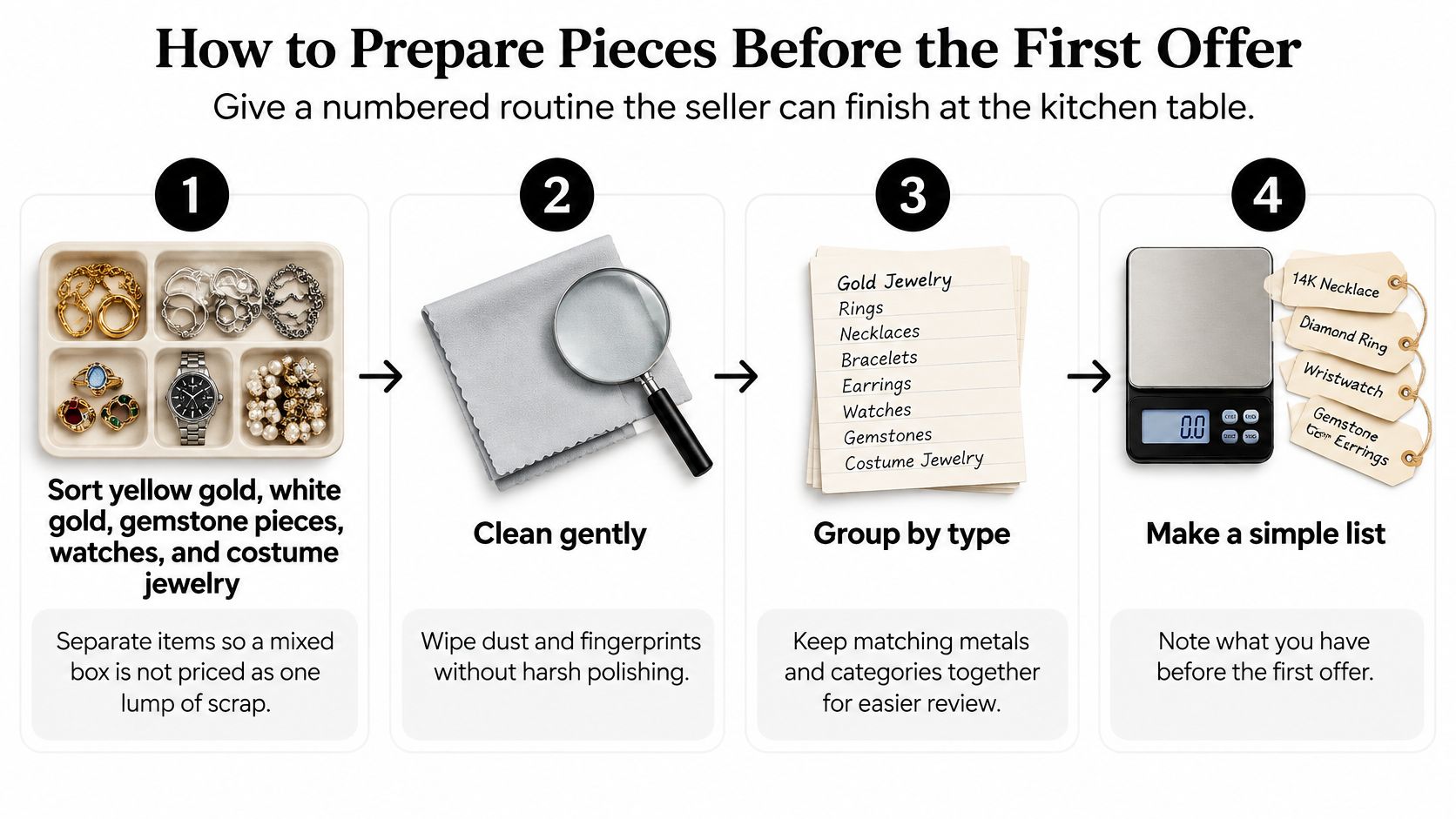
Build an inventory without changing the pieces
- Sort into separate groups. Put yellow gold, white gold, gemstone jewelry, watches, and costume jewelry in different trays or small bags. Keep uncertain items in an unknown group rather than guessing from color, and keep earrings and matching sets together.
- Look for karat stamps, maker's marks, serial numbers, and diamond report numbers with a loupe or your phone's close-focus camera. Photograph marks before the visit. Don't scrape a worn stamp to make it easier to read, and don't assume a mark proves the metal content.
- Record weight if you have a gram scale. Write the displayed grams beside the apparent karat mark, but label the measurement as gross weight if stones or other components are attached. Jewelry is usually weighed in grams and is usually an alloy, so the market price per pure troy ounce can't be applied directly to the full weight of a ring or chain.
- Clean only sturdy, uncomplicated gold you can confidently identify. Use lukewarm water, a drop of mild dish soap, and a soft brush, then rinse carefully and pat dry. Skip soaking and aggressive cleaning for pearls, opals, emeralds, turquoise, glued components, hollow pieces, and uncertain settings; avoid ultrasonic cleaners, boiling water, and chemical dips.
- Leave collectible details alone. Don't polish away patina, deepen an engraving, replace an old-cut diamond, or authorize a new shank merely to make the item look sale-ready. Ask whether the proposed work would improve the seller's net before paying for it.
- Attach receipts, old appraisals, grading reports, and family notes to the matching inventory entry. Label an old appraisal as historical documentation, not today's selling price. Our tips for selling a diamond can help you organize the diamond-specific information before a visit.
- Photograph condition clearly. Take a full-item photograph, a close-up of chips or broken prongs, and a clear hallmark image on a plain background. Give each file a name that matches the inventory so the paperwork and jewelry don't get separated.
Keep ownership records separate from pricing records
If jewelry is part of a divorce or another disputed asset division, establish authority to sell before seeking offers. The Law Office of Bryan Fagan's Kingwood resource on dividing flood buyout proceeds in divorce concerns a different asset, but provides context for why payment rights and decree language need attention before distributing proceeds.
For additional preparation context, use this video alongside your written inventory.
Finish with a single-page list showing item, metal, grams, stones, marks, and photo names. Leave room for the buyer's corrections and offer.
Why an Appraisal Is Not a Cash Offer
A bigger appraisal can accompany a smaller check. The appraisal and the offer may answer entirely different questions, and the item with the highest replacement cost may not be the easiest piece to resell.
Five values people confuse with a cash offer
| Value basis | What it answers | Relation to a cash offer |
|---|---|---|
| Replacement or insurance | Cost to replace a similar piece at retail | Often higher; cash buyers aren't funding retail replacement |
| Fair market | Price between a willing buyer and seller, neither forced | May inform an auction estimate, before seller fees |
| Wholesale or dealer | What a reseller can pay and still resell | Common estate-buyer and jeweler offer basis |
| Liquidation or immediate cash | What a prompt sale can produce | Closest to pawn buyouts and scrap quotes |
| Asking price | What a listing hopes to get | Not proceeds until a buyer pays |
Read the purpose before the amount
An insurance document may describe the cost of sourcing a comparable replacement through a retail jeweler. It doesn't promise that another jeweler will purchase your used piece for that amount.
Fair-market value assumes an appropriate selling setting and willing participants. Wholesale value leaves the dealer room for authentication, repair, inventory costs, and resale risk. Immediate-cash value reflects a seller choosing certainty and speed rather than waiting for a particular retail customer.
The distinction also matters when administering an estate or trust. Law Office of Bryan Fagan's trustee guidance provides context for documenting asset values after death, but a purchase quote shouldn't automatically substitute for a valuation prepared for a legal or tax purpose.
This diagram separates the appraisal question from the buyer's calculation.
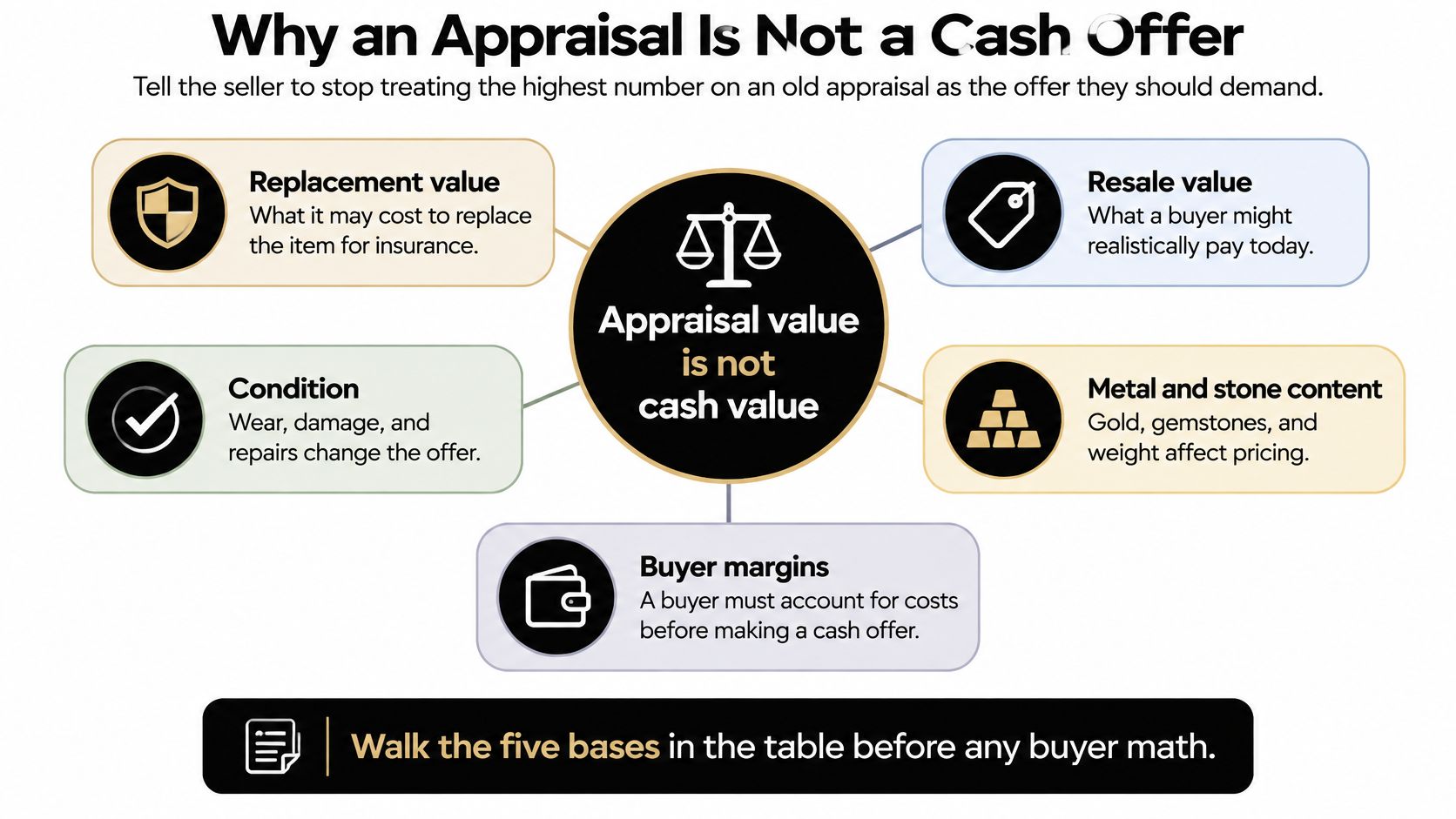
Similar materials don't guarantee similar proceeds
Say an inherited designer ring and an unsigned ring contain similar gold and diamonds. The authenticated designer piece may have an additional resale audience, while the unsigned ring may be priced mainly for its components. Rapaport's discussion of jewelry from the past highlights the importance of brand recognition and authentication in luxury resale.
For a diamond, color, cut, clarity, and carat weight affect the stone's evaluation. Natural, laboratory-created, and treated stones shouldn't be grouped under an unexplained diamond allowance. An attractive old cut may also deserve a different resale approach from a damaged stone intended for recutting.
Precious-metal and diamond values are determined by current market dealer prices, not the original purchase tag. Condition, missing documentation, and uncertain identity can change what a buyer is prepared to risk.
> Practical rule: Ask which value basis the quote uses before comparing it with another number.
An appraisal can still be useful for identification and description. Just don't negotiate a cash sale by insisting that a replacement document is a redeemable promise.
How to Negotiate an Itemized Offer
A lump-sum offer gives you little to negotiate except your reaction. An itemized offer lets you identify a missing stone allowance, an unexplained repair deduction, or a maker's mark the buyer hasn't considered.
Put the calculation on paper
- Request separate lines for metal, gemstones, brand or maker premium, and condition adjustments. A blank stone line needs an explanation. The buyer might assign no commercial value to small damaged stones, but that should be stated rather than hidden inside a total.
- Check the metal line against your inventory. Ask which weight the buyer used, what purity testing established, and whether the calculation excludes nonmetal components. Our explanation of how gold prices work gives useful context for discussing the difference between a market quotation and an offer on jewelry.
- Ask how the center stone was classified. Request the estimated color, clarity, carat weight, and cut assessment, along with whether testing indicates natural, laboratory-created, or treated material. If the stone remains mounted, ask which conclusions are estimates and what can't be established without further examination.
- For anything beyond a straightforward metal item, obtain another offer close enough in time to make the comparison meaningful. Bring the same documentation and offer the same group of items. A quote for the whole collection isn't directly comparable with a quote that excludes the best ring.
Negotiate the missing value, not your disappointment
- Separate a loan from a purchase. If you may redeem the jewelry, request the advance amount, interest, fees, term, total redemption obligation, and consequences of non-redemption. Put those terms beside the outright purchase offer so you're comparing different transactions deliberately.
- Counter with a specific unresolved point. You can say that the offer gives no credit for the maker's mark and leaves the stone line blank, then ask what the diamond adds at the buyer's current price. That invites a useful answer, unlike saying the total feels low.
- Leave when the buyer won't explain the metal and stone calculations. A buyer needn't disclose every operating expense, but you should understand what they're buying and what they're paying for. Don't trade away clarity just because the conversation feels awkward.
> Ask for an explanation of the missing line item, not a larger percentage of an old appraisal.
At Idaho Pawn & Gold Exchange, selling starts with an in-person evaluation at the store, and you decide whether to accept the offer. Treat that decision as yours to make after the questions are answered, not as an obligation created by the evaluation.
A useful counteroffer also has a stopping point. If the buyer recognizes the piece but can't pay enough for your needs, take the written quote and try your backup channel without authorizing repairs or alterations in the meantime.
Paperwork Taxes and Seller Red Flags
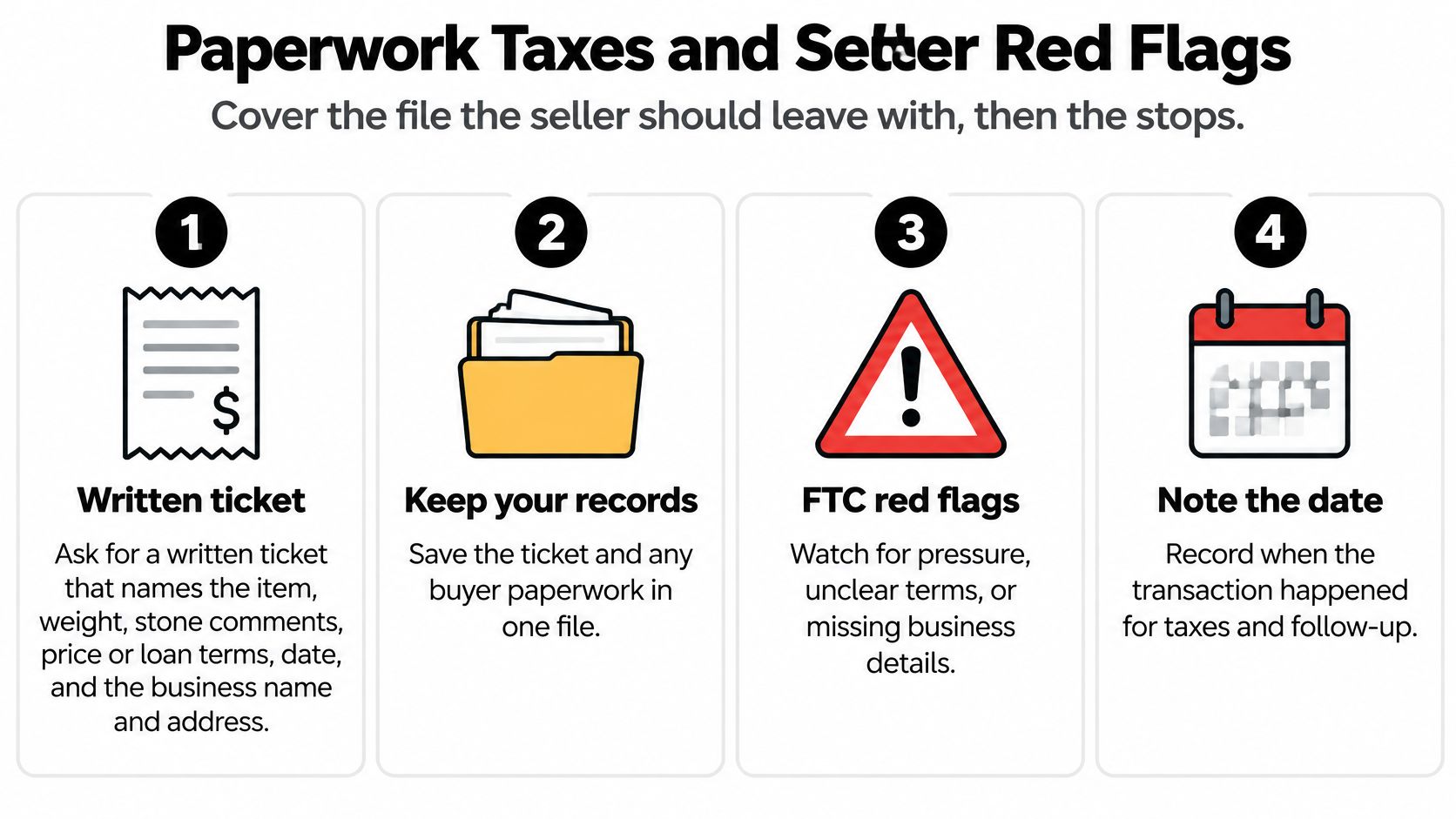
Leave with a transaction record, not just payment. Request a written ticket naming the item, weight, stone comments, purchase price or loan terms, date, and business name and address.
The FTC's gemstone, diamond, and pearl guidance recommends recording purchase representations about origin, weight or size, treatments, and care requirements. Although that guidance addresses consumers buying jewelry, a seller can reasonably request comparable clarity about the identification supporting an offer.
Photograph the ticket beside the piece before handover, when practical. Keep reports, correspondence, and payment confirmation together.
Keep the transaction file complete
Use this checklist to organize the documents and follow-up questions.
Don't accept a verbal promise that a stone is untreated as a substitute for documented identification. Where a grading report exists, check that its number and description match the actual stone rather than assuming that paperwork in the same box belongs to it.
Tax questions need their own review. Give a CPA the acquisition records, estate valuation documents, selling expenses, and final settlement. Ask the CPA to determine the applicable basis, whether the sale creates a reportable gain or loss, and how federal and Idaho rules apply.
Also ask the buyer whether any information-reporting form will be issued. Don't assume that an ordinary ring, a luxury watch, and a bullion transaction have identical reporting treatment, or that receiving no form settles your tax obligations.
Stop before a preventable loss
Red flags before you hand over estate jewelry
| Red flag | Why it matters | What to do |
|---|---|---|
| Pressure to accept before you read the ticket | Fees or an unexplained price may stay hidden | Request the itemized offer and leave if pressured |
| Offer well under melt with no explanation | Possible lowball offer, purity issue, or weighing error | Get another weight and offer promptly |
| Buyer takes the piece with no receipt | Creates loss or substitution risk | Keep custody until paid or given a proper intake or loan ticket |
| Plan to melt a signed or stone-set piece immediately | Design value could be destroyed before evaluation | Refuse destructive work before accepting written terms |
| Ship before payment clears | Creates nonpayment risk | Verify payment through the provider and use tracked, insured shipping |
| Certificate or serial doesn't match the stone or watch | Paperwork may be unrelated or false | Require independent verification before relying on it |
A payment screenshot isn't confirmation from your bank or payment provider. Even apparent clearance may not eliminate every reversal risk, so understand the platform's seller protection before sending valuables.
Before a visit, check recent reviews for payment delays, custody complaints, and pickup disputes. Ask the shop to identify the business, pawnbroker, or secondhand-dealer licenses applicable to its location and transaction type; don't assume identical requirements across Boise, Meridian, and Nampa.
Ask how diamond testing works and whether results and estimated weights will be recorded. A convincing stamp, serial number, or certificate is a starting point for verification, not proof by itself.
Choose a Treasure Valley Buyer and Book It
Choose your next action according to what you're selling and whether you need the item back. Don't spend weeks comparing channels that don't suit the collection.
Make a decision you can act on this week
- If the box is mostly unbranded gold or a mixed household collection, arrange a local evaluation. Get a written buyout offer before investing time in individual listings. Use the unaccepted quote as a comparison point, not a promise that every future buyer must match it.
- If you have a signed ring, a substantial diamond, or a recognized luxury watch, seek a specialist resale comparison. Request auction or consignment terms only when the piece appears suitable for that audience. Compare expected net proceeds after commission, authentication, shipping, insurance, repairs, and possible unsold-item charges, not the headline estimate.
- If a family member may want the piece back, evaluate redemption realistically. A pawn loan makes sense only when the repayment obligation fits a workable plan. If repayment is uncertain, postponing the transaction or choosing another source of funds may protect the heirloom better.
Set aside anything the family hasn't authorized for sale. Bring your inventory, hallmark photographs, reports, and historical paperwork, with the pieces packed separately so they don't scratch each other.
Arrange the evaluation before moving the collection
Our estate liquidation information explains the estate-buyout route. After discussing your estate-buying needs, we provide a free estate evaluation over the phone or at our Boise or Nampa location, with appointments arranged for the estate or collection.
Diamond authentication testing is free at Idaho Pawn & Gold. For stone-set pieces, discuss the evaluation process before considering shipment; arranging an in-person visit can avoid unnecessary mailing decisions.
Tell the evaluator which pieces must remain intact and which family members need to approve a sale. Leave enough time to ask questions, and don't schedule a transaction around pressure to empty the box that day.
---
Idaho Pawn & Gold Exchange offers estate buyouts and evaluations to help you understand the collection before deciding what to sell. Visit Idaho Pawn & Gold Exchange to arrange an estate evaluation in Boise or Nampa, and bring your inventory so you can discuss the pieces that deserve more than a scrap quote.