What makes a silver coin a good buy if the dealer who sells it to you won't pay anywhere near the same price to buy it back? That's the question most rankings of the best silver coins to buy leave unanswered.
My default recommendation is a common government bullion coin, not a commemorative release or an expensive presentation box. But the right choice comes down to all-in cost per ounce, verifiable silver content, and the price a real buyer will offer when you sell.
Quick Picks by Buyer Type
For most buyers seeking silver exposure, choose a standard, common-date American Silver Eagle or Canadian Silver Maple Leaf. Get purchase and buyback quotes for both, then choose the coin with the smaller transaction loss relative to its silver content.
The other choices make sense only when you have a different goal. Collecting, buying small amounts, and accumulating inexpensive circulated silver aren't the same task.
Silver coin picks by buyer goal
| Buyer type | Best pick | Why it fits | Main trade-off |
|---|---|---|---|
| Investor seeking metal exposure | Standard American Silver Eagle or Canadian Silver Maple Leaf | Recognizable bullion with standardized specifications | Dealer premium over spot |
| Budget buyer | Common circulated silver dimes, quarters, and half dollars with verified composition | Can be valued primarily for silver rather than collector appeal | More sorting and less convenient storage |
| Buyer wanting maximum purity | Canadian Silver Maple Leaf | Higher stated fineness | A small purity difference may come with a larger purchase premium |
| Collector | Proof or special-finish issues and documented key dates | Value can extend beyond silver content | Collector premium may not transfer to resale |
| Small-batch buyer wanting divisibility | Fractional bullion | Smaller cash outlay per piece | Higher cost per contained ounce; compare dealer quotes |
Choose the goal before the design
Metal investors should start with ordinary bullion. Don't pay for a date, finish, or package unless someone can demonstrate that buyers will pay extra for it later. An attractive design is a valid personal preference, but it isn't an investment calculation.
Budget buyers should investigate circulated silver rather than assume it's always cheapest. A bag of worn coins can cost more per contained ounce than a plain bullion coin when local demand pushes up the asking price. Compare metal content, not the number of pieces in the bag.
For purity-focused buyers, the Maple Leaf is the natural candidate. Still, higher fineness doesn't automatically mean a better deal. Your decision should reflect how much silver you're buying and what a local buyer will pay for that exact product.
Collectors should establish a separate spending limit. A proof coin can be enjoyable to own even when it's a poor substitute for inexpensive bullion. Treat the extra purchase price as a collecting expense until actual resale offers support another conclusion.
Fractional pieces solve a cash-budget or divisibility problem. They don't necessarily solve a value problem, because manufacturing and dealer costs are spread across less silver.
> Default choice: If you can't name your goal, buy a common bullion coin with a visible premium and a clear buyback quote.
Read every pick through the break-even calculation. A familiar name doesn't excuse an excessive spread.
How Silver Coin Categories Differ
Bullion coins are like buying silver by weight, with a government-issued identity attached. Their stated content and recognizable designs make them practical for buyers who want metal exposure rather than a collecting project. Judge them by acquisition cost, verification, and resale acceptance.
Numismatic coins are closer to art. Condition, scarcity, history, and collector demand can matter more than the metal. Buy them when you understand the specific issue, not because a seller describes an old coin as rare.
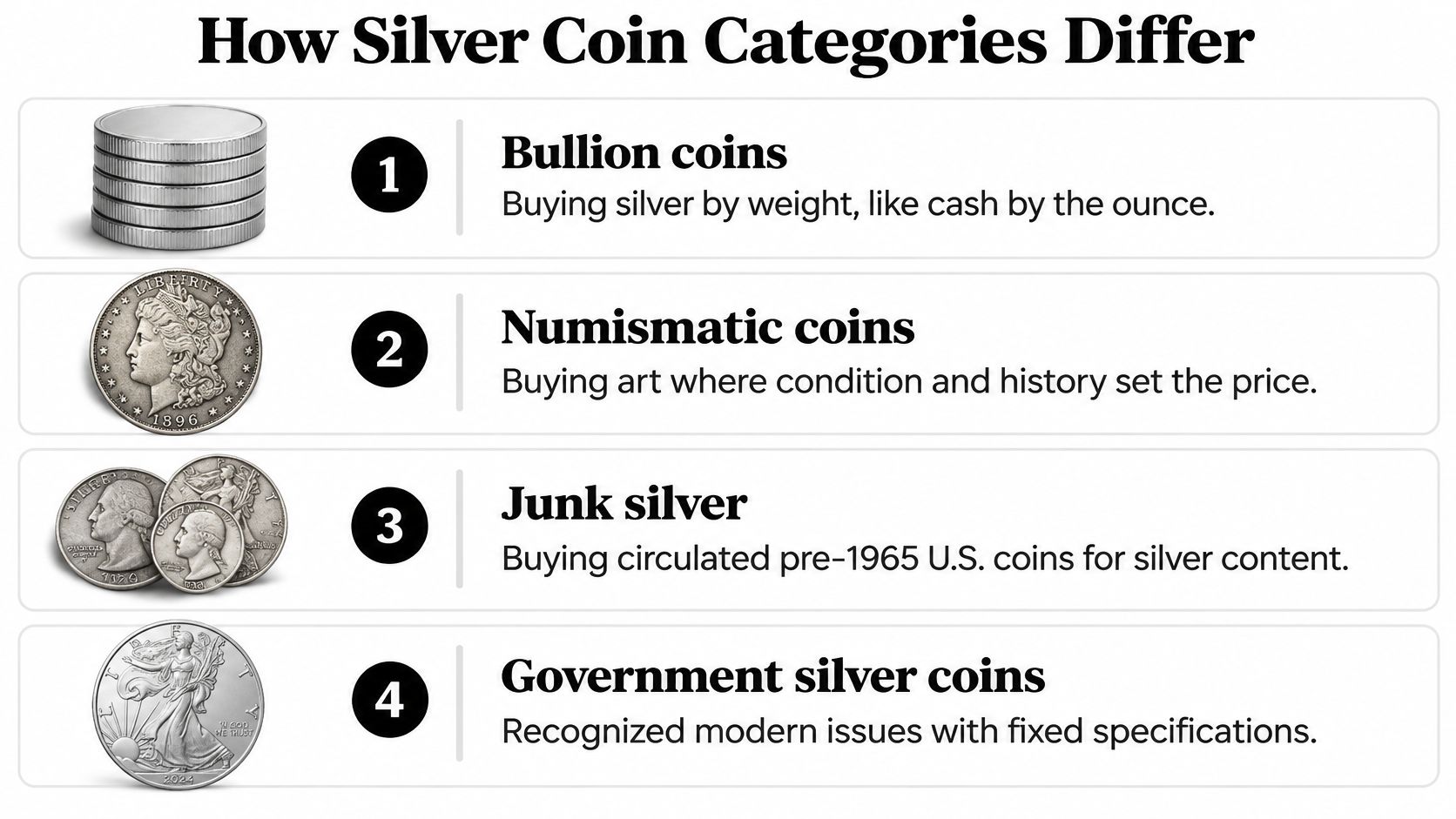
Junk silver means circulated coins bought primarily for their silver content. The name describes their role in the transaction, not their usefulness. Buyers must identify eligible issues, account for wear, and avoid accidentally paying a collector premium for a bulk-metal purchase.
Rounds are privately minted pieces shaped like coins. They can offer economical exposure, but they aren't government legal-tender coins. Ask whether your intended buyer recognizes the producer and whether that recognition changes the offer.
Coin demand isn't the whole silver market
Industrial demand accounted for roughly 59% of total silver demand in 2024, while global coin and net-bar demand fell 22% to 190.9 million ounces, according to the Silver Institute's silver-demand report.
That distinction matters. Electronics, solar technology, and manufacturing buyers use silver for different reasons than collectors and bullion investors. Strong industrial consumption doesn't guarantee that a dealer will recover your coin's retail premium.
Match the category to the job: bullion for recognizable metal exposure, numismatics for informed collecting, circulated silver for content-based buying, and rounds when their lower acquisition cost survives the resale comparison. None guarantees a short-term profit.
Premiums, Spot Price and Break-Even
Consider this hypothetical comparison, not a live price list. Assume silver spot is $30 per troy ounce and apply the illustrative premiums shown below.
Illustrative all-in cost per ounce by premium level
| Scenario | Premium over spot | Illustrative acquisition cost per ounce | Resale check |
|---|---|---|---|
| Low-premium bar | Hypothetical 3% | $30 × 1.03 = $30.90 | Local buyback quote needed |
| Common bullion coin | Hypothetical 10% | $30 × 1.10 = $33.00 | Local buyback quote needed |
| Special-issue coin | Hypothetical 35% | $30 × 1.35 = $40.50 | Collector demand must support the extra price |
These calculations exclude order-specific expenses. Shipping, insurance, payment charges, applicable tax, and storage can increase your actual cost.
Calculate the price you must recover
Spot price is the metal-market reference, not a promise that a dealer will buy your coin at that price. A buyer might offer below spot, at spot, or above it, depending on the product and local demand.
Your immediate transaction loss is:
All-in purchase cost − net buyback proceeds
Break-even occurs when future net sale proceeds equal everything you spent. If the future buyer pays below spot, silver must rise enough to cover both your purchase premium and that selling discount. If the buyer pays a premium, part of your original markup may be recoverable.
Use this method before paying:
- Normalize the purchase. Divide the complete order cost by contained troy ounces.
- Obtain an exit quote. Ask a local buyer what it would pay today for the exact product and condition.
- Measure the holding burden. Divide the purchase-to-buyback gap by your intended holding period to understand the annual dollar hurdle. This isn't a forecast or an investment return.
Premiums aren't fixed. The Silver Institute's market review reported that global coin-and-net-bar demand rose 14% in 2025, while recycling reached 197.6 million ounces, a twelve-year high. Physical buying pressure and regional shortages can change dealer pricing independently of spot.
Finzer's explanation of the financial effects of amortizing bond premiums offers a useful comparison for investors accustomed to bonds: paying above a reference value changes investment economics. Silver has no scheduled premium amortization or maturity payment, so don't apply bond accounting to coins.
If you might sell soon, favor the smaller verified transaction gap, not the more impressive product description.
American Silver Eagle and Other Government Coins
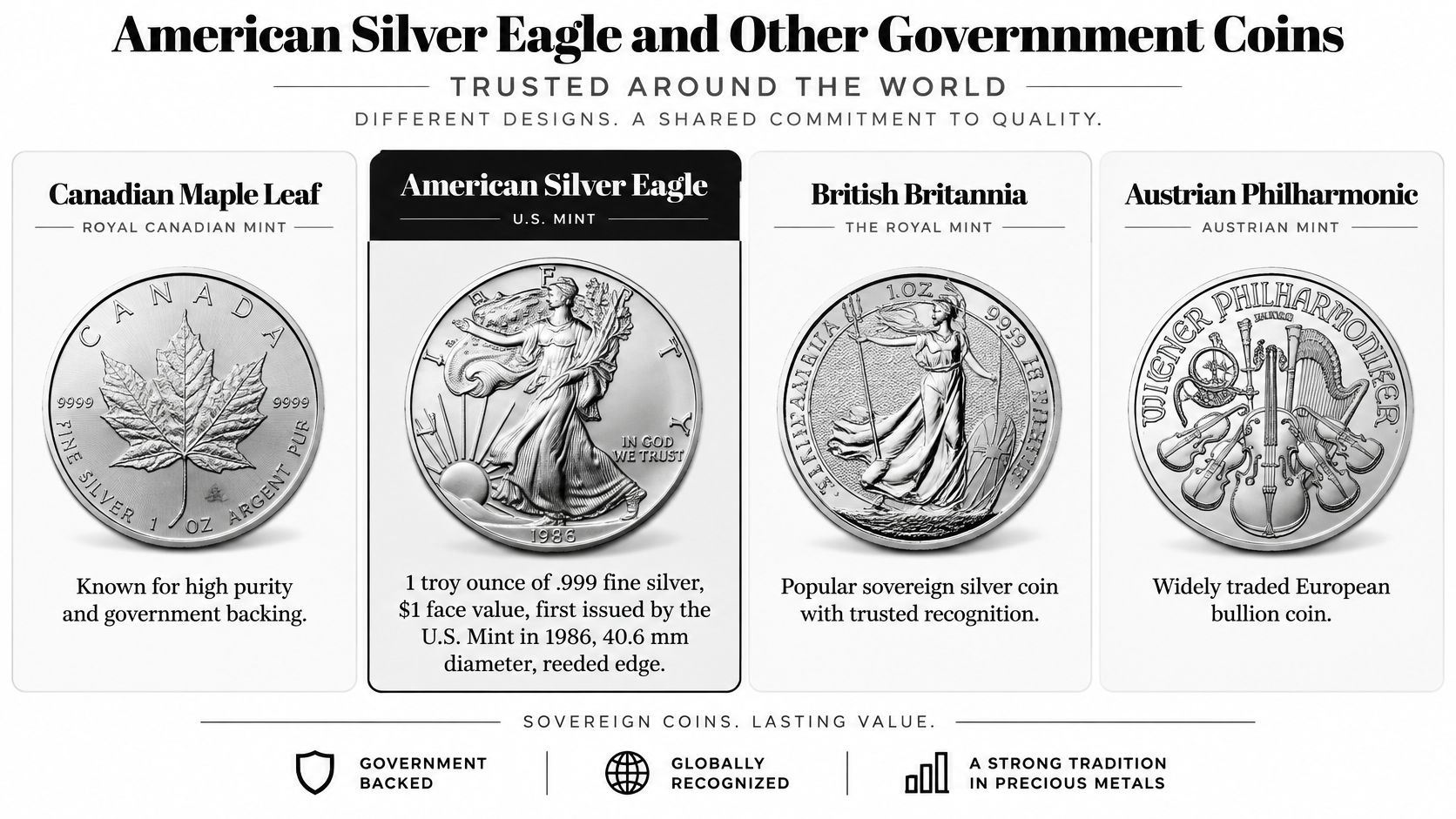
Which government-minted coin gives you the best exit value for its all-in cost? For U.S. buyers, the American Silver Eagle is a familiar benchmark. Its mintage history records its introduction in 1986. Each coin contains one troy ounce of .999 fine silver and carries a $1 face value.
That denomination is separate from the coin's metal value. Compare coins by their actual silver content and the full purchase price, not by the amount stamped on them.
The U.S. Mint's American Eagle specifications list a 40.60 mm diameter and a reeded edge. Check those details alongside weight and design when assessing an Eagle.
Specifications of major one-ounce sovereign silver coins
| Coin | Silver content | Fineness | Diameter | Edge |
|---|---|---|---|---|
| American Silver Eagle | One troy ounce | .999 | 40.60 mm | Reeded |
| Canadian Silver Maple Leaf | One troy ounce | .9999 | 38 mm | Milled |
| Vienna Philharmonic | One troy ounce | .999 | 37 mm | Smooth |
| Britannia | One troy ounce | .999 | 38.61 mm | Reeded |
Use the table as a checklist for these standard one-ounce bullion issues. Designs, sizes, and specifications can differ for other finishes or historical issues, so match the coin to the correct mint reference before buying.
Recognition has value, but don't overpay for it
The Eagle's long trading history makes it familiar to many U.S. buyers and sellers. That recognition may make a coin easier to transact, but it does not prove that a higher premium will be recovered at resale.
Get purchase and buyback quotes for the Eagle, Maple Leaf, Philharmonic, and Britannia from the same dealer. Compare the full cost per ounce with the offer for the exact coin and condition. A dealer might charge more for Eagles yet offer little extra on buyback. Another buyer may seek Eagles and quote a narrower spread. Only the paired prices show whether the recognition is worth paying for in your market.
For authentication, compare the coin with its mint reference and ask the seller to explain any discrepancy. A scale and calipers can flag obvious problems; professional testing can investigate concerns that appearance alone cannot resolve.
When verified coins contain the same silver quantity, choose the lower all-in cost unless the more expensive coin earns a demonstrably better exit price. Keep design preference separate from that calculation.
Special Issues and Premium Traps
A privy-marked Maple Leaf in an elaborate box can look like ordinary bullion with a small upgrade. The asking price may tell a different story.
Special finishes, relief, packaging, and claimed scarcity can move the purchase into collector territory. None obligates a future buyer to reimburse those extras.
The Royal Canadian Mint's Maple Leaf description specifies 99.99% pure silver; compared with .999 silver, the fineness difference is only 0.09 percentage points. At equal contained silver weight, that difference isn't a reason to accept a large additional markup.
Make the seller substantiate the premium
Before buying a special issue, ask:
- Published mintage: Is the production limit documented, and does it cover this exact version?
- Demonstrated demand: Are there completed sales for comparable condition, rather than ambitious asking prices?
- Local acceptance: Will a buyer offer more than ordinary bullion value?
- Packaging requirements: Would missing paperwork or a damaged capsule reduce the collector offer?
- Exit channel: Must you find a specialist collector to recover the premium?
A proof Eagle belongs in the same decision category: buy it for the collector finish and presentation, not as an automatic upgrade to metal exposure.
Bullion value comes from contained silver. Numismatic value comes from what collectors will pay for the particular coin, including its rarity, condition, and desirability. The distinction matters most when you need to sell without waiting for the ideal buyer.
> A limited issue isn't necessarily an easy issue to sell.
Keep collecting money separate from your silver-accumulation budget. If your goal is metal, skip the presentation upgrade and request a quote on the ordinary bullion version.
Junk Silver and Budget Buying
Are circulated silver coins a bargain at the quoted face value? Only if their verified silver content, all-in cost, and resale offer support the price. Pre-1965 dimes, quarters, and half dollars contain 90% silver, with 0.715 troy ounces of silver per dollar of face value.
Silver content in circulated U.S. silver coins
| Coin | Face value | Silver content | Silver per unit of face value |
|---|---:|---|---|
| Pre-1965 silver dime | 10¢ | 90% silver; 0.0715 troy ounces | 0.715 troy ounces per dollar |
| Pre-1965 silver quarter | 25¢ | 90% silver; 0.17875 troy ounces | 0.715 troy ounces per dollar |
| Pre-1965 silver half dollar | 50¢ | 90% silver; 0.3575 troy ounces | 0.715 troy ounces per dollar |
Don't buy a mixed bag from a face-value quote alone. Ask the seller to identify the coins and show how the stated face value converts to silver weight. Circulated silver may be economical, but the label “junk” does not guarantee a low premium. Demand for recognizable, small pieces can also affect the price. For more context, read about why junk silver isn't really junk.
Work from verified content to melt value
Use this sequence before buying a bag of circulated coins:
- Sort the contents. Separate denominations, dates, and issue types. Set questionable pieces aside until their eligibility is clear.
- Establish contained silver. Apply the specifications for each eligible issue and account for circulation wear.
- Calculate melt value. Multiply verified contained troy ounces by the current silver spot quote.
- Compare the all-in cost. Subtract melt value from the complete purchase cost. The difference is the amount paid above the metal value.
If the seller quotes by face value, have them convert the offer to cost per contained troy ounce. Then compare that figure with the seller's buyback offer for the same coins. The gap between your all-in cost and likely resale proceeds shows whether the deal works better than a modern bullion alternative.
Account for handling and condition
Mixed coins take more sorting than identical bullion pieces, and wear or damage can complicate content estimates. Check the issue rather than relying only on the portrait or an approximate age. A familiar denomination does not prove that a coin has the expected composition, and a ringing sound is not proof either.
Choose circulated silver when its verified content and actual resale spread beat your alternatives, and you are willing to handle the sorting and storage. Treat it as a budget option to evaluate by cost per ounce and exit value, not as an automatic bargain.
Where to Buy and Check the Price
A local dealer lets you inspect the product and request a selling offer during the same visit. That's useful when you're learning how a particular coin trades.
An online dealer may show a lower advertised price, but compare the delivered order cost. Payment method, shipping, insurance, and applicable taxes can change the result.
Mint-direct purchases serve a different purpose. They can suit buyers seeking a particular collector release, but don't assume buying from the issuer means paying the lowest bullion premium. Check whether the mint sells that product directly or through distributors.
Use a complete price check
- Record spot. Note the current silver reference price and quote time.
- Request the selling price. Specify the coin, condition, quantity, and payment method.
- Calculate the premium. Subtract contained metal value from the purchase price, then divide the difference by metal value.
- Add expenses. Include every charge necessary to receive the order.
- Request the buyback offer. Ask what the buyer would pay for the same product now, net of fees.
The practical guide to buying ounces of silver can help you organize a weight-based comparison.
> Price-check rule: A seller's retail price tells you what ownership costs. A buyer's offer tells you what your exit looks like.
Compare dealers using quotes taken close together. If a seller won't provide a buyback quote, obtain one independently before deciding. Refusing to explain fees or product specifications is a stronger reason to walk away than failing to publish a permanent price list.
Verify, Store and Sell Your Silver Coins
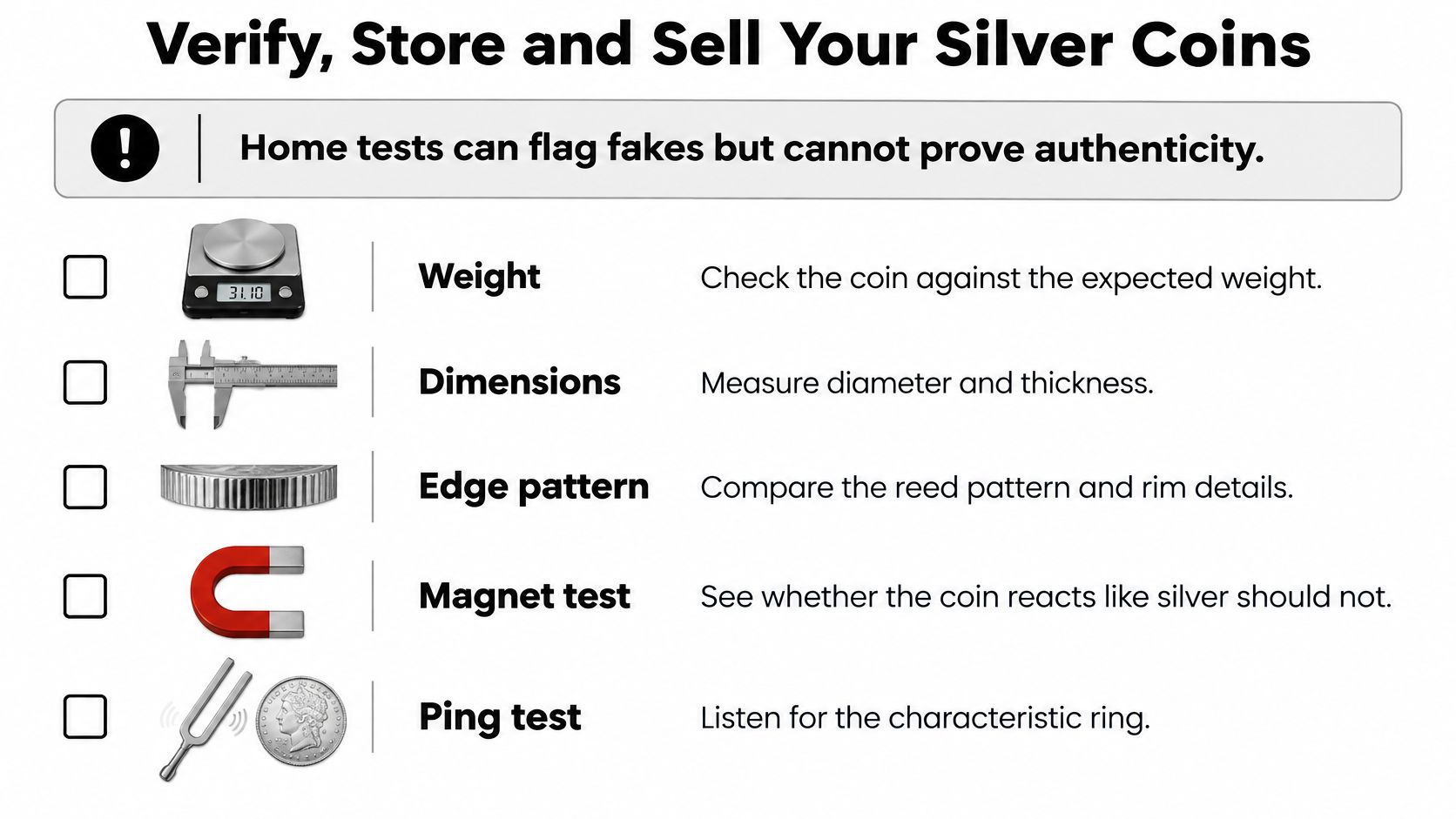
Home tests can flag problems, but they can't prove authenticity. A counterfeit can pass an isolated check, and genuine coins can produce confusing results when the wrong reference or technique is used.
The USA Today silver-coin buying guide discusses weight, dimensions, security features, magnet tests, and ping tests, while recommending professional authentication when uncertainty remains.
Check before money changes hands
- Weight: Use a calibrated scale suitable for coin measurements. Compare with the correct mint specification, not a similar-looking issue.
- Dimensions: Measure diameter and thickness with calipers. Protect the surface from hard contact.
- Design and edge: Examine lettering, relief, rim, edge pattern, and issue-specific security details.
- Magnetic response: Strong attraction is a warning. Lack of attraction isn't proof of silver.
- Sound: Treat a ping test as supporting evidence only. Don't strike valuable collector coins.
- Professional testing: Ask a qualified buyer to investigate uncertain results using appropriate equipment and reference information.
The guide to testing silver purity offers additional context for selecting checks. Avoid destructive testing on a potentially collectible piece unless you understand and accept the consequences.
Preserve the coin and its documentation
Don't polish a coin to make it look more saleable. Cleaning can damage surfaces and reduce collector value, even when it doesn't materially change the silver content.
Use properly fitted capsules or suitable sealed tubes, handle coins by their edges, and store them in a dry, secure location. Avoid soft plastic holders of uncertain composition.
Keep invoices, packaging, authentication records, and photographs together. Record the exact issue and purchase terms so a future sale doesn't begin with guesswork.
Choose the exit that fits your deadline
A local precious-metals buyer or pawn shop can inspect the coins and give an in-person offer without shipment. That makes local selling practical when speed matters, although payment timing and acceptance depend on the business and transaction.
A distant dealer or marketplace may reach a different buyer pool. Subtract shipping, insurance, platform charges, and any testing or return costs before comparing proceeds.
For collectible pieces, ask whether the buyer recognizes the numismatic premium. For ordinary bullion, focus on the net offer and payment terms. A higher headline price isn't better if fees and delays erase the difference.
Next Steps and a Local Quote
Buy deliberately, not because a countdown timer or rising-price headline makes you feel late. The best silver coins to buy are the ones that fit your purpose without creating an unnecessarily expensive exit.
Keep a written record as you build your holdings.
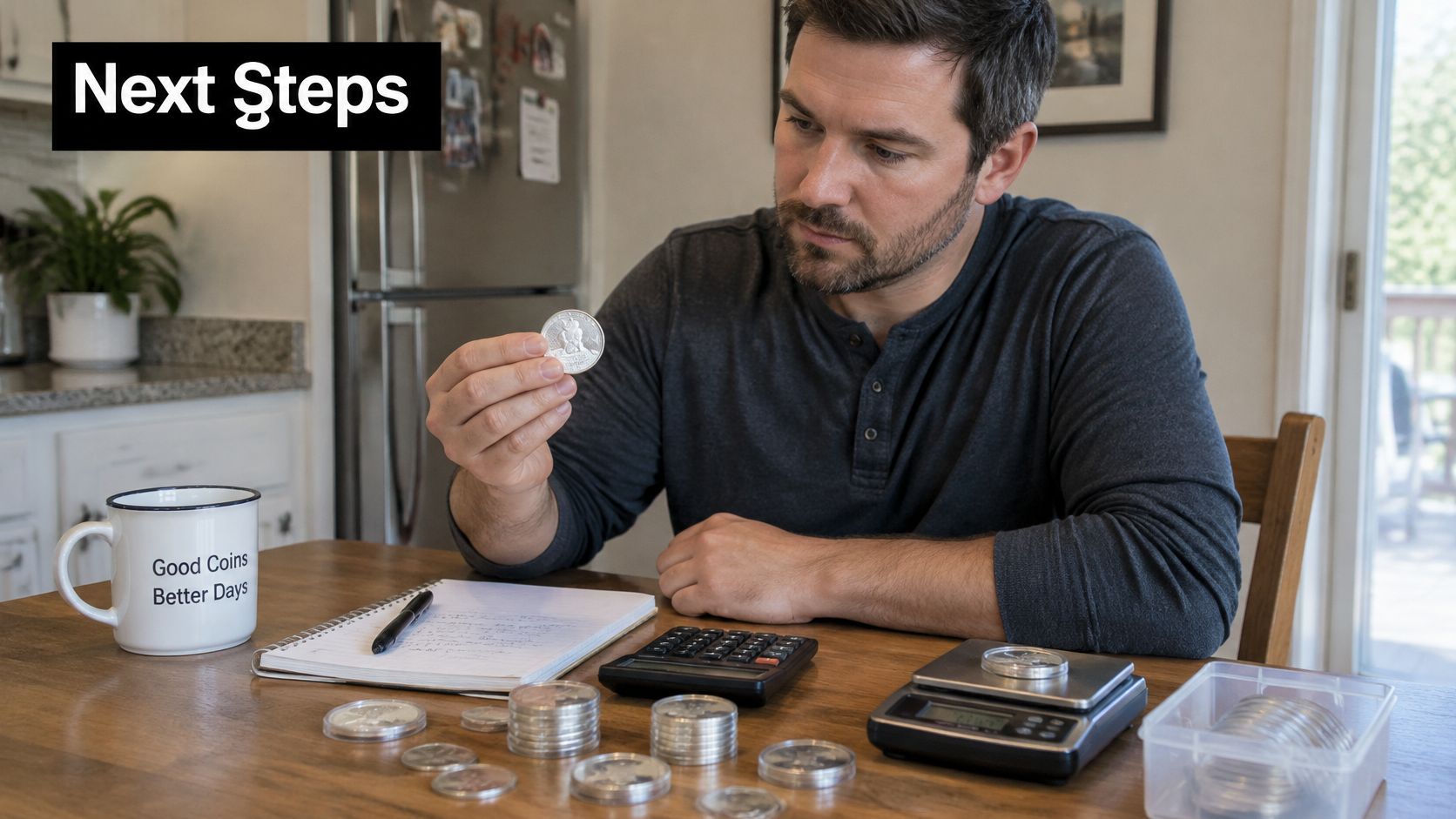
Make the next purchase measurable
- Choose the purpose. Decide whether you're accumulating metal, buying circulated silver, or collecting particular issues.
- Set the spending limit. Establish an acceptable all-in premium before contacting sellers.
- Select transparent terms. Get the product description, full purchase cost, and payment conditions in writing.
- Verify and document. Record the issue, weight, fineness, purchase premium, and available authentication results.
- Protect the holding. Use suitable storage and preserve receipts.
- Test the exit. Obtain a local offer before committing more money to the same product.
Bring the actual coins when requesting an actionable selling quote. Photographs can help identify an issue, but a buyer may need to examine condition and authenticity before making an offer.
Use the video as a companion to your own purchase checklist.
Your immediate next step is simple: check today's spot price, write down the coin's weight and purity, and get a local quote. Make the purchase only after you can explain the gap between what you'll pay and what you could receive.
---
Idaho Pawn & Gold Exchange buys and sells silver and can assess weight, purity, and authenticity when preparing an offer. Bring your coins and available documentation to a Boise, Meridian, or Nampa location, and visit Idaho Pawn & Gold Exchange to arrange a local price comparison before your next silver purchase.