
Age is the least reliable shortcut in a vintage watch price guide. A watch's value comes from the specific reference, its originality and condition, and the buyer or selling channel in front of you. A record auction result can be real and still tell you almost nothing about what an ordinary owner will receive.
Most owners need three figures, not one: an estimated dealer asking price, a probable private-sale price, and a lower fast-sale or pawn offer. Those figures answer different questions. A listing price is what a seller hopes to get, while a quick cash offer reflects what a buyer can pay after allowing for resale costs and risk.
What a Vintage Watch Is Really Worth
A vintage watch is worth what a specific buyer will pay for its exact reference in its current condition. Age alone doesn't set the price. A common watch from an earlier decade can bring less than a scarcer, better-documented model made later.
Record auction prices also distort expectations. Exceptional results usually involve rare watches with strong documentation, provenance, or historical importance. They aren't a dependable estimate for a watch that shares only the brand or decade.
Consider two watches from the same decade that look similar in online photos. One has its original dial, matching movement and papers; the other has a refinished dial and replacement hands. The differences can push their prices apart by thousands of dollars, even though both are old and both may look attractive at a glance.
The three values you'll encounter are:
- Dealer asking price: The advertised retail figure for an example a dealer is prepared to hold and market.
- Private-sale figure: A realistic estimate of what you might receive after finding a buyer.
- Fast-sale or pawn figure: A lower offer for immediate liquidity, with the buyer accounting for resale risk and costs.
A useful vintage watch price guide starts with broad market ranges, then narrows the estimate using the watch's brand, reference, condition, originality and paperwork. The practical next step is simple: write down the brand, model, reference number and serial number. Every meaningful comparison depends on identifying the watch correctly.
Typical Price Ranges by Brand, Type and Condition
Use the closest category and condition as a starting point. These are broad market estimates, not guaranteed offers or what a seller will take home.
| Watch category | Condition and originality | Typical price range | Basis |
|---|---|---:|---|
| Historically important 1960s Rolex sports model | Authenticated, original, documented | $45,000 to $180,000 | Market estimate for historically important sports watches |
| Authenticated watch from 1950 to 1970 production eras | Complete, original, documented | $8,000 to $65,000 | Market estimate varying by brand, rarity and papers |
| Vintage Omega Speedmaster, 1960s to 1970s | Original dial and movement, light wear | Compare completed sales for the exact reference | Reference and condition guide comparisons |
| Vintage Bulova Accutron, 1960s | Running, original tuning fork movement | Compare completed sales for the exact reference | Verify movement and condition |
| Vintage Seiko automatic, 1960s to 1970s | Running, original dial | Compare completed sales for the exact reference | Model and originality guide comparisons |
| Entry-level vintage from less prestigious makers | Running, standard wear | $2,000 to $5,000 | Market estimate |
| Non-running vintage watch, any brand | Cosmetically worn or incomplete | Price against parts value and repair cost | No general cash range supported |
| 1947 Patek Philippe reference 1518 with salmon dial | Exceptional, documented | $2.7 million (2024 sale) | Record-level outlier, not a typical benchmark |
A 2025 watch-auction market estimate puts authenticated watches from the 1950 to 1970 production eras in a broad $8,000 to $65,000 range. It estimates $45,000 to $180,000 for historically important 1960s Rolex sports models and $2,000 to $5,000 for entry-level vintage watches from less prestigious makers. These ranges describe categories, not every watch in them. Brand, condition, rarity, documentation, venue and buyer demand all affect the result.
Use those broad figures to set context, then compare the exact reference. Two Omega Speedmasters can differ substantially by reference and dial. A Bulova Accutron's tuning-fork movement needs to be checked, rather than assumed from the name on the dial. For Seiko automatics, the specific model and originality also matter. Look for completed sales of the exact reference; a brand-wide average can conceal important differences. For a non-running watch, weigh identifiable parts, originality and repair needs instead of valuing it like a working example.
Auction headlines are not the same as the three figures an owner may face. An asking price reflects what a seller lists a watch for, while a private-sale estimate concerns a likely transaction between buyer and seller. A fast-sale or pawn offer accounts for the need to resell and the costs and risks involved. In Boise, Meridian and Nampa, use the category ranges to frame a conversation, not as a promise of a local offer. Originality and paperwork can strengthen a comparison; missing documents or replacement parts may narrow the pool of interested buyers.
For an exceptional example, a 1947 Patek Philippe reference 1518 with a salmon dial sold for $2.7 million in 2024, according to the site hosting the spring 2024 watch-auction results. That record-level result is an outlier, not a useful benchmark for an ordinary vintage watch or a local seller's likely proceeds.
Dealer inventory is a separate comparison: a retailer's asking price is not the same as a wholesale cost or a private-sale figure. A guide to vetting wholesale timepiece suppliers can help clarify that distinction. For a model-specific example, this Breitling Navitimer guide can help frame reference-level research.
The Factors That Set a Vintage Watch's Price
Age alone does not set a watch's value. A scarce reference from a respected maker can command more than an older, common model, while an original example may be worth more than a cleaner-looking watch fitted with replacement parts. For sellers in Boise, Meridian and Nampa, the same details shape three different figures: a seller's asking price, a private-sale value, and the lower amount a fast sale or pawn may bring.
Start with brand reputation and original market position. Rolex, Patek Philippe and Omega generally attract a broader collector audience than lesser-known period makers. Switzerland's watchmaking industry reported exports valued at more than CHF 24 billion in 2022, according to the Swiss government's overview of the watchmaking industry. That figure describes the industry, not an individual watch. It gives context for the international recognition established Swiss brands can have, but the specific example still determines its price.
The reference number narrows the comparison. A single manufacturer can produce both common models and scarce variants, so a brand name alone is too broad to price a watch. Production era offers context, not a price tag. Collectibility may attach to a particular design, reference or period rather than every watch made in that decade.
Features and materials also affect demand. A chronograph adds a complication that appeals to buyers seeking that function. A perpetual calendar has a more complex mechanism and may interest a narrower group of collectors. Gold or platinum can support a material-value floor, but precious metal does not automatically make a watch more collectible than a steel reference.
Dial, documentation and provenance
A dial variant can matter more than a polished case. Distinctive color or period-specific printing may make one example more desirable than another in the same model line. Check an unusual dial carefully: refinishing can imitate a variant and reduce buyer confidence in its originality.
Box, papers and documented ownership help buyers judge completeness and provenance. Those records can support confidence that the specific watch matches its claimed history and configuration. A watch with strong documentation may attract more interest in a private sale, while a fast-sale or pawn offer still reflects the buyer's need to account for uncertainty and resale risk. The broader idea that an item's specific version and supporting history matter appears in what determines original poster prices, though watch buyers assess watch-specific details.
Rank your watch's two strongest price drivers before comparing offers. They might be its reference and original dial, or its precious-metal construction and verifiable provenance. These factors give buyers a clearer basis for an asking price or private-sale comparison. A fast-sale or pawn figure may be lower because the buyer must account for resale and uncertainty, even when the watch is collectible.
How to Estimate a Vintage Watch Value Step by Step
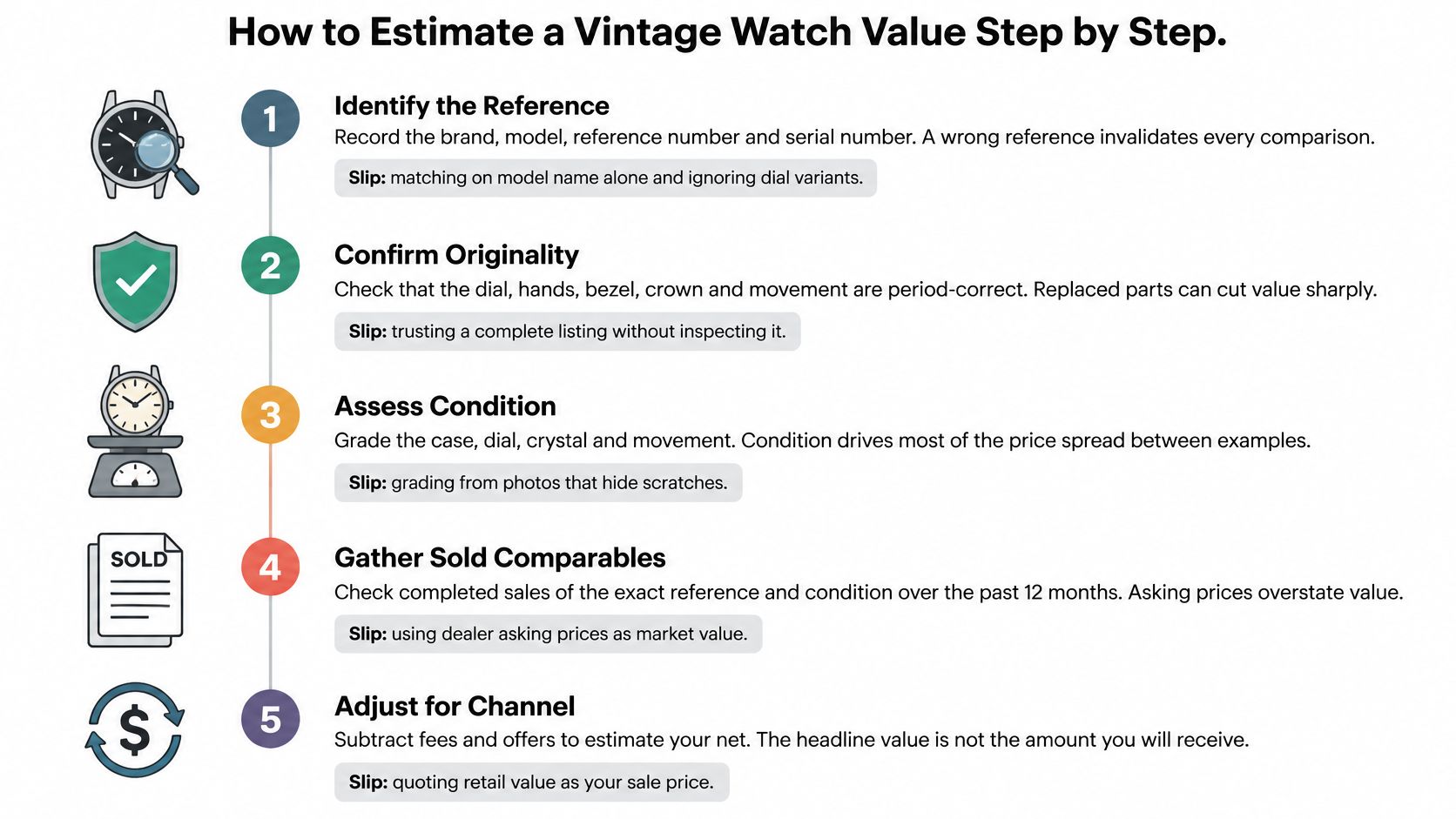
- Identify the watch precisely. Record the brand, model, reference number and serial number from the watch and its paperwork. A wrong reference makes every comparison unreliable; matching only the model name can lump together watches with different dials or specifications.
- Check whether the movement belongs. Note the movement caliber and any serial or signature, then compare them with reputable period references. A watch that runs may still contain a replacement movement, so don't treat ticking as proof of a correct match.
- Describe condition part by part. Record the case, dial, hands, crystal, crown and bracelet, along with visible engravings and case measurements. Don't call the watch “excellent” based on a quick glance; scratches, dial refinishing and case wear affect different buyers in different ways.
- List replacements, polishing and service history. Separate what you know from what you can see: an owner's account of a past service isn't the same as a receipt, and polished metal may show softened edges. Avoid assuming a fresh appearance means better originality.
- Find completed sales of matching watches. Search for sold listings of the same reference, with similar condition and completeness. Asking prices show what sellers hope to receive, not what buyers paid.
- Adjust the comparables, then write three values. Move your estimate up or down for originality, condition and documentation, then note a dealer-style asking estimate, a likely private-sale figure and a fast-sale floor. These figures separate a hoped-for listing price from a practical offer.
A useful comparison needs clear photos as well as notes. Photograph the dial straight on, the case sides, case back and bracelet, and keep any service receipt or warranty paperwork nearby. If a seller's listing shows only the face, don't assume that it proves the movement, case or originality.
Worked example: Suppose sold listings for original examples of a particular 1960s automatic chronograph cluster around $4,000. If inspection confirms that your watch has a refinished dial and you use an illustrative 15% adjustment, the private-sale estimate would be $4,000 minus $600, or about $3,400. That arithmetic is an example, not a universal discount; the size of the adjustment depends on the reference, the dial and the comparable sales. A fast-sale floor would sit below the private-sale estimate, because immediate buyers account for their own resale costs and risk.
Write down all three figures before accepting an offer. They give you a practical basis for comparing different sale routes rather than letting one headline number decide the outcome.
Originality, Authentication and Documentation
| Condition or originality state | What you see | Effect on value |
|---|---|---|
| Honest wear with original parts | Patina on lume, fine hairlines, original dial and hands | Strongest; often the reference collectors seek |
| Light service with period-correct parts | Recent service, matching parts from the era | Neutral to slightly positive with paperwork |
| Replaced hands or non-period crystal | Hands or acrylic crystal from another source | Small to moderate reduction |
| Over-polished case | Softened edges, lost chamfers, thinner lugs | Reduction; collector profile permanently altered |
| Refinished or replaced dial | Faded or incorrect printing, wrong dial variant | Large reduction; buyers discount heavily |
| Non-matching movement | Movement serial or caliber doesn't match the case | Major reduction; treated as a parts or assembled watch |
| Missing box and papers | Original box, warranty or papers absent | Moderate reduction; matters more on high-end pieces |
The strongest condition isn't always the one that looks newest. Collectors may accept patina on lume, fine hairlines and a softened crystal when the dial, hands and other key components are period-correct. By contrast, polishing can remove factory chamfers, soften the shape of the lugs and reduce case thickness, changes that can't be reversed. A professional originality assessment should examine the case, dial, hands, crown, bezel, bracelet, buckle, movement and any documented replacements, as explained in WorldTempus's discussion of vintage-watch value.
The dial and movement usually matter more than lower-cost accessories such as a strap or crystal. That's why a lightly worn watch with original parts can be worth more to a collector than a cosmetically restored watch with aftermarket components. If you're replacing a worn strap for everyday use, choose a suitable option from a supplier of watch straps, but keep the original strap or bracelet with the watch if you still have it.
Verify the movement and case match
Use a loupe and good light to check three things: whether the lug edges remain sharp, whether the case finish looks consistent on both sides, and whether the dial printing is crisp and correct for the reference. These checks won't authenticate a watch on their own, but they can flag details that deserve specialist attention.
The case reference and serial establish the model the watch claims to be and its production window. The movement caliber and serial then need to make sense for that case and period. A mismatch may reflect a documented service replacement, a watch assembled from parts or a so-called franken-watch. Those possibilities can look similar in a listing, but they don't carry the same collector confidence. A movement-authentication guide recommends photographing the movement, caliber engraving, serial, rotor or bridge signatures, case-back markings and reference number, and checking factory finishing such as perlage, Geneva stripes and anglage.
> Practical rule: A running movement is one part of the valuation, not proof of originality or a clean service history.
Build a useful appraisal file
Gather the original box, warranty card, service receipts, invoices and any letter or record that supports the watch's history. Document visible replacements and known repairs instead of leaving an appraiser to guess. This file helps prevent a high asking price for a complete, original example from being applied to a watch with a refinished dial or mismatched parts.
If you're unsure which movement or dial belongs with the reference, take the watch and your photographs to a specialist before using a high-end comparable. For a focused example of how small movement details can matter, see this history of Rolex Micro-Stella screws. An authenticated assessment can protect a strong estimate, while a mismatch found early can keep you from setting an unrealistic asking price.
Selling or Pawning and Why Your Net Differs From the Headline
| Value layer | Position versus headline | Main driver |
|---|---|---|
| Estimated retail asking price | 100% headline reference | Dealer listing, condition and completeness |
| Hammer price at auction | Below asking in many cases; venue-specific | Buyer demand, completeness and reach |
| Auction buyer's premium and fees | Adds roughly 25% to the hammer price for buyers | Venue fee schedule |
| Private-sale proceeds | Typically below asking; no fixed share | Time spent finding a buyer |
| Pawn loan or outright fast-sale offer | Usually the lowest; no fixed share | Immediate cash and the shop's resale risk |
An auction headline isn't the amount the owner takes home. The 2026 watch-investing analysis notes that auction fees can add roughly 25% to the hammer price for buyers. That premium affects the buyer's total cost; the seller's proceeds are shaped separately by the sale terms, including any commission.
The same analysis describes a selective market: in 2025, median selling prices reportedly rose about 2% despite a 36.4% increase in transaction volume, while unsold listings remained on the market for a median of 199 days. More transactions don't mean every watch sells quickly or at a higher net price. A private sale may bring a stronger price, but you need to find a buyer, prepare clear details and wait for the right offer.
A pawn loan or outright purchase gives you a faster route. The shop has to assess condition, originality and resale prospects, then allow for the possibility that the watch won't sell promptly. That's why its cash offer is generally below a private-sale estimate. A loan is borrowing, not a sale: the owner retains the right to reclaim the watch under the loan terms. An outright purchase transfers ownership.
Compare local offers against your own floor
For sellers in Boise, Meridian and Nampa, an in-person quote can help clarify how a buyer views the watch's condition and marketability. Idaho Pawn & Gold Exchange offers watch inspections and appraisals, with purchase and pawn-loan options. To compare the route with a private sale, start with information about selling luxury watches, then ask each shop how it reached its figure.
Get two or three offers if you can, and ask whether each is a loan or a purchase. Compare them with your private-sale estimate, not with a dealer's retail asking price. Different shops have different costs and appetites for resale risk, so an offer should be judged on its terms and how quickly you need the money.
Confirm Your Watch's Value Before You Sell or Pawn
Choose the route that fits both the watch and your timeline:
- Cash needed within a few days: If the watch is common and you've confirmed its identity, consider a pawn loan or outright sale. The speed comes at the cost of a lower fast-sale figure.
- Original, documented watch and time to wait: A private sale or specialist consignment may suit a recognized brand when you can answer buyer questions and provide clear documentation.
- Historically important reference: Consider a specialist auction if the watch's rarity, provenance and likely audience justify the fees. Compare expected proceeds, not just the hammer price.
- Uncertain category or authenticity: Get an appraisal before setting a price or accepting an offer. A reference or movement mismatch can change which comparables are relevant.
Set a personal floor price before asking for quotes. Then collect two or three in-person offers from shops in Boise, Meridian or Nampa and compare each with your private-sale estimate. Don't accept an offer below your floor unless the speed or certainty is worth that difference to you.
Before your first quote, choose the route you're willing to take and write your floor price down. That keeps the decision anchored to what you need, not just the highest number someone mentions.
---
For an in-person vintage-watch inspection, Idaho Pawn & Gold Exchange evaluates condition and value and can discuss either a purchase offer or a pawn loan. Visit Idaho Pawn & Gold Exchange in Boise, Meridian or Nampa to have your watch assessed and compare your options.