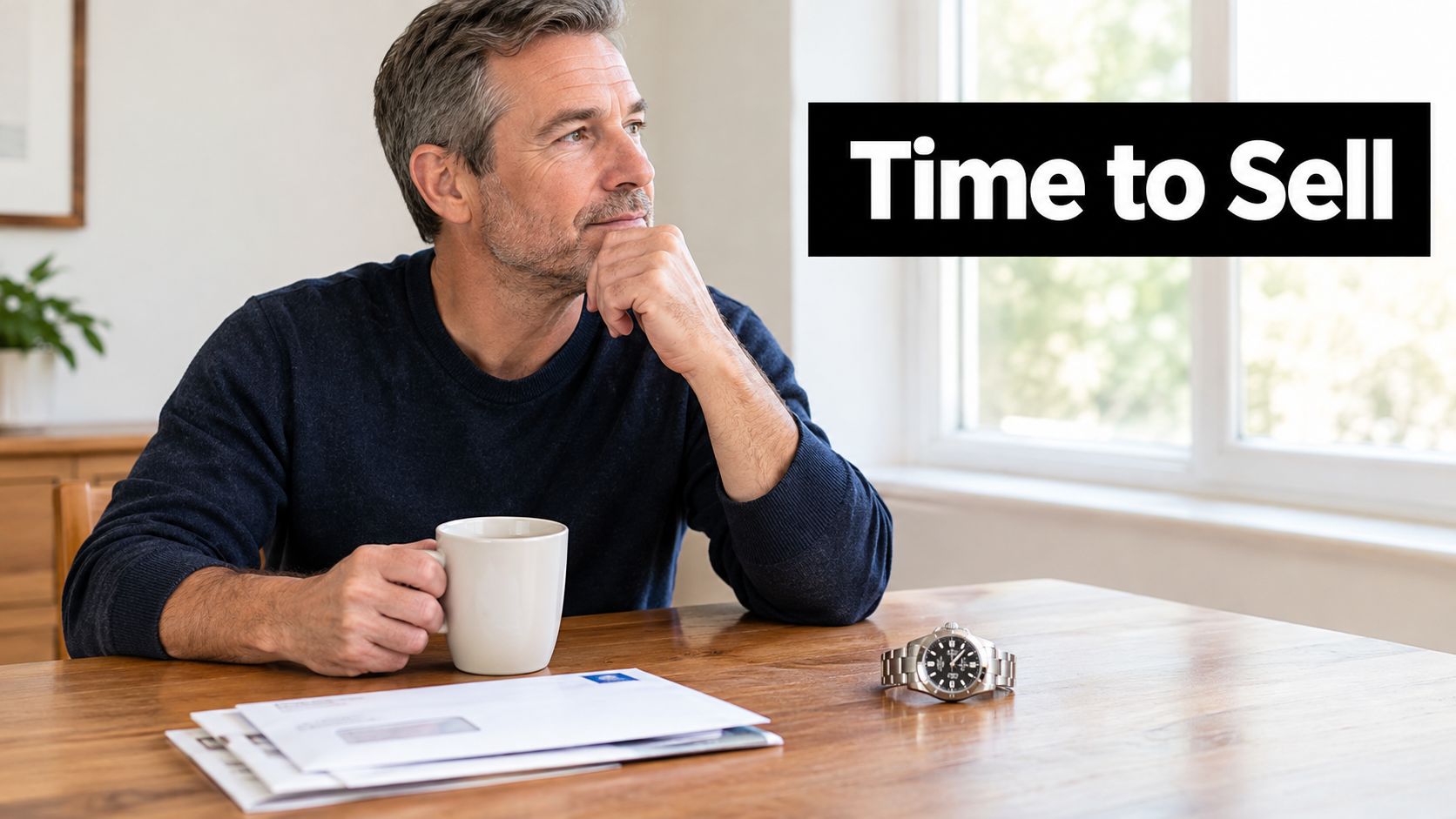
You're in a Meridian kitchen with a Rolex, Omega, or Patek Philippe in front of you, the box somewhere in a closet, and a decision to make before the next bill comes due. A Nampa business owner may need cash quickly, while a Boise collector may be tired of owning a watch that never leaves the safe. In both cases, the question isn't, “What's this watch worth online?” It's, “How much money will I receive, and when?”
Selling luxury watches is a net-proceeds decision. Authentication, condition, service history, missing links, selling fees, shipping risk, and waiting time can change the outcome more than a headline listing price. The right channel depends on whether you need speed, want to preserve ownership, or can tolerate delay in pursuit of a potentially higher return.
When a Luxury Watch Becomes a Financial Decision
A seller from Meridian once brings in a luxury watch expecting a simple answer. They know the brand, remember what it cost, and have seen similar pieces listed online for an impressive figure. The counter conversation becomes more practical almost immediately. Is the watch original? Has it been serviced? Are the bracelet links complete? What will the seller receive after someone accounts for risk and resale costs?
That distinction matters across Boise, Meridian, and Nampa. A local seller isn't operating like a collector in New York or Los Angeles with immediate access to dense specialist networks, auction houses, and private buyers. A local sale can reduce shipping exposure and shorten the time between evaluation and payment, but the buyer still needs enough margin to authenticate, service, insure, hold, and resell the piece.
The market itself rewards value more reliably than volume. Swiss watch exports totaled approximately CHF 26.0 billion in 2024, while shipment volume fell to 15.3 million watches, according to the Federation of the Swiss Watch Industry's 2024 export statistics. Watches priced above CHF 3,000 made up more than 80% of export value and still grew, while watches below CHF 3,000 declined. That doesn't mean every expensive watch sells quickly, but it does show why exact reference, condition, originality, and buyer confidence carry so much weight.
The number that matters
Your personal decision comes down to three variables:
- Net cash: What remains after authentication, service work, platform charges, shipping, insurance, and other deductions.
- Time to payment: Whether funds arrive during one local appointment or after a long consignment period.
- Risk transferred: Whether the buyer absorbs fraud, return, storage, and resale risk, or you keep carrying it.
A watch can have a high theoretical market value and still produce a disappointing outcome if the chosen channel is slow or expensive. Conversely, a direct local offer may look lower than an ambitious online listing but deliver a cleaner, faster, and more certain result.
> Practical rule: Decide whether you're optimizing for speed, ownership, or maximum possible proceeds before asking for a valuation.
The rest of the process should serve that decision. Prepare the evidence, let a qualified specialist inspect the watch, compare the three channels fairly, and demand an itemized explanation of the final offer. That approach is more useful than chasing the highest number attached to an unsold listing.
Preparing the Pieces Before the Sale
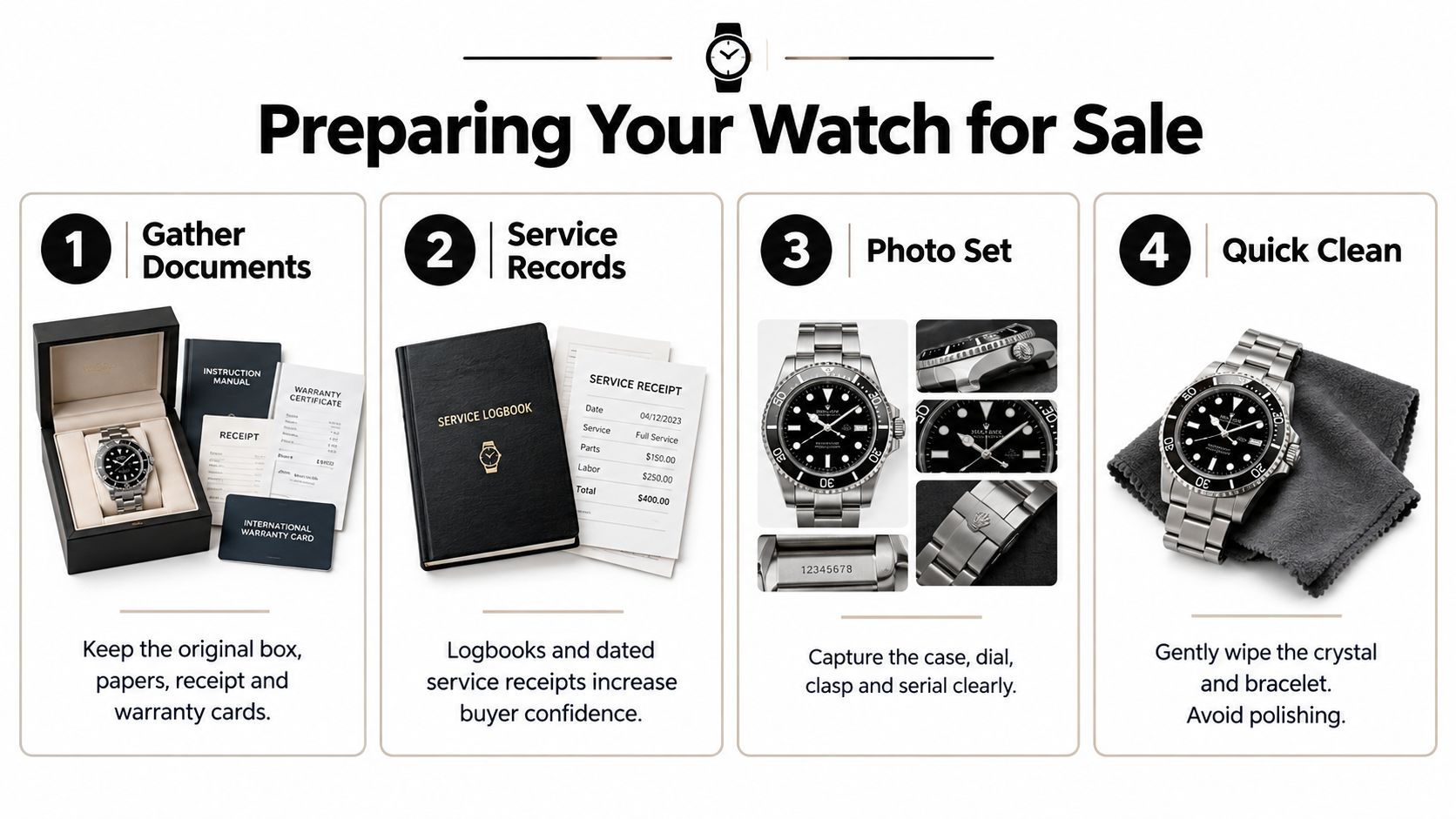
The night before your appointment, gather everything that came with the watch. Put the original box, warranty card, papers, receipt, manuals, extra bracelet links, and service invoices in one place. Documentation won't override a physical mismatch, but it can reduce uncertainty when the reference, serial, and ownership history line up.
Take a clean photo set before leaving home. Photograph the dial straight on, both sides of the case, the caseback, bracelet, clasp, crown, and any visible serial or reference markings. Record the numbers exactly as they appear, but don't post complete serial information publicly in an online listing.
A one-hour preparation routine
- Gather documents. Include the original box, papers, purchase receipt, warranty material, and service records.
- Locate accessories. Find removed bracelet links and the original clasp or strap components. Aftermarket parts should be identified rather than presented as factory equipment.
- Photograph the condition. Use indirect light and capture scratches, dents, stretched bracelet sections, crystal marks, and polishing.
- Clean gently. Wipe the crystal and bracelet with a soft cloth. Don't polish the case, refinish the bracelet, or use abrasive products.
- Write down the facts. Note the brand, model, reference, serial, approximate purchase history, known repairs, and last service.
- Leave the caseback closed. Don't open the watch yourself or take it to an unqualified person for a quick inspection.
Polishing is a common seller mistake. A fresh shine can hide the original case geometry that collectors and technicians want to evaluate, and an aggressive refinish can remove sharp lug lines or soften engraved details. A buyer may prefer to price an honest, worn case rather than guess what happened during an undocumented polish.
Bring this, skip that
Bring the watch, all related documentation, accessories, government identification, and any ownership or service history you can explain. Leave home-made authentication claims, loose cleaning chemicals, and unnecessary handling tools. Don't remove the bracelet, change the crown, replace a bezel, or install a new strap just to make the piece look more appealing.
A qualified buyer needs clear evidence, not cosmetic theater. Preparation improves speed because the technician can document the piece immediately instead of waiting for missing information or questioning whether a component was added later.
How Authentication Really Works
A serious luxury-watch evaluation isn't a glance at the dial followed by a price pulled from memory. The process should move from external evidence to internal evidence, then reconcile every finding with the reference and production era.
Five checks that should happen
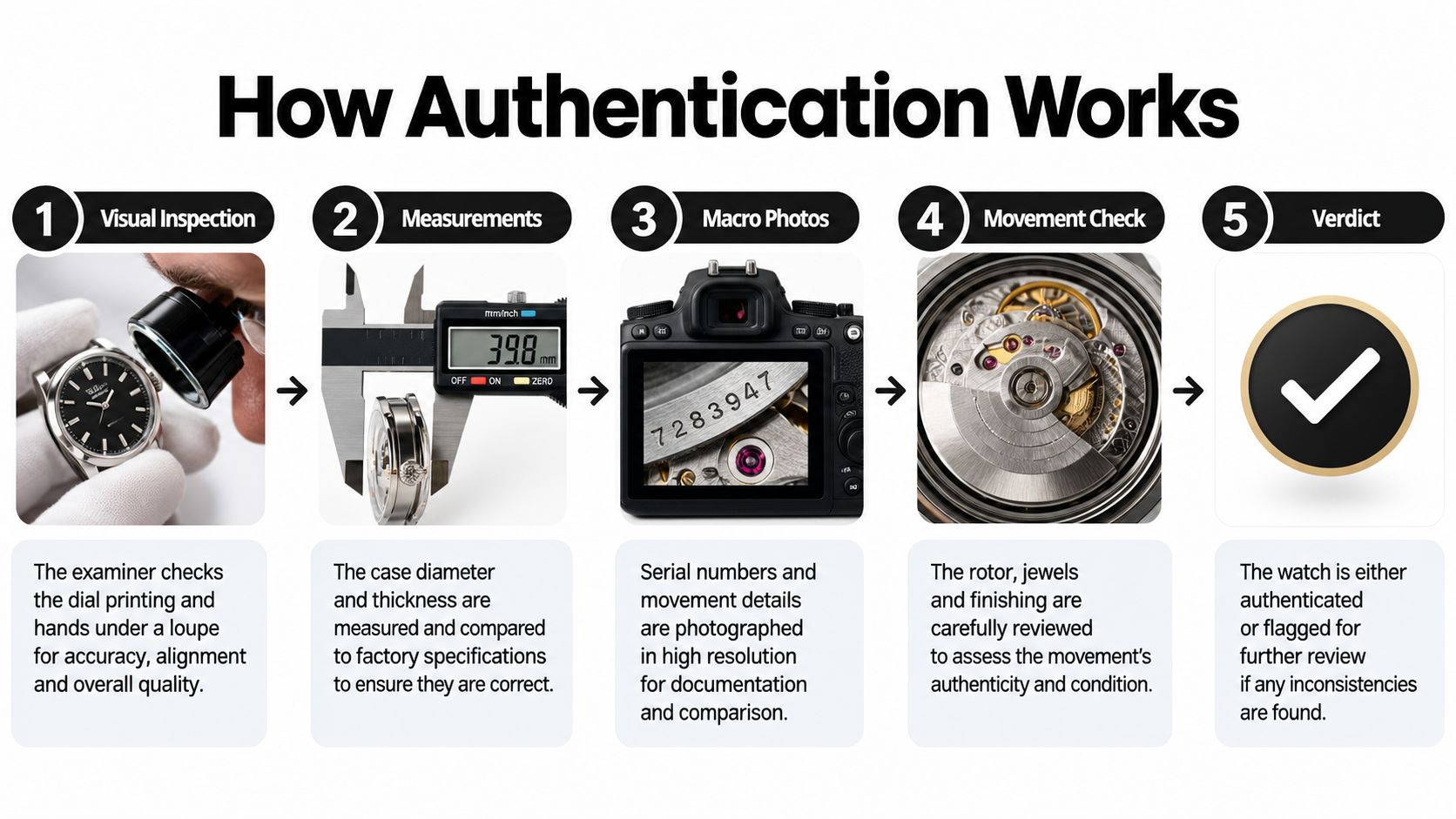
First, the technician documents the watch. They photograph the case, dial, caseback, bracelet, clasp, engravings, reference, serial, dimensions, weight, accessories, and visible condition. Those records create an audit trail and make it easier to explain why an offer changed.
Second, the external details are compared with manufacturer-specific references. The examiner checks case geometry, dial typography, handset shape, bezel construction, bracelet, clasp, and engraving style. A smooth seconds hand doesn't prove authenticity, and a convincing exterior doesn't prove that the movement belongs inside the case.
Third, the movement is inspected. The technician verifies the caliber, finishing, jewels, rotor, power-reserve behavior, and beat rate on a timegrapher. Independent watch-authentication guidance on movement inspection and X-ray fluorescence identifies in-person movement examination by a qualified watchmaker as a strong control, while XRF can assess precious-metal composition without damaging the case.
Fourth, XRF is used when metal composition affects the valuation. This is especially relevant when a seller represents a case or bracelet as precious metal. The test adds evidence without requiring destructive sampling.
Fifth, the findings are reconciled. The serial, reference, movement, components, production era, and paperwork must tell the same story. If they conflict, the transaction should pause rather than proceed on optimism.
Authentic, original, and sound are different answers
A watch can be genuine but modified. It may contain an authentic movement inside a case from another production period, an aftermarket bezel, replacement hands, or a refinished dial. Collectors often call a mismatched construction a Frankenwatch, and the label matters because originality affects buyer confidence and resale value.
Box and papers help, but they aren't conclusive. A warranty card can belong to a different watch, while a watch without papers may still be genuine after careful inspection. Ask the evaluator whether the result is genuine-original, genuine-modified, inconclusive, or counterfeit, and ask which physical findings support that conclusion.
If a buyer can't explain what was inspected, how the movement was checked, or why a deduction applies, the evaluation is incomplete. You should be able to understand the evidence without being a watchmaker.
Comparing the Three Real Channels for Boise Sellers
Boise-area sellers usually have three practical choices: borrow against the watch, sell it outright, or place it with a specialist on consignment. These routes solve different problems. Choosing among them based only on the advertised price is how sellers lose time or underestimate risk.
| Channel | Typical speed | Certainty of closing | Typical fees | Best fit |
|---|---|---|---|---|
| Pawn loan | Fast after approval and documentation | High if the watch qualifies | Interest and loan charges under the written agreement | You need cash but want to retain ownership |
| Outright local sale | Usually faster than a private listing | High once the offer is accepted | Generally reflected in the buyer's margin rather than a separate seller commission | You want a clean exit and predictable payment |
| Consignment | Slower and dependent on buyer demand | Lower until the watch sells | Commission, shipping, insurance, and possible service or authentication deductions | You can wait and accept selling responsibility |
A pawn loan preserves your ownership, but it isn't free money. Read the principal, interest, due date, renewal terms, fees, and default consequences before signing. A loan can make sense when the cash need is temporary and the watch matters to you, but a missed obligation can put the piece at risk.
An outright sale is the simplest route. A local buyer handles authentication, carrying costs, and resale exposure after the transaction. You may give up some theoretical upside in exchange for certainty, no months-long listing process, and less shipping exposure.
Consignment can reach specialist buyers who may pay more for a rare reference, but the watch remains tied up while the seller waits. Online selling also brings photography, buyer messages, insured shipping, returns, platform rules, and fraud concerns. A less liquid mid-luxury watch can sit far longer than its retail price suggests.
> The highest listing price isn't the highest financial outcome if you pay to ship, insure, authenticate, and wait.
A sought-after Rolex or Patek Philippe may attract immediate local attention because a specialist already understands the reference. An Omega, Breitling, or IWC can still be valuable, but its buyer pool and holding period may differ. Match the channel to your actual priority, not to an imaginary buyer who pays the best possible price instantly.
Pricing the Watch for Real-World Net Value
Start with completed sales, not active listings. An asking price shows what someone hopes to receive. It doesn't prove that a buyer accepted the number. Auction pricing guidance from Grailr warns that asking prices, hammer prices, and automated estimates don't establish completed-sale value or guaranteed returns.
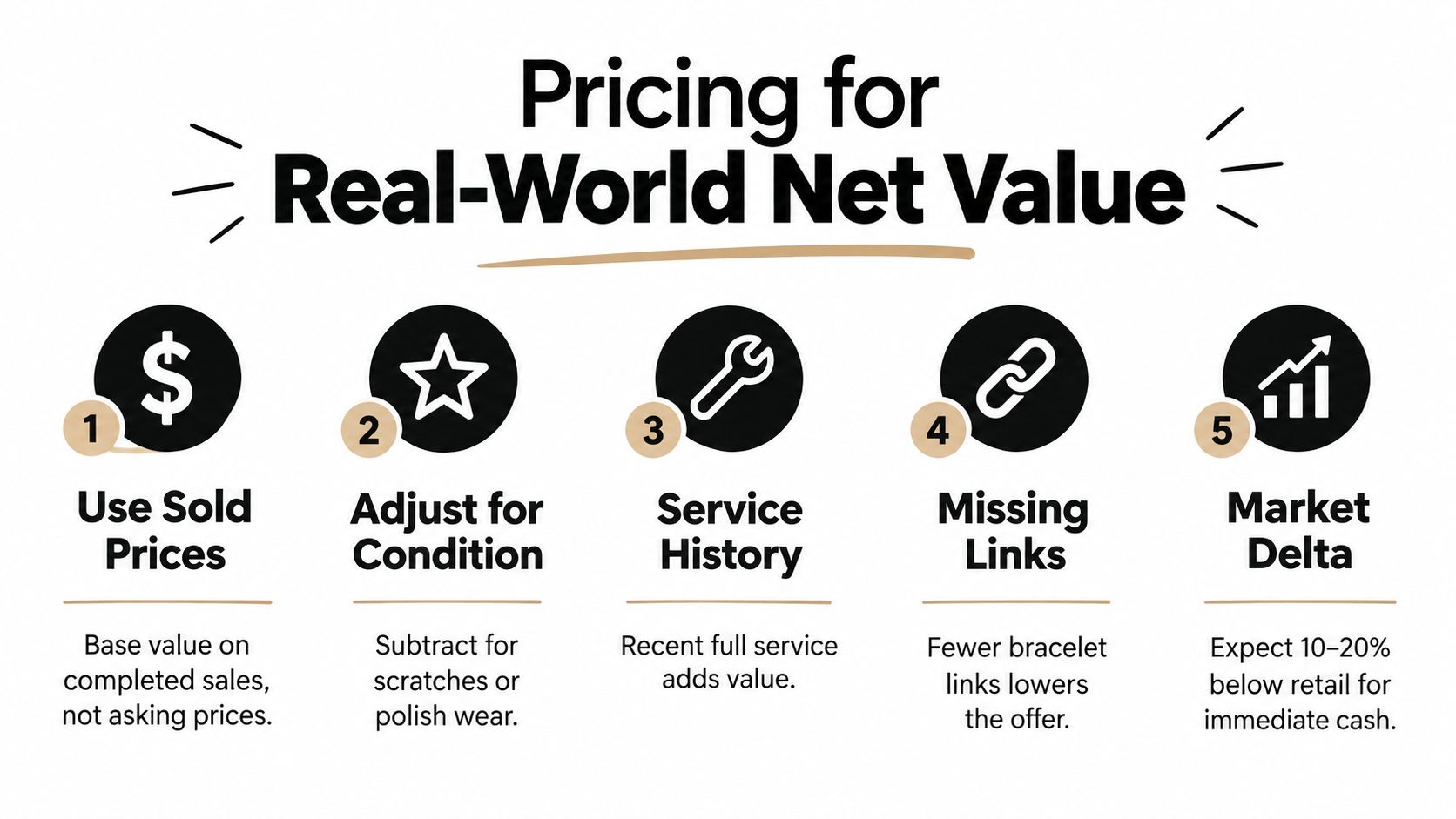
Build a comparable set using the exact reference and materially similar examples. Compare production year, dial, bezel, metal, bracelet, accessories, originality, and condition. A polished case, missing links, aftermarket parts, uncertain service history, or warranty exposure deserves an explicit deduction, not a vague feeling that the watch is “a little lower.”
A simple net-cash worksheet
Write down these lines:
- Conservative completed-sale value
- Less authentication or inspection cost
- Less expected service or repair work
- Less carrying and insurance cost during the sale period
- Less platform, auction, or consignment charges
- Less expected return, fraud, or shipping exposure
- Less your required margin or risk allowance
- Equals expected net proceeds
For an immediate local sale, the buyer is effectively performing this calculation before making an offer. If the movement needs attention, the bracelet is incomplete, or the watch has uncertain originality, those issues reduce the amount available today.
Scarce references require extra discipline. A small number of celebrity, special-dial, or unworn sales can distort the median, especially when the dataset is thin. Require several comparable completed transactions, discount stale or unverifiable records, and avoid using one spectacular result as your local price anchor.
Why the headline price shrinks
Suppose an online listing shows $12,000. That is not automatically your cash value. A conservative buyer may deduct for service, authentication, incomplete accessories, platform costs, carrying time, and the margin required to resell safely. Depending on the watch and channel, the actual net cash could land between $7,500 and $9,000, but that range is an example of the calculation, not a valuation of any particular model.
The point is simple. Don't compare a direct offer with an unsold listing. Compare the direct offer with the amount you would keep after every cost and delay in your chosen channel.
Walking Into Idaho Pawn and Gold for an Offer
A typical local visit starts with identification, the watch, and the documents you gathered at home. At a Boise, Meridian, or Nampa counter, the evaluator should first confirm what you brought, record the reference and serial, inspect the condition, and explain what additional examination is needed before a final number.
A transparent conversation doesn't require the seller to know every caliber or factory variation. It does require the evaluator to explain the deductions in plain English. Ask whether the movement will be inspected, whether measurements will be recorded, whether the offer assumes servicing, and whether the quoted figure is for an outright purchase or a loan.
Idaho Pawn & Gold Exchange buys and evaluates luxury watches, including brands such as Rolex, Patek Philippe, Audemars Piguet, Hublot, Vacheron Constantin, Richard Mille, Breitling, Omega, and IWC, using authentication and resale considerations as part of the offer process. That makes it one local option to compare with a specialist dealer or consignment route.
What good counter behavior looks like
A careful operator should be willing to:
- Record identifying details: Reference and serial information should appear on the intake record.
- Document physical condition: Measurements and macro photographs create a defensible evaluation.
- Inspect the movement appropriately: The evaluator should explain whether the movement was opened and what was observed.
- Separate value categories: Ask for conservative liquidation value, likely resale value, and maximum loan advance as distinct figures.
- Explain deductions: Service needs, aftermarket components, missing accessories, and originality concerns should be identified.
- Provide written terms: An offer expiration date and transaction terms prevent misunderstandings.
Don't leave a high-value watch without a written receipt that identifies the piece. Verify the business identity and licensing information at the counter, keep copies of the documents you sign, and ask when payment is made. A local transaction removes much of the risk associated with shipping a valuable watch to an unknown buyer, but it doesn't remove the need for basic documentation.
You can also ask what happens if a later inspection changes the assessment. A clear adjustment policy protects both sides. If the buyer won't explain how a conditional offer becomes final, treat that uncertainty as part of the cost.
Negotiating the Final Offer and Closing the Deal
The final thirty minutes are where sellers often focus on the biggest number and overlook the terms around it. Negotiate with evidence, not emotion. Point to complete links, documented service, original components, strong condition, and comparable completed sales. If the buyer hasn't inspected the movement or explained a deduction, ask whether a more thorough method would change the offer.
Request an itemized offer before agreeing. It should identify the watch, state the purchase or loan amount, list deductions or charges, and show when the offer expires. For a pawn loan, read the repayment amount, interest, due date, renewal rules, and default consequences in plain language.
Closing checklist
- Verify the buyer: Confirm business identity, licensing information, and the person handling the transaction.
- Review the itemized offer: Check the reference, serial, condition notes, deductions, and final amount.
- Get a written receipt: Make sure it identifies the watch and records the transaction date.
- Separate sale from loan terms: Don't treat a loan advance as the watch's sale value.
- Confirm payment timing: Ask exactly when and how funds are released.
- Record the offer expiration: A written date prevents later confusion about market adjustments.
- Retain copies: Keep the signed paperwork, photos, service records, and payment documentation.
The highest verbal offer may not be the best deal. A loan with expensive terms can cost more than the difference between two offers, while a consignment agreement can reduce the final payout through commissions and months of carrying risk. Compare the amount you keep, the time required, and the obligations you accept.
After the transaction, update your home insurance records, remove the watch from any scheduled personal-property policy, cancel linked storage or authentication accounts, and retain service and sales records for tax purposes. Then close the file. A completed sale is better than an attractive number that never reaches your bank account.
---
If you're ready to sell luxury watches in the Boise area, Idaho Pawn & Gold Exchange can evaluate your piece for an outright purchase or discuss a pawn-loan option while accounting for authentication, condition, and resale demand. Bring the watch, its documents, and your identification to Idaho Pawn & Gold Exchange for a direct, local conversation about what you can receive and when.