
You're standing in a parking lot, or scrolling a listing at the kitchen table, with a bag that looks right. The logo sits straight, the leather smells like leather, and the seller says it came from a boutique. The price is good enough that you don't want to walk away, and not so low that you can laugh it off. That is the moment luxury bag authentication starts. It isn't a yes from one stamp or one app. It is a layered risk decision: what you can prove, what you can't, and what that gap does to the price you'll pay, pawn, or ask.
I would treat the result as a file, not a sticker. Write down what matches, what doesn't, and what you never saw. A genuine bag with a replaced clasp is still genuine, and it can still be worth less than the listing implies.
How to Authenticate a Luxury Bag Step by Step
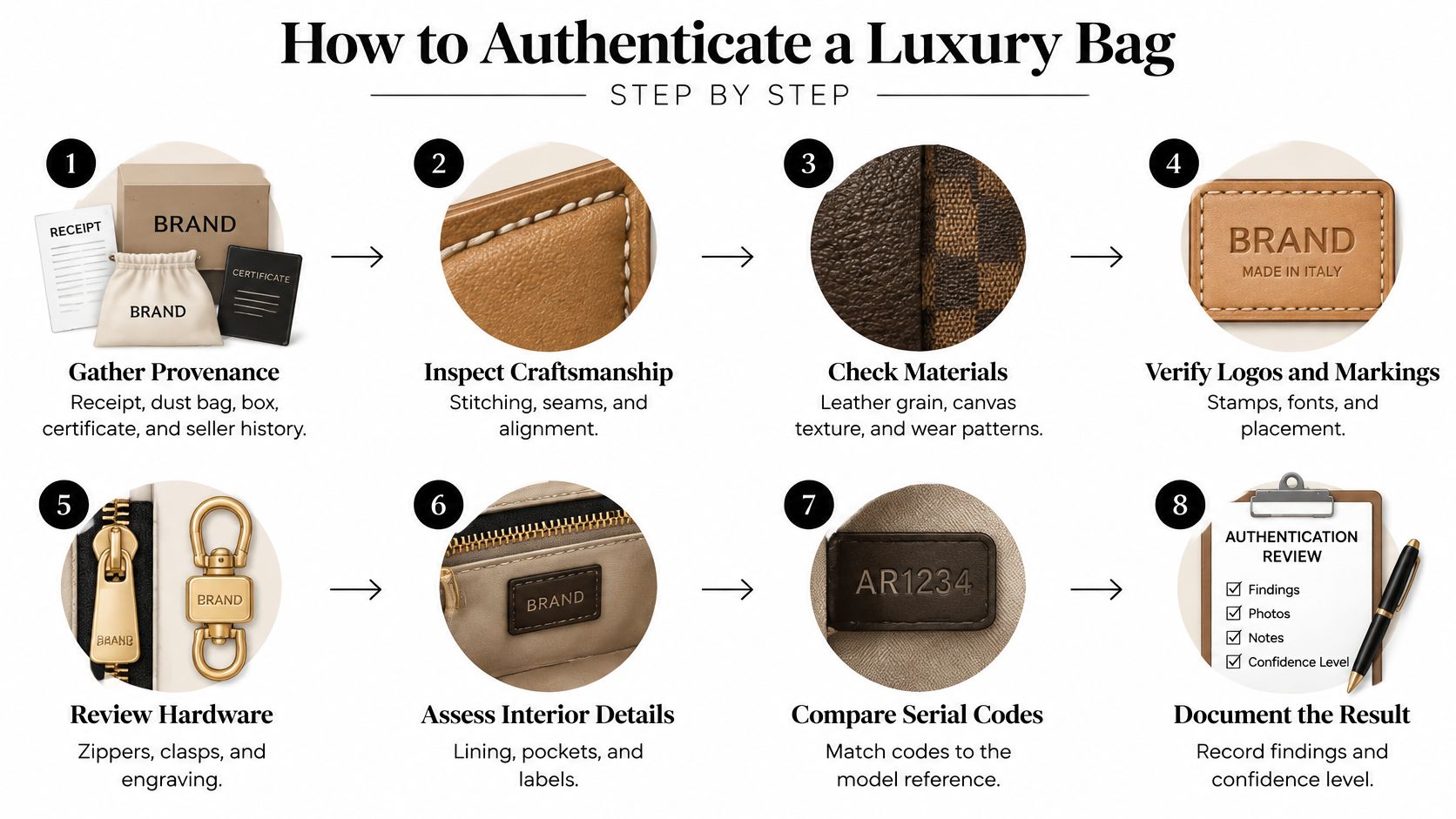
The order is the method. People who copy bags reproduce the marks buyers check first and miss how those marks relate to the rest of the piece. Work these eight steps in sequence, and don't jump to the serial because it feels decisive. What each area should look like sits in the inspection map after this walkthrough.
If you're still learning what a fair secondhand ask looks like before you inspect, Cedar & Lily Clothier's bag picks show how real listings sit under a set budget. A price far under that kind of range is easier to question before you ever open the flap.
Start with what you can document
1. Gather provenance. Receipt, dust bag, box, certificate, and a plain account of where the seller got the bag come first, because paperwork frames every later mismatch. Missing papers don't fail a bag. They raise how much the construction has to carry on its own.
2. Identify the exact model, production period, and known variations. Pull reference photos for that season, not a generic brand page. A correct check against the wrong year will green-light a copy and reject a legitimate vintage piece.
3. Photograph and weigh the complete bag. Shoot the interior and every hardware piece, then note any mismatch with a trusted reference weight for that model. Those photos are the record if someone later disputes your call.
Then read the construction
4. Check silhouette and panel geometry, then materials under neutral light. Shape comes before grain. A wrong silhouette won't be saved by nice leather, and colored room light hides dye and edge problems.
5. Inspect logos and typography, then stitching. Logos are the easy copy. Stitch length, thread, and how seams meet show whether the same construction built the panels around that logo.
6. Verify hardware finish, engraving, and attachment. Screws, weight, and how parts are fixed tell you whether the metal belongs with that model, not merely whether a name is stamped on it.
7. Check date codes, serial numbers, or microchips last. These identifiers are the easiest thing to add once the rest of the bag looks close. They confirm a story. They don't start one.
8. Record each step as confident, unclear, or failed, and decide only when the notes agree. One failed step fails the check. An unclear step is not a pass you talk yourself into.
Say the logos are crisp and the stitch length matches the reference, but the hardware screws are the wrong head and sit proud of the leather. That bag fails the hardware step, so it fails the whole check. Passing the logo step doesn't vote it back in.
What Each Inspection Area Should Show
Use this map as a scan, not a scorecard. Each row names the area, what you look at, a signal that fits a genuine piece of that model, and a red flag that should stop you.
| Inspection area | What to check | Genuine signal | Common red flag |
| --- | --- | --- | --- |
| Silhouette and panel geometry | Proportions, corner shape and symmetry against model reference | Panels match reference proportions and seams sit square | Shape looks slightly off or panels are unevenly sized |
| Leather or textile grain | Grain pattern, texture and feel across panels | Consistent grain matching the model's material | Plastic-looking surface or grain repeated identically |
| Logo and typography | Letter spacing, alignment across seams, stamp depth | Clean, even spacing and crisp stamp | Uneven spacing, blurred or shallow stamp |
| Stitching | Stitch length, evenness, thread color and finish | Even, consistent stitches matching the model | Uneven, doubled or loose stitches where the reference is tight |
| Edge paint and glazing | Finish along leather edges | Smooth, sealed, even color with natural variation | Paint pooling, bubbling or sitting on top of the leather |
| Lining | Lining fabric, logo print, stitch line and label | Lining matches the model and stitches are tidy | Wrong fabric, misaligned print or glue residue |
| Hardware finish and weight | Finish, engraving, weight and attachment screws | Crisp engraving, consistent weight, screws matching the model | Light weight, soft engraving, mismatched screw heads |
| Date code, serial or microchip | Format and placement against the model era | Format matches the reference for that period | Format from the wrong era or a serial that does not fit the date |
Why the first and last rows mislead people
Silhouette is the row people rush. A bag can look "close enough" in a phone photo and still have a corner radius or panel width that never left that factory. Compare proportions to a reference of the same model and season, under flat light, before you award any other row a pass.
Date codes, serials, and microchips are the other easy miss, in the opposite direction. A format that matches the era is supporting evidence. It is not proof the leather, lining, and hardware were made together. A serial from the wrong period, or a code that doesn't fit the date the seller claims, fails that row even if the monogram looks clean.
Good signals only count against a model-specific reference. The table tells you what to look for. It does not hand out pass-or-fail rules you can apply to every house.
Two failures I would not talk past: edge paint that sits on top of the leather instead of sealing into the edge, and hardware that feels light with engraving you can smear with a fingernail. For how real hide should feel before you judge grain, Grainmark Leather tips on real leather are a useful baseline, then you still compare that feel to the model's own material.
A rubbed corner or a re-stitched handle can be a repair, not a counterfeit tell. Log wear and prior work separately from construction findings. On Louis Vuitton, corners, handles, and lining take the most daily damage, and how those three areas age on a pre-owned piece is worth reading before you call honest wear a fake.
> Practical rule: If a row conflicts with the reference, mark it failed or unclear. Don't average it away because three other rows looked fine.
Brand Markers That Change Your Checks
A checklist written for one house will misread another. Hermes saddle stitch is not a Chanel test, and a Louis Vuitton date-code format will not tell you anything useful about a Gucci serial sticker. Verify the marker that house uses, then remember the limit that stops it from being proof by itself.
| Brand | Marker to verify | Limit to remember |
| --- | --- | --- |
| Hermes | Hand saddle stitching and the blind stamp on the leather | Stamp style and placement changed over decades, so compare to the exact era |
| Louis Vuitton | Date code, factory code and monogram alignment at seams | Code formats changed over time, and vintage pieces may carry older codes |
| Chanel | Serial sticker or card and, on recent pieces, a microchip | Serial labels can be copied, so match format and era rather than trusting the sticker alone |
| Gucci | Interior serial sticker and label stitching | Label placement and print vary by product line, so compare to the same line |
| Dior | Interior serial or date sticker and cannage quilting pattern | Quilt pattern and stitch density differ across models, so check the exact model |
Chanel is the clearest example of a marker that looks official and still fails. Say the hologram sticker is crisp, the card is present, and the digits are the right length for a modern bag. If that code belongs to a period the sticker's style never used, the marker is unclear at best and failed if the eras openly conflict. You compare the exact model and the year, not "Chanel" in general. In 2024, counterfeit Chanel goods submitted to Entrupy for verification represented approximately $500.47 million in value, according to WWD's coverage of Entrupy's State of the Fake data. Volume like that is why a copied sticker is a business model, not a rare mistake.
If you can't find a marker the reference says should be there, log it as unclear, not failed, until you know that year's placement. A blind stamp that moved, or a microchip on a recent piece instead of a card, is a period change. Missing stitching quality is a different problem. Before you buy a pre-owned Chanel, a photo and records checklist keeps the sticker, the card, and the construction shots in one place so a later reviewer isn't guessing from a single glam shot.
Tools and Tests Worth Using
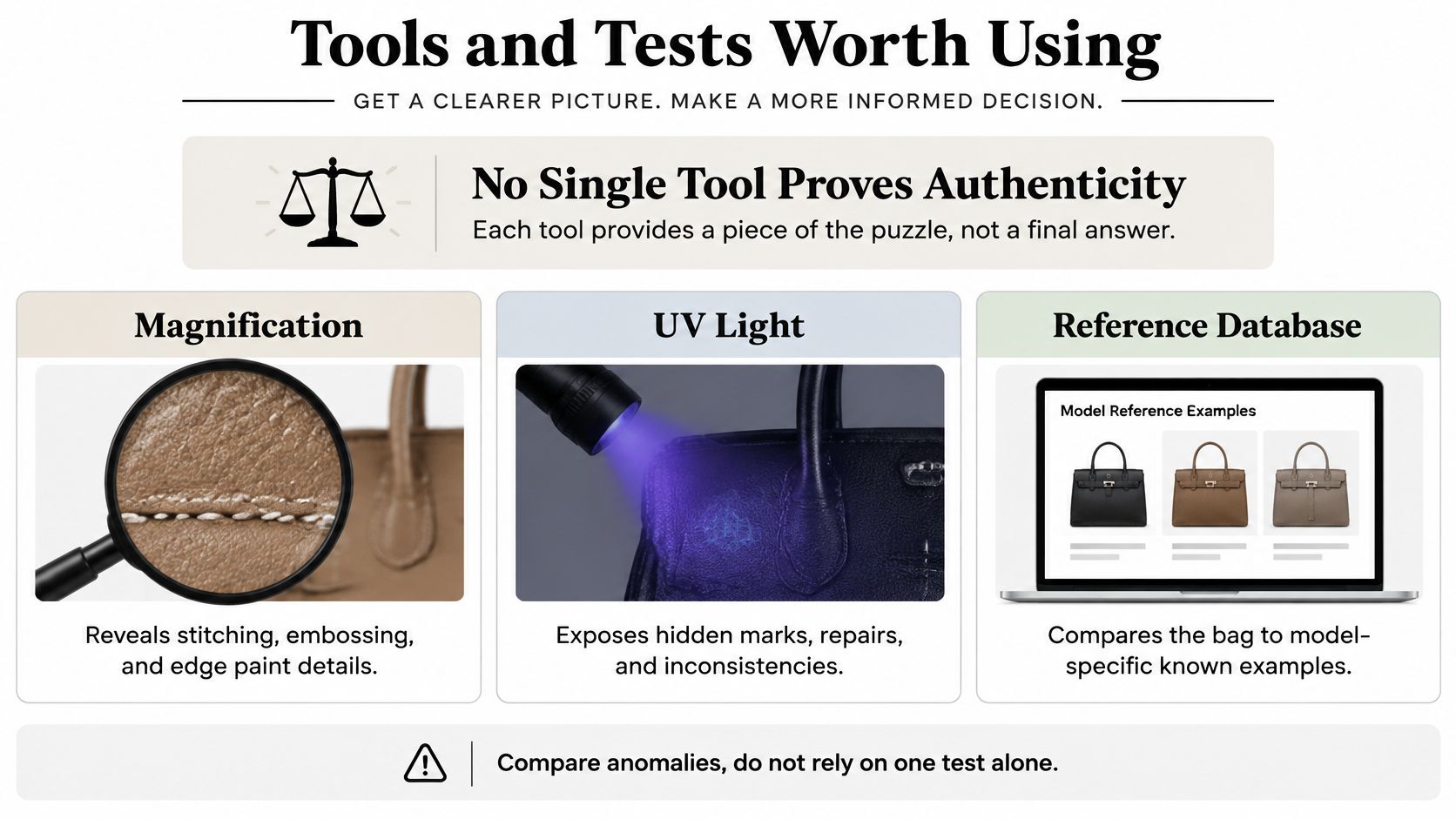
No single tool settles the question. Each one is an anomaly detector you read against a model-specific reference. An authentic bag can carry replaced hardware. A careful copy can match a surface spec. A matching test is a note in the file, not a verdict.
| Tool | What it detects | What it misses | Escalate when |
| --- | --- | --- | --- |
| Magnification or loupe | Stitch density, edge paint and engraving detail | Internal construction and hardware composition | Any stitch or edge finish looks off |
| UV light | Adhesives, glue residue and repairs | Counterfeits that use matching adhesives | Repairs or glazing look uneven |
| Scale and reference weight | Hardware mass mismatch against the model | Replaced hardware of similar weight | Weight differs from the reference |
| X-ray fluorescence | Metal composition of hardware | Construction and fused components | Hardware finish or weight is inconsistent |
| Radiographic imaging | Internal hardware construction and how parts are fused | Surface details such as stamps | Internal layout conflicts with the reference |
| AI image-based verification | Pattern matches against a large reference set | Unusual vintage or repaired pieces, which can return unidentified | Result is unidentified or conflicts with visual checks |
What an unidentified scan actually is
In 2025, Entrupy processed products worth $3.7 billion and classified 91.9% of scanned luxury items as authentic, leaving 8.1% unidentified, according to WWD's coverage of Entrupy's State of the Fake report. That unidentified share is a decision point. It is not a counterfeit verdict, and the 91.9% figure is not a promise that your bag, your brand, or your photos will land the same way.
Magnification and UV are the tools you can use at a table. A scale matters once you have a reference weight for that hardware, not a guess that "real bags feel heavy." X-ray fluorescence and radiographic imaging belong later, when finish, weight, or internal layout already conflict, and only if the test won't damage the bag. Ask any shop which tool it uses and whether the result is written down. Designer handbags and fine watches are checked through luxury authentication before a transaction here, and Entrupy provides full certification for designer handbags and other luxury goods. How that step fits a pawn or a sale is in the decision guide at the end.
> A tool that agrees with a bad visual check doesn't cancel the visual check. Pause when the layers disagree.
Red Flags and What an Inconclusive Result Means
The first red flag usually arrives before any stitching does. Ask a seller for close-ups of the hardware, the screws, the date code, and the lining, then watch the reply. A straight seller sends angles. A problem seller sends a deadline.
- Extra photos refused: One polished beauty shot, nothing of hardware, interior, or edges.
- Pressure to close: A deadline measured in minutes, or a claim that authentication "isn't how this works."
- Price far below market: A number that only makes sense if the bag isn't what it claims to be.
- No receipt and a vague origin: "Gift from a friend of a friend," with nothing you can check.
- Authenticity claimed with no written record: A verbal "it's real" and no inspection notes.
- Serial and date that fight each other: A code from one era on a model from another.
- Photos only in poor light: Warm filters, flash blowout, or crops that hide edges and stamps.
No single flag proves a fake. Each one shrinks what you can verify, and verification is what the price rests on.
An inconclusive result means the check ran and could not confirm the bag. Record it as a gap in the file: which layer failed, and why. In 2024, Entrupy scanned handbags and sneakers with an estimated combined resale value of $1.9 billion, and its authentication technology identified 8.4% of scanned products as fake or unidentifiable, according to Fashion Dive's reporting on Entrupy's data. A result inside that share calls for a second method or a professional look, and the offer or bid should reflect the missing confirmation until it arrives.
A clean result carries limits too. It certifies authenticity at the moment of the scan; it says nothing about a replaced turnlock, a recolored edge, or a lining that was swapped out after the photos were taken. The same paperwork gap shows up in other goods people buy on trust. The Wine Labs April wine market digest follows how fine-wine fraud hits buyers who accept a label without a record they can recheck.
> An inconclusive result is a reason to pause, document what failed, and price the uncertainty or walk.
How Authentication Changes a Bag's Value
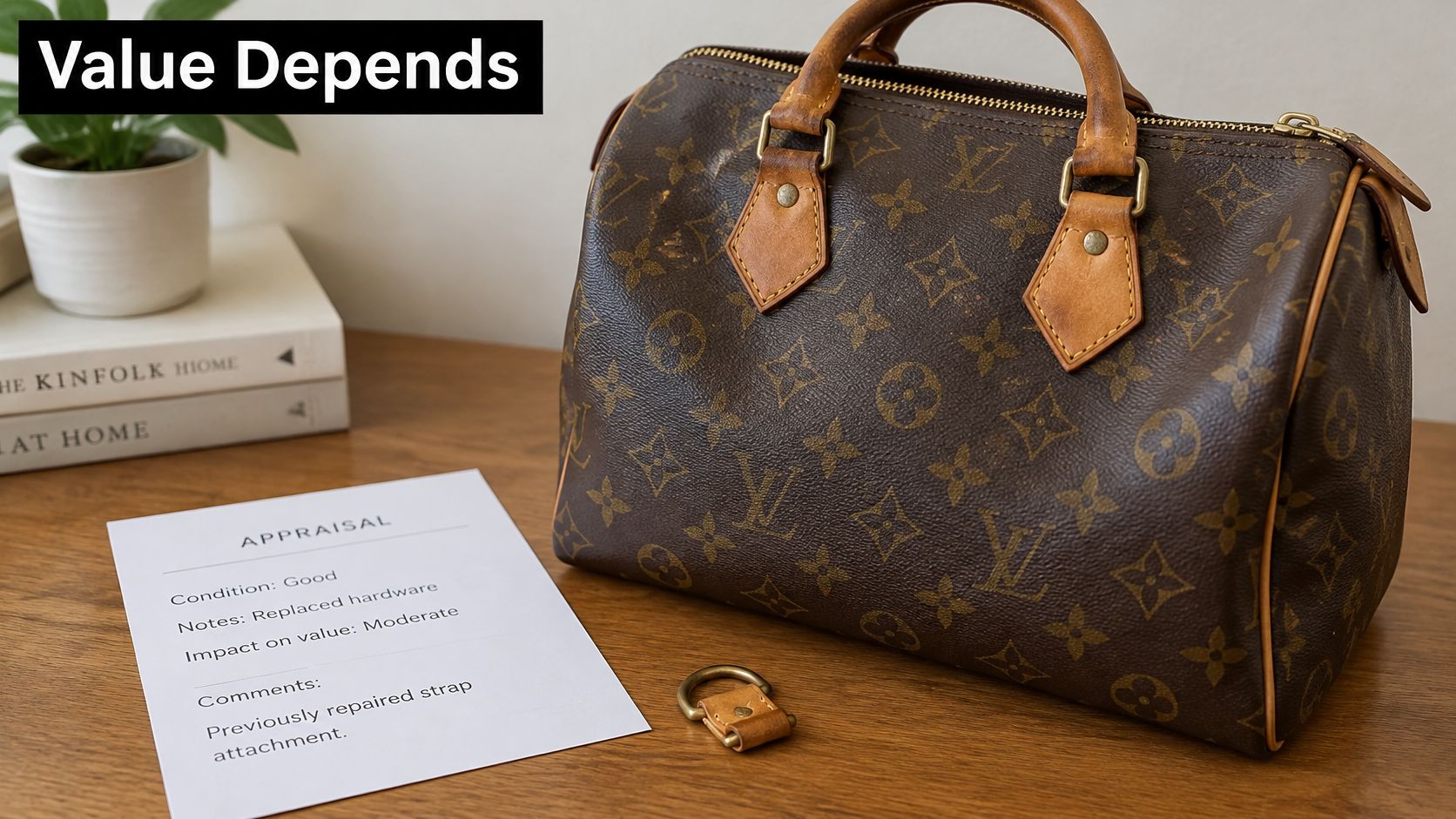
Authentication protects a price. It doesn't set one. A genuine bag with an undisclosed repair, replaced hardware, or a missing dust bag and box will sell or pawn for less than the model page suggests, because the next buyer prices in what nobody wrote down.
What the written record has to contain
The gap closes when the file lists four things in plain language: condition, modifications, provenance, and included accessories. "Authentic" with no sentence about the replaced strap, the scuffed base, or the absent clochette leaves the other party to assume the best case. That assumption is how deals fall apart at the counter.
In 2025, authentication and verification were rated the most valuable digital-product-passport feature by 70% of consumers when buying and 67% when selling, based on a survey of 7,800 resale-engaged consumers conducted by BCG and Vestiaire Collective. Both sides of the table want the record, not only the buyer.
For a pawn, the offer weighs authenticity, condition, and what similar bags resell for. Bring the bag, any receipt or card, and a short note of repairs you know about. Don't describe a piece as mint, or as authenticated, unless that record exists. If a later reviewer disputes the result, the written notes show who checked what, and on which date. If you're ready to sell rather than borrow against it, where to sell a used Louis Vuitton near Nampa walks through what a local sale looks like once the bag is documented.
A short look at how a physical inspection is talked through, including what the examiner is comparing, helps before you agree to a number.
Decide When to Get a Professional Check
Match the situation to the check. A high asking price with no paperwork is not the same job as a boutique receipt in the box.
| Situation | Recommended check | Why |
| --- | --- | --- |
| Private seller, high price, no receipt | Independent expert review and instrument test before paying | Price and missing paperwork raise the stakes |
| Reputable retailer, receipt and box included | Your own checklist, then a quick review if anything conflicts | Provenance is already documented |
| Pawn or sale to a shop | Ask for the shop's authentication step and a written record | The record protects both sides |
| Vintage or heavily repaired piece | Expert review with photos and measurements | Legitimate variation and repair are easy to misread |
| Conflicting serial, date and construction | Professional review and no transaction until resolved | Conflicting evidence is the strongest red flag |
What to do before you pay, pawn, or list
At our Boise, Meridian, and Nampa counters, every item accepted goes through an 8-step authentication process. Every item in the store is guaranteed authentic, and each sale carries a full authenticity guarantee. Bring the bag, its accessories, and any information that helps identify it. Many used pieces are one of a kind, so call the selling store before you drive, and call ahead when the piece is large or unusual.
Before money moves, I would finish this short list.
- Name the model and the year you believe the bag is, in writing, against a reference photo.
- Keep the photo set of exterior, interior, hardware, edges, and any code or chip location.
- Separate wear from construction. Repairs go in their own note.
- Don't pay while a serial, a date, and the construction still disagree.
- Ask for the written result if a shop or a service checks it, including any unidentified finding.
An inconclusive file is a reason to get that second review, not a reason to talk yourself into the deal because you already drove across town.
---
Idaho Pawn & Gold Exchange checks designer handbags before a pawn or a sale and stands behind pieces it accepts with a full authenticity guarantee. If you're in Boise, Meridian, or Nampa with a bag you want priced on a real inspection, not a logo glance, bring the piece and its accessories in. Visit Idaho Pawn & Gold Exchange and call ahead if the bag is unusual so the right store has time to review it.