
Yes, most pawn shops do buy electronics, especially recent phones, laptops, gaming consoles, and audio gear, but offers depend on working condition, age, completeness, and whether the device is free of account locks. What if the model on the box isn't what decides your offer at all? A newer phone that's still tied to your account can be turned away, while an older, wiped, and complete console gets a yes. The counter team is really testing resale readiness, not the price you paid new.
Which Electronics Pawn Shops Accept
Do pawn shops buy electronics? Yes, but not every device. Idaho Pawn & Gold Exchange accepts any items with value, especially precious metals, diamonds, newer electronics, gaming systems, and tools. You can see the current electronics categories on the Idaho Pawn & Gold electronics page. The rule is simple: a shop buys what staff can test, price, and resell without guessing.
Data privacy and activation locks are the gatekeepers. An activation lock works like a lien on the device. Until it is cleared, staff cannot safely resell it, so the device may be turned away even if it powers on. A missing charger is an inconvenience. A lock is a title problem.
| Device | Typical Acceptance | What Affects the Offer |
|---|---|---|
| Smartphones | Usually accepted when free of account and carrier locks | Model age, screen condition, battery health |
| Laptops and tablets | Usually accepted with login removed | Processor generation, storage, battery health, software support |
| Gaming consoles | Commonly accepted with controllers and cables | Model, working ports, included games |
| Cameras and lenses | Often accepted with batteries and chargers | Shutter wear, sensor condition, lens included |
| Televisions and audio gear | Accepted if it powers on and tests clean | Size, age, panel defects, speaker output |
| Smartwatches and power tools | Accepted when functional and complete | Brand, battery condition, charger and case |
| Obsolete or badly damaged devices | Often declined or offered for parts | Water damage, missing parts, unsupported software |
How To Read The Table
Smartphones, laptops, and tablets are the easiest yes when they are recent, charge properly, and open to a setup screen. A cracked display or a battery that drops quickly does not always mean refusal, but it lowers what a buyer will pay. Gaming consoles need controllers and cables because a buyer expects to use the system right away. Cameras hold value when lenses, batteries, and chargers come with them, while televisions and audio gear need a clean picture and clear sound.
Smartwatches and power tools follow the same logic. A complete kit with a working battery is easier to resell than a bare device. Obsolete or badly damaged gear is different. If software is unsupported, parts are missing, or the device cannot be tested, staff often decline it or value it only for parts.
That is why erasure and sign-out belong in the same breath as condition. You do not need to know the shop's full test routine before you walk in. You do need to know whether the device can be cleared and resold.
The pool of idle gear is large. In 2024, 88% of Americans reportedly kept unused electronic gadgets at home, about 1.3 billion devices with an estimated combined value of $67 billion, according to a study by SellCell and SellMobile reported by Waste360.
> Four-question check: Is it signed out and erased, is it recent enough for resale demand, does it power on and hold a charge, and do you still have its charger and accessories?
If a device fails that check and has no resale path, responsible disposal may be the better route. Businesses retiring equipment in bulk can start with a recycling vendor's overview of shops that buy electronics, published as IT asset retirement guidance for Atlanta businesses. For a single household device, the checklist above is usually enough to decide whether a pawn visit makes sense.
How Pawn Shops Price Electronics and Make Offers
An offer starts with resale value, not original retail price. Staff focus on condition, current demand, brand, age, included accessories, and resale likelihood, and newer phones, laptops, consoles, cameras, televisions, and audio gear usually have clearer markets. The Environmental Protection Agency durable goods data estimated that Americans generated 2.7 million tons of selected consumer electronics in 2018, with approximately 1.04 million tons collected for recycling, a 38.5% recovery rate. That volume explains the supply, but it doesn't set the price for your specific model.
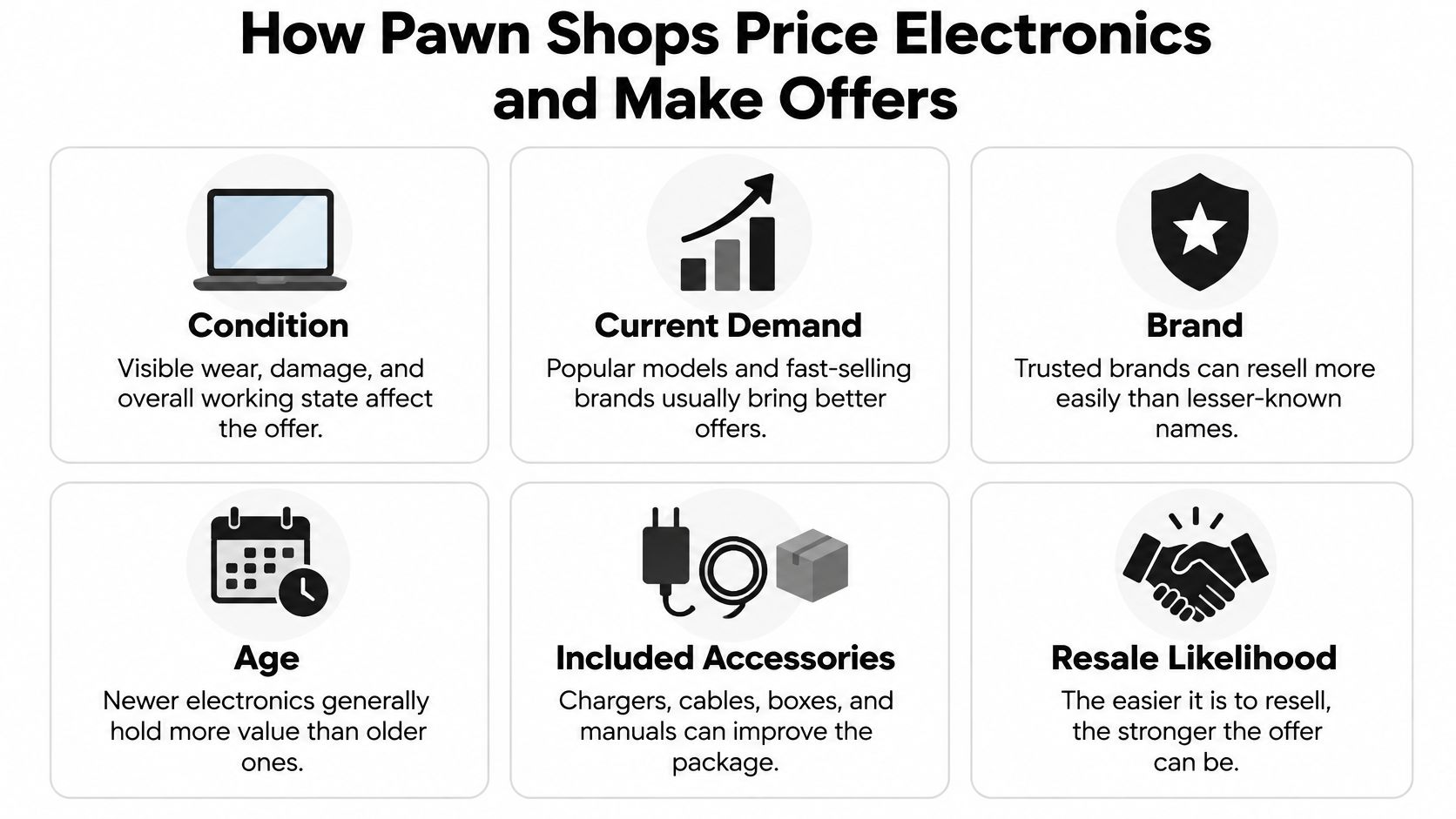
Selling to us starts with an in-person evaluation at the store, and you decide whether to accept the offer. Pawn and sell customers review any offer or loan terms before deciding at the store, so there's no obligation to sell after testing.
What Staff Check At The Counter
- Model and storage: Staff confirm the exact model, storage size, and processor generation, then compare recent resale prices for that version.
- Cosmetic grade: Chips, deep scratches, dents, and loose buttons suggest harder use and make resale harder.
- Battery health: A phone or laptop that won't hold a charge needs a repair budget built into the offer.
- Functional tests: Power, screen response, ports, cameras, speakers, keyboards, and charging all get checked.
- Accessories present: An original charger, cable, controller, or case saves the shop replacement cost.
- Activation lock status: A locked device can't move to a new owner, so staff verify it's cleared.
Why The Number Sits Below Resale
From that resale price, the shop covers testing labor, capital cost, warranty or return risk, storage, and resale expenses. The device may sit while it waits for a buyer, and staff time goes into cleaning, listing, and standing behind it. That's why your payment sits below a private-sale price.
Phones give you a useful benchmark. In the fourth quarter of 2023, 46.8 million second-hand mobile devices were sold globally at an average selling price of $304 per device, and CCS Insight reporting on the second-hand device market counted 76.6 million units traded in during the same quarter. A pawn offer on a phone should sit below that kind of resale figure because the shop still has to test, store, and resell it.
Before you visit, check completed resale prices for your exact model and storage size. At the counter, ask staff to walk through each deduction so you can compare their number with your research. If you're considering a loan instead of a sale, estimate repayment first with our pawn loan calculator.
Pawning Versus Selling Electronics Side by Side
A pawn is a short-term cash loan where your device is collateral and you keep ownership if you repay. A sale transfers ownership for one payment. We offer pawn loans where you use an item you own as collateral, and a pawned item returns to you after the loan amount and interest fees are paid.
| Factor | Pawn Loan | Outright Sale |
|---|---|---|
| What you receive | Cash loan with the device as collateral | One cash payment for the device |
| Ownership | You keep ownership while the loan runs | The shop owns the device once you accept |
| Credit check | None required | None required |
| Getting it back | Pay the loan amount plus interest and fees | Not applicable, the item is sold |
| If you do not repay | The shop may sell, layaway or wholesale the item | Not applicable |
| Cost | Interest and fees, APR listed as low as 35% | The gap between your payment and resale value |
| Best when | You can repay and want the device back | You want cash and no longer need the device |
Two Situations Readers Mix Up
Say you need your phone back within a month and you've got a paycheck coming that covers repayment. A pawn can fit because the device is collateral, not gone for good. But if repayment is only a hope, you risk losing a phone you rely on every day.
Say you've replaced a tablet and the old one sits in a drawer. Selling is cleaner. You take one payment, carry no due date, and don't pay interest to recover something you no longer use.
> The deciding question isn't which option pays more today. It's whether you want the device back badly enough to accept a repayment deadline.
No credit check is required to pawn or sell with us, because either decision rests on the item itself. For an unpaid pawn, we may put the item up for sale, offer a layaway term, or wholesale it to a dealer, depending on the item and your communication. That outcome is the cost of missing the date, so don't treat a pawn as a sale with a bonus chance.
Pawn APR is listed as low as 35%, and that rate shapes your total repayment. Add the loan amount, interest, and fees before you choose, then decide whether getting the device back is worth that total. Our pawn and sell page lays out both paths if you want to compare them again at home.
If you can't repay on schedule, selling upfront usually protects you from a worse surprise. If you can repay and the device matters, a pawn keeps ownership within reach.
How to Erase Your Data Before a Pawn Visit
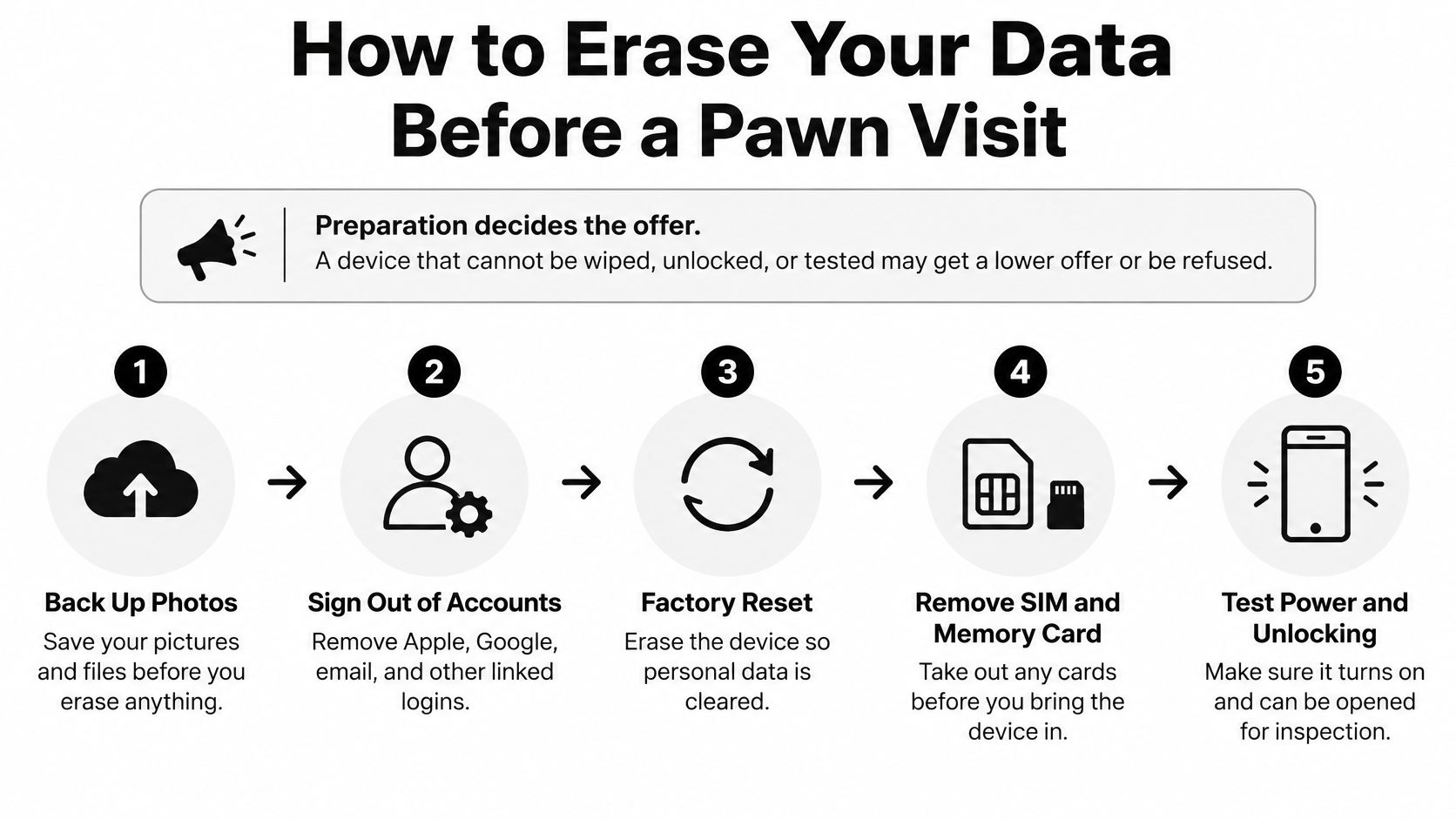
A device that can't be wiped, opened, or tested creates fraud and data risk for the next owner and for you. Staff may offer less for it, or refuse it. Preparation is therefore a gatekeeper, not a finishing touch.
Seven Steps In Order
- Back up first: Save photos, contacts, messages, and files to a cloud service or computer before you erase anything.
- Remove SIM and SD cards: Take both out physically, since removable storage is separate from internal storage.
- Sign out everywhere: Sign out of your Apple, Google, or Microsoft account and messaging apps, and turn off Find My or Find My Device.
- Clear management and activation locks: Remove work or enterprise profiles and disable the activation lock tied to your account.
- Delete, then factory reset: Delete data manually, then run the manufacturer's full factory reset from settings.
- Confirm the setup screen: Restart the device and confirm it reaches its welcome or setup screen without asking for your password.
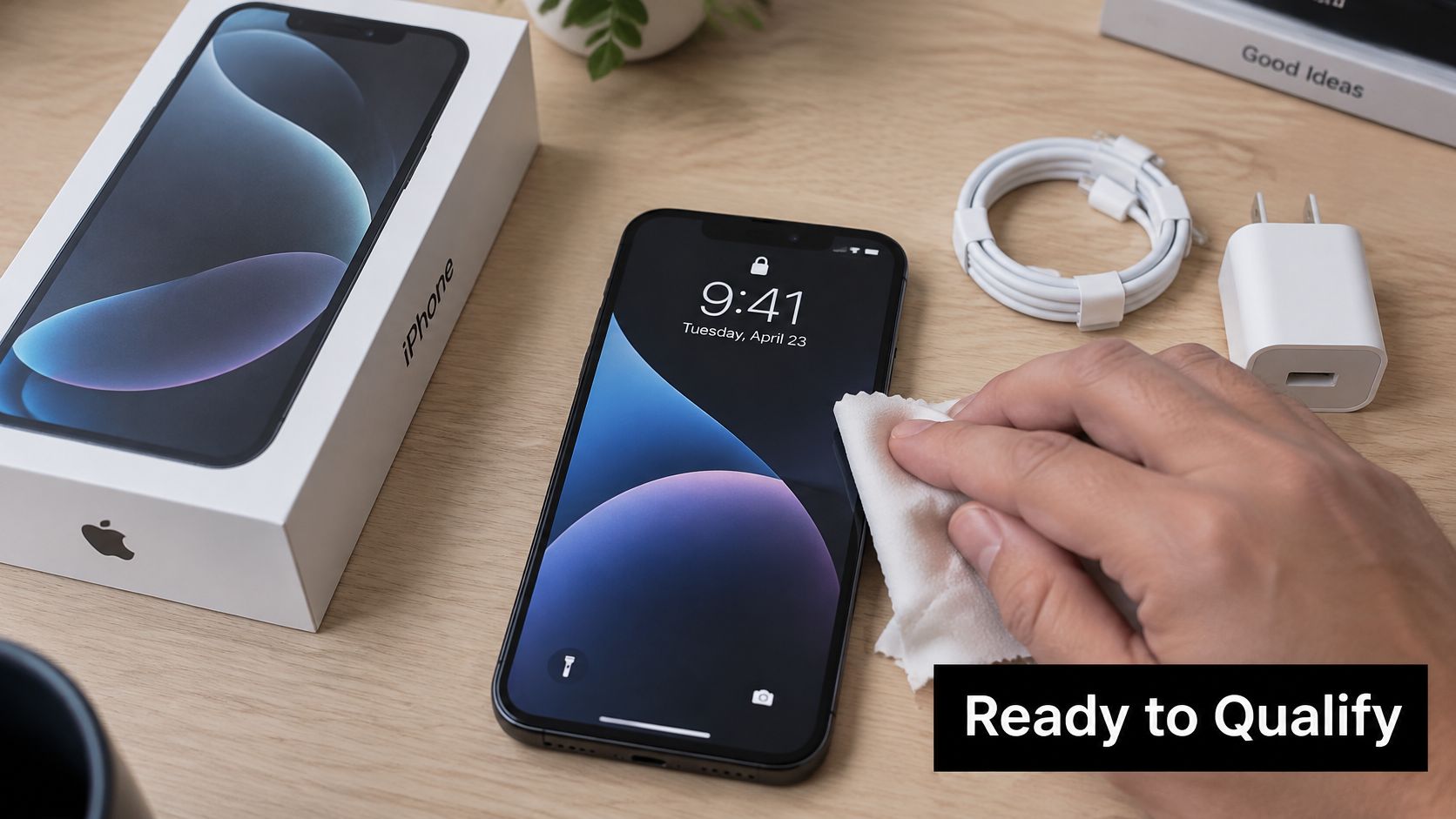
- Pack the complete kit: Bring the original charger, cables, box, controllers, lenses, and other accessories.
The order matters because a reset alone doesn't handle every risk. Personal information can remain on devices that weren't properly erased, including contacts, messages, photos, browsing history, financial information, and tax records, according to the FTC guide to removing personal information from a phone. NIST media sanitization guidance, as summarized in that advice, separates manual deletion from a full manufacturer reset and notes that resetting may not erase an inserted card.
That distinction is where readers often get confused. Deleting a photo folder isn't the same as sanitizing a device. A factory reset after sign-out prepares the device for a new account, while a reset while you're still signed in can leave an activation lock that blocks setup later.
> Setup screen rule: If the device still asks for your old account after the reset, it isn't ready to sell.
Laptops need extra care. Ordinary file deletion can leave recoverable data on a drive, so use the operating system's secure erase or reset option and choose the setting that removes files and cleans the drive. Disclosure helps here too. Tell staff about defects, replacement screens, or a battery you've had serviced.
If you're recycling a device instead, the same caution applies. Beyond Surplus explains how to safely remove data before recycling electronics, which is useful before any handoff.
If you can't complete the reset or reach the setup screen, tell staff before you arrive. They can explain whether the device can be tested at all, which saves you a trip with a device that's likely to be refused.
Mistakes That Lower Offers or Block a Sale
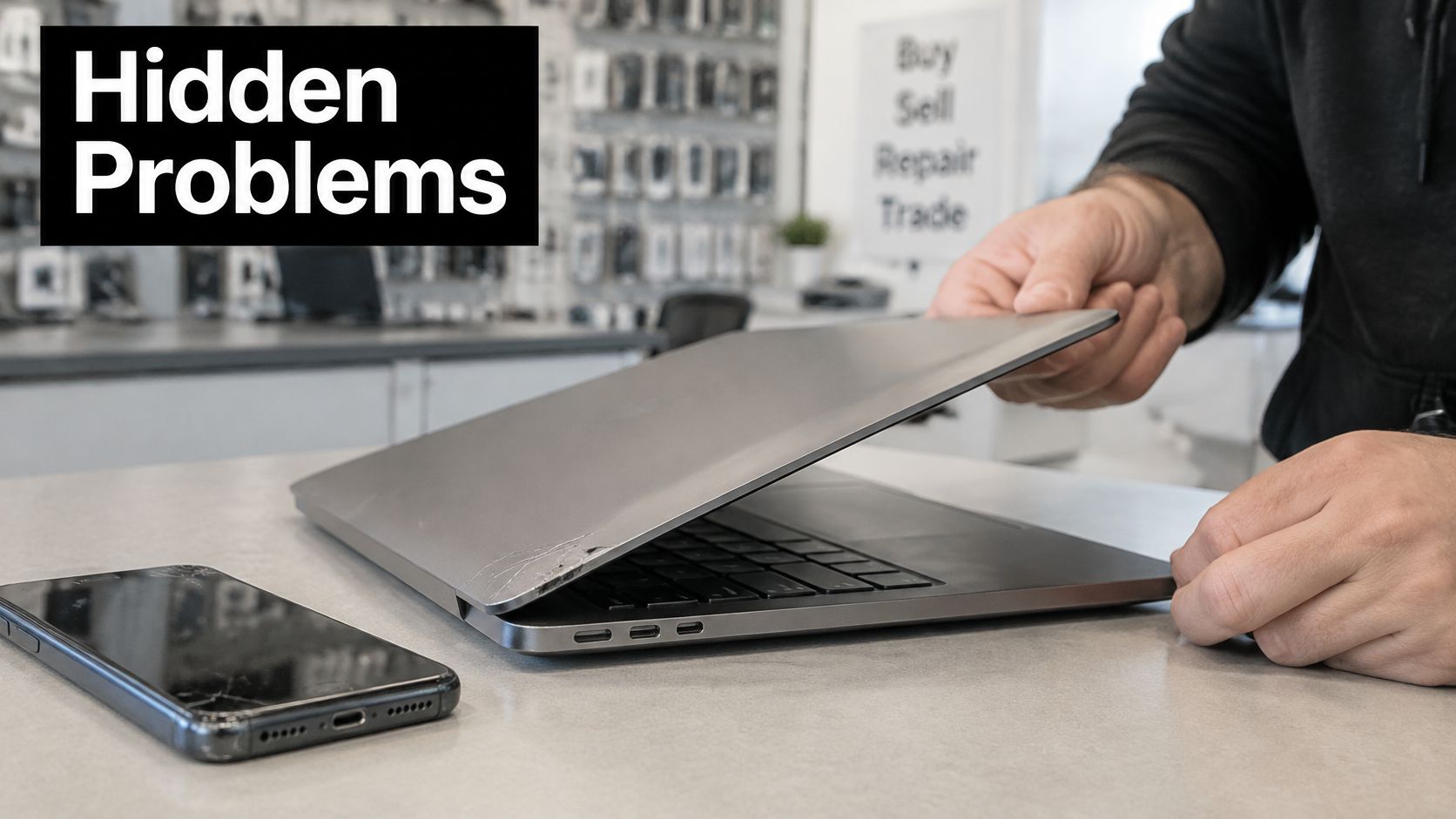
A device can light up and still be hard to value. Hidden damage, worn batteries, missing parts, unsupported software, and unclear warranty coverage all raise the shop's risk. The photo below shows the kind of visible damage that prompts closer testing, not an automatic yes.
Independent European consumer testing found recurring problems with refurbished products, including undisclosed internal water damage, misleading warranty information, and sellers failing to meet warranty obligations, in the Euroconsumers report on refurbished goods. In that study, 37% of respondents viewed longer warranties as an improvement that would encourage refurbished purchases, while another 37% wanted stronger oversight of repairs. Shops test hard because buyers worry about exactly those failures.
Mistakes Beyond Basic Preparation
- Hiding water exposure or battery trouble: Corrosion, a swollen battery, or random shutdowns can turn an offer into a refusal once staff open ports and run diagnostics.
- Pricing from what you paid new: An older model's resale value, not its launch price, sets the starting point. A newer generation release can cut demand for yours quickly.
- Treating a working screen as full value: Battery wear, unsupported software, a noisy fan, or a worn hinge lowers value even when the display looks fine.
- Forgetting a pawn due date: Missing repayment can lead to the item being sold, placed on layaway, or wholesaled, so a calendar error can cost you the device.
The short video below is a useful companion while you inspect your own device for these issues.
Before you leave home, run a quick self-test. Power the device on, check every port with its cable, test speakers and cameras, and confirm the battery holds a charge through an hour of normal use. If something fails, disclose it upfront. A smaller honest offer is better than a refusal after staff find the problem themselves.
Confirm Your Device Qualifies Before You Visit
What makes a device an easy yes at the counter? Usually two qualifications come first: the device has no carrier restrictions, and your data is gone. A recent, working, complete device that is free of carrier restrictions and has been factory reset is the strongest candidate for either a pawn loan or a sale. An activation lock or carrier lock is a qualification problem, not a pricing problem, so fix it at home where you still control the account. Cleaning the screen and gathering the charger, as shown below, helps the counter test the device without hunting for missing pieces.
Local Steps Before The Counter
- Check your category: Compare your device with the acceptance criteria and pricing factors you reviewed, including model age, battery health, and software support.
- Finish erasure and sign-outs: Complete the backup, account sign-outs, factory reset, and setup screen check at home. If the screen still asks for a previous account or password, the reset is not finished.
- Call the Boise, Meridian, or Nampa location: Describe the exact model and ask whether it is the kind of electronics the store is buying or lending against right now.
- Bring the basics and ask what else is needed: Pack the device, its charger, accessories, and any proof of ownership you have. Ask the counter what identification or extra paperwork its process requires before the evaluation begins.
- Compare and ask questions: Set the offer against the resale price you checked, ask what deductions were applied, then choose a pawn loan or a sale.
Review the loan or sale terms before you agree. If you pawn the item, save the repayment details the store gives you and put the due date in your calendar the same day. Our app lets customers pay and monitor pawn loans and balance, which helps you track what is due without relying on memory.
> You are not committed because the counter tested the device. The offer is yours to accept or decline after you hear the terms.
Readers who prefer to shop rather than sell can browse secondhand options before visiting. Our online shop lists pre-owned products in categories including Art & Collectibles, Clothing, Shoes & Accessories, Coins & Paper Money, Electronics, Sporting Goods, Gaming, Handbags, Jewelry, Home & Garden, Musical, Tools, and Vehicles. Seeing listed electronics gives you a practical sense of what local buyers are offered and what kinds of devices move through the store.
If the device is recent but locked, fix the lock first. If it powers on but stalls at an account request, finish the reset. If it is obsolete or badly damaged, call before carrying in something the store is likely to decline. A short call, a clean reset, and a complete kit give you the clearest answer to do pawn shops buy electronics for your specific device.
---
If your phone, laptop, console, or other device is working, free from carrier restrictions, wiped, and complete, bring it to Idaho Pawn & Gold Exchange in Boise, Meridian, or Nampa for an in-person evaluation for a sale or pawn loan. We'll test it, explain the offer and terms, and let you decide with no credit check required. Start by visiting Idaho Pawn & Gold Exchange to plan your visit.