
You've found the bag. The photos look right, the price sits below retail, and the seller says it won't last long. That's the exact moment to slow down, because buying well isn't about spotting a logo. It's about building a documented chain of evidence before money changes hands.
Resale has become mainstream. Bain & Company estimated secondhand luxury reached approximately €33 billion in 2021, marking a 65% increase from 2017 to 2021, in its Bain & Company luxury market analysis. More choice helps you, but it also means more restored bags, copied codes, and listings that look better than the item that arrives. If you want to buy designer bags second hand without paying for someone else's mistake, you need a channel you can verify, a price you can defend, and a return path in writing.
Where to Find Secondhand Designer Bags Worth Buying
You see the same model in three places at three prices, and the cheapest listing has the blurriest photos. The decision isn't which bag you like. It's which seller gives you enough evidence and enough time to check it.
| Channel | Best for | Main risk | Confirm first |
|---|---|---|---|
| Local pawn shop | Buyers who want to inspect in person | Limited selection and one-off pieces | Item availability by phone and the return window |
| Consignment boutique | Curated stock with staff inspection | Prices usually carry a margin above private sales | Written authenticity policy and condition notes |
| Luxury resale platform | Large selection and model comparisons | Listing accuracy and shipping risk | Platform authentication policy and buyer protection terms |
| Peer-to-peer marketplace | Lowest prices on common models | Highest counterfeit exposure | Seller history, date or serial code photos and independent authentication |
| Private sale | Rare or vintage pieces at negotiated prices | No standard return rights | Written proof of provenance before payment |
What Each Channel Does Well
A local pawn shop suits you if touch matters. You can test zippers, smell the lining, check corner wear under real light, and ask questions face to face. The trade-off is selection. Stock turns on what walks in, so you may wait weeks for a specific size or color.
A consignment boutique gives you curation and staff who've already handled the bag. You'll usually pay more than you would privately, because the shop takes a margin for display, staffing, and screening. That premium only makes sense if you get written condition notes and a clear authenticity policy in return.
Luxury resale platforms are strongest for comparison. You can line up the same model in several conditions and see how price moves with wear. Your risk shifts to photos and shipping, since you can't feel structure or weight until the box arrives, so buyer protection terms matter as much as the listing price.
Where Risk Concentrates
Peer-to-peer marketplaces often produce the lowest headline price on common models, and the widest gap between good and bad sellers. I'd treat independent authentication as a cost of buying there, not an optional extra. If the price only works without that fee, it doesn't work.
A private sale can surface vintage pieces you'll never see in a boutique. It also leaves you with the weakest recourse if something's wrong. Get provenance in writing, pay through a method that leaves a record, and don't let rarity talk you out of an inspection period.
> Favour any channel that gives you a written authenticity policy, a clear return path, and time to inspect in person or through detailed photos.
We offer designer handbags through our stores, and our listings show items from the Boise, Meridian and Nampa stores, with each listing identifying the selling store. You can browse our current handbag listings before you travel. Many items are unique used items, so contact the selling store to confirm availability before you drive over, because the exact bag you saw may not come back in stock.
Screen out sellers early if you spot these patterns.
- Refusal to send close-ups: No clear photos of the date code, logo, and hardware means no purchase.
- Pressure to pay off-platform: Requests for gift cards or untraceable payment remove your dispute protection.
- A story instead of documents: "Inherited from a relative" explains nothing without supporting evidence.
- A price far below recent sales: A bargain that far under comparable sales usually has a reason you haven't found yet.
How to Verify a Designer Bag Before You Pay
No single cue settles authenticity. A correct code can sit inside a wrong bag, and a convincing logo can sit on wrong hardware. Work in layers, and stop when the layers stop agreeing.
The six steps below give you a fixed order, so you don't start with the easiest detail and talk yourself into the rest.
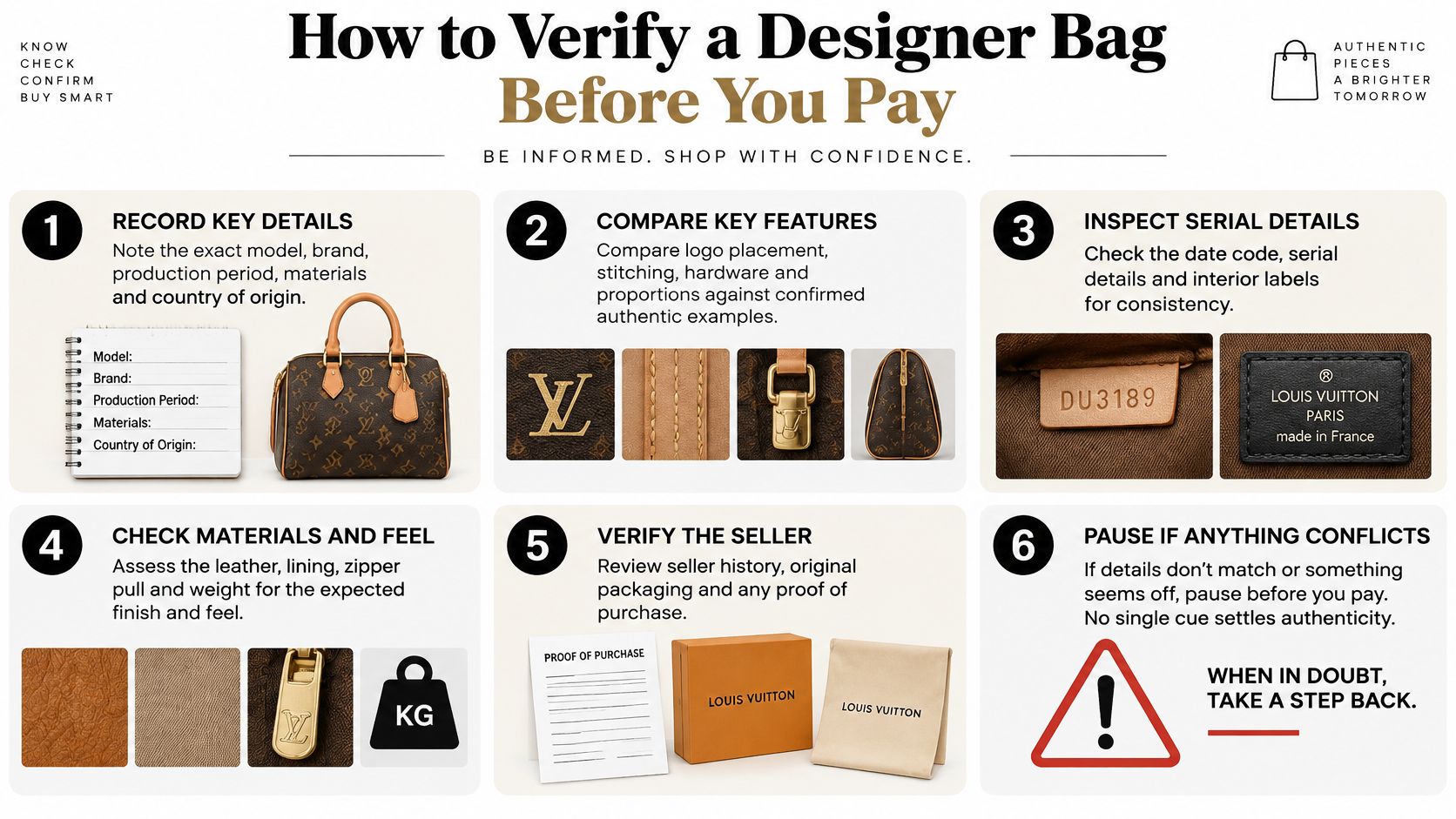
The Six Step Check
- Record the exact reference first. Write down the model, brand, production period, materials, and country of manufacture before you examine the bag. Every later comparison needs that fixed reference, otherwise you'll compare a bag against the wrong years, linings, or hardware finishes and draw the wrong conclusion.
- Compare components against the same model. Check the logo, embossing, date or serial code, stitching, edge paint, lining, zipper, lock, hardware finish, and construction against reliable reference photos of that exact model. A match on one cue proves little. Consistency across all of them is what builds confidence.
- Inspect the regions trained reviewers check first. Start with the body, clasp, label, lock, logo, and zipper, then widen out. A peer-reviewed computer-vision study in Complex and Intelligent Systems identifies 12 useful inspection regions, including bag body, button, coding, embossing, front, clasp, label, lock, logo, sign, tag, and zipper. That same work makes a point buyers miss. Each brand and component needs its own reference set, so don't treat a generic image search as a verdict.
- Treat packaging as supporting evidence only. A dust bag, box, receipt, or serial code doesn't prove the bag in front of you is authentic. Accessories move between items, receipts can be fabricated, and codes can be copied. Use them to support a case that already holds together, never to rescue one that doesn't.
- Create your own record before payment. Take high-resolution photographs of every panel, code, stamp, zipper pull, and flaw, and get the seller's condition description in writing. If the bag that arrives differs from the bag described, those dated images and that written note are what support a return or dispute.
- Escalate above your comfort threshold. For an expensive purchase, request an independent expert opinion and, where it's available, microscopic or materials analysis. Automated tools flag anomalies quickly and work well as a first pass, but human examination still decides high-value items.
How We Handle This Step
We check designer handbags and fine watches through luxury authentication before a transaction. Entrupy, an AI-powered authentication tool, provides full certification for all designer handbags and other luxury goods we handle, and every item in our store is guaranteed authentic, with each sale carrying a full authenticity guarantee. You can read how that process works on our luxury authentication page.
That layered approach matters because a tool result and a visual check answer different questions. One flags inconsistency at a microscopic level. The other tells you whether handles, lining, and hardware belong on that model from that period. You want both answers to point the same way.
The short video below is useful for seeing how small details look up close before you inspect a bag in person.
> Stop rule: Walk away when provenance, seller identity, return rights, or component consistency can't be independently verified.
That rule feels strict when you want the bag. It's the rule that keeps one bad purchase from wiping out the savings from your last three good ones.
Condition Signs That Change What a Bag Is Worth
The most expensive mistake is paying a pristine price for a restored bag. Two listings can show the same model in the same color, and the bag with recolored panels, replaced handles, and a failing lining is worth far less, even if its photos look cleaner.
Condition isn't a vibe. It's a set of specific checks, and some carry real financial weight because even strong screening isn't perfect. An industry account of luxury authentication technology reports current combined methods may achieve roughly 98 to 99% accuracy on many categories, which still implies approximately 1 to 2 misclassified items per 100. On a bag costing thousands, that residual risk is exactly why your own condition inspection can't be casual.
| Area | What to check | Warning sign |
|---|---|---|
| Color and leather | Panel-to-panel consistency, texture and sheen | Patchy color or glossy recoloring |
| Edges | Edge paint overlap and clean lines | Paint on stitching or bubbling edges |
| Handles | Attachment points and stitch regularity | Replaced handles or loose stitching |
| Hardware | Alignment, finish and engraving | Mismatched or heavily polished hardware |
| Lining | Separation, stains and odor | Peeling interior or strong smell |
| Shape | Structural deformation and corners | Sagging base or crushed corners |
Start With Color and Leather
Look across panels in natural light, not under warm shop lighting. Original leather tends to show consistent texture and sheen from panel to panel, with wear that matches where hands and surfaces touch. Recoloring often looks too even, too glossy, or slightly plastic at the edges, and it can conceal scuffs, dye transfer, and corner damage underneath.
Run your fingers along the edges next. Clean edge paint sits in a neat line. Paint that overlaps onto stitching, bubbles, or peels in strips tells you someone has redone it, or that heat and age have started breaking it down. Either way, price it as work needed.
Check Structure Before Surface
Handles tell you how a bag has lived. Inspect attachment points for stretched holes, loose stitching, and cracking where the handle bends, and compare stitch regularity on both sides. Replaced handles reduce originality even when the workmanship is tidy, so they should reduce the price too.
Hardware should align, sit flush, and carry a consistent finish across clasps, feet, zipper pulls, and rings. One bright piece among duller originals often means replacement or heavy polishing. Then open the bag. Check for lining separation at the seams, peeling interiors, stains, and odor, since a smoke or mildew smell rarely leaves completely and lining failure is expensive to correct properly.
Set the bag down empty. A sagging base, leaning sides, or crushed corners signal structural deformation that stuffing hides in photos. Corners matter most, because worn piping and rubbed leather there are hard to repair invisibly.
Say a bag is listed as excellent condition, but the edge paint looks freshly dyed, one panel shines more than the rest, and the lining is spotless in a way that suggests replacement. Price it as a restored item, not a pristine one. The restoration may be honest and well done, but it changes originality, future resale, and what you should pay today.
Run this routine on any bag before payment.
- Light test: Compare every panel in natural light for color and sheen.
- Edge and handle pass: Feel for bubbling paint, cracking, and loose attachment stitching.
- Open and empty test: Check lining, odor, and whether the bag holds its shape unstuffed.
What a Secondhand Designer Bag Should Really Cost
Your real cost is the all-in figure: price plus tax, shipping, authentication, cleaning, and likely repairs. Negotiate from that number, because the figure in the headline is only where the conversation starts.
Build the figure from several recent sales of the same model, size, material, color, and condition. Sellers anchor high and unrealistic listings sit unsold for months, so a single asking price proves nothing. A cluster of completed sales tells you what buyers paid.
Handbags are unusually well suited to that comparison. Coverage in Women's Wear Daily on secondhand luxury handbags notes a 2025 report found consumers surveyed purchased an average of 40% of their handbags secondhand, compared with 28% of their total wardrobes. That depth of trading works in your favor, because it produces the comparable sales you need to price a specific model instead of guessing from a brand name.
Set Expectations by Brand
Discounts below original retail are real, though the size varies widely with brand, model, condition, age, and demand. Some labels hold value far better than others. Brand-level movement gives you a starting frame, then model and condition make the biggest difference.
| Brand | Resale movement | Pricing implication |
|---|---|---|
| Gucci | Milder | A modest discount can already be fair |
| Balenciaga | Moderate | Check model-specific demand before assuming |
| Bottega Veneta | Steeper | Price the first years of ownership carefully |
| Louis Vuitton | Steepest of this group | Buy below recent comparable sales |
Read the table as a warning against brand-level shortcuts. A seller quoting retail minus a small percentage may still be expensive if that model has fallen harder, and a bag from a steadier brand can be fairly priced with a smaller discount. Ask which recent sales support the asking price.
Build the Number You'll Actually Pay
Take a hypothetical example. A bag listed at $2,000 carries a $150 authentication fee, $160 shipping, and an estimated $200 handle repair, which puts the all-in cost at about $2,510 before tax. If recent sales of the same model in comparable condition cluster near $2,300, that listing only works if the seller moves well below the cluster.
Pay attention to what that authentication fee buys you. A proper check produces documentation you can point to later if a dispute arises, and a bag sold without it carries uncertainty you pay for twice: once now, and again if you ever resell. Missing provenance, heavy restoration, odor, peeling interiors, replaced handles, recoloring, and mismatched hardware all justify a risk discount or walking away.
> Quote the all-in figure when you negotiate, name each documented flaw, and ask whether authentication and a return window are included.
Our own valuation follows the same logic from the other side of the counter. A loan amount is based on the wholesale, resale or secondhand value of an item rather than its new price. Our team values items based on condition, completeness, resale demand and comparable prices, which is why two bags from the same brand can receive very different offers.
I'd rather lose a bag to another buyer than win it at a price that needs everything to go right. If the math only works when you ignore repairs, skip authentication, and assume strong resale later, the math doesn't work.
Returns, Disputes and What Protects You
A bag can pass your checks and still disappoint you at home. The lining smells stronger in a warm car, a zipper catches under load, or a corner looks worse in daylight. Protection isn't what you arrange after that moment. It's what you secured before you paid.
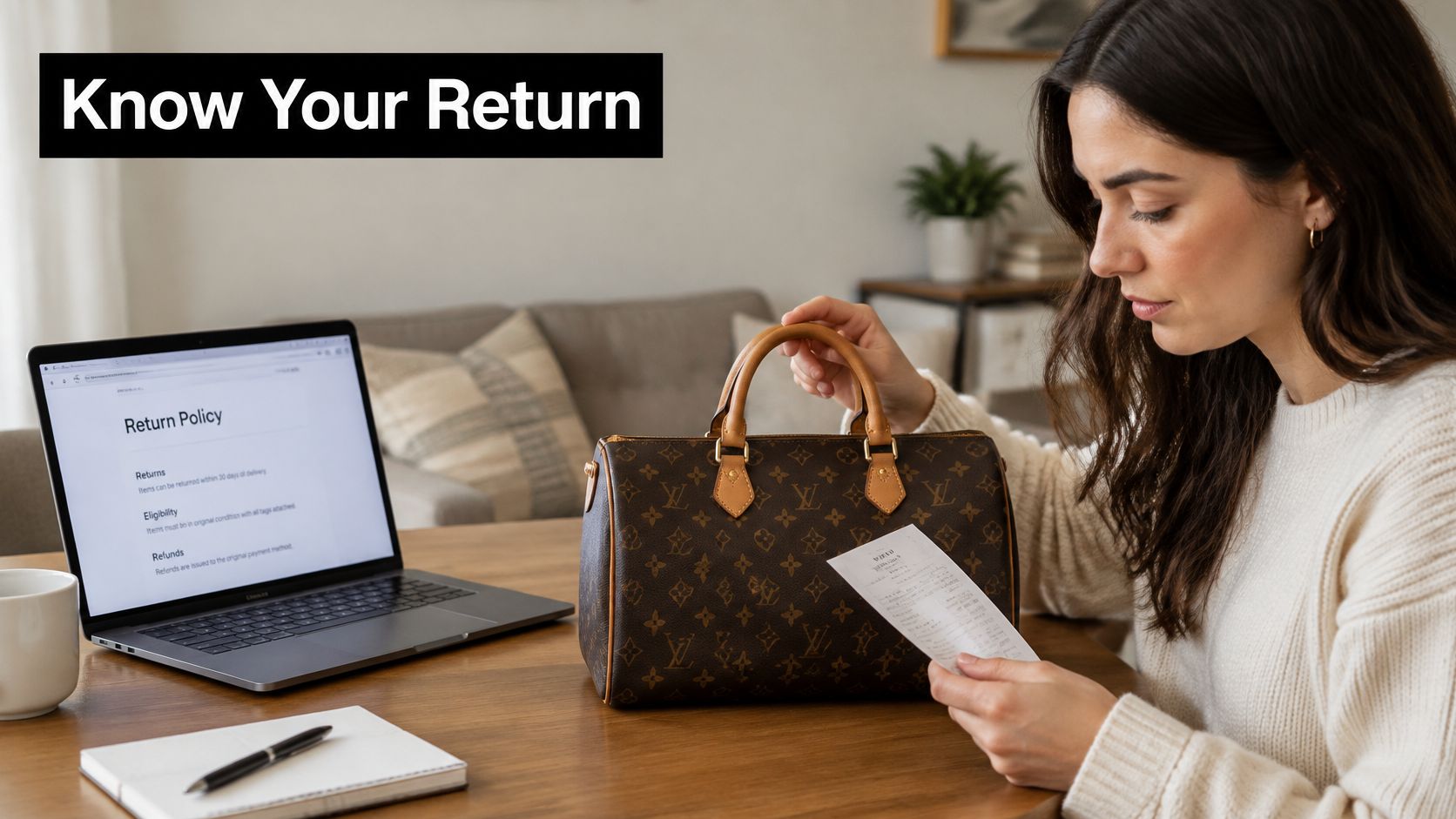
Our window is short and specific. Used items purchased in-store can be returned within 1 day of purchase, so inspect hardware, lining, handles, and structure at the counter and again as soon as you get home. You can review the terms on our refund policy page before you buy. We also hold a zero-tolerance policy for counterfeit or knock-off products, which means authenticity isn't left to a seller's assurance.
Why Confidence Isn't Protection
Buyers overestimate their own screening. Reporting on UK Intellectual Property Office research into pre-loved counterfeits found one in four UK pre-loved clothing buyers unknowingly purchased a counterfeit online in the previous year. The same reporting found 63% believed they could identify a fake, yet one-third did not check authenticity before buying, and nearly 60% reported quality, deterioration, or refund problems after the purchase.
Those numbers explain why a platform badge or an authenticity card shouldn't end your questions. Ask who authenticated the bag, what method they used, what happens if an independent reviewer disagrees, and how many days you have to raise it. Get the answers in writing while the seller still wants your payment.
Keep a Dispute File From Day One
Build the file before there's a problem, because reconstructing it later is where buyers lose.
- Listing record: Save screenshots of photos, price, and condition claims.
- Seller messages: Keep every promise about authenticity, flaws, and returns.
- Payment proof: Retain receipts and transaction references.
- Arrival photos: Photograph the bag, packaging, and any flaw on the day it arrives.
If a refund is approved and you need to follow its progress, the Compass+ guide to tracking refunds lays out how to monitor the payment side step by step. Keep that alongside your transaction reference so you're not relying on memory or a seller's timeline.
If a bag fails inspection, act inside the return window, not after it. Contact the seller or store, send the dispute file, state the specific discrepancy, and request a refund or an independent opinion before the window closes. Calm, dated, documented beats certain and undocumented every time.
Confirm the Bag and Book Your Visit
Turn all of that checking into a short plan you can run this week. The goal is simple. Arrive knowing which bag you're inspecting, what it should cost all in, and what would make you walk away.
Your Five Step Plan
- Shortlist two or three listings. Match them against the model, size, material, and budget you've already priced against recent sales. A shortlist stops you from stretching your rules for the only bag you're emotionally attached to.
- Note which store each listing names. Boise, Meridian, and Nampa hold different stock, and a bag listed at one location won't be waiting at another. Write the store next to each listing so your calls and your trip go to the right place.
- Call that store before you travel. Confirm the bag is still available, because used pieces are often one of a kind and published inventory changes as items sell. You can browse published inventory online and then confirm an item is still available at its store, or contact a store about a specific item you need.
- Ask for the paperwork before payment. Request the authentication record, the written condition description, and the return terms, then compare the total against your all-in figure. If a seller can't produce those three things, you don't have a chain of evidence yet.
- Run your inspection in person. Work through color, edges, handles, hardware, lining, odor, and structure, and keep dated photos for your file. Test the bag empty and loaded, because zippers and clasps behave differently under weight.
> Buy only when the documented chain of evidence, the all-in price, and the return path all check out.
If any one of those three is missing, you're not buying a bargain. You're buying the risk the seller didn't want to carry. Another bag in that model will surface, and it'll surface with better evidence or a better price.
That patience is the whole skill when you buy designer bags second hand. Sellers count on urgency, on the fear that this exact bag won't appear again. Sometimes it won't. Paying too much for the wrong one still costs more than missing it.
---
Browse our current designer handbags online, note the store named on the listing, and call ahead so we can confirm the bag you want is still on the shelf in Boise, Meridian, or Nampa. Every handbag we sell goes through luxury authentication with Entrupy certification and carries a full authenticity guarantee, so you can inspect condition and paperwork in person before you commit. Start your shortlist today at Idaho Pawn & Gold Exchange.