925 means the silver is 92.5% pure, or 925 parts pure silver in every 1,000 parts by weight, and that ratio is the sterling silver standard. It's a fineness figure, not a weight and not a price, so a 925 stamp never means 925 grams and never tells you what the piece in your hand is worth.
You've probably got that piece within reach right now. A chain from a drawer, a ring that no longer fits, a serving spoon from a parent's house, and somewhere on the metal there's a number too small to read without tilting it toward the light. You want to know whether it's worth the trip to a buyer, and whether that tiny mark settles the question.
It settles part of it. A fineness mark is a claim about composition, and a claim is worth checking before money changes hands. What follows is the plain version of what the number means, how the arithmetic works out in grams, where the mark shows up on real objects, and how to separate solid sterling from a plated imitation dressed up with the same digits.
What 925 Means on Silver
A 925 stamp states that the metal is 92.5% silver. The silver hallmark reference compiled on Wikipedia puts it precisely: 925 parts pure silver out of every 1,000 parts by weight, with the other 7.5% made up of a different metal, most often copper. Copper raises hardness and durability, which matters because near-pure silver is too soft for rings, chains, bracelets and functional objects that get handled every day.
Fineness is always expressed in parts per thousand. That's the piece most first-time sellers miss. The number describes a proportion, so it can't also describe a mass, a price or a brand. A heavy platter and a tiny pendant can both carry 925 because both are 92.5% silver. A 925 stamp tells you nothing about how many grams sit in your hand, and it doesn't set the dollar figure a buyer will offer.
In the United States, sterling silver is the term for products containing at least 92.5% pure silver, and an article may display 925 to express that same ratio. The rule gives you a floor to work from, not a guarantee about any particular object.
Run the math once and the number stops being abstract. Take a 10-gram ring stamped 925. It theoretically contains 9.25 grams of pure silver, and that figure comes before you subtract manufacturing tolerances, set stones, solder joints, plating or any other non-silver component. If the ring has a large cubic zirconia and a repaired band, the recoverable silver is lower than 9.25 grams. Same stamp, different metal content.
> The short version: 925 is a purity ratio, not a weight or a price.
That 7.5% of other metal is also the reason a genuine piece can darken, leave a faint mark on skin, or fail to match the bright white of a fresh polishing cloth. Those behaviors come from the alloy, not from fraud.
Silver Markings Chart from 800 to 999
Every silver number you'll meet works the same way. The digits are pure-silver parts per thousand, so 800 means 80% silver and 999 means 99.9%. Higher numbers cost more per gram and behave differently in the hand and on the polishing cloth.
| Stamp | Common name | Typical items |
|---|---|---|
| 999 (99.9% pure) | Fine silver | Bullion bars, rounds and investment pieces |
| 990 (99% pure) | High-fineness silver | Specialty bullion and artisan work |
| 970 (97% pure) | High-grade silver | Some antique and international pieces |
| 958 (95.8% pure) | Britannia silver | British premium tableware and commemorative pieces |
| 950 (95% pure) | 950 silver | French and European antiques, fine flatware |
| 925 (92.5% pure) | Sterling silver | Rings, chains, bracelets, earrings and modern flatware |
| 900 (90% pure) | Coin silver | Older American spoons, serving pieces and coins |
| 835 (83.5% pure) | Continental silver | Nordic and German household silver |
| 800 (80% pure) | 800 silver | German silverware and older European pieces |
Not every sterling piece spells out a number. These word-marks mean the same 92.5% standard:
- STERLING or STER: the spelled-out version of 925, common on American jewelry and flatware.
- S925: a frequent stamp on imported silver jewelry, where the S stands for silver.
- 925 Silver or .925: the same ratio with a decimal point or a descriptive word attached.
- Lion passant: on British silver, this walking lion figure stands for 925 sterling, as the Sheffield Assay Office hallmark guide sets out.
Then there are the marks that imitate silver without being silver. Learn these four and you'll avoid most of the disappointment:
- EPNS: electroplated nickel silver, a silver skin over a nickel alloy base.
- EPBM: electroplated Britannia metal, a pewter-family base with silver plating.
- Silver Plated or Silverplate: a thin coating, with the thickness rarely stated on the piece.
- A1: a plating quality grade from old Sheffield manufacturers, not a purity figure.
> How to read any hallmark: take the number together with whatever sits beside it. A maker's mark, assay-office symbol or date letter changes what you know about the piece far more than the digits alone.
Real Examples of 925 Marks on Jewelry and Silverware
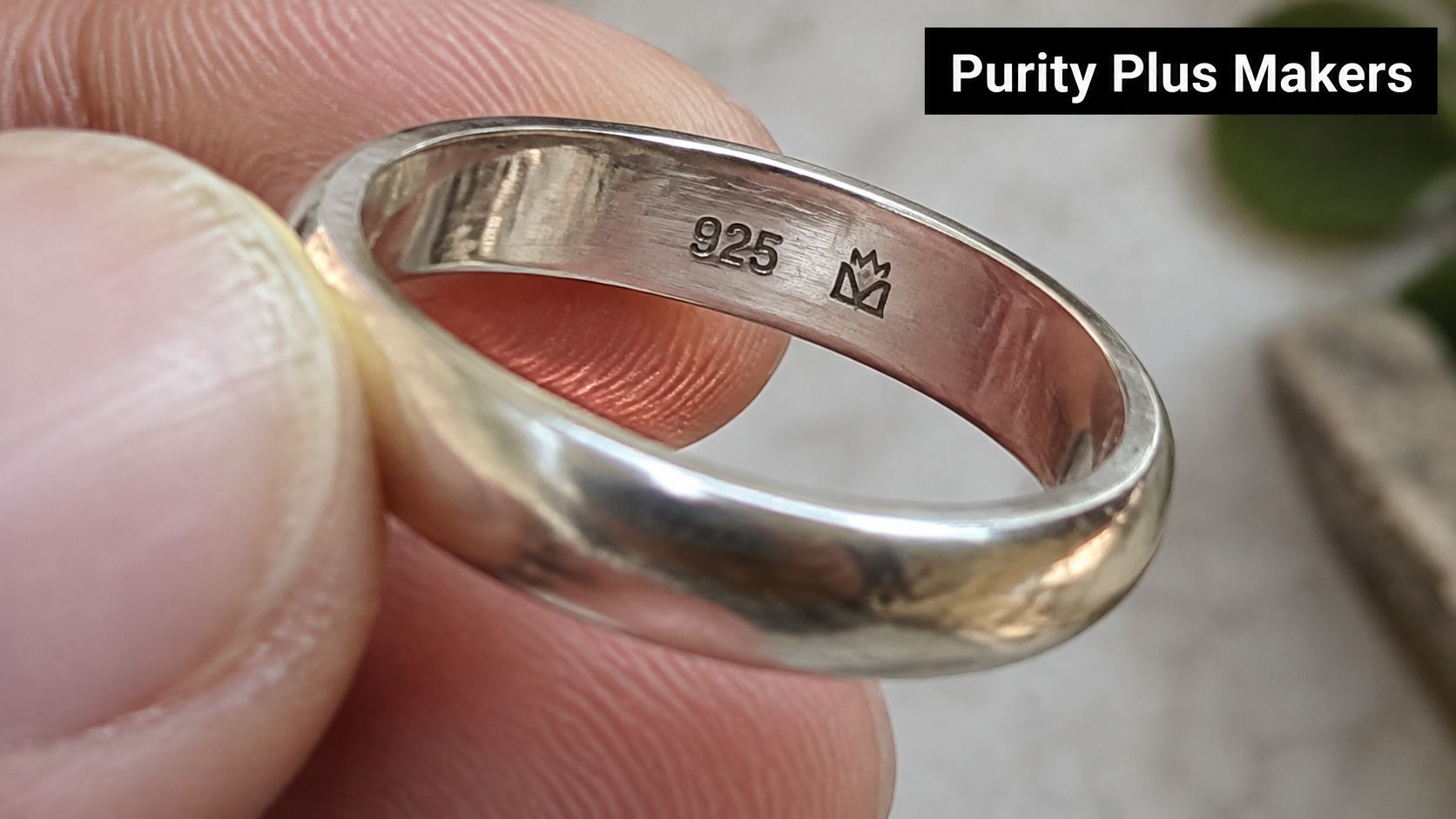
A modern sterling ring usually tells its story in two tiny impressions on the inside of the band. One reads 925. The other is a small maker's mark, sometimes just initials, sometimes a logo. The number states the alloy; the maker's mark names the company standing behind it. When you see both, you're looking at a piece that was struck the way U.S. guidance expects, with the quality claim and the responsible party side by side.
The 925 standard isn't a local convention. The International Convention on Hallmarks recognizes Ag 925 as one of its legal fineness standards, alongside Ag 800, 950-class standards in some systems, and Ag 999 fine silver. Participating assay offices apply a Common Control Mark after testing an article, and the mark itself identifies both the metal and the fineness in parts per thousand. That's why a piece assayed in one country can be read by a buyer in another without translation.
Move to a teapot and the same standard appears inside a bigger cluster of stamps. The Sheffield Assay Office record of its first 2024 hallmark describes a hallmarked teapot carrying 925 as the fineness mark for sterling, meaning 925 parts per 1,000 silver. Around that number sit the assay office symbol, a date letter and a maker's mark, and together they date and place the object.
Now pick up an antique British spoon with no number at all. It isn't a fake. British silver identification leaned on pictorial marks long before numeric stamps became common, as the convention's history explains. The lion passant signaled sterling, while a Britannia figure signaled the higher 958 standard imposed in Britain from 1697 to 1720, before sterling returned as the principal standard. An unnumbered spoon with a lion is sterling. One with Britannia is 958.
American flatware carries its own history. Coin silver spoons and serving pieces marked 900 or "coin" predate the shift to sterling as the dominant U.S. standard, and the lower number reflects the silver content of the coins silversmiths once melted down. If you're shopping new pieces instead, this guide to choosing a sterling silver chain by style and quality covers what to look for on the clasp tag.
The trap is the grand serving tray with a mark that looks official. EPNS in a neat rectangle reads like a hallmark to an untrained eye, and it stands for electroplated nickel silver. The silver is a microscopic skin over a base-metal core worth a fraction of solid sterling by weight.
How to Tell Genuine Sterling Silver from Silver Plate
A piece marked 925 makes a specific claim about its silver content, but the stamp alone cannot verify that claim. The Federal Trade Commission says silver, sterling and sterling silver should indicate at least 925 parts silver per 1,000. Its consumer guide to buying precious metal jewelry also explains that silver items should identify the company or person responsible for the mark. Rules govern how silver content and plating are represented; checking a particular object takes separate steps.
Start with simple checks, then use professional testing if the value warrants it.
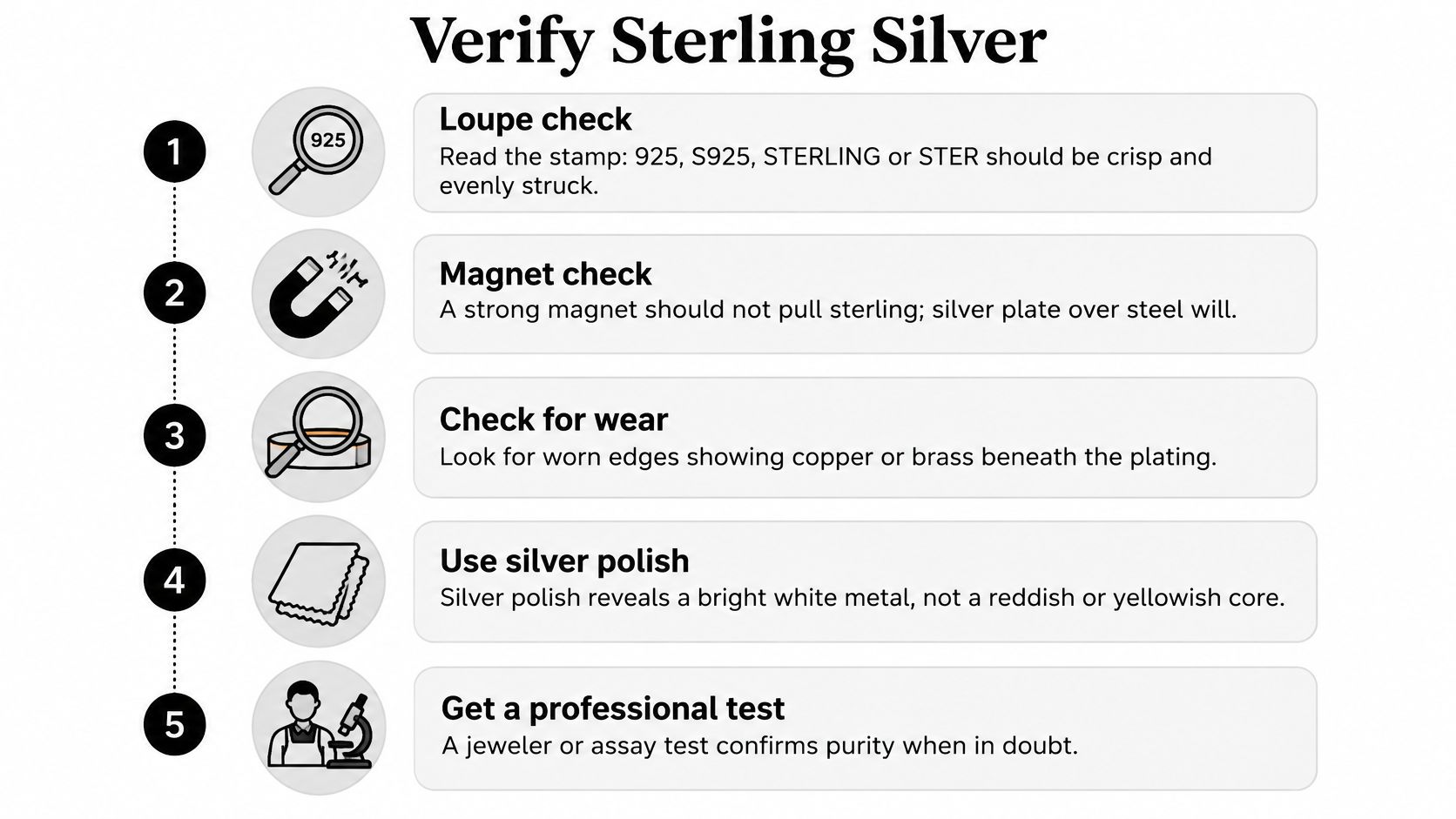
1. Inspect the stamp with a loupe or phone macro lens. Look for 925, .925, S925, STERLING or STER. A clear mark is easier to read, but even a crisp stamp is still a claim, not proof. Blurry, off-center or misspelled marks deserve extra scrutiny.
2. Test with a strong magnet. Silver is not magnetic, so a firm pull can point to steel or another magnetic base metal. A lack of attraction does not prove an item is silver, since brass and copper are also non-magnetic. Test the main body, too: a genuine sterling piece may have a magnetic spring, pin or clasp.
3. Compare the weight with a similar-sized item. Sterling can feel heavier than nickel silver, pewter or thin plated brass of the same dimensions. This is a rough comparison, not a measurement. A scale cannot identify the metal either, but it can give you a precise weight for a later estimate.
4. Check edges and other high-wear spots. Examine ring shanks, chain links, tray rims and the backs of pendants. Plating may wear away at these points, revealing a brass, copper or gray core. A uniform silver-colored surface is encouraging, but it does not rule out plating.
5. Listen to larger pieces. A tap may produce a clear ringing tone from solid silverware, while some plated base-metal pieces sound flatter. Treat this as a clue, not a verdict: shape, thickness and construction affect the sound.
6. Use a silver acid kit only if you accept the risk of damage. The test requires a small scratch to expose the metal beneath the surface. A creamy-white reaction is consistent with silver; green can indicate base metal. Choose a hidden spot and follow the kit's instructions for neutralizing and rinsing. Since the test can leave a mark, avoid it on pieces you want to preserve.
7. Consider an X-ray fluorescence (XRF) scan when the value justifies professional testing. XRF analyzes metal composition without cutting, scratching or dipping the piece. It reads the surface layer, however, so heavy plating can make a reading misleading. Idaho Pawn & Gold Exchange uses an XRF Analyzer that provides lab-quality results. Learn how XRF and Sigma Metalytics testing work.
A magnet, close inspection and careful comparison can screen out some obvious fakes. For a valuable or plated-looking item, ask about testing that accounts for the possibility that the surface and underlying metal differ.
Why the Alloy Exists and What 925 Cannot Tell You
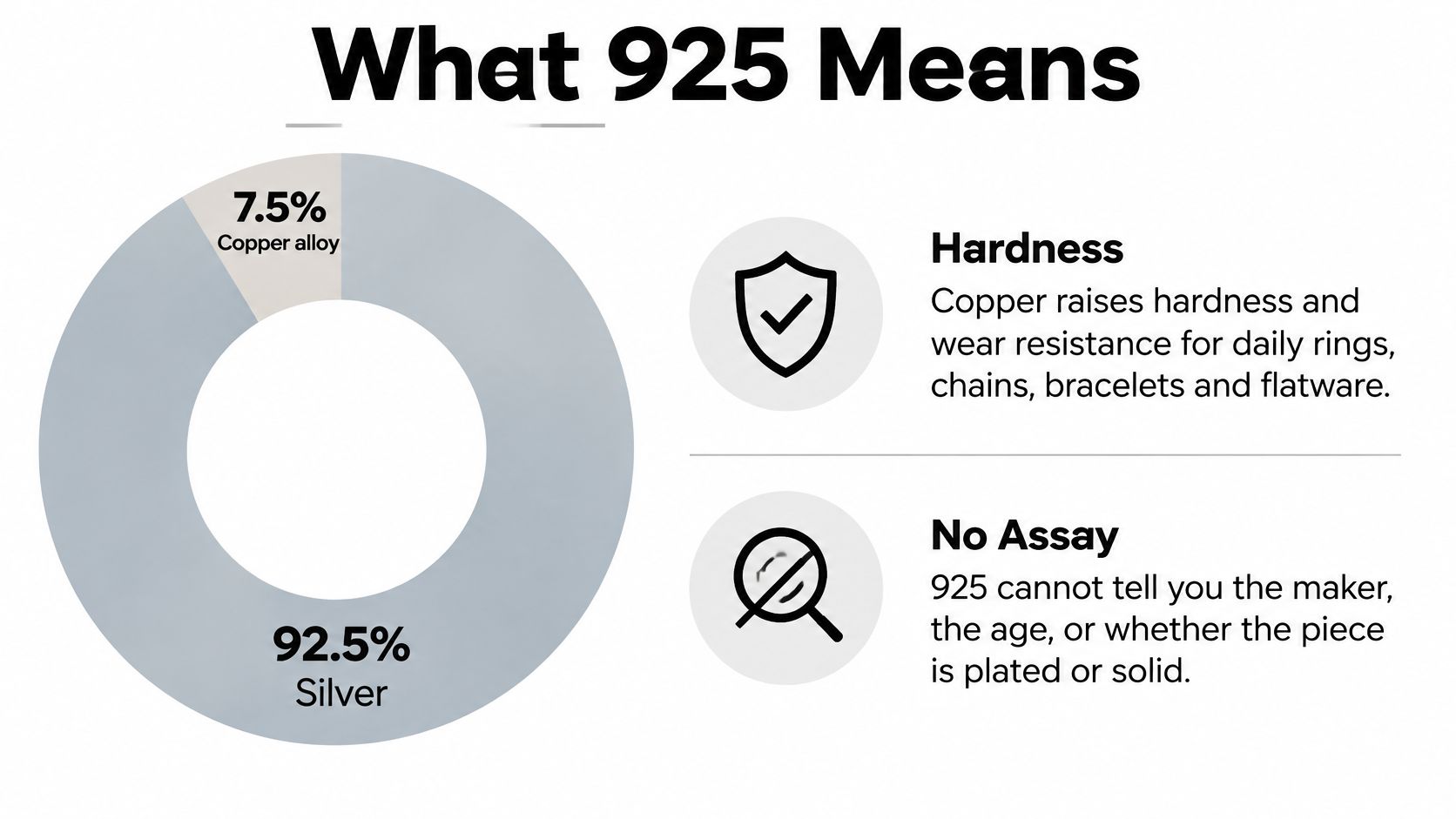
Nearly pure silver is soft. It bends, dents and scratches, so a 999 ring would lose its shape within months of daily wear. Alloying solves that. The FTC Jewelry Guides set 925/1,000 as the minimum silver content for describing an item as silver, solid silver or sterling silver, and they exist partly because the alloying metals are necessary: adding copper to traditional sterling increases hardness, wear resistance and form stability for jewelry and flatware. That copper is also why sterling tarnishes and why a snug ring can leave a green trace on skin in hot weather.
The math that turns a stamp into grams
The working formula is simple: estimated silver mass multiplied by 0.925 gives approximate fine-silver content, before you account for assay uncertainty, non-silver parts, and the buyer's refining or resale margin. A 20-gram chain holds about 18.5 grams of silver. A 100-gram piece holds about 92.5 grams, against 99.9 grams in 100 grams of 999 silver, assuming the mark is accurate and the full weight is silver alloy. That gap between 92.5 and 99.9 is what separates sterling from bullion, and it's why the two don't price the same per gram.
What the stamp cannot tell you
- It isn't a weight. A pendant and a platter both read 925. You still have to put the piece on a scale.
- It isn't proof of authenticity. Stamps can be counterfeit, incomplete, or applied to only one component of a mixed-metal item. A hallmark is evidence of claimed fineness, not a substitute for verification.
- It doesn't set the price. Value depends on recoverable silver mass, condition, design, brand and the prevailing silver market price, as India's Bureau of Indian Standards note on silver grades sets out. The stamp says nothing about the day's market.
- It doesn't name the maker, country or date. Those details live in the surrounding hallmarks and documentation.
- It isn't the only real silver. Coin silver at 900 and fine silver at 999 are genuine alternatives, and the BIS framework recognizes 800, 835, 958, 970, 990 and 999 grades alongside 925.
Because stamps can be counterfeit or applied unevenly, professional evaluation combines hallmark inspection with weight and dimensional checks, and, where economically justified, an assay. Destructive or laboratory testing may be needed when plating, solder or mixed-metal construction could distort a surface reading.
> Selling rule: estimate the fine silver first, then look up the live price, then decide whether the offer makes sense. The stamp is step one, never the whole answer.
Get Your Silver Tested Before You Sell
925 means 92.5% sterling silver, and the stamp on your piece is a claim worth confirming before money changes hands.
Certain moments call for a professional check rather than a kitchen-table test: selling or pawning a piece, settling an estate among siblings, insuring jewelry, or buying secondhand from a marketplace listing. Each involves a number you'll have to defend or accept. Our stores in Boise, Meridian and Nampa run free precious metal scans, so you can walk in with rings, chains, flatware or coins and walk out knowing what the metal is.
What a professional adds is measurement. Gold and silver estimates are based on weight, tested purity and a market reference in the same units, and testing is done with an XRF Analyzer that returns lab-quality results. That matters most for jewelry, because jewelry is usually weighed in grams and is usually an alloy, so the price per pure troy ounce can't be applied directly to the full weight of a ring or a chain. A 20-gram bracelet isn't 20 grams of sellable silver, and a proper estimate accounts for that before quoting a figure. This walkthrough on how gold and silver pricing works in Boise and Nampa shows how those figures come together before you accept an offer.
Do the free scan first. Then decide whether the offer is fair, whether you'd rather keep the piece, or whether it's time to sell.
---
Idaho Pawn & Gold Exchange buys and sells gold, silver, jewelry, coins, rounds and bullion, and we'll tell you exactly what your 925 piece contains before you commit to anything. Bring your rings, chains, flatware or coin silver to any of our Boise, Meridian or Nampa locations for a free precious metal scan and a no-obligation estimate, whether or not you decide to sell. Visit Idaho Pawn & Gold Exchange to see what else we evaluate, from luxury watches to designer handbags.