
The ring is in a drawer, the divorce paperwork is somewhere nearby, and the appraisal shows a number you'd be relieved to receive. Then a buyer makes an offer that's much lower. Before you decide the offer is unfair, find out what the appraisal measures and what the buyer is pricing.
Selling engagement rings after divorce works best as a documented financial decision, not a percentage-of-retail calculation. Confirm your authority to sell, establish exactly what you own, and compare what you'll keep after costs. You don't need to explain the marriage to get a useful valuation.
Confirm You Own the Ring Before You List It
You may have a ring purchased during the marriage, a decree that barely mentions jewelry, and an ex-spouse who still expects part of the proceeds. Wearing the ring doesn't resolve those competing claims. Neither does having the original receipt.
After a marriage has occurred, an engagement ring is commonly treated as a completed gift belonging to its recipient, but state law and divorce agreements can change the answer, as LegalClarity's explanation of ring ownership after divorce makes clear. An upgraded ring or a replacement purchased during marriage deserves particular attention rather than an assumption that it has the same status as the original gift.
Check the documents that control the sale
Read these documents together, not in isolation:
- Final decree: Look for language awarding jewelry, personal possessions, or specifically identified assets.
- Property settlement: Check whether you received the ring outright or owe an offset or share of its value.
- Marital-asset inventory: Find any description, photograph, appraisal reference, or identifying report number.
- Prenuptial agreement: Check whether gifts, heirlooms, or later replacements receive separate treatment.
For a Texas divorce, The Law Office of Bryan Fagan's explanation of how Texas divides marital assets provides useful context for discussing classification with your attorney. Don't apply another state's property rules to your own settlement.
If the ring appears as marital property, don't assume possession gives you unrestricted sale authority. A pending case or temporary order may restrict disposal, so ask your attorney whether listing or selling it would breach an obligation.
> Before listing: Get written confirmation of your authority to sell and any obligation to divide the proceeds. Another party's consent isn't a substitute for court approval when approval is required.
Tonight, pull the decree, search the asset schedules for the ring, and mark any unresolved claim. Keep the attorney's confirmation or appropriate written consent in your sale file.
How to Build a Sale-Ready Ring File
A buyer needs enough evidence to identify the ring, assess its condition, and explain an offer. A folder of attractive photographs isn't enough if the stone's identity is uncertain, and an old receipt doesn't establish its present condition.
Use this checklist to organize the paperwork before you carry the ring between buyers.
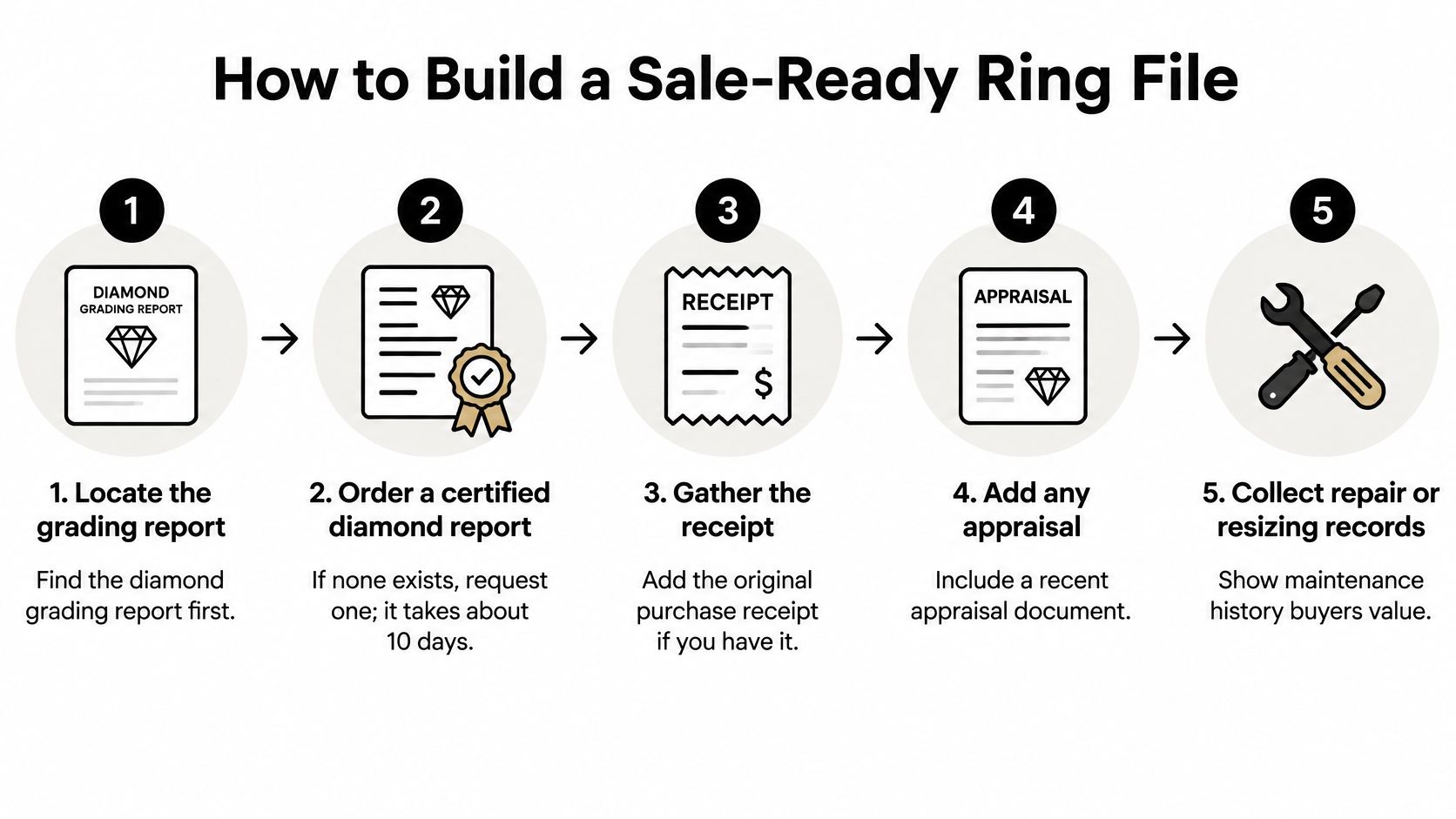
Assemble the evidence in order
- Locate the grading report. Search the purchase folder, email attachments, and the original jeweler's records, then check that the report describes the stone you're selling. If none exists, we can help obtain a certified diamond report, which takes 10 days; weigh that step against the likely usefulness of the report before committing to additional expense.
- Gather the receipt, appraisal, and service records. Include resizing, prong repairs, stone replacements, and other alterations, because the ring may no longer match its original description. Keep the documents separate and clearly labeled so a buyer doesn't mistake an insurance appraisal for a grading report.
- Photograph the ring systematically. Take sharp photographs from above and from the side, beside a ruler, and close enough to show the inside metal stamp and visible damage. Record total ring weight if you have an appropriate jewelry scale, but don't describe that measurement as the weight of the metal alone.
- Have an independent gemologist confirm the stone's identity and condition. Request the cut, color, clarity, and carat weight, along with an explicit identification as natural, laboratory-grown, or simulated. Our explanation of whether you can tell a real diamond by eye helps clarify why appearance alone shouldn't settle that question.
- Record qualifications and condition issues. Copy any reported treatments or fluorescence accurately, and note chipped edges, worn prongs, missing accent stones, and engraving. Buyers need to distinguish an ordinary cleaning issue from damage or an alteration that affects their resale options.
- Create a concise intake packet. Include your government identification, ownership statement and supporting confirmation, report number, metal purity, stone measurements, and photographs. Share identification through the buyer's intake process, not in a public listing, and retain your own copies of everything supplied.
> Carat weight alone isn't a complete description. Give buyers the evidence they need to explain how they priced the whole ring.
A complete file lets you compare offers on equal terms. If buyers disagree, you can ask which characteristic or condition issue explains the difference instead of negotiating against an unexplained number.
The Three Values Behind a Ring Offer
Value benchmarks and what each one tells you
| Benchmark | What It Measures | Who Uses It | Predicts Cash? |
|---|---|---|---|
| Insurance replacement value | Cost to replace the ring at current retail | Insurers and policy renewals | No |
| Fair-market value | Price between an informed buyer and seller, usually supported by a written appraisal | Estates, divorce settlements, and tax records | Only a starting point |
| Expected cash or trade offer | What a dealer will pay today based on current wholesale prices | Sellers choosing a buyer | Yes for cash; trade credit isn't cash |
| Net proceeds | Offer minus cleaning, resizing, shipping, appraisal, and any consignment commission | The seller deciding whether to accept | Yes, this is the real result |
The most misleading document is often the most official-looking one: the insurance replacement appraisal. Its purpose is to estimate replacement cost, not to promise that a dealer will buy your ring for that amount. A detailed appraisal can still be useful identification evidence without being a useful cash target.
A dealer buying for resale has to account for acquisition cost, preparation, and the risk of holding inventory. A private buyer may evaluate the ring differently, but their advertised alternatives still matter. Neither buyer owes you the original retailer's margin.
Why lab-grown stones need a fresh valuation
A laboratory-grown diamond can be attractive, documented, and recently appraised while receiving a disappointing cash offer. National Jeweler reported a **14% year-over-year decline in wholesale lab-grown diamond prices in the first quarter of 2026**, including a **28% drop for three-carat rounds**. Those are wholesale market measures, not a formula for discounting your particular ring.
The practical consequence is that an older valuation may reflect replacement options that a buyer can now obtain more cheaply. Don't treat a high online asking price as proof against a lower offer, either. An unsold listing tells you what someone wants, not what a buyer has paid.
Precious metal and diamond values are determined by current market dealer prices. Our explanation of how gold prices work provides context for the metal portion, but a finished ring also requires a separate assessment of its stones and condition. Ask when the quote expires rather than assuming it remains available indefinitely.
Make the gap explainable
Obtain independent written valuations and ask the evaluators to reconcile meaningful differences. The explanation may involve the grading laboratory, fluorescence, treatments, mounting condition, missing documents, or different assumptions about the selling channel.
We review each diamond for color, cut, clarity, and carat, and discuss the appraisal with the customer before a sale. Ask for an itemized offer separating stone and metal, plus distinct cash and trade figures if both are available. That makes the appraisal-to-cash gap visible and prevents store credit from being mistaken for money you can use elsewhere.
How a Divorce Story Shapes Buyer Offers
A listing built around the wrong marriage asks the buyer to think about your relationship before they evaluate the ring. That may feel honest or cathartic, but it doesn't give them a reason to pay more.
The personal note can become more prominent than the jewelry itself.
University of Toronto researchers analyzed approximately **1.5 million eBay listings for diamond solitaire engagement rings over a 13-month period** and found that listings without a disclosed negative relationship history were more likely to sell and generally achieved higher prices. In a separate attitudinal survey described in the same account, respondents considered divorce-associated diamonds more likely to be authentic, yet were reluctant to pay a comparable price.
Separate personal meaning from product information
That finding doesn't establish a universal divorce discount, and it doesn't justify misleading a buyer. It shows why a negative relationship narrative can work against an otherwise credible product description.
Lead with the grading report, metal purity, measurements, and condition. Answer legitimate questions accurately, but don't turn the listing into an explanation of who ended the marriage or why.
This video provides another way to engage with the subject.
Keep factual disclosures prominent: FTC guidance on diamonds and gemstones requires clear qualification for laboratory-created and simulated stones. Neutral marketing means removing unnecessary emotional framing, not removing information that affects what the buyer is purchasing.
If deciding what to do with the ring raises family tensions, Interactive Counselling's support for families navigating divorce offers a separate place to address those concerns. A buyer's negotiation isn't the right setting for resolving them.
> Test each listing sentence: Does it help someone verify the ring, or does it only tell your story?
Where to Sell and Turn Offers Into Net Proceeds
Sale routes compared for a divorce ring
| Route | Speed | Payout Pattern | Costs to Subtract | Best For |
|---|---|---|---|---|
| Direct sale to a jeweler or pawn shop | Potentially completed during the visit after evaluation | Agreed purchase amount rather than a share of a later sale | Any preparation, appraisal, or travel costs | Sellers who prioritize certainty and prompt payment |
| Consignment | Payment follows a successful sale | Agreed share of final sale price | Commission, insurance, photography, shipping, and return-related costs | Sellers with documented rings who can wait |
| Auction | Follows the auction schedule and settlement terms | Winning bid subject to reserve and contract terms | Seller fees, shipping, insurance, and any applicable unsold-item charges | Unusual or high-value pieces suited to the auction's buyers |
| Private sale to an individual | No guaranteed completion date | Negotiated payment from the buyer | Advertising, payment processing, shipping, insurance, and time | Sellers prepared to manage screening and transaction risk |
A published account from Wealthysinglemommy describes a California divorcee who sold a **1.5-carat engagement ring in 2023 for $2,500**, against a reported **2012 retail value of $10,000**, or **25% of the original retail price**. That's an individual transaction, not a resale rule. Its useful lesson is that the old retail figure and the eventual purchase offer can be very different.
Compare money kept, not headline offers
Use a written calculation for every route:
Net proceeds = sale proceeds − all seller-paid costs
For a hypothetical comparison, suppose a direct buyer offers a lower amount but requires no further preparation. A consignment business proposes a higher listing price, but you must subtract its commission, photography, insurance, and shipping before comparing the alternatives. The listing price isn't guaranteed, and payment won't arrive unless the ring sells under the agreed terms.
Run the slower route using both the hoped-for sale price and the lowest price you'd authorize. If it only beats the direct offer at an optimistic price, you're accepting uncertainty for a possible gain, not securing a better result.
Don't spend on resizing or cosmetic work just because it might make the ring easier to display. Ask whether the work changes the offer enough to recover its cost. A future wearer may need a different size, and a dealer may prefer to arrange repairs through their own workshop.
Read the transaction terms
For consignment, get the commission, minimum acceptable price, markdown authority, insurance responsibility, withdrawal terms, and payment trigger in writing. Establish who holds the ring and what happens if it's damaged, returned, or left unsold.
At auction, distinguish seller deductions from the buyer's premium. A buyer's premium is generally charged to the purchaser, although it can influence how much they're willing to bid. Read the actual seller agreement instead of subtracting every fee mentioned in an auction advertisement.
For a private sale, arrange a secure inspection and a payment method you can verify independently. Don't release the ring based on a payment screenshot or an email claiming funds are pending. If you ship, confirm insurance coverage for jewelry and the carrier's requirements before accepting payment terms.
- Record custody: Obtain a receipt whenever you leave the ring for evaluation or sale.
- Record the offer: Keep the date, amount, expiration, deductions, and proposed payment method.
- Record the description: Make sure the offer identifies the ring and states whether its center stone is natural, laboratory-grown, or simulated.
Choose certainty deliberately
An outright sale and a pawn loan aren't interchangeable. If your goal is to dispose of the ring permanently, request a purchase offer rather than borrowing against it.
Our estate jewelry and diamond buying information provides context for bringing jewelry in for assessment. Selling an item to us starts with an in-person store evaluation, and you decide whether to accept the offer. Diamond authentication testing is free.
If the ring belongs to a wider estate collection, we provide a free estate evaluation over the phone or at our Boise or Nampa location after discussing the estate buying needs. That preliminary estate conversation is different from the in-person evaluation required to sell an individual item.
Accept a lower immediate offer only when the certainty and avoided ongoing costs are worth more to you than the expected net result of waiting. Today, pull your grading report and request a written purchase offer. Compare what you'll keep, when you'll receive it, and what must happen before payment becomes final.
---
Idaho Pawn & Gold Exchange offers in-person ring evaluations and free diamond authentication testing, with the appraisal discussed before you decide whether to sell. Bring your ring, grading report, and ownership documentation to Idaho Pawn & Gold Exchange to review an offer against your net-proceeds goals.