
The most popular advice about sell diamond ring calculators is to treat the number they produce as a real offer. It isn't. A calculator is a structured estimate, and the moment you understand that, you can use one properly instead of being disappointed by the gap between the screen and the cash.
Most tools fail because they collapse four separate valuations into a single figure. They mix the diamond, the metal, the design premium and the deductions that a buyer will apply, then present one opaque number with no explanation of where it came from. That number is almost always a retail-side figure, and it will run well above what anyone hands you across a counter.
A better approach is to separate the estimate into line items you can check. The Gemological Institute of America's 4Cs framework, which the institute dates to its founder Robert M. Shipley in the 1940s and formalized with the D-to-Z color scale in 1953, gives you a standardized starting point for the stone (GIA). It does not give you a cash price. The work of turning grades into money happens in the open, one line at a time.
Four Line Items and the Metal Math Behind Them
Split the calculator into four lines before you treat the total as money you can spend. Line one is the diamond, from verified 4Cs and comparable sales. Line two is the metal, from alloy purity and weight. Line three is the setting and design premium, and I add it only when the maker, hallmarks, or condition can be checked. Line four is the allowances: transaction cost, testing, refurbishment, and inventory risk. The screen total is those lines added together. A cash offer usually keeps the first two, trims or drops the third, and applies the fourth in full.
Metal content is arithmetic, and the order matters. Weigh the ring in grams and record the gross weight. Read the karat or fineness mark, such as 14K or 585, and treat the stamp as a starting point. Testing is what establishes what the piece contains. Convert karat to a fraction of pure gold by dividing by 24, so 14k is 0.583. Remove the weight of stones, solder, and other non-metal parts before you apply that fraction. Jewelry is usually weighed in grams and is usually an alloy, so the price per pure troy ounce cannot be applied to the full weight of a ring. Multiply the remaining metal weight by fineness, then by today's pure-metal price per gram, and write the date beside the result. A simple content estimate is weight times purity times the price per unit of pure metal. A look at precious metal pricing shows why the per-gram figure and the per-ounce figure are not interchangeable.
Take a 10-gram 14-karat ring set with a 0.50-carat natural round. The metal line is 10 × 14/24, about 5.83 grams of pure gold, and that figure still has to come down once the stone and other materials are removed. The diamond is a separate line. The GIA's guidance on diamond value defines clarity by the size, number, position, nature, and visibility of inclusions and blemishes, and cut by proportions, facet arrangement, polish, and symmetry.
Weight alone does not price the stone.
| Metal grade | Fineness (fraction) | Fine metal in 10 g |
|---|---|---|
| 10k gold | 0.417 | 4.17 g |
| 14k gold | 14/24 | 5.83 g |
| 18k gold | 18/24 | 7.50 g |
| 22k gold | 22/24 | 9.17 g |
| 24k gold | Effectively fine gold | 9.99 g |
| Platinum 950 | 950 parts per thousand | 9.50 g |
The common slip is an unverified stamp, or counting stones and setting hardware inside a heavy mount. Either one inflates the fine-metal weight, and that inflated line is one place the cash offer falls away from the calculator.
Price the stone on its own, add a premium only when you can verify it, then subtract the allowances. What is left is an indicative resale range, not a bid. Three checks show whether the tool is doing the work: each line item shows its inputs, the total is labeled indicative, and the missing variables are listed. For buyers comparing wholesale replacement costs, the HonHo Wholesale Jewelry pricing guide shows how metal and stone costs stack on the supply side. Wholesale replacement and a counter offer are different numbers. The gap is the allowances, plus any premium the buyer will not pay.
> Practical rule: if the calculator cannot show you the metal weight and the purity it used, it is not calculating. It is guessing.
Diamond Grades That Move the Number
Carat weight is one input, not a price. The GIA defines a metric carat as 200 milligrams, measured to high precision but reported to the nearest hundredth on standard grading documents (GIA 4Cs grading guide). Two stones of identical weight can differ widely in value because color, clarity and cut change rarity, visual performance and buyer demand. A calculator that multiplies a generic price per carat is not estimating your diamond. It is estimating an average diamond that may not exist.
Go factor by factor. Color on the D-to-Z scale moves the number because whiteness is scarcer at the top. Clarity depends on the size, number, position and visibility of inclusions, so a stone with a feather at the edge is not the same as one with a cloud under the table. Cut gets special treatment because GIA's round-brilliant system uses modeled proportions and observed light-performance data, and its evaluation incorporates face-up appearance, design and craftsmanship. A poorly cut stone can look dull next to a smaller, better-cut one.
Then add the secondary inputs a serious tool should request. Shape matters because non-round stones need their own comparables. Fluorescence can help or hurt depending on strength and color. Treatments listed on a report change what you own. And the stone-level baseline comes first, with condition and liquidity adjustments applied afterward, rather than baked into a single multiplier.
> The common mistake is treating carat weight as a price. It is a weight, and weight without grade tells you very little about what a buyer will pay.
An online tool cannot verify laboratory grading, treatments, authenticity or mounting condition. That is why the estimate should display an uncertainty range and ask for a report number or clear photographs. If you want to understand what a visual check can and cannot confirm before you rely on a photo-based estimate, this guide on telling a real diamond by eye is worth reading before you submit anything.
Origin and Paperwork That Set Estimate Confidence
The same ring can produce a high estimate or a low one depending on what you can prove. Natural and laboratory-grown diamonds are different product categories with different supply conditions, buyer perceptions and resale behavior. A calculator must ask for origin before it produces a number, and it should never blend the two into one pricing model. Blending them is how sellers end up with a figure that no buyer will honor.
Documentation is the second half of confidence. A recognized grading report verifies color, cut, clarity, carat weight, origin and treatments. A seller's own description verifies nothing. The table below shows how confidence changes with the evidence you can supply.
| Evidence | What it verifies | Confidence |
|---|---|---|
| Recognized grading report | Color, clarity, cut, carat, origin and treatments | High, shown as a range |
| Other lab or appraisal | Stated grades and sometimes origin | Medium, check the issuer |
| Seller description only | Nothing independently verified | Low, shown as provisional |
| Photos only | Setting condition and visible features | Low, needs in-person check |
Missing or outdated paperwork does more than lower confidence. It moves the estimate from a documented market figure to a provisional one and adds an authentication step before any offer becomes real. Record the report number if one exists, and keep the loose-stone value separate from the total ring value, because the setting and the stone are valued on different logic.
> What to bring: the grading report or its number, any purchase paperwork, and clear photos of the stone, the setting and every hallmark inside the band.
Why the Calculator Value Runs Above Cash Offers
The gap between the calculator figure and the cash offer is not a scam. It is the difference between a retail-side benchmark and a liquidity price. A calculator can show replacement value at current retail, a comparable-listing price, a trade-in credit, a private-sale estimate and immediate cash. Most sellers receive the immediate-cash number, and it sits at the bottom of that ladder by design.
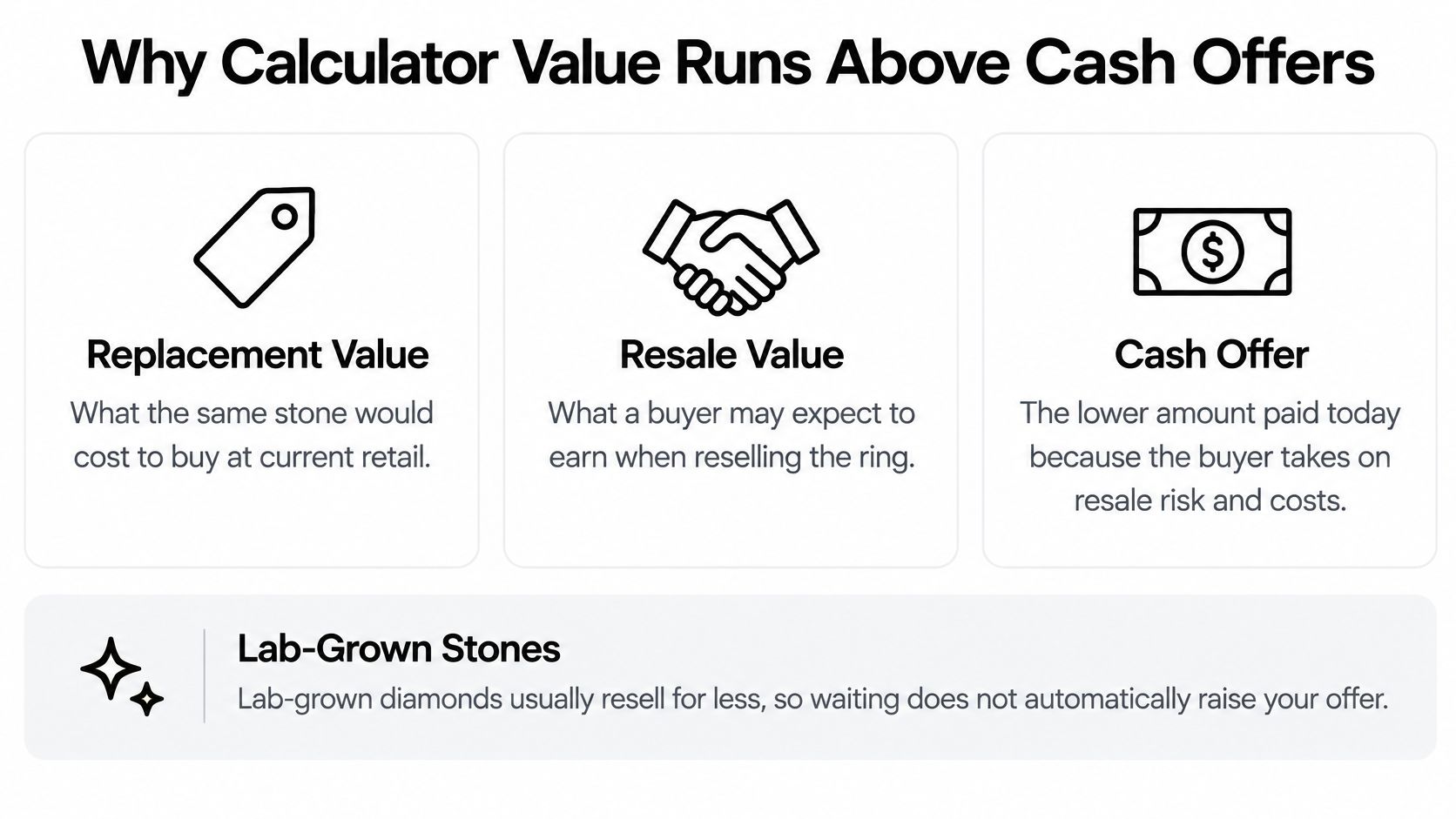
The 2026 benchmark material makes the range concrete. Natural-diamond jewelry resells at roughly 25% to 50% of original retail, while lab-grown resale runs roughly 10% to 30%, based on observed U.S. offer ranges from 2025 and the first half of 2026 (Brilliant Buyback resale report). The same source cites a standard one-carat diamond averaging about $8,007 in September 2021 versus about $3,898 in September 2026, a decline of roughly 51%. That comparison alone explains why a purchase price or an insurance appraisal predicts so little about what you can get today.
| Stone or measure | Typical resale or price | What it means for an offer |
|---|---|---|
| Natural diamond | 25% to 50% of original retail | A strong grade still resells for a fraction of retail |
| Lab-grown diamond | 10% to 30% of original retail | Lower share, with a volatile market |
| Standard one-carat diamond | About $8,007 (Sep 2021) to about $3,898 (Sep 2026), down about 51% | Past purchase price is a weak guide to today's cash |
Does lab-grown mean you should wait? Waiting is a bet on the market, not a fix. Compare net cash and time-to-sale instead of hoping the number moves. The setting may hold value through precious-metal weight, brand and recoverable stones more than through its original designer price, which is another reason a single blended figure misleads.
> Every estimate needs a date stamp and a volatility warning. A figure without a date is a rumor with a dollar sign.
How to Get an In-Person Appraisal and Offer
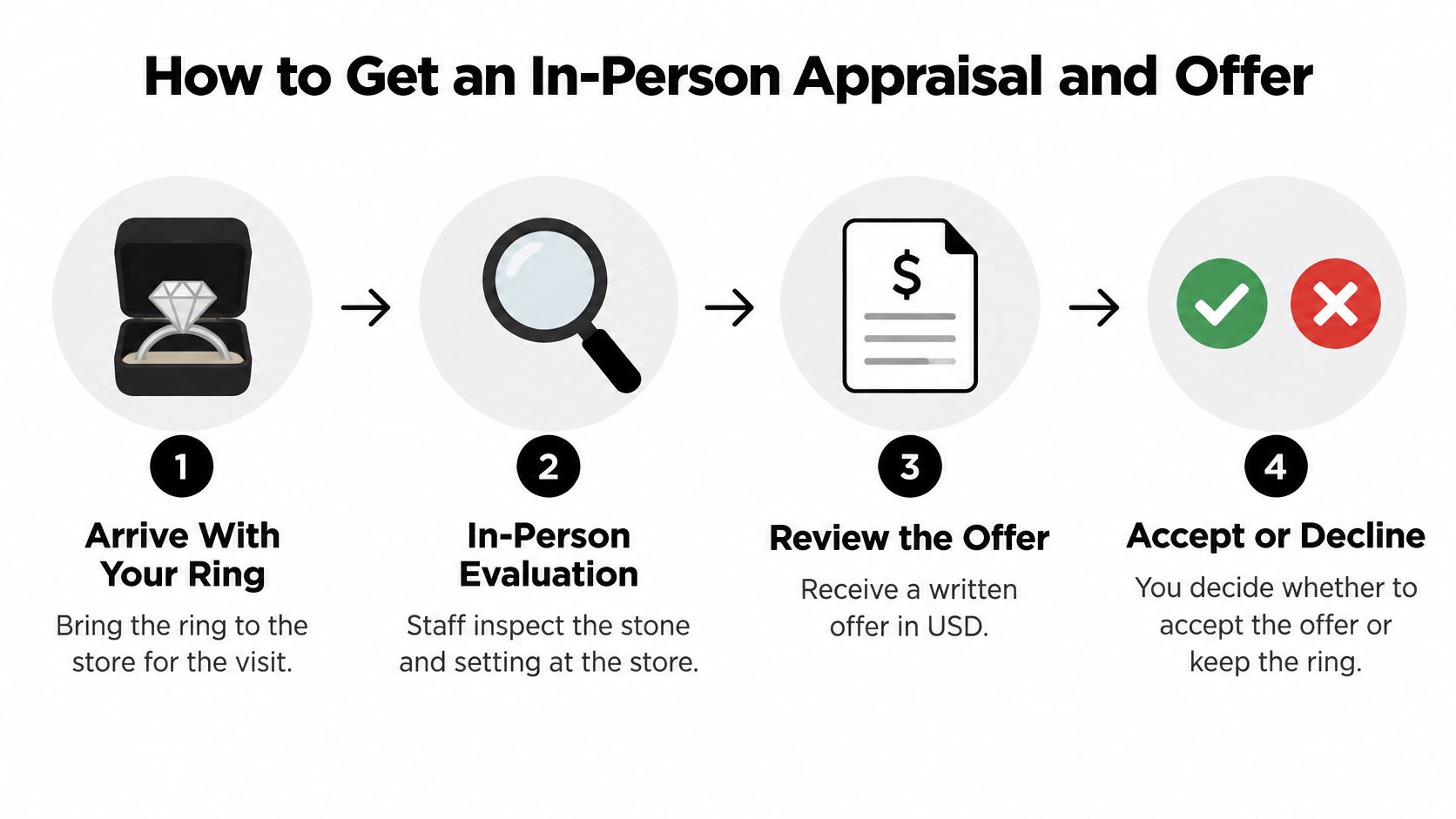
An in-person visit starts with an evaluation at the store, and you decide whether to accept the offer. That sequence matters because nothing before the visit is binding on either side. The calculator estimate walks in with you, and the appraiser either confirms its line items or shows you where they shift.
Six steps, each with a reason and the slip that costs sellers money.
- Bring the ring, the report and the paperwork. The grading report or its number, any purchase receipt and an earlier appraisal give the appraiser something to verify against. The slip is arriving with only the ring and a memory of what it cost.
- Ask for diamond authentication testing. This checks origin and treatments, and it is the step that separates a natural stone from a lab-grown one. The slip is assuming the paperwork covers it when the report is old or missing.
- Have the stone reviewed for color, cut, clarity and carat, and ask the appraiser to explain each grade. You are buying information as much as a price. The slip is accepting a grade you do not understand. When a grade is explained in plain terms, you can tell whether the deduction against your estimate is justified or padded.
- Ask how the metal is valued. Precious metal and diamond values are determined by current market dealer prices, so ask for the date and the weight used. A simple metal-content estimate is weight multiplied by purity, then multiplied by the price per unit of pure metal. Jewelry is usually weighed in grams and is usually an alloy, so the market price per pure troy ounce cannot be applied directly to the full weight of a ring or chain. The slip is leaving the setting out of the appraisal entirely.
- If the stone has no report or the offer depends on the grade, ask about a certified report. Certified GIA gemologists inspect and appraise diamonds, and a certified diamond report takes 10 days. That wait is the trade-off: a firmer grade can support a firmer price, but it delays the cash. The slip is accepting an offer before the stone is tested.
- Compare the offer with your net-cash benchmark, then accept, decline or hold. You are not obligated to take the first number. The slip is deciding in the chair without a second data point.
A clear offer looks like the calculator output you should have received: separate lines for the stone, the metal and the deductions, with the date printed. When a line moves against the estimate, ask which input moved it. Weight, purity, grade and the dealer price on the day are the only levers, and each one can be checked. If you want to start the conversation before you visit, you can request a quote with photos and details, then bring the ring in for the evaluation that sets the number.
Decide Whether to Sell, Hold or Document Your Ring
The decision is not "what is my ring worth." It is "which option gives me the best net cash for the time and risk I can accept."
Sell now when the offer after deductions meets your net-cash benchmark and you do not need the paper value for insurance. Hold when the stone is natural and its value depends on a report you could improve, or when you need the ring for insurance rather than cash. An insurance replacement figure is not a sale offer, and treating it as one keeps sellers waiting for a number that never arrives. Document first when the ring lacks a grading report, the origin is unknown, or you have only a seller's description. Diamonds receive free testing to authenticate them, so there is little reason to guess.
Before you act, run three checks. First, date-stamp the estimate and the metal price it used. Second, confirm origin and any treatments in writing. Third, compare at least two offers against your net-cash number, not against the retail figure.
The calculator result is a starting point, not a guaranteed offer. Bring the report or its number to the visit and let the in-person evaluation do the work the screen cannot.
---
At Idaho Pawn & Gold Exchange, we evaluate diamond rings in person, review the stone's color, cut, clarity and carat with you, and explain how current market dealer prices shape the offer before you decide anything. We can also help obtain a certified diamond report when the paperwork is missing, and our team provides free diamond authentication testing so you know what you have. Visit Idaho Pawn & Gold Exchange to request a quote or stop by one of our Boise, Meridian or Nampa locations to turn an estimate into a real number.