
A typical pawnshop loan requires you to be at least 18, present a government-issued photo ID, and have the legal right to pledge the item. Your credit score isn't the gate, but that doesn't mean the shop skips verification.
The familiar advice to bring something valuable and collect cash leaves out the questions that matter at the counter. Can the clerk identify the property? Can you explain why you're entitled to pledge it? And does the written agreement tell you exactly how to get it back?
For borrowers in Boise, Meridian, Nampa, and nearby communities, pawnshop loan requirements involve both qualifying and protecting your right to redeem. The item gets you considered for a loan. The paperwork determines what you're agreeing to.
Why a Pawn Loan Skips the Credit Application
You bring a gold ring to the counter expecting questions about your employer and credit history. Instead, the clerk asks for identification, examines the ring, and asks how you acquired it. That's not a shortcut around underwriting. It's a different kind of transaction.
A pawnbroker holds property as security rather than relying primarily on your promise to make payments from future income. The clerk therefore needs to establish who you are, what the item is, and whether you can lawfully pledge it.
The basic counter transaction looks like this.
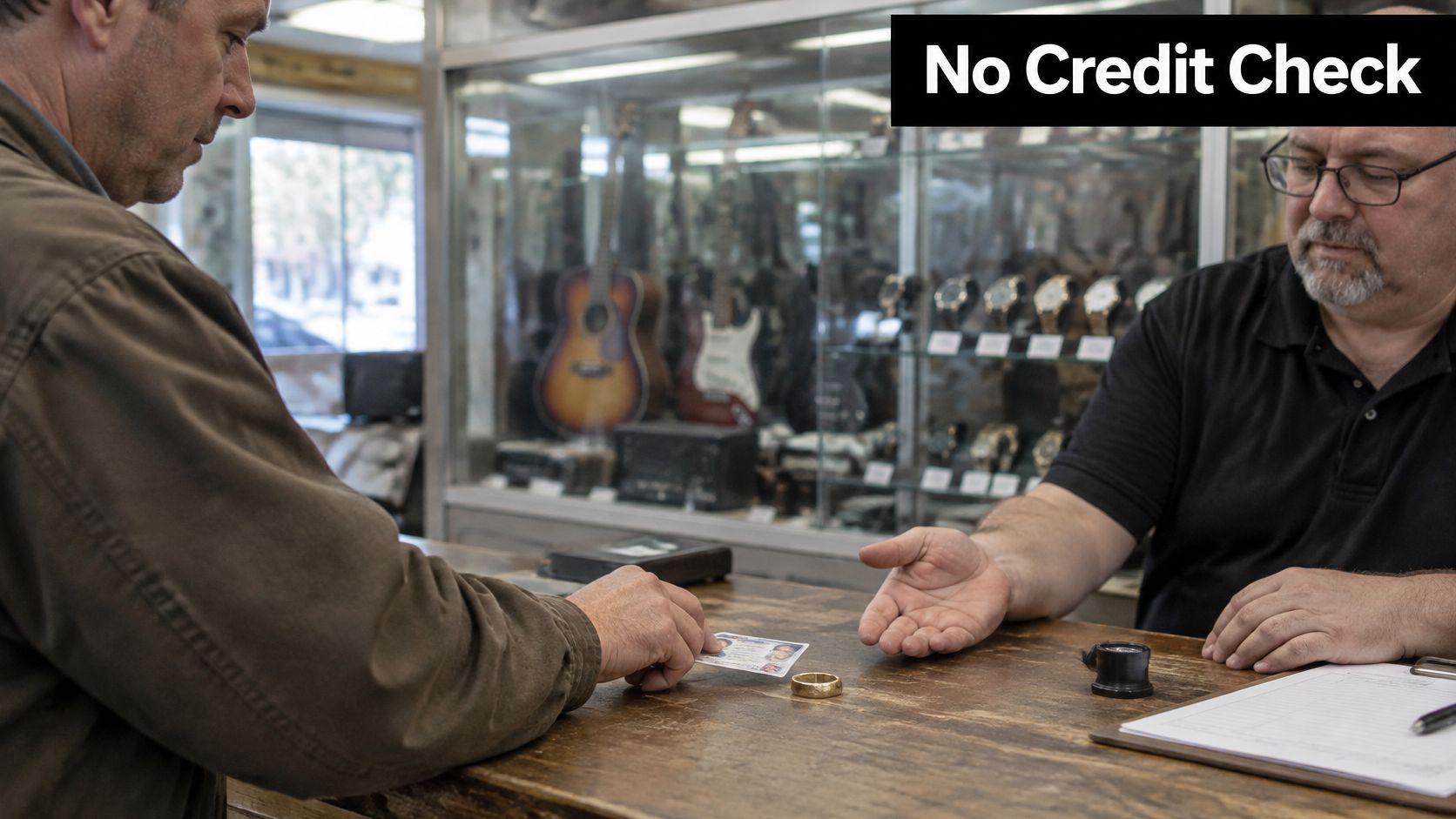
What replaces the bank application
Fremont County's pawnbroker requirements illustrate the verification involved: identification must include a photograph, transaction records are maintained electronically, and the customer receives a signed document stating the loan term and due date.
Think of the arrangement as a coat check with a financial obligation attached. The shop holds the item, the ticket identifies your claim, and paying the agreed redemption amount allows you to reclaim it. Unlike an ordinary coat check, failing to meet the agreement can mean losing the property.
At Idaho Pawn & Gold Exchange, we don't require a credit check to pawn or sell an item. For a pawn, you leave collateral, we offer a loan amount, and our process includes a 10-day grace period to repay. That grace period shouldn't be mistaken for the entire loan term.
> Practical rule: No credit check means the shop isn't using a credit score as the qualification gate. It doesn't mean anonymous borrowing or automatic acceptance.
The phrase also appears in unrelated financing contexts. If you're comparing it across purchases, the guide to no-credit-check acreage from Dollar Land Store concerns land, not pawn lending. Don't assume the same phrase means the same collateral arrangement or repayment rights.
Before leaving home, test your readiness against the actual counter requirements rather than preparing a bank-style application.
The Checklist That Decides If You Qualify
| Requirement | What satisfies it | What usually blocks it |
|---|---|---|
| Age | At least 18 years old, consistent with the eligibility described in the Texas consumer loan study | Under the adult eligibility threshold |
| Photo identification | Unexpired government photo ID, such as a state driver's license or state ID card | Expired ID, or a photocopy with no original |
| Right to pledge | Lawful possession and the right to leave the item as collateral | Stolen property, borrowing without authority, or ownership the customer cannot explain |
| Acceptable collateral | Personally owned tangible property such as jewelry, precious metals, electronics, or luxury goods | Incomplete or inauthentic property, or an item with weak resale demand |
| Value basis | Current condition and secondhand, wholesale, or resale value | Expecting a loan equal to the new retail price |
| Credit and income | Not standard prerequisites for a collateral pawn | Treating the visit like a bank application that needs a score, job, or pay stubs |
This is a preparation checklist, not a guarantee that every item will receive an offer. The shop still needs to accept the type of property you bring and establish enough about it to make a lending decision. An otherwise eligible customer can bring an item that isn't suitable collateral.
The Texas study describes an asset-backed advance without a conventional credit application and lists adulthood, acceptable identification, and the legal right to possess and pledge the property as eligibility requirements. That supports the basic distinction between a pawn and income-based borrowing, but Texas rules aren't a substitute for Idaho's local requirements.
Read the rows as separate checks
Your identification and your collateral answer different questions. A valid license establishes your identity. It doesn't establish that a watch belongs to you, that a handbag is authentic, or that an electronic device works.
Likewise, a receipt doesn't fix an expired ID. A valuable item doesn't remove the need to explain ownership. Preparing each part separately prevents the frustrating assumption that strength in one area excuses a missing requirement elsewhere.
For local age-related preparation, our guide to how old you have to be to pawn something in Idaho addresses that question directly. Bring the original identification you intend to use, rather than relying on an image stored on your phone.
Prepared versus not ready
A prepared customer brings a current state ID, a personally owned ring, and any available purchase or transfer paperwork. The clerk can concentrate on identifying and assessing the property instead of resolving avoidable documentation gaps.
A customer bringing an expired license and a borrowed watch without the owner's authority has separate problems. Renewing the license would address identity, but it wouldn't establish permission to pledge the watch.
Before requesting a cash figure, gather:
- Original identification: Check its expiration date and bring the document itself.
- Ownership information: Bring available receipts, transfer records, or estate documents.
- The complete item: Include relevant chargers, components, keys, or accessories.
Don't confuse a smaller-than-expected offer with rejection of your eligibility. Qualification and the amount offered are separate decisions.
Ownership Papers That Hold Up at the Counter
An ID proves who you are, not that the item is yours to pledge. That's the gap a simple requirements checklist can leave unexplained.
Credible's explanation of pawnshop loans identifies ownership documentation alongside identification as part of preparing for a pawn transaction. In practice, the useful paperwork depends on how you acquired the property, not just its category.
Use the following visual as a preparation aid, not a promise that a particular document guarantees acceptance.
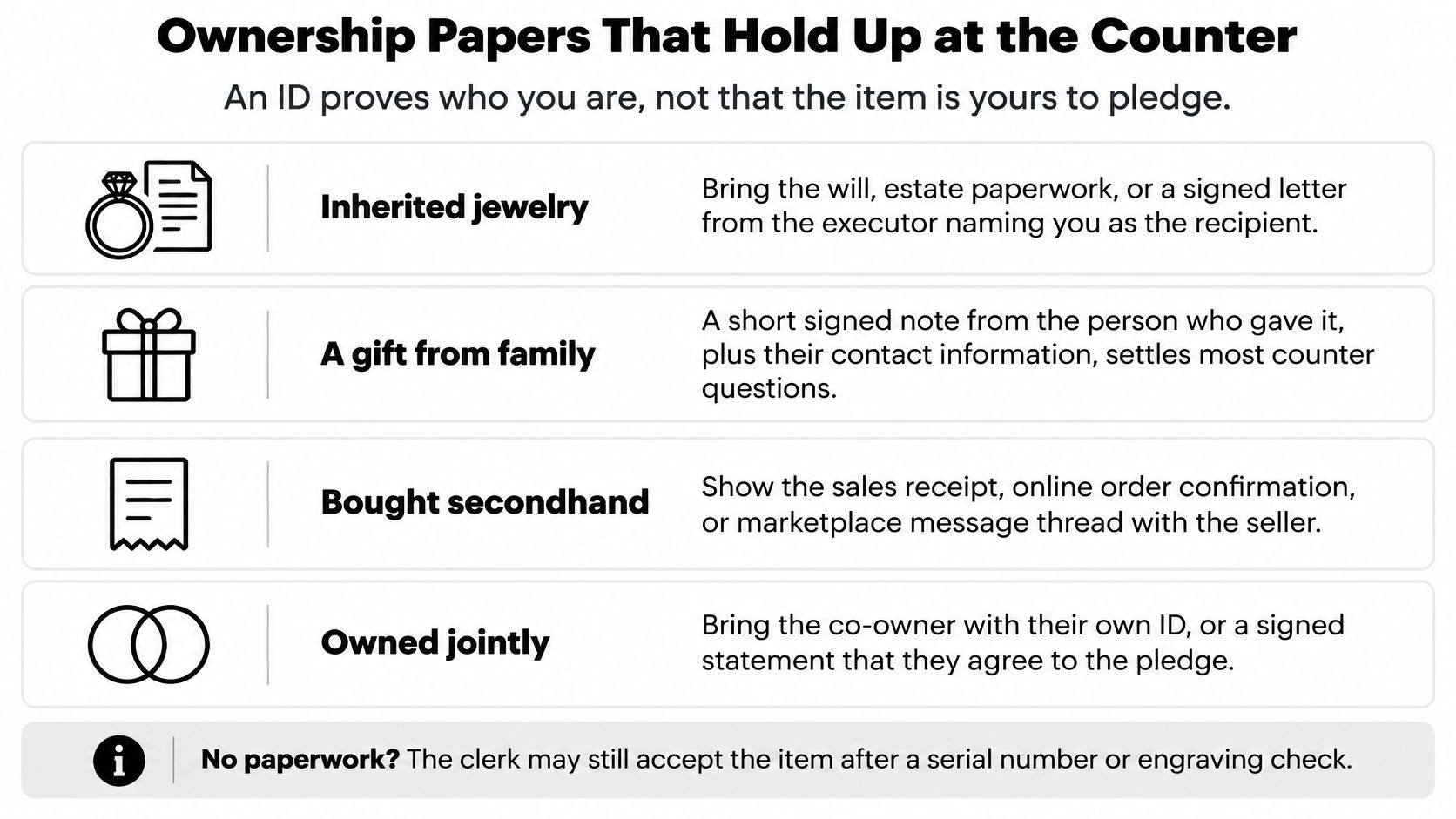
Inherited jewelry and family gifts
For inherited jewelry, bring a will, estate distribution paperwork, or correspondence identifying you as the recipient if those records exist. A family story may explain possession, but the clerk can still need clarification, particularly if an estate hasn't finished distributing property.
Don't assume that being related to the deceased gives you authority to pledge everything in the estate. Property you're holding for an executor or another beneficiary isn't necessarily yours to use as collateral.
A gift presents a different issue. The original receipt may name the giver rather than you, which isn't a reason to create replacement paperwork or alter a receipt. Explain the transfer and bring any genuine gift note or supporting communication you have.
> A missing receipt is a question to resolve, not permission to invent an ownership history.
Joint ownership and secondhand luxury goods
With jointly owned property, the question is whether you have authority to pledge it, not merely whether you helped pay for it. If that authority is unclear, resolve it with the co-owner before visiting. A co-owner's written consent may help explain the situation, but don't assume it settles every legal or store requirement.
For estate or secondhand luxury goods, separate ownership from authenticity. A sales receipt or marketplace conversation can help explain the transfer, while service records, serial numbers, original packaging, and authentication documents help identify the object.
An appraisal estimates worth. It doesn't, by itself, establish ownership. Similarly, a branded box doesn't prove that the watch inside it is authentic.
Accurate descriptions also matter when ownership is disputed. Our explanation of how pawnshops work to decrease theft provides context for why identification and item records deserve careful attention.
For a serialized phone or high-value watch, bring your unexpired photo ID, any genuine receipt or transfer document, and the serial number if available. Don't erase identifying marks or guess at a model number. Let the clerk record what can be verified.
How Condition and Resale Value Set the Cash
The offer isn't a refund of what you paid. A receipt can document a purchase, but it doesn't establish what another buyer would pay for the item today.
At Idaho Pawn & Gold Exchange, we base the loan amount on the item's current appraised value, current condition, and our ability to sell it. We use wholesale, resale, or secondhand value, not its new-store price. This explains why a well-documented purchase can still produce an offer below the owner's expectations.
A useful way to understand the assessment is to consider the questions a prospective secondhand buyer would ask. Is it genuine? Does it work? What's missing? Is this the exact version buyers want?
Authenticity comes before cosmetic appeal
A polished luxury watch with an uncertain identity poses a different problem from a visibly worn watch whose model and authenticity can be verified. Appearance alone can't resolve questions about replacement parts, branding, or the identity of the item.
The same distinction applies to jewelry. A clean, verifiable gold piece may support a stronger advance than a higher-priced fashion or luxury item whose materials or brand can't be confirmed. The original price doesn't remove uncertainty.
Condition then affects how the item can be resold:
- Wear and damage: Identify chips, dents, loose stones, broken clasps, or unreliable controls.
- Completeness: Include the charger, remote, detachable parts, or other components needed to use the item.
- Exact identity: Provide the model, material, and serial information you can substantiate.
- Buyer demand: Recognize that popularity when purchased doesn't guarantee current resale interest.
Condition assessment also requires distinguishing normal aging from repairs or damage. For a specialist example, HD Asian Art's guide to spotting cracks and repairs in bronze explains the kinds of details buyers examine in that category. It isn't a pawn eligibility guide, but it illustrates why a close inspection can matter more than surface shine.
Judge the offer against your purpose
We review the loan amount, costs, and due date with you before you decide. You can decline the offer. A cautious advance limits the shop's exposure if the item eventually needs to be resold, but you still need to decide whether the available cash solves your problem at an acceptable redemption cost.
Use the pawn loan calculator as a planning aid, then rely on the written agreement for your actual obligation. Ask what valuation basis supports the offer and whether missing components or uncertain authenticity affected it.
A modest offer may reflect the secondhand market rather than a problem with your identification. Knowing which issue limits the amount helps you make a useful decision instead of arguing from the original receipt.
Idaho City Rules That Change the Same Pledge
| Place | Rule that changes the transaction | What to confirm |
|---|---|---|
| Fremont County | Photo identification, electronic transaction records, and a signed writing with the loan term and due date | An acceptable original photo ID and a signed ticket you can read |
| Caldwell | A loan-amount-based redemption period, plus a written term and due date | Which period applies to your amount |
| Boise | The business licensing checklist includes the applicant's state photo ID and good standing with the Idaho Secretary of State | The shop's licensing, then your own amount and due date on the ticket |
| Idaho Falls | A municipal pawnbroker license is required | That the broker holds the local license before you pledge |
Business licensing and borrower repayment deadlines are different subjects. Boise's pawn or precious metals licensing checklist asks the business applicant for identification and proof of good standing. Those are business-application requirements, not a statement of how long you personally have to redeem a ring.
Local rules can address different parts of the transaction, including licensing, recordkeeping, documentation, and redemption. Don't treat a requirement from Fremont County as a statewide rule or assume that a neighboring city uses identical contract procedures.
Separate the shop's permission from your repayment clock
A business license concerns the broker's authority to operate. Your pawn ticket concerns the property you leave, the cash you receive, and the conditions for reclaiming it. Seeing evidence of the former doesn't eliminate the need to read the latter.
For Caldwell, the relevant distinction is a redemption period tied to the amount borrowed. Because that's a local timing rule rather than a Boise licensing provision, verify the applicable period in the current local ordinance and on the proposed agreement before relying on a verbal explanation.
This matters to borrowers comparing locations around Boise, Meridian, and Nampa. Don't infer a city's maturity or forfeiture rules based on another nearby jurisdiction's rules. The same ring and the same cash advance can involve a different contractual path depending on where the transaction occurs.
> Before signing: Ask the employee to distinguish the maturity date, any grace period, and the date after which the item may be sold. They aren't interchangeable labels.
Verify the agreement that applies to your pledge
Focus on the details that determine what you must do next:
- Total redemption amount: The amount needed to reclaim the property under the stated terms.
- Maturity date: The scheduled repayment deadline.
- Grace or redemption period: Any additional period and its conditions.
- Other charges: Whether storage or administrative charges apply.
- Nonpayment consequences: What permits forfeiture or sale, and whether notice is involved.
At our stores, the written terms for the particular item determine rates, charges, and repayment arrangements. Don't substitute a general explanation, a different customer's experience, or a business-license checklist for that agreement.
If a clerk describes an extension or notice procedure, ask where it appears in writing. A clear explanation should help you understand the document, not require you to disregard it. Keep your copy somewhere you can retrieve it before the deadline, not just when you're ready to collect the item.
Reading the Ticket Before the Item Can Be Sold
Treat the pawn ticket as the contract and tracking record, not a receipt to pocket unread. It should let you identify the pledged property and understand the conditions for getting it back.
A Federal Reserve Bank of Kansas City study of pawnshops describes tickets recording the borrower's name and address, identification type, item description and serial numbers, amount lent, maturity date, interest rate, and redemption amount. The historical study also describes reporting pawn transactions to police, which explains why accurate item records serve more than a billing purpose.
Check the ticket's main components before signing.
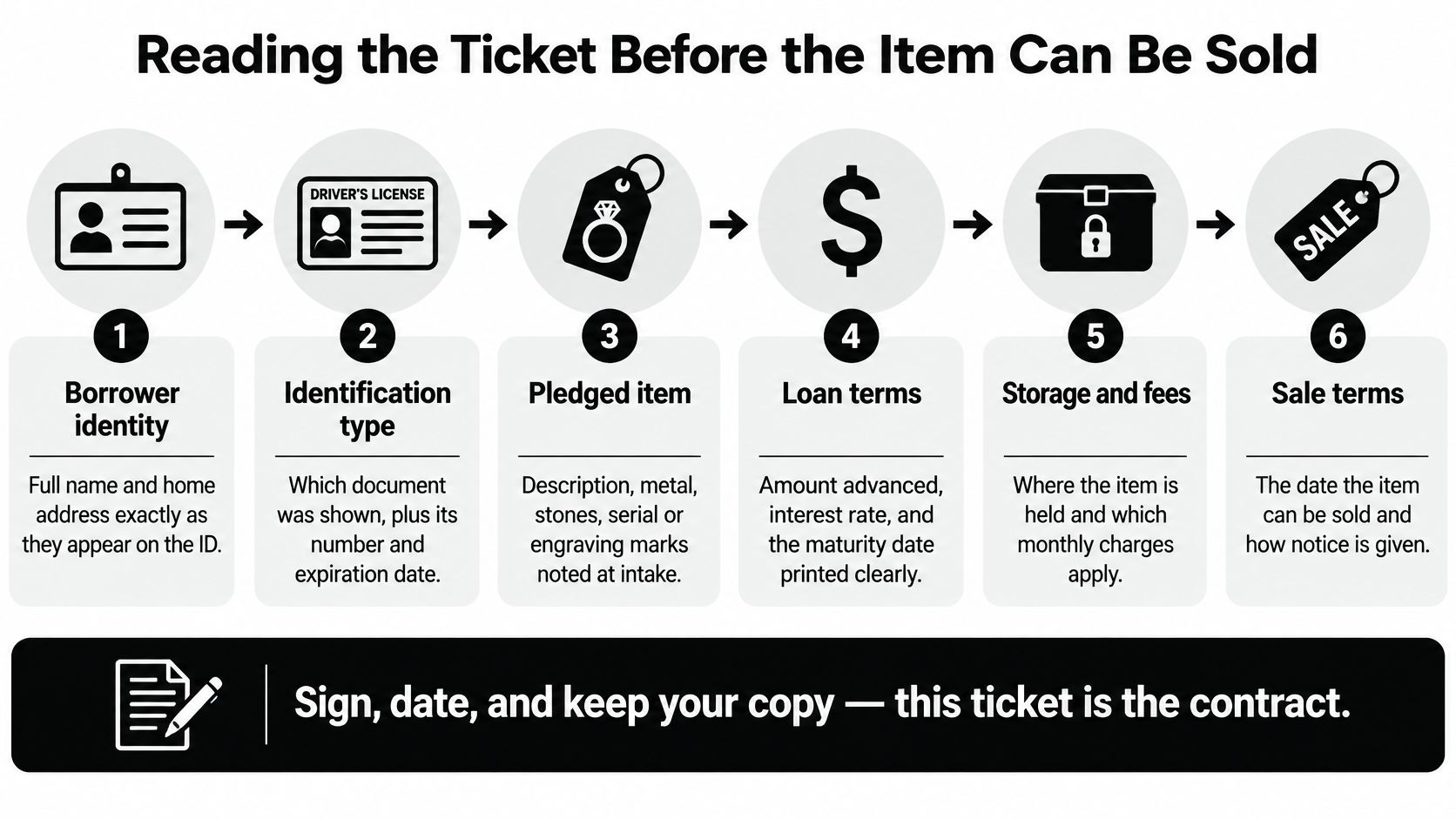
Build a redemption worksheet
Write these entries in the following order, using your own agreement rather than an advertised example:
- Cash received: The amount advanced to you.
- Finance charge: The stated borrowing cost.
- Other fees: Any applicable storage or administrative charge.
- Due date: The printed maturity date.
- Renewal cost: What you must pay to extend or renew, and what remains owed.
- Grace period: The applicable period and conditions.
- Final date before sale: The point after which the agreement and applicable law permit disposal.
For a hypothetical pledge, call the amount advanced the principal. Add the charges required by the agreement to determine the redemption total. Repaying only the principal won't necessarily release the item.
At our stores, we don't charge pawn ticket or storage fees, except for larger vehicles requiring off-site storage. We return the pledged item after the loan amount and interest fees are paid.
Don't confuse renewal with repayment
A renewal can keep a pledge active without clearing the principal. Ask how each payment will be applied and what the next redemption total will be. Don't assume a partial payment changes the deadline unless that change is confirmed.
For an unpaid pawn, we may put the item up for sale, offer a layaway term, or wholesale it to a dealer, depending on the item and the customer's communication. Communicating doesn't automatically suspend a deadline.
For additional context on the transaction, this video accompanies the written explanation.
Federal rules governing certain tribal trading activities describe disclosure and nonrecourse conditions in the applicable pawn-loan regulation; those rules aren't a universal Idaho rate schedule. The practical tradeoff is that default on a nonrecourse pawn puts the loss on the collateral rather than conventional collection against other assets, but you can lose the item.
Match every worksheet entry to a printed term or written clarification before accepting.
Confirm the Offer Before You Leave the Counter
The final decision isn't whether you qualify. It's whether the written offer works for you.
Sit with the agreement long enough to understand these lines:
- Cash you'll receive: The actual amount available to take home.
- Every charge: The finance cost and any other applicable amount.
- Your repayment deadline: The due date and how any grace period operates.
- Renewal or nonpayment: What another term costs and what happens if you don't repay.
At Idaho Pawn & Gold Exchange, pawn and sell customers review the offer or loan terms before deciding at the store. Don't accept because you've already spent time having the item evaluated. The evaluation doesn't obligate you to proceed.
Read advertised pricing in context
For borrowers in Boise, Meridian, and Nampa, our pawn loans range from $20 to $100,000, and our homepage lists pawn APR as low as 35%. That advertised minimum isn't a promise that every item or agreement receives that rate. APR expresses an annualized cost, so read it alongside the actual charges and redemption amount for your proposed term.
You should be able to explain the obligation in your own words before signing: what you receive, what you must pay, and when the property becomes at risk. If the employee's explanation and the ticket don't match, pause until the discrepancy is resolved.
Bring your unexpired photo ID and available ownership or serial-number papers. Ask to see the redemption total, and walk away if the written agreement doesn't match what was said at the counter.
---
At Idaho Pawn & Gold Exchange, we evaluate personally owned items for collateral loans and review the amount, costs, and due date before you decide. Visit a Boise, Meridian, or Nampa store with your item, original photo ID, and available ownership documents, and ask us to explain the written redemption terms before you sign.