
You've got a drawer with an older phone, maybe a laptop you replaced last year, and a bill you'd rather clear this week. Selling locally sounds simple until you start asking what a shop will accept, what happens to your data, and whether you're being offered a purchase or a loan. Treat this as an appraisal, not a guess.
What to Expect When Selling Electronics Locally
A Meridian seller walks in with an older phone, its charger, and a hope for quick cash. The first question isn't the price. It's whether the device powers on, holds a charge, has an intact screen, and can be signed out of every account so staff can test it properly.
That's typical when you're searching for pawn shops near me that buy electronics. A shop still has to resell the item to someone else, so staff will weigh exact model, storage capacity, functionality, condition, accessories, and resale demand. A clean, current, freed device gives them less risk than a locked phone with no charger and a swelling battery.
Sale and Pawn Loan Are Different Transactions
Don't blur these two options.
- Outright sale: You transfer ownership, take the payment, and you're done. There's no device to reclaim and no repayment date.
- Pawn loan: You leave the item as collateral and retain ownership while the loan is active. You must meet the written terms to get it back.
- No universal acceptance: A shop can decline categories, older models, or items it can't test or resell with confidence.
Ask which transaction you're being quoted before you discuss money. A loan amount and a purchase offer are built for different purposes, and comparing them as if they're identical leads to bad decisions.
Working electronics can have a second life before they become waste. The Global E-waste Monitor 2024 findings on global electronic waste report that the world generated 62 billion kilograms of electronic waste in 2022, while only 22.3% was documented as formally collected and recycled. That gap is why a usable phone, laptop, console, or camera is worth evaluating for resale first, while broken or obsolete gear may belong in a responsible recycling stream.
If a phone is your main item, review these top tips for selling used phones before you visit, then apply the same discipline locally. Identify the device precisely, protect your data, test what you can, compare the terms, and be willing to walk away. Not every electronic should be sold, and a fair process starts by admitting that.
How to Find Pawn Shops That Buy Electronics
Don't drive around Boise, Meridian, and Nampa hoping a counter accepts electronics. Use a repeatable search routine and verify the policy before you leave home.
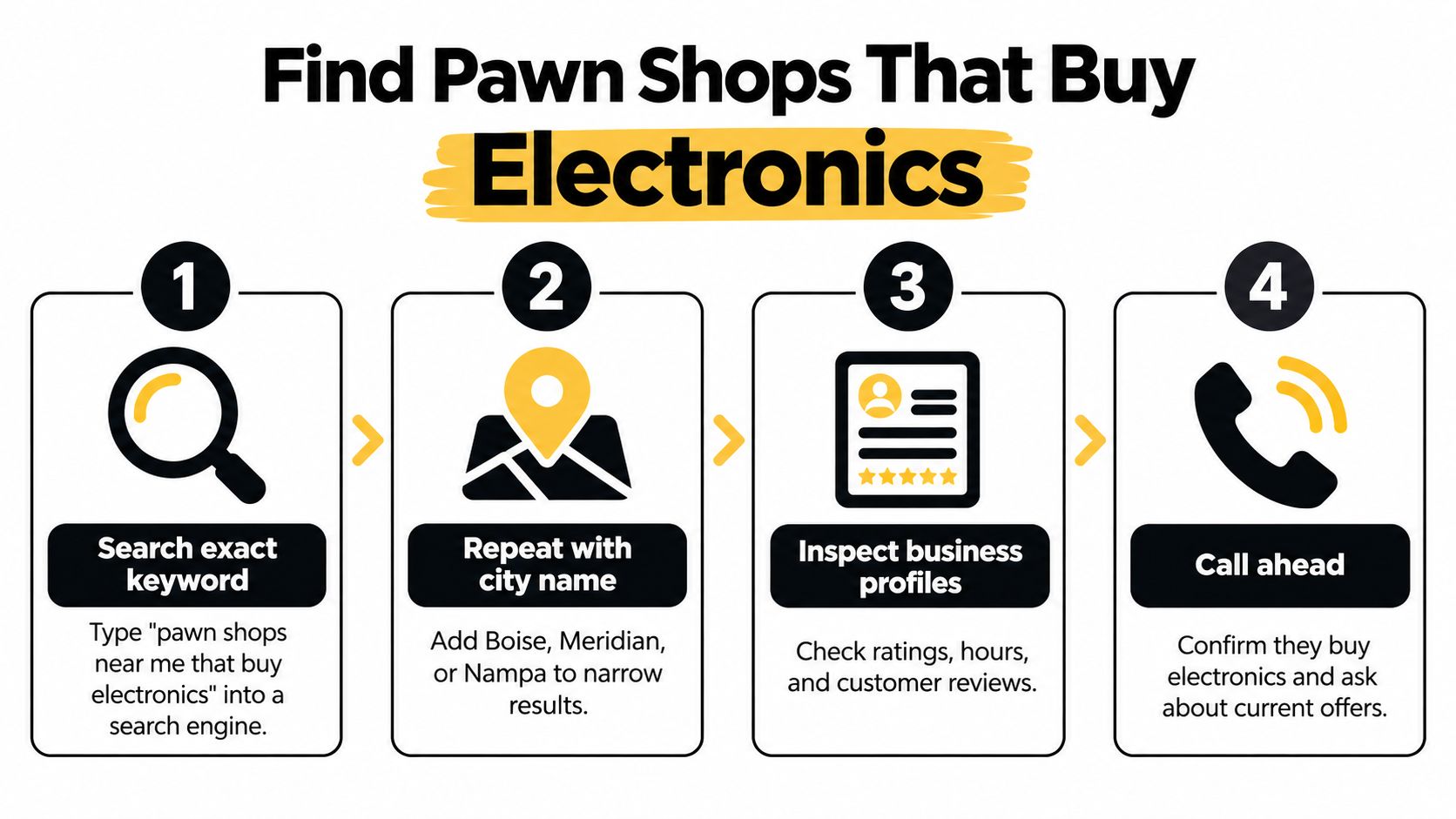
Start with the exact phrase pawn shops near me that buy electronics, then repeat the search with your city name added. Open the business profile and the official website, not just a directory snippet. Look for explicit language about buying, selling, or accepting electronics, then confirm the address, current hours, and phone number for the specific location you plan to visit.
The visual below summarizes the search sequence before you make the call.
Call Before You Travel
Search listings go stale. Policies change, inventory needs change, and one location may handle a category differently from another. A short call saves a wasted trip and tells you whether staff can test your item that day.
#### Questions to Confirm Before Visiting
| Question | Why It Matters |
|---|---|
| Do you buy this exact category and model? | Prevents a trip for an item the shop won't evaluate |
| Is the quote an outright purchase or a pawn loan? | Clarifies ownership, deadlines, and repayment duties |
| What testing do you perform in store? | Shows which defects or locks could change the offer |
| What ID or proof of ownership should I bring? | Avoids delays, especially for phones, laptops, and consoles |
| Which accessories do you want with it? | A proprietary charger or controller may be essential |
Write down who you spoke with and what they said. If the answer is vague, call another shop. You want specific categories, specific requirements, and a clear explanation of the transaction type.
Idaho Pawn & Gold is one local option to check because its services include buying and selling electronics across the Boise area. Use its current store locations for Boise, Meridian, and Nampa to pick the right location, then still call ahead. A website confirms where to go. A direct conversation confirms whether your exact device is worth bringing in today.
Electronics Worth Asking About
Build a short inventory before you call. "An old laptop" isn't enough information for a useful answer. Neither is "a Samsung phone" or "a game system." Staff need the details that separate an easy resale from a risky shelf item.
Categories to Confirm Locally
- Phones: Note the exact model, storage, carrier or regional variant, locked or open status, battery behavior, screen condition, and whether the charger is included.
- Laptops and tablets: Record the model, storage, operating condition, keyboard and trackpad response, charging behavior, and included power adapter.
- Gaming systems: Identify the console version, storage, controllers, cables, dock or power supply where applicable, and whether every controller holds a charge.
- Cameras and audio gear: Bring model details, lenses or mounts, batteries, chargers, cables, and any information about shutter, sensor, speaker, or connection problems.
- Smartwatches and portable electronics: Confirm pairing status, band and charger inclusion, battery runtime, screen damage, and whether the device has been removed from your account.
Current models aren't the only items worth asking about, but age matters because buyers need another customer to want the device. An older phone that works, turns on properly, and includes its charger is a more credible candidate than a newer device that won't power on. Condition can outweigh age, but it doesn't erase weak demand.
> Separate what works from what merely looks worn. A scratch is cosmetic. A cracked display, swollen battery, activation lock, or intermittent charging port creates functional risk.
There's also material value inside electronics, although that doesn't mean every device earns a resale offer. The EPA estimate for materials recovered from mobile phones says recycling one million mobile phones could recover 35,000 pounds of copper, 772 pounds of silver, 75 pounds of gold, and 33 pounds of palladium. That's an argument for responsible handling when resale isn't practical, not a promise that a single damaged phone has meaningful scrap value at a pawn counter.
Be direct about edge cases. Ask whether the shop evaluates a nonworking unit for any purpose, but don't expect a cash offer just because you brought it in. Very old, locked, incomplete, or low-demand electronics may need repair, donation, or certified recycling instead. Your inventory should lead to precise questions, not optimistic assumptions.
Prepare Electronics for a Safe Handoff
Don't hand over a device that still contains your photos, messages, passwords, payment apps, or work files. Privacy preparation isn't a final tap on a reset button. It's a sequence, and skipping early steps can make later steps impossible.
Identify and Document the Device First
Record the brand, exact model, storage capacity, carrier or regional variant, serial number or IMEI where applicable, and every included accessory. Photograph the powered-on screen, ports, corners, and existing damage. A short power-on video helps establish condition before testing begins.
Keep that record separate from the device you're selling. If there's a disagreement about capacity, included cables, or a crack that existed before handoff, your documentation gives both sides something concrete to review.
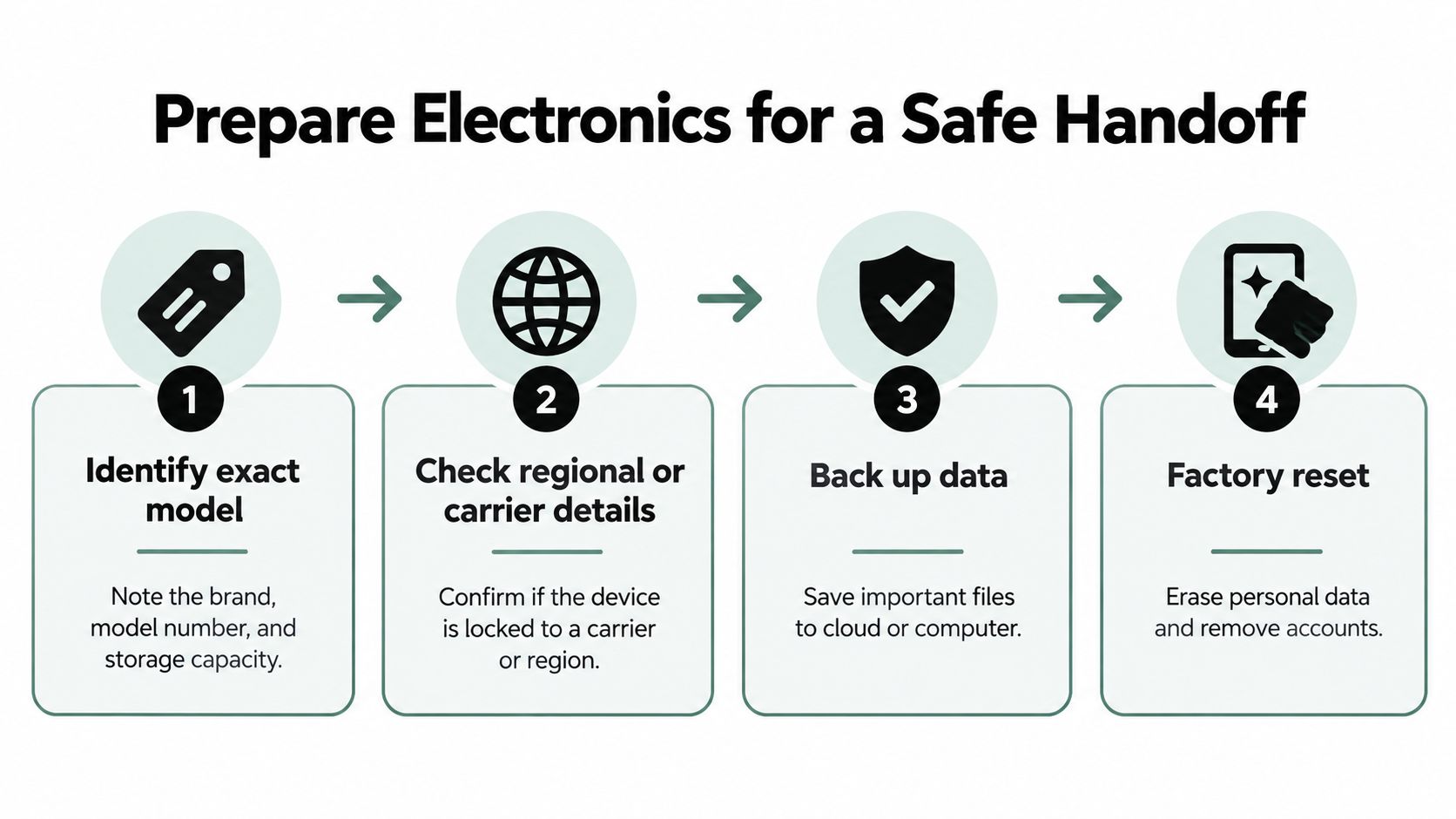
The process below follows the same order you should use at home.
Back Up, Sign Out, Then Reset
Back up anything you need to another device or trusted cloud account, then verify the backup opens. Remove SIM and memory cards, unpair watches and accessories, disable remote-device tracking, and sign out of Apple, Google, Microsoft, Samsung, gaming, and other manufacturer accounts. Remove activation locks before you perform a manufacturer-supported factory reset.
The FTC guidance on removing personal information from a phone advises consumers to back up their data, remove SIM cards, sign out of accounts, and reset phones before selling or recycling them. Follow that order. Resetting first can make account removal harder and may destroy the only copy of something you still need.
- Before leaving home: Back up, remove cards, sign out, disable tracking, reset, and confirm the setup screen appears without your account.
- In your records: Keep photos, serial or IMEI details, test notes, and proof of ownership when you have it.
- At handoff: Bring the charger and accessories you listed, and make sure staff can power on and test the device.
- Before you leave: Get a written receipt identifying the item and its stated condition.
Deletion isn't always complete sanitization, particularly for computers and separate storage devices where information may remain recoverable. If a laptop held sensitive business, financial, or medical records, don't rely on an informal consumer reset. Use a documented organizational sanitization process or get qualified help before considering resale.
> Practical rule: If you can't sign out, remove the activation lock, or prove the reset worked, pause the sale and fix that problem first.
A locked device creates two risks at once. The shop may not be able to test or resell it, and your account may still be attached to hardware you no longer control. Solve the account problem while the device is still in your hands.
How Shops Test and Value Electronics
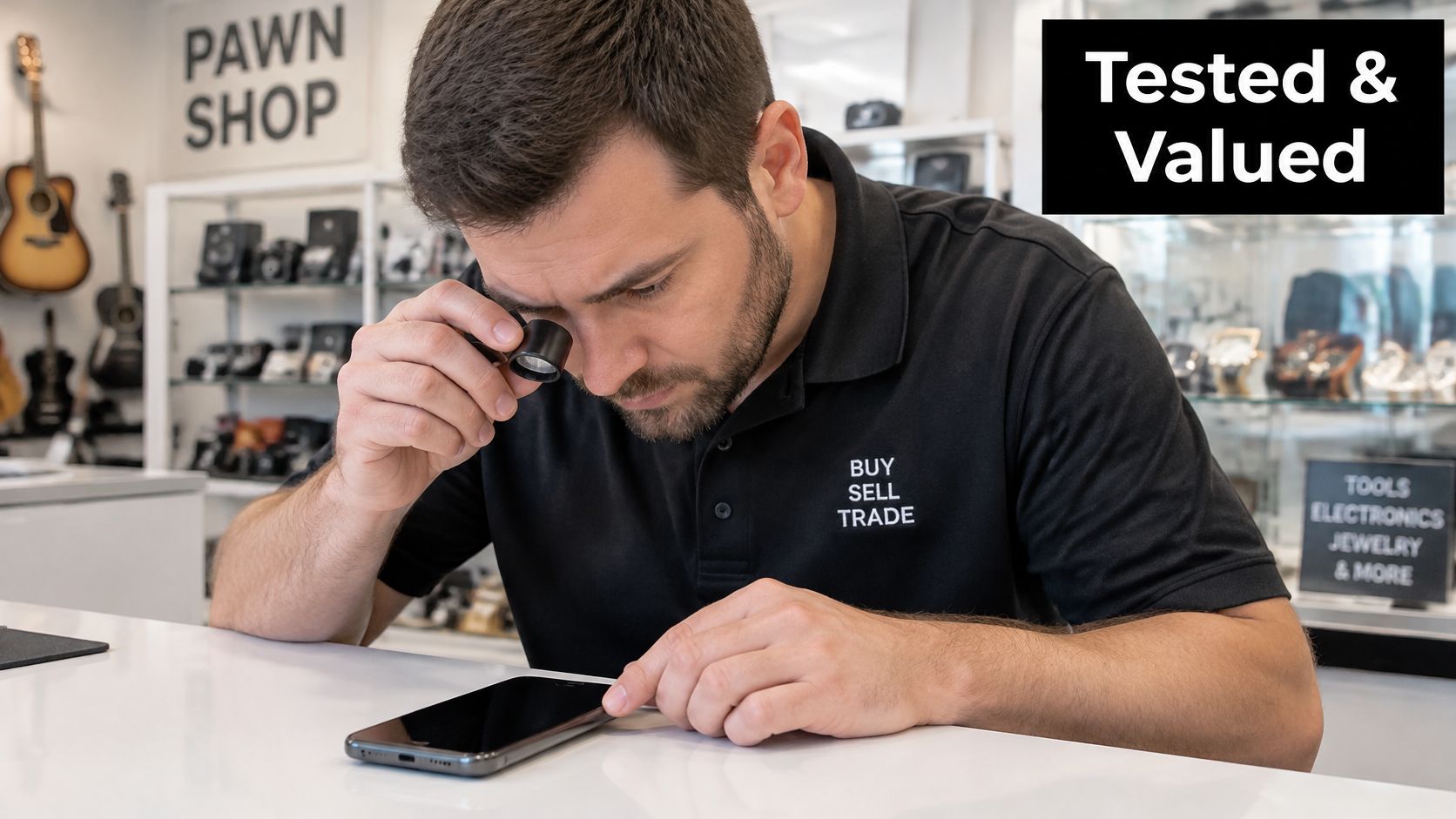
A credible appraisal is boring in the right way. Staff power the device on, test core functions, compare the configuration with what you claimed, and look for risks that would trouble the next buyer. You should do much of that work first so there are fewer surprises.
Test Functions, Not Just Appearance
Check battery health or runtime, display and touchscreen, cameras, speakers, microphones, ports, Wi-Fi and Bluetooth, biometric sensors, controllers, and charging behavior. Plug the device in and watch whether charging is stable. Make a short recording, take photos, connect a controller, and test every button you expect the buyer to test.
Write down functional defects separately from cosmetic wear. A scuffed corner belongs in one column. A cracked display, swollen battery, liquid indicator, missing proprietary charger, activation lock, or loose port belongs in another because those problems can block resale or require repair.
- Cosmetic wear: Minor scratches, scuffs, worn finish, or a complete but tired case
- Functional risk: Battery swelling, failed ports, dead pixels, camera faults, account locks, or unstable charging
- Identification risk: Claimed storage that doesn't match settings, unclear carrier status, or missing ownership evidence
Clean the device and bring complete accessories, but don't hide defects. There's a useful discussion of whether clean, brand-name electronics receive stronger pawn offers if you want to understand how presentation fits into appraisal. Cleanliness helps staff inspect the item. It doesn't turn a failing battery into a working one.
Benchmark and Question the Quote
Use several completed-sale references for the identical model, storage, condition, and included accessories. Current asking prices only show what sellers hope to receive. Completed sales give you a better benchmark when you judge whether a local offer is reasonable for immediate, in-person convenience.
If your item is an Apple laptop, it can also help to review how a specialist frames condition and configuration when you sell your used MacBook, then bring the same exact details to a local appraisal. Don't compare a bare laptop with a complete bundle and pretend they're equal.
Data preparation can affect testing too. The NIST media sanitization guidance and verification advice emphasizes verifying that data sanitization succeeded, while modern storage generally doesn't require repeated multi-pass overwriting and such repetition can reduce flash-media lifespan. In plain terms, use the appropriate manufacturer-supported method, verify the result, and don't damage flash storage by overwriting it again and again.
Before accepting, ask whether deductions are preliminary or final, whether the quote is a purchase or loan amount, when the offer expires, and what the written terms say. For a pawn loan, ask about fees, redemption steps, and what happens if you miss the terms. For a sale, confirm the receipt matches the device and condition.
Compare Selling Pawning and Other Options
Your decision shouldn't begin with "How much cash can I get today?" Start with whether you want the device back, whether it works, what a repair would involve, and whether another person can realistically use it.
Use One Decision Framework
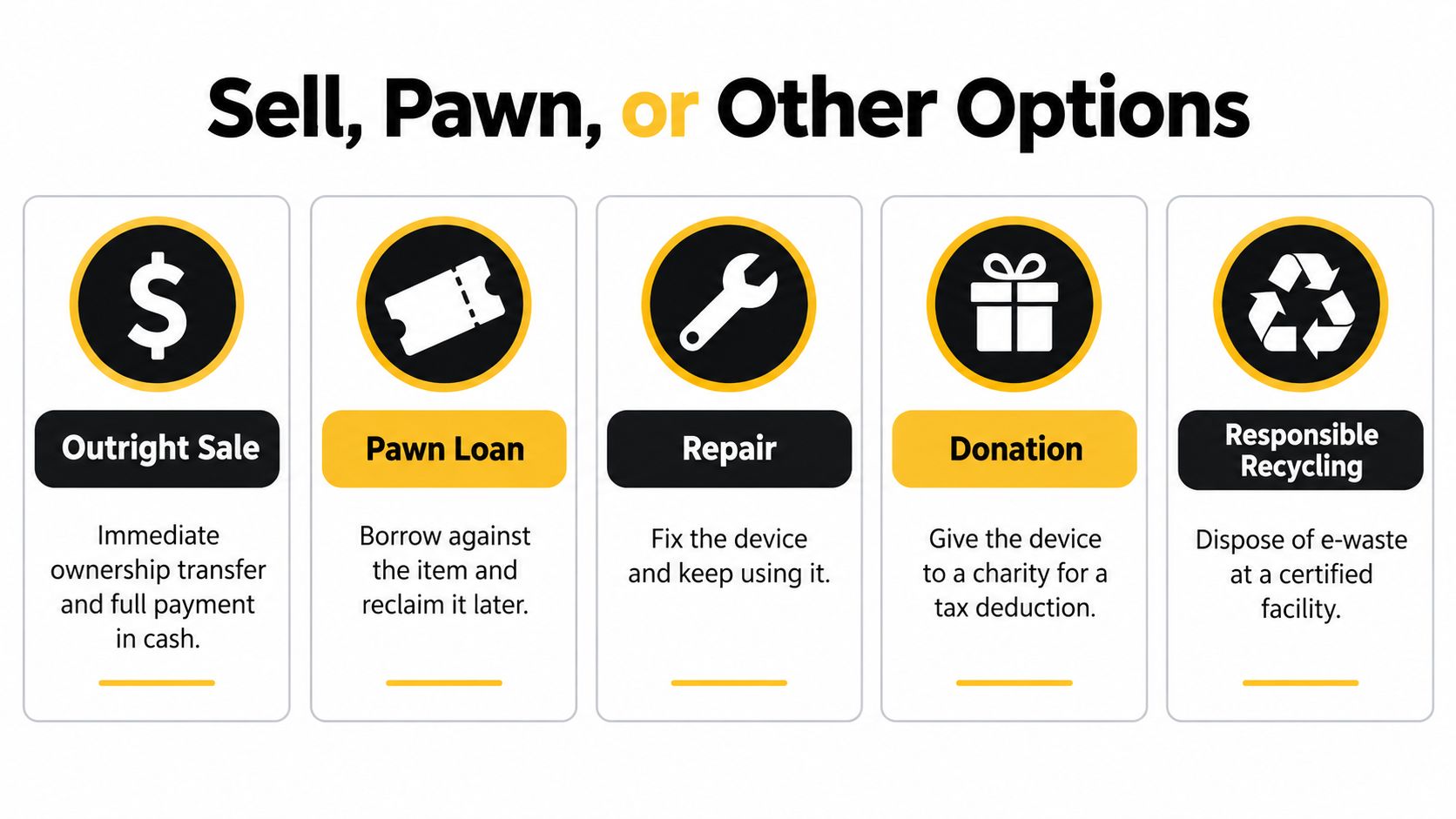
- Sell outright when you're finished with a working device and want a clean ownership transfer. Document the item, condition, accessories, and payment in writing.
- Pawn when you want the item back and you're confident you can meet the redemption terms. Review proceeds, fees, deadlines, and default consequences before signing.
- Repair when the device still fits your needs or a fix makes its remaining useful life more valuable than an immediate low offer.
- Donate when it works well enough for someone else but local resale demand is weak and you don't need cash from it.
- Recycle responsibly when it doesn't power on, can't be safely repaired, is locked beyond your control, or has battery damage that makes resale inappropriate.
If you're considering pawning because timing is the problem, read this explanation of a pawn loan as an alternative option for quick cash and compare the total obligation with the amount you receive. Don't choose a loan for a device you never intend to reclaim. That's usually a sale decision disguised as a loan.
Repair deserves a real comparison, not a guess. A 2026 laptop repair cost guide can help you frame the questions to ask about likely repair scope before you decide whether fixing a laptop makes more sense than accepting an offer. Compare the repair path with completed-sale references and your own need for the machine.
The environmental side supports keeping usable devices in circulation and recycling the rest responsibly. The Earth911 summary of global electronics recycling levels notes that only 22.3% of the world's 2022 electronic waste was documented as formally collected and recycled, while formal collection had risen from 8 billion kilograms in 2010 to 13.8 billion kilograms in 2022. A working item may serve another buyer better than a recycling stream. A dead or unsafe item shouldn't be pushed into resale just to chase a small offer.
Idaho Pawn & Gold Exchange is a local option that buys and sells electronics alongside gold, silver, jewelry, diamonds, and luxury goods. That local fit still doesn't make the decision for you. Choose the route that matches ownership, timing, privacy, repairability, and the device's realistic next use.
Plan a Fair Electronics Visit
Bring order to the visit before you bring the device to the counter. A fair outcome depends less on haggling and more on arriving with evidence, asking precise questions, and understanding the paperwork.
Your Visit Checklist
- Confirm acceptance: Verify the shop evaluates your exact category and model at the location you'll visit.
- Pack evidence: Bring identification, ownership records when available, chargers, cables, controllers, and other listed accessories.
- Bring your notes: Include model and storage details, serial or IMEI records, functional test results, known defects, and completed-sale references.
- Protect the handoff: Confirm accounts and activation locks were removed, the reset was verified, and removable cards aren't still inside.
- Clarify the offer: Ask whether it's an outright purchase or pawn loan, how testing affects it, which deductions apply, and when it expires.
At the counter, let staff test the device and explain what they're checking. If a deduction appears, ask which test or missing accessory caused it. Vague answers make comparison impossible, and you shouldn't accept terms you can't explain back in your own words.
For an outright sale, verify the receipt identifies the correct device, configuration, included accessories, and stated condition. For a pawn loan, confirm exactly what you must pay, when you must act to reclaim the item, and what happens if you don't meet those terms. Keep the paperwork somewhere you can find it.
> If the transaction type, deductions, fees, or redemption terms aren't clear, leave with your device and get another opinion.
Search again for pawn shops near me that buy electronics if you need a second local comparison, and use the same evidence packet at every visit. Consistent information makes offers easier to compare because each shop is judging the same model, condition, and bundle.
Before traveling, verify current electronics policies, hours, and location details directly with the shop you choose in Boise, Meridian, or Nampa. Walk in prepared, disclose defects, and don't trade privacy or clear ownership terms for speed.
---
Idaho Pawn & Gold Exchange buys and sells electronics and offers pawn loans and other services for customers in Boise, Meridian, and Nampa. Bring a properly prepared device, your identification and accessories, and your test notes, then ask for a clear explanation of whether you're receiving a purchase offer or pawn loan terms. Visit Idaho Pawn & Gold Exchange to verify current location details and confirm that your electronics are a good fit before you go.