A pawn shop cash loan is cash advanced against an item you already own, which the shop holds until you repay the loan and charges. The figure that matters is the total dollars due on your payoff date, not a headline APR, along with what losing the item would cost you.
Maybe a repair bill landed before payday, and you're looking at a spare ring, watch, or tool set to cover the gap. You don't necessarily want to sell it. You want cash now and a realistic way to bring your property home.
That decision starts with the written offer and your calendar. For borrowers in Boise, Meridian, and Nampa, national figures can provide context, but they aren't a local quote.
What a Pawn Shop Cash Loan Costs to Redeem
A pawn loan exchanges temporary possession of your property for cash. Redeeming means paying the amount needed to get that property back. Renewing means keeping the item pledged under an extended agreement rather than taking it home.
Pawn charges are usually quoted as a monthly percentage, and even a modest monthly figure annualizes into a very high APR. That is why the dollars due on your payoff date tell you more than the headline rate. The table below uses a flat 20 percent monthly charge purely as a 30-day teaching example. Treat it as generic context rather than an Idaho rate or a quote from Idaho Pawn & Gold Exchange.
Sample 30-day pawn payoff at a 20 percent illustration rate
| Example item | Cash received | Charge for 30 days | Given up if unpaid |
|---|---:|---:|---|
| Gold band | $150 | $30, making $180 due | The ring |
| Wristwatch | $500 | $100, making $600 due | The watch |
| Tool set | $80 | $16, making $96 due | The tools |
The numbers are illustrations rather than appraisals. The item names do not establish what a particular ring, watch, or tool set would secure, and the example assumes no additional charges.
Start with the payoff amount
In the gold-band example, the borrower receives $150 and needs $180 to redeem at the illustrated deadline. The extra $30 buys temporary access to cash. Nothing else changes hands.
For the hypothetical watch, $500 received becomes $600 to redeem on time. Renew once at the same charge and the total cost across both periods is $700. What changes is the amount still due at the end: $600 if you paid the first charge at renewal, $700 if you let it ride.
The same assumptions make the tool set $96 to redeem on time or $112 across a renewal. Watch the difference between *paid so far* and *still owed*. A renewal payment can keep the agreement active without bringing the item home or reducing the original amount borrowed, so ask for both figures in writing.
Renewal math matters because extensions are easy to get. Idaho Pawn & Gold Exchange lets a pawn loan be renewed as many times as you need, and the store team reviews the loan amount, costs, and due date with you before you commit. Each extension adds a charge while the item stays pledged, so the calendar becomes the cost driver.
Add the cost of losing the item
APR helps compare borrowing costs on an annual basis, but your immediate decision needs a dollar amount and a date. It also needs an honest assessment of the property.
A spare tool set may be replaceable. A wedding band might carry sentimental value that no replacement can restore. A work tool might cost you income while the shop holds it.
> Practical rule: Judge the loan by the payoff you can afford and the loss you can tolerate. The cash offered is only one part of that picture.
Idaho Pawn & Gold Exchange does not charge pawn ticket fees or storage fees, except for larger vehicles that need off-site storage. Your written terms still need to identify the applicable finance charges and payoff obligation.
You can run the numbers through the pawn loan calculator, which shows a three-month payoff and savings estimate, then compare the estimate with the actual counter offer. Before leaving, copy these details somewhere you will find them:
- Cash received: The amount you take home.
- Finance charge: What borrowing costs under the agreement.
- Due date: The exact repayment deadline.
- Total due: The amount required to retrieve your item on that date.
What Shapes the Offer and What Papers to Bring
Your original purchase receipt can help identify an item, but it doesn't determine today's loan offer. A counter evaluates what the property could reasonably sell for, considering authenticity, condition, completeness, and demand.
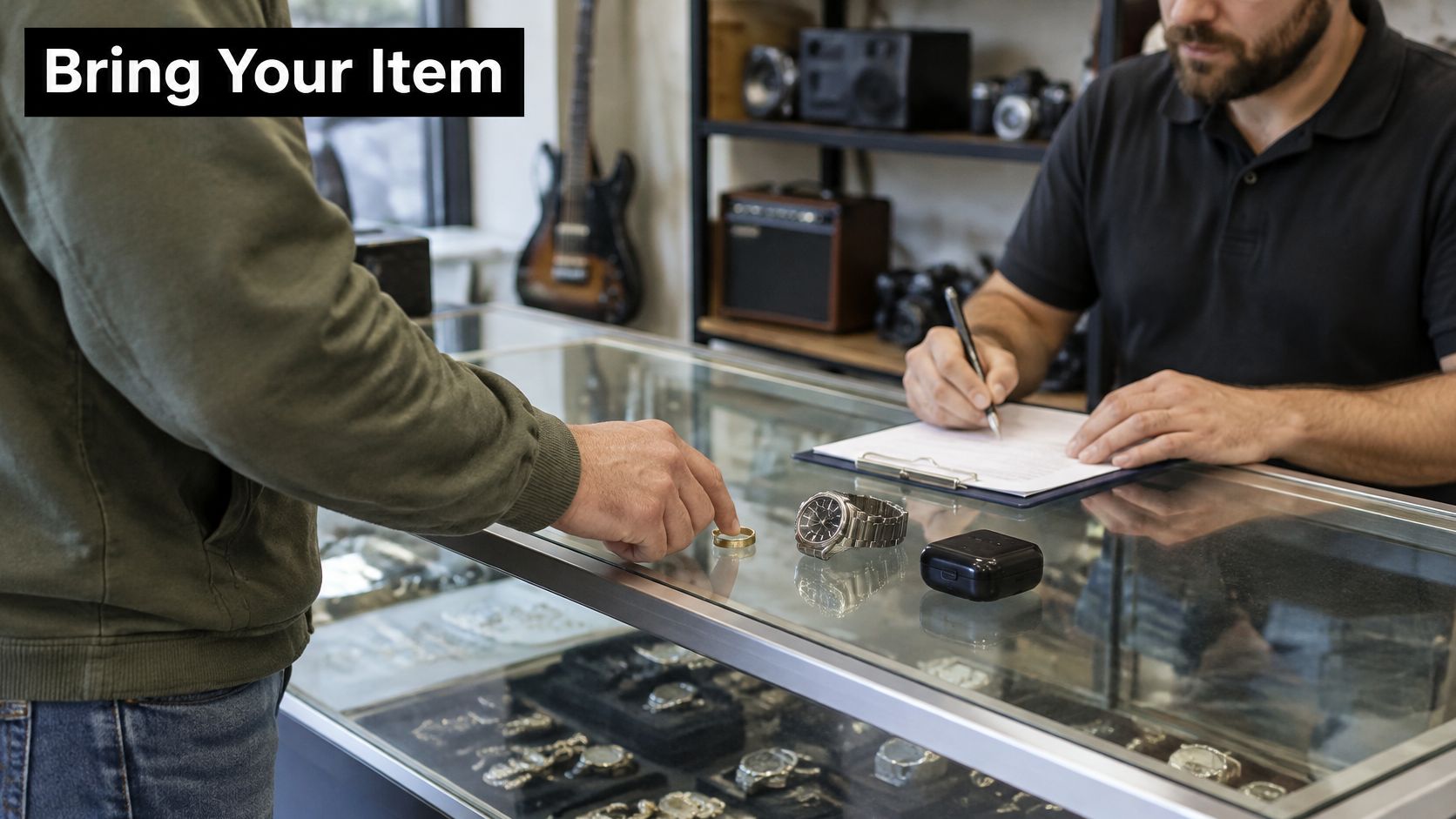
Bring the actual item rather than relying on a photograph or an online asking price. Staff need to inspect and, where appropriate, test what you're offering.
Match your preparation to the item
Different categories need different evidence. Confirm current acceptance before transporting something bulky or unusual.
- Gold, silver, and bullion: Weight, purity, and authenticity matter. Separate pieces you know are precious metal from costume jewelry, and bring any identifying packaging.
- Diamonds and recognized luxury watches: Authenticity, condition, and supporting documents help establish what the item is. Include available grading documents, service records, boxes, and papers.
- Designer handbags: Brand, authenticity, wear, odors, and hardware condition affect resale appeal. Bring the dust bag and original accessories when available.
- Electronics: Show that the device works. Charge it beforehand and include its charger, necessary cables, and accessories.
- Tools and musical instruments: Demonstrate operation and bring matching batteries, cases, or essential components. A complete, usable item is easier to evaluate than an assortment of incomplete pieces.
- Vehicles: Ownership documentation and storage arrangements require advance attention. Discuss the title and transport logistics before bringing the vehicle.
Clean gently rather than trying to restore value through aggressive polishing or amateur repairs. Don't erase hallmarks, damage a watch case, or use household chemicals on delicate stones.
Bring evidence and set your borrowing limit
Prepare a government-issued photo ID, the item, and any ownership documents relevant to its category. Title papers and serial-number records deserve particular attention where applicable. Keep your own record of identifying marks and included accessories.
At our stores, no credit check is required to pawn or sell. You review the offer or loan terms before deciding, and you can decline them.
Ask which resale fact limited the offer: condition, authenticity, missing accessories, or demand. That question is more useful than arguing from the original retail price. Our guide to getting the best loan from a pawn shop can help you prepare before visiting.
Borrowing less may be smarter than securing the largest offer. A Mexico City pawn-borrowing experiment examines repayment structure and collateral loss, a useful reason to think about affordability before selecting property, not a basis for predicting Boise outcomes.
Consider a complete, lower-value spare item if it covers the bill with a more manageable obligation. Leave damaged or incomplete pieces at home unless the counter confirms they're suitable. Don't bring extra property merely to increase a loan beyond what you need.
How the Loan Moves From Appraisal to Redemption
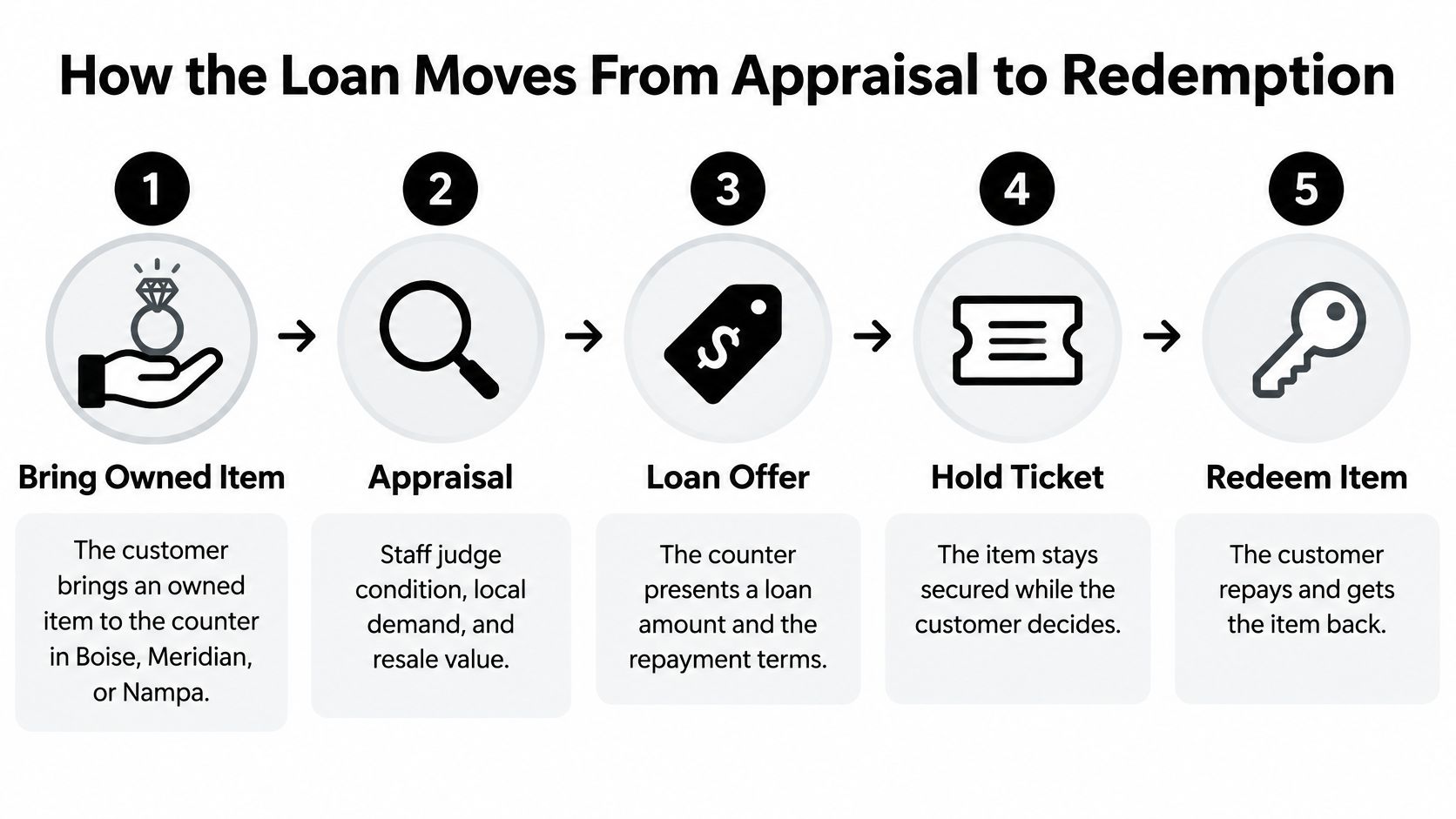
The counter transaction should leave you with a clear record of what you pledged and what must happen next. The following visual summarizes the main stages; the written agreement supplies the details that a diagram can't.
Follow the transaction from item to ticket
- Bring property you own. At a counter in Boise, Meridian, or Nampa, present the item and its relevant accessories. Identify anything that affects its operation or ownership before the evaluation begins.
- Receive an appraisal-based offer. Staff assess condition, authenticity, resale demand, and likely resale value. The proposed loan is a portion of what the shop expects it could recover through resale, not a refund of your retail purchase price.
- Review the agreement before accepting. Our team reviews the loan amount, costs, and due date with you. This is the point to resolve unclear wording, correct the item description, or decline the transaction.
- Leave the collateral and receive cash. If you accept, the shop holds the item and you receive the agreed loan amount. Keep the ticket and any payment instructions together, and verify that the collateral description matches your property.
- Identify the fixed term. The ticket states when repayment is due. Don't substitute your next payday, a remembered conversation, or another borrower's experience for the date on your agreement.
Understand each possible ending
- Redeem and retrieve the item. Pay the loan amount and applicable interest fees under the agreement. We return the pawned item after those obligations are paid. Check the item and included accessories when collecting it.
- Renew rather than retrieve. An agreed renewal keeps the collateral pledged. Confirm what payment is needed, whether principal changes, and which deadline replaces the previous one. An extension is not the same transaction as redemption.
- Confirm the grace period and final window. We provide a 10-day grace period to repay the loan. Have the counter identify how that period applies to your ticket and mark the final redemption deadline. Don't assume the grace period changes every other term.
- Recognize the unpaid-loan outcome. If the agreement remains unpaid beyond its applicable window, the shop can generally sell the pledged property. The Federal Reserve's analysis of pawn lending explains the collateral-backed structure and why the lender generally turns to the item rather than pursuing an unsecured balance.
State rules affect loan charges, redemption periods, and disclosures. The practical result is simple: a national description explains the type of transaction, but your written ticket identifies your obligation.
Keep a legible photograph of it as well as the original. If any date or item description is unclear, resolve it while you're still at the counter rather than after the deadline approaches.
Pawn Loans Next to Payday Title and Online Options
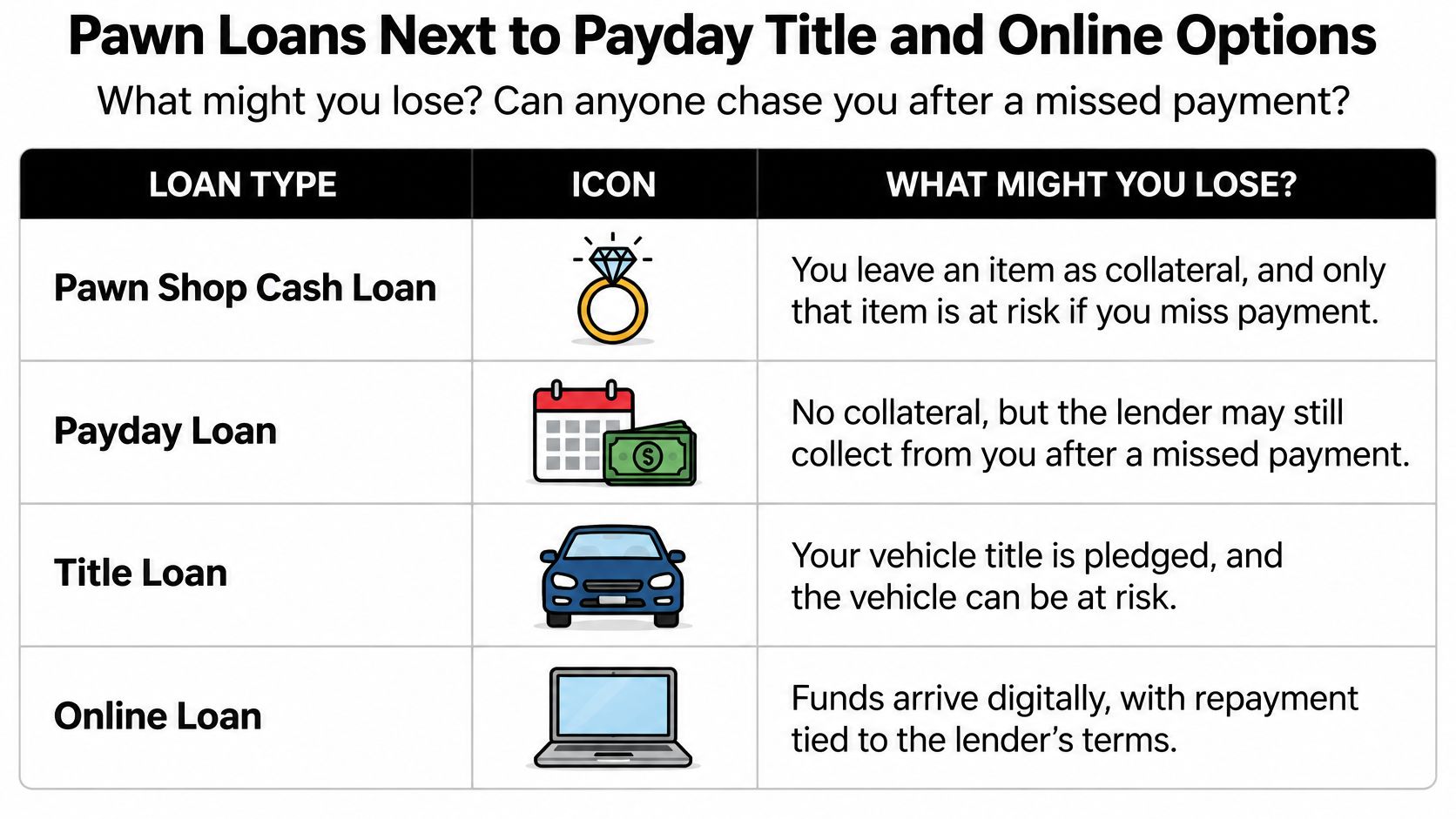
Compare borrowing options by asking what you might lose and whether a missed payment leaves a debt someone can still collect. Fast access to money doesn't answer either question.
This visual highlights the main differences in collateral and repayment exposure.
Pawn shop cash loans versus other short-term cash options
| Option | Credit check | What is at risk | If you do not repay | Fits when |
|---|---|---|---|---|
| Pawn shop cash loan | No at our stores | The pledged item | Shop generally sells the item, usually without a deficiency balance | You can redeem a spare item on time |
| Payday loan | Lender-specific screening; a conventional credit check may not be required | Bank-account funds and additional charges | Authorized drafts, fees, and collections may follow | A paycheck gap has a verified, affordable repayment source |
| Auto-title loan | Lender-specific screening | The vehicle | Possible repossession and other consequences under the agreement | You understand and can tolerate the transportation risk |
| Online installment or cash advance | Product-specific credit, income, or account screening | Usually repayment funds rather than a pledged household item | Fees, collection, or other consequences under the product terms | Scheduled payments fit after essential bills |
| Selling the item outright | No | Ownership, transferred now | No loan remains to repay | You don't need the item back |
Choose by consequence, not convenience
Pawn: A spare item can limit the transaction's collateral risk to property you can do without. That doesn't make pledging an heirloom harmless, even when it isn't essential for daily life.
Payday: Read the bank-account authorization as closely as the price disclosure. If repayment would leave you short for rent or food, the arrival of a paycheck doesn't make the loan affordable.
Title: Treat transportation as part of the cost assessment. Losing access to a vehicle can disrupt employment, school runs, or medical appointments beyond the value of the original bill.
Online installment or cash advance: “Online” describes delivery, not a uniform financial product. Check mandatory fees, optional charges, withdrawal permissions, due dates, and whether the obligation remains after a missed payment.
Selling: An outright sale avoids a future payoff date. Its trade-off is permanent ownership transfer, so compare an actual buy offer rather than assuming it equals the loan offer.
Look for the risk of repeated borrowing
The CFPB's Making Ends Meet Survey analysis found that 2.5% of consumers had taken out a pawn loan, compared with 2.0% for an auto-title loan; among consumers who had used a pawn loan in the previous six months, 73% still owed money on a pawn loan when surveyed in June 2019.
Those are national survey findings, not Boise repayment forecasts. They make it worth asking whether your plan clears the obligation or merely postpones it. An outstanding loan doesn't by itself reveal why a borrower hasn't repaid.
For additional comparison points, use this video alongside the written terms of any offer.
Our guide to emergency funds and quick-cash options can also help you consider alternatives before committing property. Pawn when you can redeem a spare item, consider selling when you can't, and avoid risking a car or daily-use phone for a bill that could be handled another way.
Three Boise Tickets From Redeem to Walk Away
A loan can look manageable at the counter and become difficult when income arrives late. These fictional Treasure Valley scenarios show how the calendar changes the outcome. They aren't customer accounts or store quotes.
For scale, FirstCash Holdings' annual report filed with the Securities and Exchange Commission reported an average U.S. pawn-loan amount of $283 per transaction at December 31, 2024. That figure describes the reporting company's U.S. business, not every American pawnshop or our local offers.
A Meridian borrower retrieves a chain
Say a Meridian customer borrows $280 against a spare gold chain. Using the earlier hypothetical monthly illustration, the charge would be $56, making the on-time redemption $336, with no additional charges assumed.
The borrower identifies the paycheck that will cover the full amount and sets the money aside before spending on nonessential purchases. At the agreed deadline, the customer pays and takes the chain home.
The cheaper decision here is redeeming within the original term. The useful preparation wasn't predicting that cash would somehow be available. It was identifying which income would cover the obligation after essential expenses.
A Nampa borrower extends a watch loan
For a separate example, suppose a Nampa customer borrows $283 against a watch. At the same hypothetical percentage, each full charge period costs $56.60.
A delayed payday leads to a renewal without any principal reduction. Across the original period and the renewal, finance charges total $113.20, and cumulative payments to recover the watch total $396.20, assuming no other fees.
The customer eventually retrieves the watch, but the extension costs money without increasing the cash originally received. The better decision is to renew only after writing down the new deadline, cumulative cost, and remaining payoff.
If those figures don't fit the revised paycheck, the extension doesn't solve the underlying shortage.
A Boise borrower pays something but loses the item
A Boise customer pledges a tool set, makes a partial payment, and assumes that payment protects the property indefinitely. The remaining obligation stays unpaid beyond the applicable ticket window.
The partial payment alone doesn't require the shop to return the tools. What it accomplished depends on the written agreement and how the payment was applied.
For an unpaid pawn, we may put the item up for sale, offer a layaway term, or wholesale it to a dealer, depending on the item and the customer's communication. Don't assume any particular option is guaranteed.
> Paying something is not the same as completing redemption.
If the customer already knew repayment was unrealistic, requesting an outright buy offer at the start could have avoided borrowing charges. The decision should follow the achievable outcome, not just the hope of keeping the item.
Plan the Payoff Before You Sign
Start with the money that will remain after housing, food, utilities, transport, and existing commitments. A paycheck's full amount isn't available for redemption if most of it already has a job.
Then connect the proposed payoff to a specific income source. An expected sale, uncertain overtime shift, or reimbursement that hasn't been approved deserves more caution than confirmed income.
Use a written checklist rather than a mental promise.
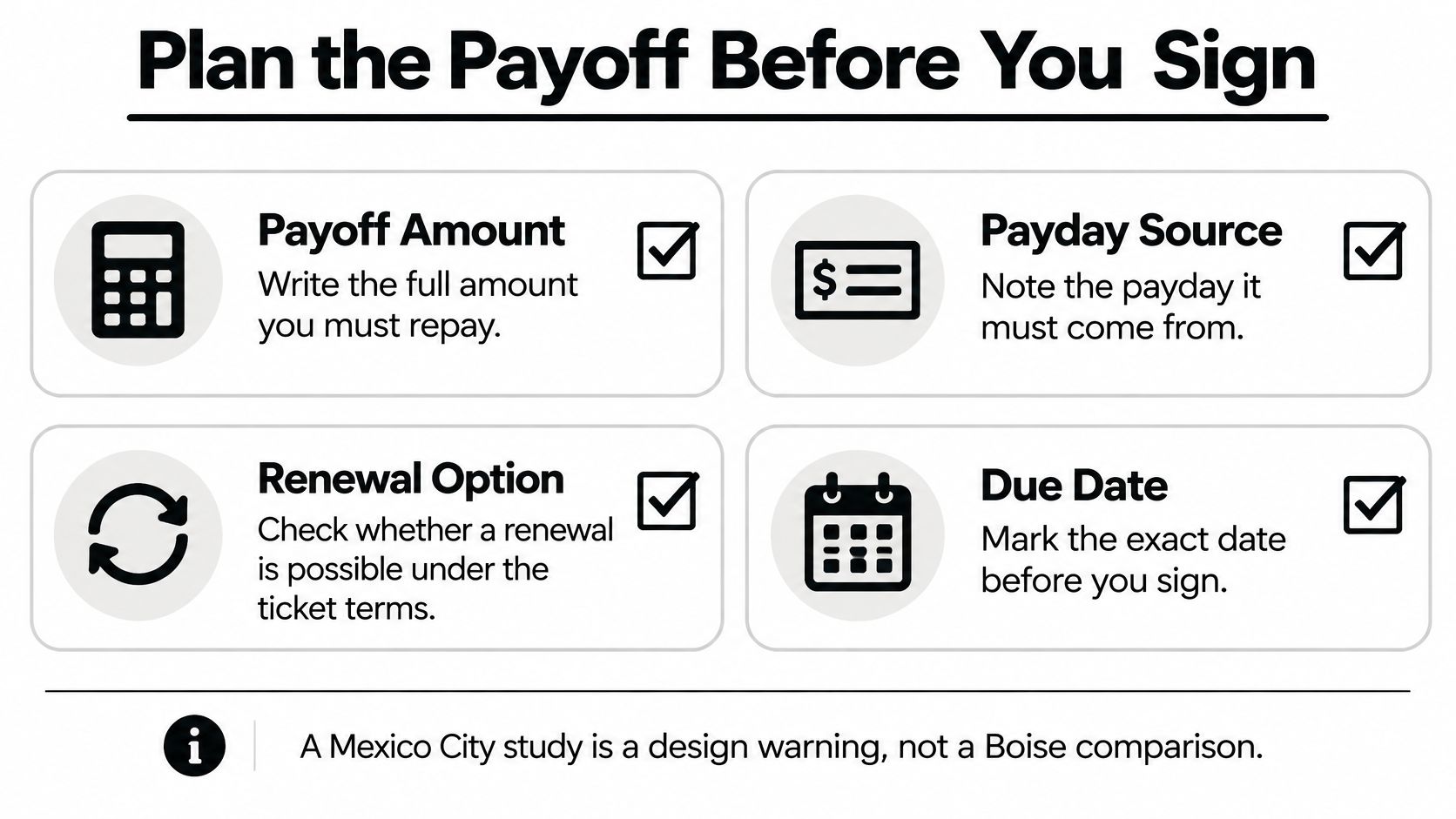
Build a calendar you can actually follow
- Assign the income: Write which paycheck or other confirmed funds will cover redemption.
- Protect essential spending: Subtract unavoidable expenses before deciding the payoff is affordable.
- Set reminders: Add an advance reminder and the actual deadline to your phone calendar.
- Record payment treatment: Ask whether a partial payment reduces principal, pays charges, or does something else under the agreement.
- Keep confirmation: Save receipts and updated balance information whenever you pay.
A reminder can prevent forgetting. It can't create the money you need, so arrange the funds before relying on the alert.
If you're balancing other debts, Fintrack's tool to calculate interest savings on debt can help compare broader repayment choices. Use the pawn ticket's actual terms for the collateral loan rather than assuming a general debt calculator models its renewal rules.
Treat renewal as a new decision
We allow a pawn loan to be renewed as many times as the customer needs. That flexibility doesn't mean repeated renewal will fit your budget.
Before extending, request the amount needed now, the next deadline, and the amount needed to retrieve the item later. Compare that remaining obligation with your updated income and expenses.
> Before extending: Ask whether the next pay period will genuinely be different, or whether you're paying to postpone the same shortfall.
Idaho requirements govern the local transaction. Confirm current written terms in the store and check applicable Idaho licensing and disclosure requirements through the relevant state authorities. An Illinois example or an outside lending study is not a statement of Boise law.
Use a straightforward sell-versus-pawn test: if recovering the item before the final redemption window isn't realistic, request a buy offer instead. You can compare that offer without committing to it.
Pawn Loan FAQs
Does a pawn loan show up on my credit report?
Don't assume that no credit check automatically answers every reporting question. Ask how the shop reports the transaction, if at all. The generally non-recourse structure concerns collection against collateral, not a universal promise about every business's reporting practices.
What if I lose my ticket?
Contact the store promptly and explain the situation. Ask what identification and ownership verification are needed before the item can be released. Keeping a photograph of the ticket helps you identify the transaction, but don't assume a photograph replaces the original under the store's procedures.
Can the shop sell my item early?
The written agreement and applicable rules determine when an unpaid item becomes eligible for sale. Have the counter identify the final date while you're reviewing the ticket. If you believe a sale occurred before the permitted point, retain your documents and ask the store to review the transaction.
Is a pawn loan regulated in Idaho?
Pawn transactions are subject to applicable state rules. Ask for current written disclosures and check licensing requirements rather than relying on a general internet summary. Your documents should make the repayment obligation and relevant deadlines understandable before you accept.
How much can I borrow?
The counter must inspect the item before giving a meaningful offer. Resale potential, authenticity, condition, and completeness matter more than what you originally paid.
For an unusual item, prepare these details before visiting:
- Identification: Brand, model, material, and distinguishing marks.
- Condition: Whether it works and whether anything is missing.
- Documentation: Available ownership records, certificates, or service papers.
A national average can help describe a market, but it can't appraise your property. The in-person written offer is the amount you can evaluate.
Get a Written Offer in Boise, Meridian, or Nampa
Bring your item to our Boise, Meridian, or Nampa counter with the information needed to evaluate it. You don't need to arrive committed to borrowing or selling. Arrive ready to compare a written proposal with what you need and what you can afford.
We offer pawn loans from $20 to $100,000, and our calculator provides a three-month payoff and savings estimate. Diamond authentication testing is free. If you're bringing a stone, request authentication rather than guessing what it is from appearance alone.
Make the offer usable
An offer is useful only when you understand what accepting it changes. Before agreeing, resolve these points:
- For a loan: Confirm the cash advanced, charges, repayment date, and conditions for recovering the item.
- For a sale: Confirm the purchase amount and that you're choosing a permanent transfer rather than a temporary pledge.
- For either choice: Check the item description and keep the paperwork you receive.
Use our website for current locations, services, and the calculator, then confirm the applicable terms in person. An estimate can help you prepare, but it doesn't replace the written agreement for your item.
Existing customers can use the Pay my pawn option to access the customer payment portal. That payment takes place outside our website, so follow the listed payment instructions and retain your confirmation.
Choose the outcome before accepting
If the written payoff fits your available income, pawn the item and immediately enter the deadline in your calendar. Keep the redemption money separate when the designated income arrives.
If the payoff doesn't fit, ask for a buy offer and assess whether you're comfortable giving up ownership. Selling may be the cleaner choice when you need the cash but don't have a credible path to repayment.
You can also refuse either offer and leave with your property. A clear transaction is one you understand well enough to accept or decline without guessing.
---
Idaho Pawn & Gold Exchange offers item-backed cash loans and in-person buy offers, so you can compare temporary borrowing with selling outright. Visit Idaho Pawn & Gold Exchange to find our Boise, Meridian, or Nampa locations, then bring your item for a written offer and choose only after the amount, charges, and repayment date make sense to you.