What would you pay to keep that ring? Most pawn-versus-sell advice answers a different question, namely which counter hands over more cash today, and it stops there. That's the easy half. The harder half is what the loan costs by the day you redeem, what buying an equivalent piece later would cost if you sold instead, and how likely you're to miss the deadline. Put those three numbers next to each other and is it better to pawn or sell gold stops being a slogan and becomes arithmetic you can do at your kitchen table.
Pawning or Selling Gold at a Glance
Sell if you don't want the piece back or can't confidently repay a loan; pawn if you're covering a short, dated cash gap and the item matters to you beyond its metal weight. That's the short answer, and the table below shows why the two paths diverge long after the cash changes hands.
| Factor | Selling Gold | Pawning Gold |
| --- | --- | --- |
| Ownership after payment | Buyer owns the gold | You keep ownership while the loan is open |
| Cash received | One payment at the agreed offer, usually below resale value | Loan principal, usually below the item's value |
| Ongoing costs | None after the sale, apart from any seller spread already in the offer | Interest or finance charges, plus fees and renewal charges |
| Timing | Cash the same day in most shops | Cash the same day, with repayment due by the loan deadline |
| Main risk | The item is gone for good, even if gold prices rise later | Losing the item if the loan isn't repaid or renewed on time |
| Best fit | You don't want the item back and need cash | You need a short cash bridge and can repay before the deadline |
Why the ownership row outranks the cash row
A sale ends your relationship with the object in one visit. A pawn keeps it reclaimable, but only on the condition that you repay by the deadline, so what you're really buying with the finance charge is time-limited ownership, not the item itself. Read the cash row as a snapshot and the ownership row as the whole movie.
The principal on a pawn loan usually comes in below what the same shop would pay to buy the piece outright. The lender advances a share of the value and holds back a margin for the risk that the loan goes unpaid, plus the cost of storing and insuring your gold while it sits in the safe. That gap isn't a trick, it's the price of the option to change your mind.
> Practical rule: match your repayment date to a real, dated inflow of cash before you sign anything. If you can't name the day the money arrives, you're not choosing a loan, you're choosing a delayed sale at a lower price.
Find the column that fits your timeline and your feelings about the piece, then test that instinct with numbers rather than trusting it. The rest of the arithmetic is straightforward once you've written down the weight, the karat and the charges.
How to Value Gold Before You Sell
Every offer starts with two measurements: how much the item weighs and how much of that weight is gold. The karat stamp sets the second number, and it's the one sellers most often guess at.
| Karat | Gold content | Typical pieces |
| --- | --- | --- |
| 24K | 99.9% | Bars, bullion and fine coins |
| 22K | 91.7% | Some coins and traditional jewelry |
| 18K | 75.0% | Fine jewelry and designer pieces |
| 14K | 58.5% | Common everyday jewelry in the US |
| 10K | 41.7% | Entry-level jewelry and class rings |
The melt-value math
Melt value is weight in grams times purity times the spot price per gram. As an illustration, 10 grams of 14K gold at a spot price of 100 dollars per gram works out to 10 x 0.585 x 100 = 585 dollars before any buyer margin. A real offer lands under that figure because the buyer pays for testing, refining, handling and the risk of holding metal until it moves.
Two practical notes on the inputs. Convert the quoted spot price per troy ounce into a price per gram before you multiply, and weigh jewelry with stones set aside or accounted for, since a cubic zirconia doesn't add gold weight. A kitchen scale that reads to a tenth of a gram is enough to sanity-check a counter weight.
When the piece is worth more than its metal
Melt value is a floor for scrap, not a ceiling for jewelry. A signed designer piece, a well-made antique chain, a rare pattern or a ring with a decent diamond can bring more intact than melted, because a buyer resells it as jewelry rather than feeding it to a refiner. Price those items both ways and ask which number the offer is built on.
The opposite case is just as useful. A plain high-karat scrap ring, a broken chain or a bullion round tracks metal value closely, so an offer far below the melt calculation deserves a question, not a shrug.
Before you drive anywhere, do three things:
- Weigh it: note the grams on your own scale so you can compare against the shop's certified scale.
- Read the stamp: look inside the band or on the clasp for 10K, 14K, 18K or 22K, and write down exactly what you see.
- Log the marks: write down any maker's name, hallmark or patent stamp, and photograph it, because that's the evidence behind a nonmetal offer.
What a Gold Pawn Loan Really Costs
The number that matters isn't the principal, it's the total redemption cost: principal plus the finance charge for the term, plus storage or service fees, plus any renewal charge if you extend. Ask for each line separately, in writing, before you hand over the item.
A worked example, purely illustrative
Say a shop advances 1,000 dollars against a bracelet with a 25 percent finance charge for one month. Redeem on the due date and you pay 1,250 dollars to walk out with the bracelet.
Now say the same loan gets renewed twice, paying the charge each time to push the deadline out. Every renewal adds another finance charge on top of the principal you still owe at redemption, so the total you pay to borrow that 1,000 dollars climbs well past the single-month cost while the bracelet stays in the safe.
Set that beside a hypothetical outright offer for the same bracelet and an estimated price to buy a comparable piece later. Those figures are the entire decision.
The break-even test
Selling and replacing later costs you the replacement price minus the sale offer. Pawning costs you the charges. So the loan wins on money alone when:
> Total charges < replacement cost minus today's sale offer.
In the example, a single month's finance charge can land below the gap between the sale offer and the replacement price, so pawning is cheaper than selling and rebuying. Add two renewals and the charges overtake that same gap, and selling wins by a wide margin. The item never moved, but the answer flipped because the term did.
What the annualized rate does and doesn't tell you
A monthly charge that looks alarming when multiplied by twelve isn't automatically irrational for a gap you'll close in weeks. The Federal Reserve's G.19 consumer credit release lists an average 24-month commercial-bank personal-loan rate of 11.90% in its latest listed data and describes consumer borrowing costs as high, so the cheap alternative many people imagine isn't especially cheap either, and it comes with a credit check and a longer commitment. Run your own numbers through our pawn loan calculator and write down the largest redemption payment you can make from money you already expect, not from money you hope for.
One part of this can't be solved with arithmetic. If the bracelet was your grandmother's, no replacement purchase restores it, and that value sits outside the worksheet. Decide that piece separately, then let the numbers govern the rest.
How Gold Price Swings Change the Decision
A high price feels like a sell signal. The recent pattern argues for more caution than that.
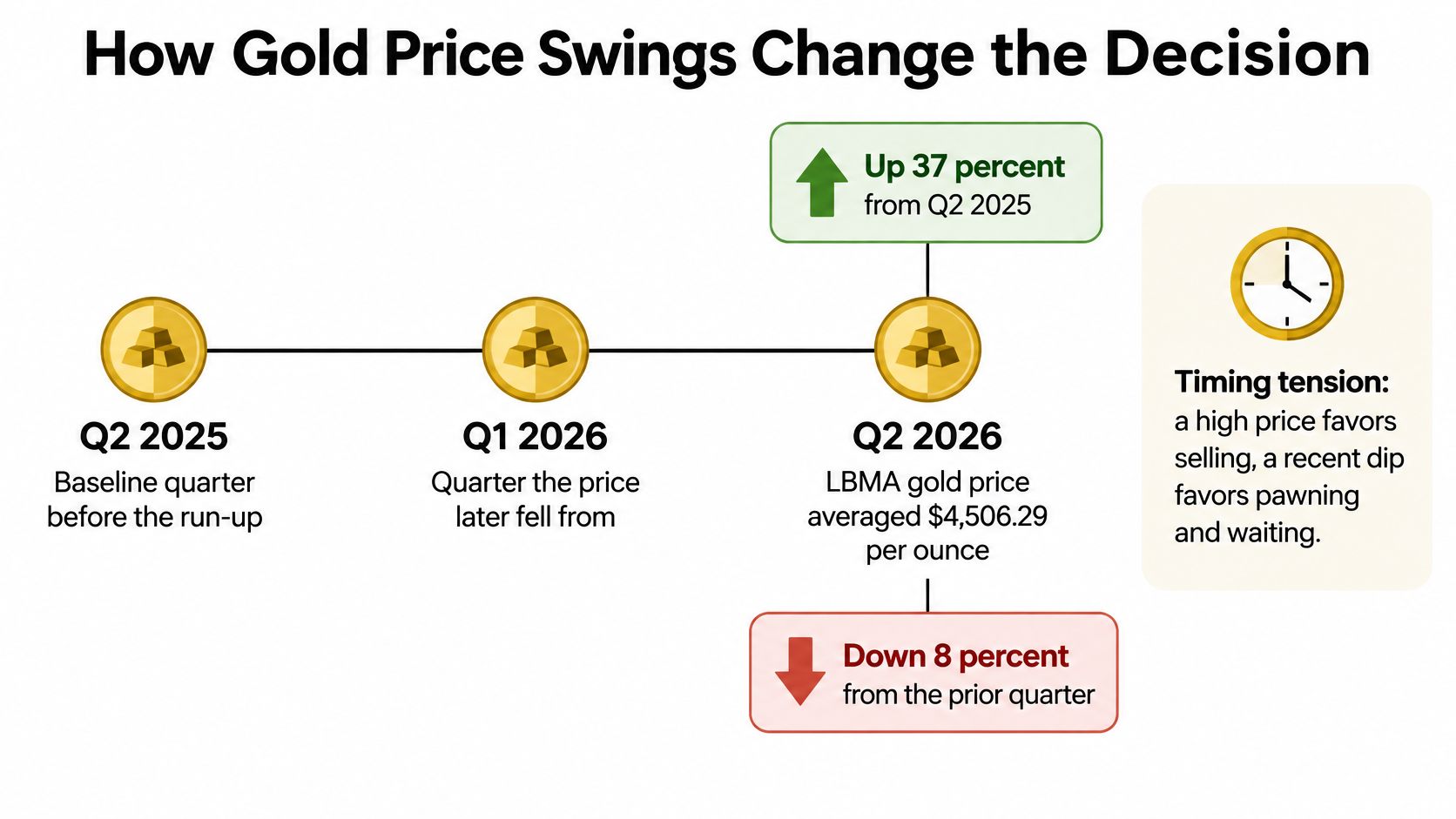
The World Gold Council's Gold Demand Trends for the second quarter of 2026 reports that the LBMA gold price averaged 4,506.29 dollars per ounce in Q2 2026, 37% above Q2 2025, while falling 8% from the preceding quarter. Strong yearly appreciation and a real quarterly pullback in the same dataset means "prices are high, sell now" is an incomplete rule.
Three paths, three different risks
| Scenario | Cash now | You keep the item | Main risk |
| --- | --- | --- | --- |
| Sell now | Full offer for melt and nonmetal value | No | Gold may rise later with no upside for you |
| Pawn and redeem | Loan principal, less than the offer | Yes, if repaid by the deadline | Charges build up and the deadline must be met |
| Pawn then default | Loan principal only | No | The shop may sell, layaway or wholesale the item |
The middle row carries something the other two don't: option value. While the loan is open you still own the piece, so you keep exposure to whatever the metal does next, and you keep the craftsmanship, brand and stones that a melt offer ignores. That option is only real if you redeem. Default converts a pawn into the worst version of a sale, because you took a loan-sized advance instead of a sale-sized offer and lost the item anyway.
What happens to an unpaid pawn
For an unpaid pawn, we may put the item up for sale, offer a layaway term, or wholesale it to a dealer, depending on the item and how the customer communicates with us. Talking to the shop before the deadline keeps more of those doors open than silence does. If you want the mechanics behind the daily number on the board, our explainer on how gold prices work covers spot, purity and the buyer's margin.
> Set a sell-or-redeem threshold before the loan starts, and recalculate the redemption cost against the current price at every renewal date.
Practically, that means writing two numbers on the ticket copy: the price at which you'll redeem and keep the piece, and the price at which you'll ask to convert to a sale instead. A pawn taken out to wait for a better price without those numbers is just an expensive way to postpone the same decision.
Situations Where Each Option Makes Sense
The verdict changes with the item and with the certainty of your repayment date, so take the cases one at a time.
A dated cash gap. A paycheck landing in three weeks, a tax refund already filed, a bill that clears when a client pays. Pawn, provided the redemption payment fits the budget without borrowing again. The term matches the problem, which is the whole case for a collateral loan.
Income you can't forecast. Commission months, seasonal work, an unclear start date on a new job. Sell. When the repayment date is a guess, renewals turn a small charge into a large one and you risk losing the piece after paying for the privilege.
Bullion, coins and plain scrap. These usually favor selling, because their value tracks metal content and there's little nonmetal worth to protect. A high price alone isn't pressure to act, though: the World Gold Council's first-quarter 2025 supply figures show gold recycling totaled 345.3 metric tons, down 1% year over year despite a 38% increase in the average quarterly gold price, so holders broadly didn't rush to the counter even as prices climbed.
An heirloom you'd miss. Pawn if repayment is realistic, and treat the finance charge as the cost of keeping the object rather than as a return on an investment. If repayment isn't realistic, selling to a buyer who values it as jewelry beats losing it to default.
A branded or collectible piece. Here the verdict flips toward selling when the intact resale value clearly exceeds the metal price, because a specialist buyer or an auction route can pay for the name, the condition and the demand. Pawning such a piece advances only a fraction of a value you've already established.
Inherited items with no paperwork. Get an appraisal or an independent evaluation first, then compare that document to the counter offer. Selling an estate piece on melt math alone can discard the premium that made it worth keeping in the family.
Match your own case to one of these, then name the single factor that pushes the other way. If it's sentiment, price it as a separate line. If it's an uncertain repayment date, that factor usually outranks everything else on the page.
Compare Offers and Confirm Your Choice
Run the two quotes side by side rather than sequentially, so you're comparing live numbers instead of a memory of last week's offer.
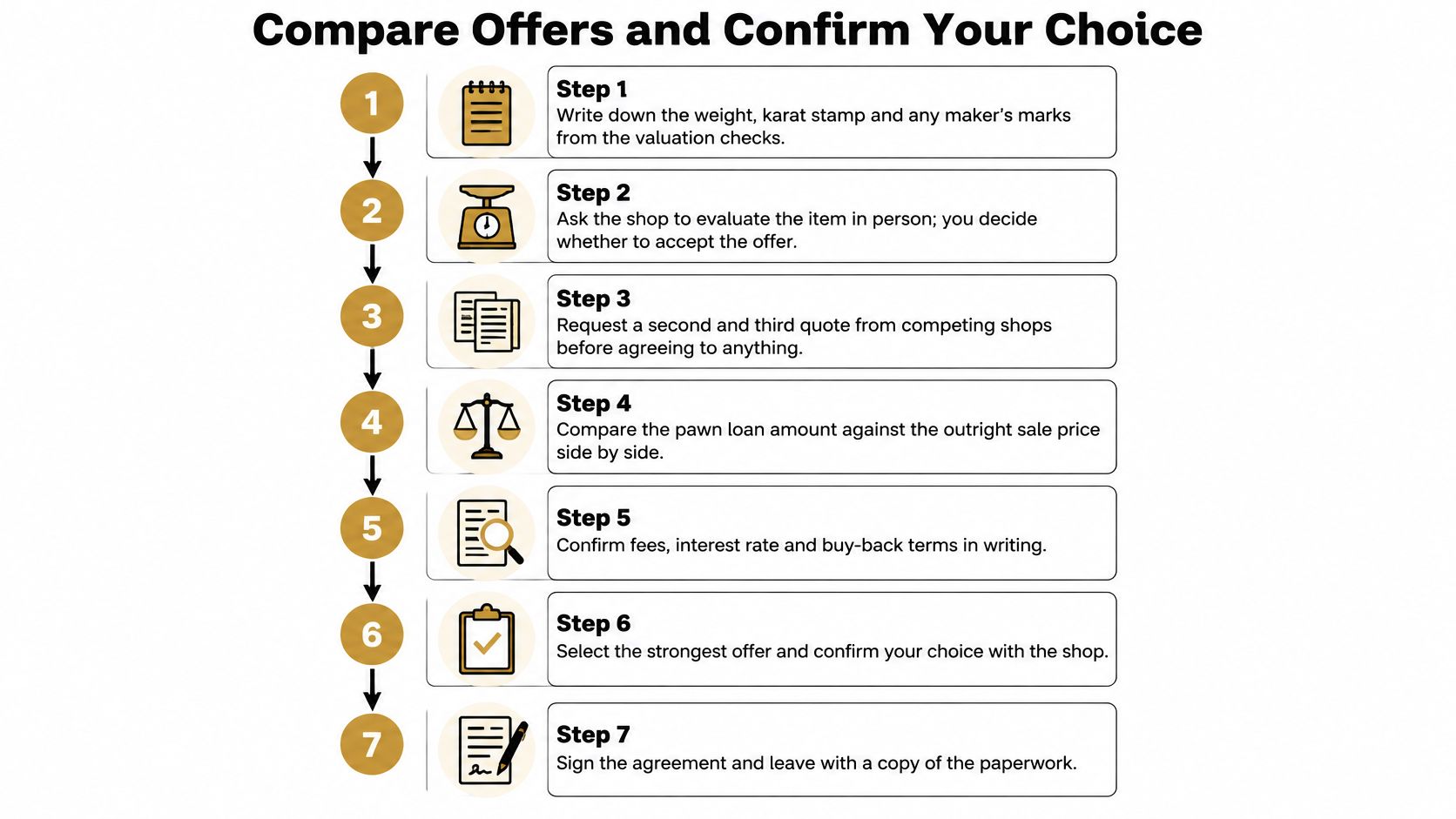
The seven-step routine
- Write down your own measurements. Grams, karat stamp, maker's marks, and whether any stones are set. Bring the note with you.
- Have the shop evaluate the piece in person. We assess items at the store, and you decide whether to accept the offer, so an evaluation commits you to nothing.
- Get the pawn quote in writing. Principal, finance charge for the term, storage or service fees, renewal charge, and the exact repayment date. Five lines, no gaps.
- Get the sale offer in writing. The amount paid today, how it splits between metal and nonmetal value, and any condition attached to it.
- Put three numbers on one sheet. Total redemption cost, today's sale offer, and the realistic price of buying an equivalent item later from a jeweler or a dealer. That third number is often skipped, and it's what makes the comparison honest.
- Stress-test the loan. Drop the gold price by a tenth and add one renewal to the term, then check whether the redemption payment still fits your budget. If a modest price dip or a single extension breaks the plan, the loan was never affordable, it was merely optimistic.
- Choose the option that survives the stress case, then confirm every term before signing and leave with a copy of the ticket or the sale receipt.
The five-question checklist
- Do you need it back? If no, the loan's only advantage disappears.
- Is repayment certain before the deadline? Certainty means a dated inflow, not a hope.
- Does the redemption cost fit in the stress case? Test the extended term, not the best case.
- Is the sale offer close to melt or to a documented nonmetal value? Ask which one the buyer priced.
- Does the price trend change your answer? Recheck spot on the day you sign, not the day you started researching.
Our guide on how to get the best loan from a pawn shop walks through preparing an item and negotiating terms in more detail.
The decision rule, stated plainly
Pawn when you want the item back, can repay inside the term, and the total cost passes the break-even test against replacement. Sell when you don't want it back, when repayment is uncertain, or when the intact offer beats what the loan plus charges would ever deliver. Neither choice is better in the abstract, and the arithmetic changes with the item, the term and your calendar.
For the visit itself, we buy and sell gold and silver, offer pawn loans against items you own, and provide free precious metal scans using an XRF analyzer at our Boise, Meridian and Nampa stores. Bring the purity stamp, your weight note and any receipts, appraisals or boxes, and ask for the quote in writing so you can run the comparison at home. Don't polish an older piece before you come in, since aggressive cleaning can damage patina, stones and plating that a buyer would otherwise pay for.
---
Bring your gold to Idaho Pawn & Gold Exchange in Boise, Meridian or Nampa for a free precious metal scan, then ask for two written numbers on the same visit: an outright purchase offer and a pawn quote with the principal, charges and repayment date spelled out. Weigh those against what a replacement would cost you, and you'll know within minutes whether keeping the piece is worth the finance charge or whether selling is the cleaner deal.