
You're sitting at the kitchen table with money ready to invest, watching gold command attention while mining shares move even more sharply. The obvious question is, is it better to buy gold or gold stocks? The useful question is more personal: do you want an asset you can hold, a business that can grow, income from an equity investment, or a liquid position inside a brokerage account?
Gold and gold-mining stocks aren't interchangeable. Gold is a commodity. A mining stock is an ownership claim on a company that must discover, permit, finance, extract, process, and sell that commodity. The right choice depends on what you want to happen after you buy.
Why the Right Question Is Not Just Gold vs Gold Stocks
A buyer opens two price charts, gold and a mining ETF, then chooses whichever line climbed higher. That comparison skips the forces behind each investment. The better question is what you want your purchase to do after you own it: preserve purchasing power, pursue growth, generate income, or provide convenient market exposure.
Physical gold gives you direct bullion exposure. Its return primarily follows the market price of gold, minus the premium and selling spread attached to the product. A gold-backed fund offers similar price-oriented exposure through a security. Neither depends on a specific mine meeting its production target.
Gold stocks give you business exposure with gold as the central driver. A miner's results also depend on energy prices, labor, debt, currencies, permitting, political conditions, ore quality, capital spending, and management decisions. Higher gold prices can expand a company's margin, but rising costs or an operational failure can erase that benefit.
The current market backdrop reinforces the distinction. The World Gold Council reports that gold reached 53 record highs in 2025, while global investment demand rose 84% to a record 2,175 tonnes in its full-year review of gold demand trends. Strong bullion demand may support miners, but it can also push investors to pay more for companies whose operating risks remain.
Start with the job you need the investment to perform
Ask which outcome matters most:
- Crisis protection: Choose direct bullion exposure. You own an asset without an earnings report, mine plan, or board of directors.
- Growth potential: Consider diversified gold-mining equities. You accept larger price swings for the possibility that higher gold prices expand operating margins.
- Income: Review mining companies or mining funds that may pay dividends. Those payments come from an operating business and can change.
- Convenience: A gold-backed ETF may fit if you want exposure without storing metal or arranging a dealer sale.
My direct view is simple. If you would be upset to see a gold position behave like a technology stock, do not start with a miner. If you already hold a broad stock portfolio and deliberately want a more reactive satellite position, gold stocks can have a place. Match the asset to the job, not to the excitement around the ticker.
What You Are Actually Buying in Each Case
Buy a one-ounce coin or a bar, and you own a specified quantity and purity of metal. The value changes mainly with bullion prices, but your actual result also depends on the dealer's purchase premium, the price offered when you sell, and the costs of protecting the item.
Buy shares of a mining company, and you own part of an operating business. That business has reserves, equipment, workers, contracts, debt, environmental obligations, and a management team. Its share price reflects gold, but also the market's judgment about whether the company can turn ore into profitable production.
Bullion, mining shares, and gold-backed funds are different categories
Physical gold is the most direct form. Coins and bars can be held privately or stored professionally. Jewelry is also physical gold, but its value can include design, craftsmanship, and resale considerations that don't apply in the same way to investment bullion.
Gold stocks include individual producers, exploration companies, royalty businesses, and funds holding baskets of miners. An individual miner may have substantial exposure to one region or one project. A diversified mining ETF spreads company-specific exposure across multiple holdings, but it remains an equity investment and can still move sharply with the market.
A gold-backed ETF belongs in a third category. Instead of owning mining businesses, it generally seeks to track bullion through a financial vehicle. It removes much of the storage work for the investor, but it doesn't give you coins in a safe or bars you can inspect personally.
> Practical rule: If you can't explain whether your investment owns metal, a claim on metal, or a business that produces metal, you haven't compared the products yet.
Physical gold doesn't issue earnings guidance. A mine can miss production, encounter lower-grade ore, face a permitting delay, or need additional capital. That structural difference matters more than whether two price charts happened to point upward during the same period.
Side by Side Comparison of Returns, Risk, and Liquidity
Gold and gold stocks can both benefit from a stronger bullion market, but they don't deliver the same ride. The World Gold Council reports that gold produced an average annual return of 10.4% from the end of the Bretton Woods gold-standard era in 1971 through 2019, while its longer-term compound annual return was 7.6%. The same analysis found gold was less volatile than equities, including individual stocks, industry sectors, and global MSCI equity indexes, as summarized through FRED's gold and index series.
That history doesn't promise a future result. It does show why bullion is usually the calmer instrument, while miners introduce an equity layer that can amplify both gains and losses.
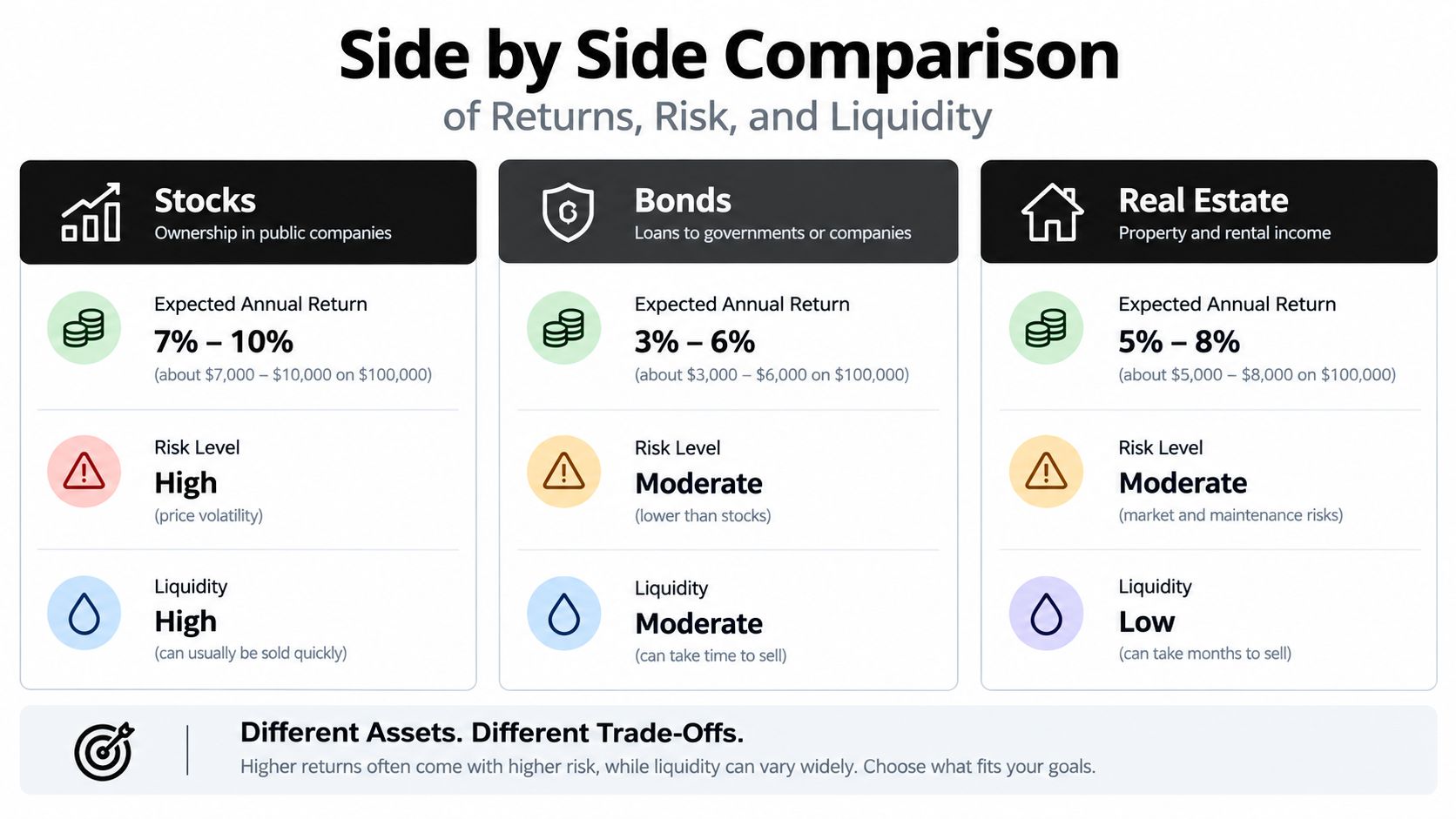
| Factor | Physical Gold | Gold Stocks / ETFs |
|---|---|---|
| Primary exposure | Bullion price | Gold price plus business performance |
| Income | No dividend or operating income | Some companies and funds may pay dividends |
| Volatility | Generally more direct and less equity-like | Higher sensitivity to company and market conditions |
| Main risks | Dealer spread, storage, insurance, purity, and liquidity | Costs, debt, dilution, management, permits, currencies, and market valuation |
| Selling process | Dealer transaction or fund redemption process | Brokerage transaction during market trading |
| Best use | Defensive holding and direct metal exposure | Growth-oriented equity exposure and operating leverage |
A mining stock can outperform bullion during a sustained rally if the company controls costs and expands its margin. It can also decline while gold rises if investors lose confidence in management, a project stalls, or expenses increase faster than revenue.
Where the answer is one-sided
Bullion wins when the priority is direct exposure without corporate execution risk. No miner can suffer a production outage because a coin is sitting in your possession.
Gold stocks win on trading convenience and potential income. You can place an order through a brokerage account, and an operating company may distribute part of its cash flow. That convenience doesn't make the stock safer. It makes the position easier to trade.
For smaller physical purchases, spreads and storage deserve the same attention as the quoted gold price. For securities, valuation and business quality matter as much as the metal's direction.
Why Gold Stocks Move More Than Gold Itself
A mining company sells gold at the prevailing market price, then pays to extract and process it. The difference is its operating margin. Production costs do not move in exact proportion to bullion, so a modest change in the gold price can produce a much larger change in that margin.
Consider the simplified example used by CPR Asset Management. A miner sells gold at $2,000 per ounce and has an all-in cost of $1,500, leaving a $500 margin. If gold rises 10% to $2,200, the margin reaches $700, a 40% increase before taxes and other effects. If gold falls 10% to $1,800, the margin drops to $300, also a 40% change, as explained in CPR Asset Management's analysis of how mining profits amplify gold-price moves.
That operating structure drives the difference between bullion and mining shares. Gold moves first, while the company's profit can move faster because many costs remain in place over the short run.
Amplification creates opportunity and exposure
CPR estimates average gold-miner volatility at approximately 36% and describes average beta, or operating sensitivity to gold, at about 2. In broad conditions, a 1% move in gold can correspond to an approximately 2% move in mining equities, although actual results vary substantially by company and period.
The risks go beyond the calculation:
- Energy and labor: Rising operating costs can compress margins while bullion remains firm.
- Permitting and politics: A mine depends on approvals, local relationships, and regulatory stability.
- Currency movements: Companies may earn revenue in one currency while paying expenses in another.
- Debt and dilution: Management may borrow money or issue shares to fund development.
- Ore grades: A reserve estimate does not guarantee that every tonne will produce the expected amount of metal.
- Country concentration: One jurisdiction can expose shareholders to changing rules or political disruption.
A diversified mining ETF limits the effect of one company's failure, but sector risk remains. An individual stock offers greater upside when management executes exceptionally well, along with greater downside when a project disappoints.
> Amplification is a feature only if you want amplified swings. If your real objective is emergency protection, buying a business with operational failure risk solves the wrong problem.
Which Investor Profile Fits Each Option
The right product becomes clearer when you describe the buyer rather than the market.
The crisis hedger
You want an asset outside a company's income statement and something you can hold directly. Physical bullion is the better match, provided you understand storage, insurance, purity, and resale spreads before buying. Keep the product recognizable and the transaction documented. The trade-off is that bullion won't pay you a dividend or expand production.
The growth-oriented investor
You already own diversified equities and can tolerate a position that behaves more aggressively than bullion. A diversified gold-miners ETF may suit that role better than a single exploration stock because it spreads exposure across operating businesses. The cost is equity volatility, and the fund can still fall for reasons unrelated to the day's gold quote.
The income-seeker
You want metals exposure with possible dividend income. Mining equities are the relevant category, not physical coins. Treat the dividend as a distribution from a company with real expenses, capital needs, and management choices. A high indicated yield doesn't turn a weak producer into a dependable income asset.
The hands-off saver
You want gold exposure but don't want a home safe, insurance questions, dealer appointments, or a selling process. A low-cost gold-backed ETF may be more practical. You give up direct possession of metal, and you still need to review the fund structure, fees, custody arrangements, and trading mechanics.
The buyer who wants two different jobs covered
Some investors hold bullion for defense and a limited mining allocation for equity upside. That combination makes sense only when each position has a defined purpose. Don't buy both just because choosing feels uncomfortable. Hold both when you want direct metal exposure and operating sensitivity, and you can withstand the different behavior of each.
VanEck notes that mining shares can move substantially farther than gold in either direction because miners' earnings are geared to the metal price. That is why I wouldn't label a mining ETF a substitute for bullion. It may complement bullion, but it isn't the same defensive tool.
Costs, Storage, Insurance, and Tax Treatment
The purchase price is only the first line on the receipt. Physical buyers need to account for the dealer spread between the quoted bullion price and the price of the coin or bar, then consider what the dealer will pay when they sell. Storage, insurance, authentication, and the time required to find a buyer can affect the result.
A home safe may reduce recurring storage charges but creates security and insurance questions. A bank box or private vault may improve security, but it adds an ongoing expense and may affect how quickly you can access the metal. Jewelry can carry additional design and craftsmanship value, which makes it a different comparison from standard bullion.

Securities have different friction
A brokerage account removes the physical handling problem. You can buy or sell a gold-backed fund or mining ETF without arranging a purity test or transporting a coin. The account may still involve fund expense ratios, bid-ask spreads, and trading or advisory costs, so “easy to trade” doesn't mean “free to own.”
Tax treatment depends on the product, account, holding period, and jurisdiction. In the United States, physical precious metals can receive collectible treatment, while mining stocks and ETFs may follow securities tax rules. Don't assume the tax result from one product applies to another. Ask a qualified tax professional before making a purchase, particularly if the position is large or held across different account types.
> Before you buy: Write down the purchase price, expected resale price, storage plan, insurance arrangement, fund expenses if applicable, and likely tax treatment. A return that looks attractive before friction may be ordinary after friction.
The practical conclusion is blunt. If you may need to sell soon, the spread on physical metal can matter more than a small change in the spot price. If you choose a stock or fund, the absence of storage doesn't protect you from poor valuation or a weak business.
A Practical Decision Framework for 2026
Use three questions before you place an order.
- What must the position do? If the answer is hedge, emergency optionality, or tangible ownership, start with physical bullion or a gold-backed vehicle. If the answer is growth, amplified exposure, or possible income, examine mining equities.
- How soon might you need the money? A brokerage security is usually easier to transact than a coin or bar, while physical metal requires a buyer, a purity assessment, and an acceptable spread.
- How much movement can you tolerate? If a sharp decline would make you sell in panic, don't choose the more volatile instrument because its upside looks attractive.
The decision tree
Buy physical bullion when you want direct gold exposure, local control, and a defensive holding that doesn't depend on a company remaining profitable.
Buy a diversified gold-miners ETF when you already hold broad equities, want amplified exposure to price moves, and accept that the investment may behave like a volatile equity rather than a quiet store of value.
Consider both when you want two distinct outcomes. Let bullion address direct metal exposure and let miners provide a separate growth-oriented allocation. Keep the roles clear so you don't judge the defensive asset by the performance standard of the equity position.
For a single mining stock, apply a margin-of-safety test before buying. Compare its expected all-in sustaining cost with the current gold price, then stress-test the business under a 10% to 20% gold-price decline, as recommended in the supplied market framework. If the company's economics look fragile under that scenario, don't call the stock a gold hedge. Call it what it is, a high-risk operating bet.
Next Steps for Local Buyers in Boise and the Treasure Valley
If you're buying physical metal in Boise, Meridian, or Nampa, walk into a shop with a plan rather than a target dollar amount. Bring identification if the dealer requires it, know whether you want coins, bars, or jewelry, and ask for the product's weight, purity, premium, buyback policy, and documentation.
Ask how the quoted price compares with the current spot price and whether the dealer will show both the purchase price and the expected resale price. That spread is more useful than a vague promise that the item is “close to spot.” For larger or unusual pieces, ask how the shop verifies authenticity.
Verification questions worth asking
- Testing: Does the dealer use XRF analysis, ultrasonic thickness testing, or another documented method?
- Purity: Is the fineness marked, and does the test confirm the marking?
- Condition: Is the item priced as bullion, jewelry, or a collectible?
- Resale: What would the shop pay if you sold the same item back?
- Paperwork: Will you receive a receipt identifying weight, purity, and product type?
- Storage: If you buy more than you want to keep at home, what secure storage options are available?
XRF can help identify elemental composition, while ultrasonic testing can help detect thickness inconsistencies. No single test replaces careful buying from a reputable source, but a transparent verification process reduces avoidable uncertainty.
If you prefer securities, use a brokerage account and research diversified products such as a gold-backed ETF or a gold-miners ETF before considering an individual producer. Read the fund documents, holdings, expenses, and risk disclosures. Don't buy a mine because its ticker feels like a shortcut to owning gold.
Take this checklist into the shop:
- Product type and intended purpose
- Weight and purity
- Spot price used for the quote
- Purchase premium
- Dealer buyback price
- Authentication method
- Storage and insurance plan
- Tax questions for your professional adviser
---
Idaho Pawn & Gold Exchange offers physical gold and silver bullion purchases, including special orders from $5,000 to $250,000, along with gold and silver stock alerts by text. Visit Idaho Pawn & Gold Exchange in the Boise, Meridian, or Nampa area to compare your bullion options and ask practical questions before you buy.