
A coin collection can turn into cash quickly, but a fast offer isn't automatically a fair one. If you've inherited coins, found them in a safe, or need money for an unexpected expense, start by separating what the gold is worth from what a collector might pay. That gives you a practical benchmark before a buyer names a price.
Calculate Your Coins' Value Before You Call a Buyer
| Coin | Gross weight | Gold purity | Fine gold (troy oz) |
|---|---:|---:|---:|
| American Gold Eagle, 1 oz | 33.931 g | 91.67% | 1.000 |
| Canadian Maple Leaf, 1 oz | 31.103 g | 99.99% | 1.000 |
| American Buffalo, 1 oz | 31.103 g | 99.99% | 1.000 |
| Krugerrand, 1 oz | 33.930 g | 91.67% | 1.000 |
| American Gold Eagle, 1/10 oz | 3.393 g | 91.67% | 0.100 |
These specifications help prevent a common mistake: treating a coin's gross weight as if every gram were gold. A 22-karat American Gold Eagle weighs 33.931 grams, but its alloy includes silver and copper; it contains one troy ounce of fine gold. For the metal-value calculation, use fine-gold content, not gross weight. The U.S. Mint's bullion coin specifications can help you verify published details for its coins.
Build a metal-value baseline
Use a three-stage check before requesting offers:
- Identify the coin. Record its issuer, denomination, date, mintmark, and condition. A recognizable bullion coin should be identified by type, not casually grouped with unidentified scrap.
- Verify its specifications. Check the published weight, diameter, edge, and fineness. If you have a scale, use it as a preliminary check, not as a substitute for a buyer's authentication.
- Calculate the baseline. Multiply the coin's fine-gold ounces by the current spot price per troy ounce. Then compare an offer with that metal-value figure and consider whether a genuine collector premium may apply.
For a clearly hypothetical example, if spot gold were $4,000 per troy ounce, a one-ounce Gold Eagle would have a metal-value baseline of $4,000. A hypothetical offer at 92% of spot would be $3,680 before any separately stated fees. That gap is not automatically unfair: a buyer may account for testing, handling, resale demand, and price risk. But you should be able to understand the calculation rather than accept a bare “cash percentage.”
Bullion premiums and numismatic premiums are different. Bullion value comes from the coin's fine-gold content and market pricing; a numismatic premium reflects collector demand for features such as rarity, condition, or provenance. The Gold IRA Association's guide to understanding American Gold Eagle pricing offers further context on separating those value components. To see how market references feed into estimates, review how gold prices work.
Write this line for each coin: Coin | Fine-gold ounces | Spot price | Metal-value baseline | Offer as a percentage of baseline. Once you have it, you can tell whether an offer is below your metal benchmark and ask what accounts for the difference.
How to Prepare and Authenticate Coins Before Negotiating
Sorting and documenting coins before you visit a buyer reduces confusion and helps protect collector value. The U.S. Mint's bullion consumer guidance recommends checking published coin specifications and understanding market premiums. Avoid acid tests, scratching, or other destructive checks, especially on coins that might interest collectors.
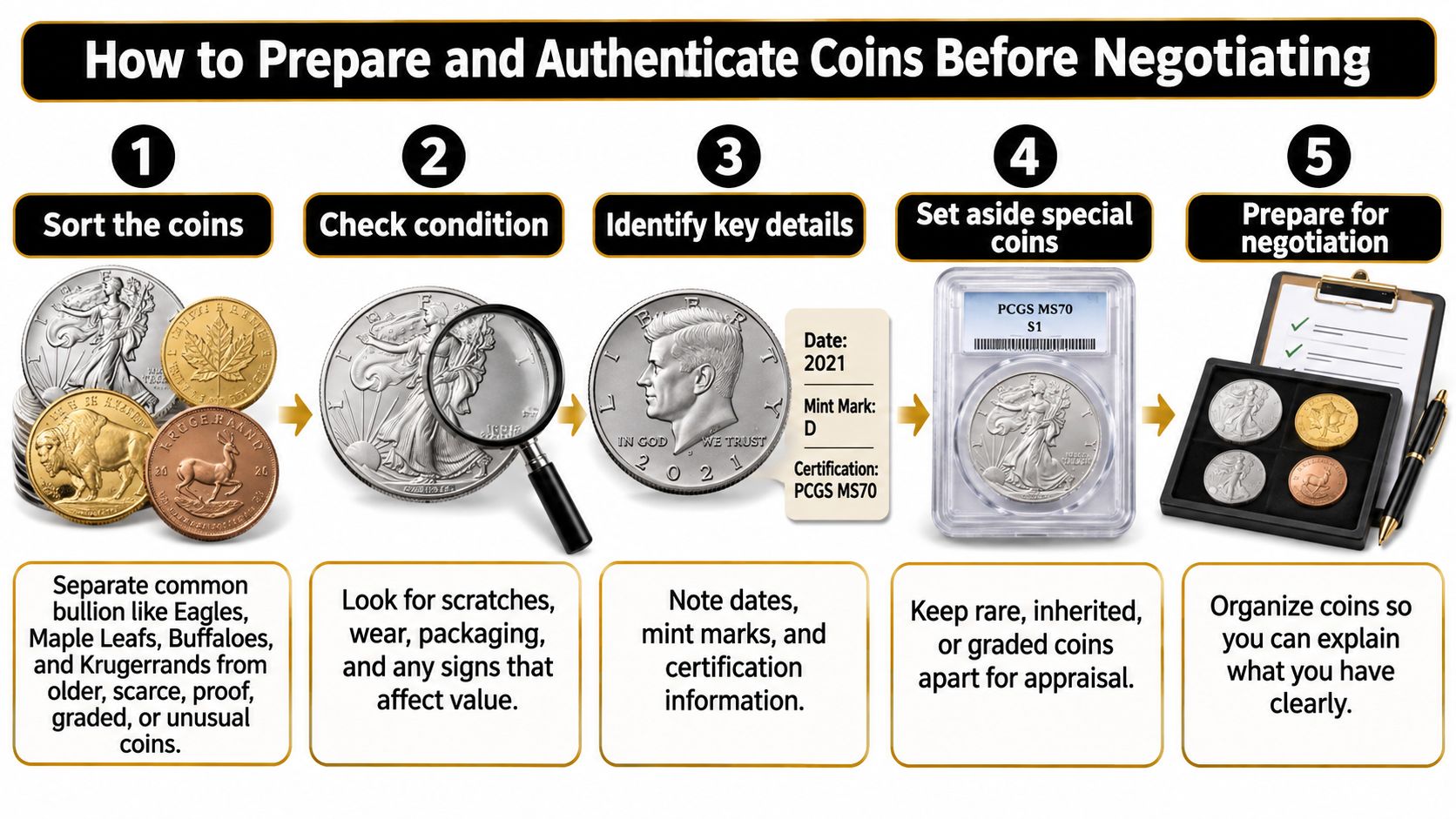
- Make two groups. Put common bullion such as Eagles, Maple Leafs, Buffaloes, and Krugerrands together. Set aside older, scarce, proof, graded, or unusually well-preserved coins for a separate collector appraisal; a bullion-only offer may not account for their additional appeal.
- Photograph everything before testing. Take clear pictures of both faces, the edge, capsules, boxes, certificates, and identifying marks. These records help you show what you brought if packaging or condition becomes part of a pricing discussion.
- Check weight and diameter. Weigh each coin in grams on a calibrated scale and measure its diameter with calipers, then repeat any reading that drifts. A single reading from an unverified scale is a weak basis for disputing a buyer's test.
- Request non-destructive screening. Ask about methods such as density, conductivity, magnetic-response screening, or X-ray fluorescence (XRF). If a result is borderline, ask for a second method instead of treating one uncertain reading as conclusive.
- Keep packaging and paperwork together. Put capsules, certificates, and other documents in a labeled envelope with the related coins. Don't clean or polish coins before evaluation, because altering the surface can affect a collector's assessment.
- Get offers after you've organized the lot. Once you've sorted, photographed, measured, and gathered records, request written offers for the coins you have. If you're comparing testing approaches, this overview of thermo and Sigma Metalytics precious-metal testing explains why buyers may use screening equipment.
A coin that passes a basic check should match its published weight and diameter, with screening results that agree. Those checks don't establish a collector grade, but they give you a clearer basis for discussing authenticity and price.
Pawn Shop, Local Dealer, Online or Auction Compared
A bullion offer and a collector offer answer different questions. First separate a coin's metal value from any possible collector premium. Then compare selling channels based on the coin's likely audience, your deadline, and the money left after costs.
| Option | Speed | Price basis | Costs to check | Best fit |
|---|---|---|---|---|
| Pawn shop | Same day | May be based on metal value; a pawn loan uses the coin as collateral | Loan interest and forfeiture if unpaid | Small amounts when cash is urgent |
| Local bullion dealer | Same day | Metal value, less the dealer's spread | Testing or handling fees, if listed | Common bullion coins |
| Online dealer | Several days, after shipping and verification | Spot-based bid, often paid after receipt | Insured shipping, packaging, and return costs if rejected | Larger lots and price comparison |
| Coin shop or auction | Coin shop timing varies; auctions usually take considerably longer than a same-day sale | A coin shop may consider collector demand; auction proceeds depend on sale results | Appraisal fees, seller commission, and consignment fees | Rare dates, proofs, and graded coins |
A local buyer can suit common bullion when you want an in-person evaluation and prompt payment. An online dealer may be worth considering for a larger lot if you accept shipping, verification, and a wait for payment. Compare the expected net proceeds, not just the headline bid.
Rare dates, proofs, and graded coins may attract collector interest that a metal-only offer does not include. A coin shop can assess that potential; an auction may reach buyers seeking specific pieces, but fees reduce proceeds and the timeline is usually longer than a same-day sale. Confirm the expected timeline and costs before committing. For a useful overview of how to avoid costly coin selling mistakes, consider how each channel reaches buyers for your type of coin. You can also review general information about the auction process when weighing whether a longer sale timeline suits you.
Compare four points: How soon will I be paid? Is the offer based on metal value, collector demand, or both? What costs will be deducted? Does the buyer assess the kind of coin I'm selling? A higher-looking price can leave you with less after fees. Ask for the expected net amount and decide whether the trade-off works for you.
If you need cash quickly, contact a local buyer and ask about its in-person evaluation process. If you can wait, compare online bids or ask a coin shop about collector value. Choose the route that fits your deadline and gives the coin's metal value and any collector premium separate consideration.
Negotiating a Fair Offer and Getting It in Writing
Request two or three written offers on the same day. Gold prices and dealer spreads can change, so same-day quotes are easier to compare. Ask each buyer to identify the spot-price reference, the percentage or spread applied, all testing, shipping, or handling fees, whether the offer reflects bullion or collector value, and how long the quote is locked.
The Commodity Futures Trading Commission's precious-metals guidance advises buyers and sellers to compare costs and get fees in writing. It also explains that dealers buy below spot and sell above it, with the difference known as the spread. Convert each quote into a price per gram or troy ounce of fine gold so you're comparing like with like, not a one-ounce bid against a half-ounce bid.
The CFTC also warns that retail coin dealers generally aren't regulated like many financial professionals. Check a buyer's credentials, complaints, business history, and physical location yourself. During the discussion, ask the buyer to explain the math and every deduction.
> A practical rule: If a buyer won't show how the offer was calculated, don't surrender the coin.
Watch for these warning signs:
- An unexplained cash percentage. Ask what price reference and deductions produced it.
- A bullion coin called generic scrap. Ask why the buyer is using that classification and what discount it creates.
- Pressure to accept immediately. You can compare the offer with your other written quotes.
- Guaranteed returns or inflated collectible claims. Treat them as reasons to pause and verify the claims independently.
Before accepting, get a receipt that names each coin and lists weight, fineness, price basis, deductions, and payment method. A clean record shows what you sold and how the buyer arrived at the payment. At an in-person evaluation at Idaho Pawn & Gold, the customer decides whether to accept the offer; if the number misses your baseline, you can leave without selling.
Taxes and Records for Inherited or Undocumented Coins
A cash sale can still create a taxable gain. The holding period and cost basis affect how the gain is calculated. The USA Today overview of precious-metals capital gains explains that investment precious metals are generally treated as collectibles. Long-term gains may be taxed at a maximum federal rate of 28%, while short-term gains are taxed as ordinary income.
| Situation | Tax treatment | Federal rate ceiling | Record to keep |
|---|---|---|---|
| Held one year or less | Ordinary income | Your applicable ordinary income rate | Purchase receipt and sale statement |
| Held more than one year | Long-term collectibles gain | 28% maximum | Purchase receipt and specific identification list |
| Inherited coins | Generally treated as long-term gains; basis usually reflects the estate valuation at the date of death | 28% maximum | Estate inventory and appraisal |
| Undocumented coins | Basis may be unknown; FIFO may apply | Depends on sale timing | Photos, serial numbers, and grading certificates |
Cost basis is the amount used to measure a gain or loss. Specific identification connects a sold coin to its purchase record when you can adequately identify it. If you cannot, FIFO may apply, which can affect the calculation when coin values have risen. Do not treat an estimated purchase cost as established fact.
For inherited coins, the estate inventory and appraisal are the key records for determining basis. Keep inherited pieces separate from coins you bought yourself, and preserve any estate or probate papers, photographs, grading certificates, serial numbers, and the buyer's settlement statement. If you need cash but do not need to sell everything, ask an accountant whether selling only the amount needed fits your circumstances.
A buyer can document the transaction, but tax advice should come from an accountant. Ask how to establish basis for inherited or undocumented coins, which state tax rules apply, and what reporting requirements or records matter for your sale.
Choose Where to Sell Your Coins Locally
For common bullion and a same-day evaluation, a local sale can avoid shipping and let you see the testing process. Coins with potential collector value need extra care: take the time to gather records and arrange an appropriate appraisal before accepting a bullion-only bid.
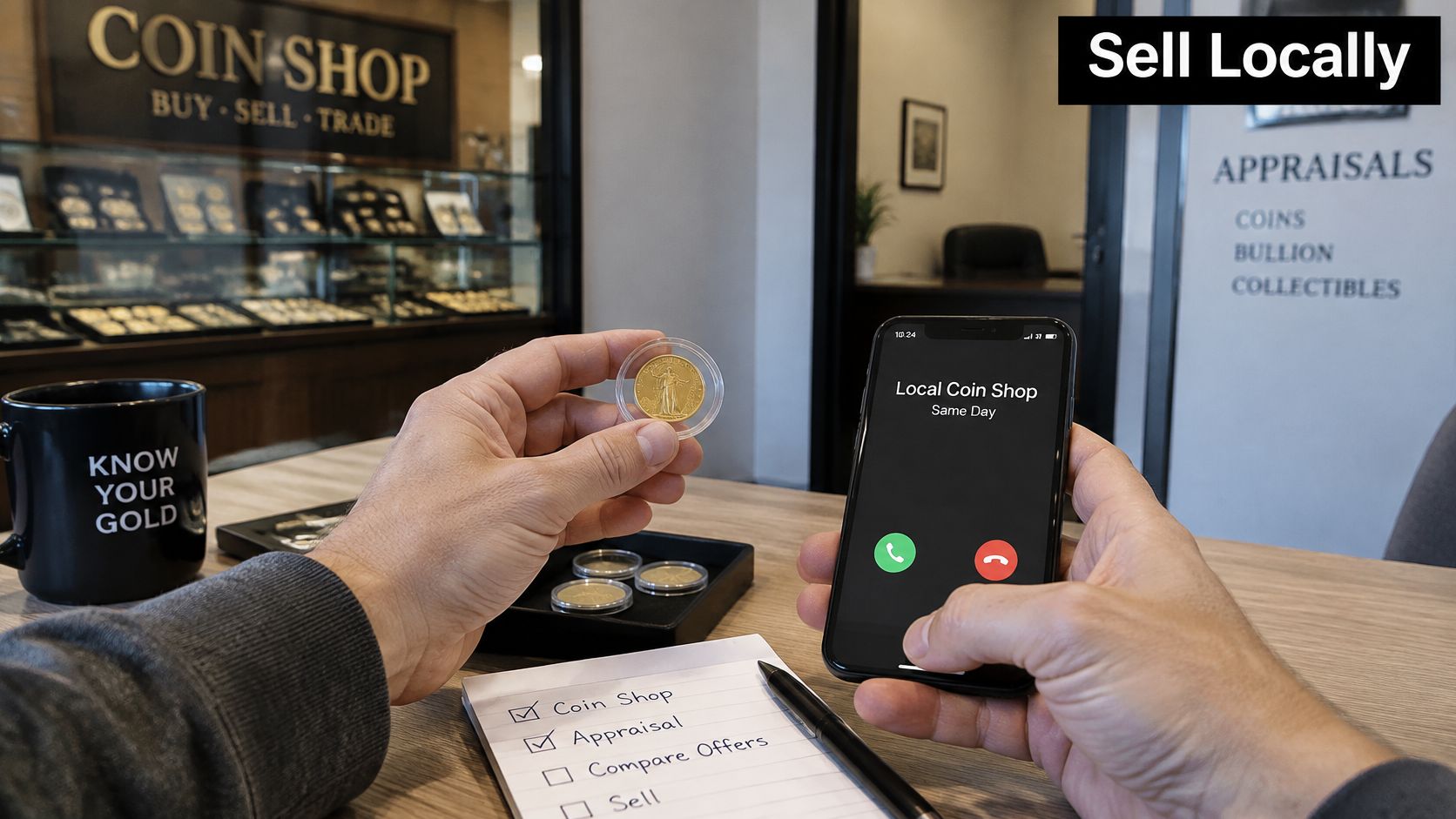
Idaho Pawn & Gold buys gold, silver, jewelry, coins, rounds, and bullion at its Boise, Meridian, and Nampa locations. The business offers free precious-metal scans and uses an XRF Analyzer to provide lab-quality results. Bring sorted coins in their capsules, along with photos and documents, so you can compare the evaluation with the specifications you recorded.
At the in-person evaluation, the customer decides whether to accept the offer. Bring your own metal-value baseline and a competing quote, and compare the final figure with any stated deductions before signing. If the coin may have a collector premium, ask whether the offer is based on bullion value or collector value.
See the process in this video before planning your visit:
Choose the location closest to you, decide on a walk-away number before you arrive, and bring only the coins you're prepared to sell. Find locations and hours on the Idaho Pawn & Gold website.
---
Idaho Pawn & Gold Exchange evaluates gold coins in person, with free precious-metal scans at its Boise, Meridian, and Nampa locations. Sort your coins, bring your records, and visit Idaho Pawn & Gold Exchange to discuss an offer and decide whether it works for you.