
Most guides on how to pawn jewelry tell you to polish your rings, bring your insurance appraisal, and negotiate down from retail price. Follow that script at a real counter and you'll walk out frustrated. An insurance appraisal estimates what a retail store would charge to replace a brand-new piece after a theft or loss, including store markups, design overhead, and retail profit margins.
A pawnbroker isn't insuring your jewelry. We're lending cash against what we can reliably recover if you don't come back for it. Once you understand the gap between retail replacement numbers, secondary-market demand, and raw metal melt value, you stop guessing at the counter and start reading offers with clear eyes.
Knowing how to calculate your jewelry's metal floor, compare written loan terms in actual dollars, and pick the right repayment timeline turns a stressful errand into a predictable financial decision.
How to Pawn Jewelry Step by Step
Every pawn offer tracks what a lender can resell the item for on the secondary market, never the original receipt price or an insurance certificate. Because the jewelry itself secures the cash advance, traditional credit scores stay out of the transaction. In the UK, a University of Bristol study published in the National Pawnbrokers Association 2020 report found that gold jewelry was by far the most commonly pledged item, while diamond jewelry was pledged by about 1 in 10 borrowers and watches accounted for 6%. The same study recorded a median loan of £120 versus a mean of £243, reflecting how pawn loans usually work as small-dollar liquidity tools rather than long-term consumer debt.
Before you head to a shop, look at how the core transaction moves from sorting your jewelry box to bringing your piece back home.
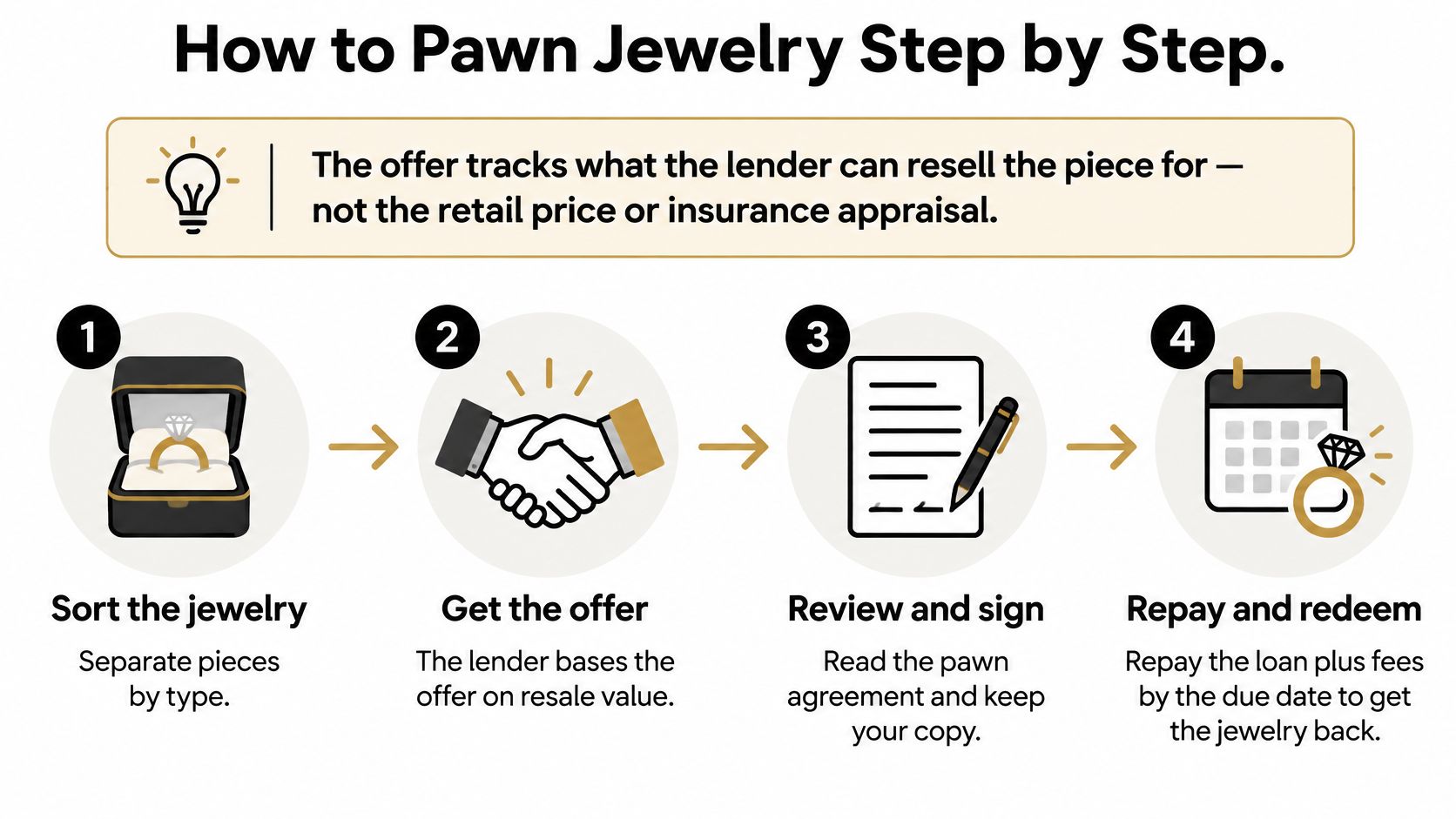
Walking Through the Eight Counter Steps
- Sort solid metals from fashion pieces. Put solid gold, platinum, and sterling silver in one pouch, and set aside gold-filled, plated, and costume pieces so they don't slow down the appraisal. If a pendant has a detachable stone or charm, keep it separate from the chain weight.
- Document everything at home. Snap clear photos of each piece under bright light, including zoomed-in shots of clasps, stamps, and hallmarks. Write down any maker's marks, serial numbers, or lab report numbers before the item leaves your hands.
- Gather your photo identification and proof of residence, since local and state ordinances require licensed shops to log who pledged every item. Some jurisdictions also enforce holding periods before a shop can place forfeited goods on the sales floor.
- Get an in-person counter evaluation. Expect the staff to weigh each piece on a calibrated gram scale, verify karat purity with an electronic tester or XRF spectrometer, and inspect gemstones under a loupe.
- Collect at least two written offers. Don't accept the first verbal quote you hear. Ask each counter specialist whether the quote reflects raw collateral melt value or expected retail resale value, because that single answer tells you whether the shop is pricing in brand and gemstones.
- Read the entire loan agreement line by line, paying close attention to the principal, monthly or annualized interest rate, storage or processing fees, maturity date, grace period, and forfeiture rules.
- Sign the agreement, count your cash before stepping away from the window, and store your pawn ticket somewhere safe. Treat that ticket like a claim check for your jewelry.
- Redeem on schedule. Return before the deadline with the principal plus accrued interest and fees to reclaim your piece.
Realistic Counter Timelines
Plan your visit around the complexity of what you're bringing. A plain gold chain or wedding band can usually be weighed, tested, and priced in 10 to 20 minutes. Luxury watches from brands like Rolex or Omega, along with certified diamonds or intricate estate pieces, take longer because staff need to check movement authenticity, verify serial numbers, or pull recent auction comparables. Occasionally, a high-value watch or rare stone requires a second look by a senior gemologist before a final loan figure goes on paper.
> Counter habit: Never combine five different items onto a single pawn ticket if you might want to redeem only one or two later. Ask for separate tickets on separate pieces so you can pull back your favorite ring without paying off the entire bundle at once.
Identification and Paperwork to Bring
Pawning is a regulated collateral transaction, not a casual cash swap. Licensed shops are legally obligated to record who pledged each item and submit transaction logs to local law enforcement databases, which protects both the borrower and the shop from stolen-goods disputes.
Here are the two baseline identity documents you should keep in your wallet before stepping inside.
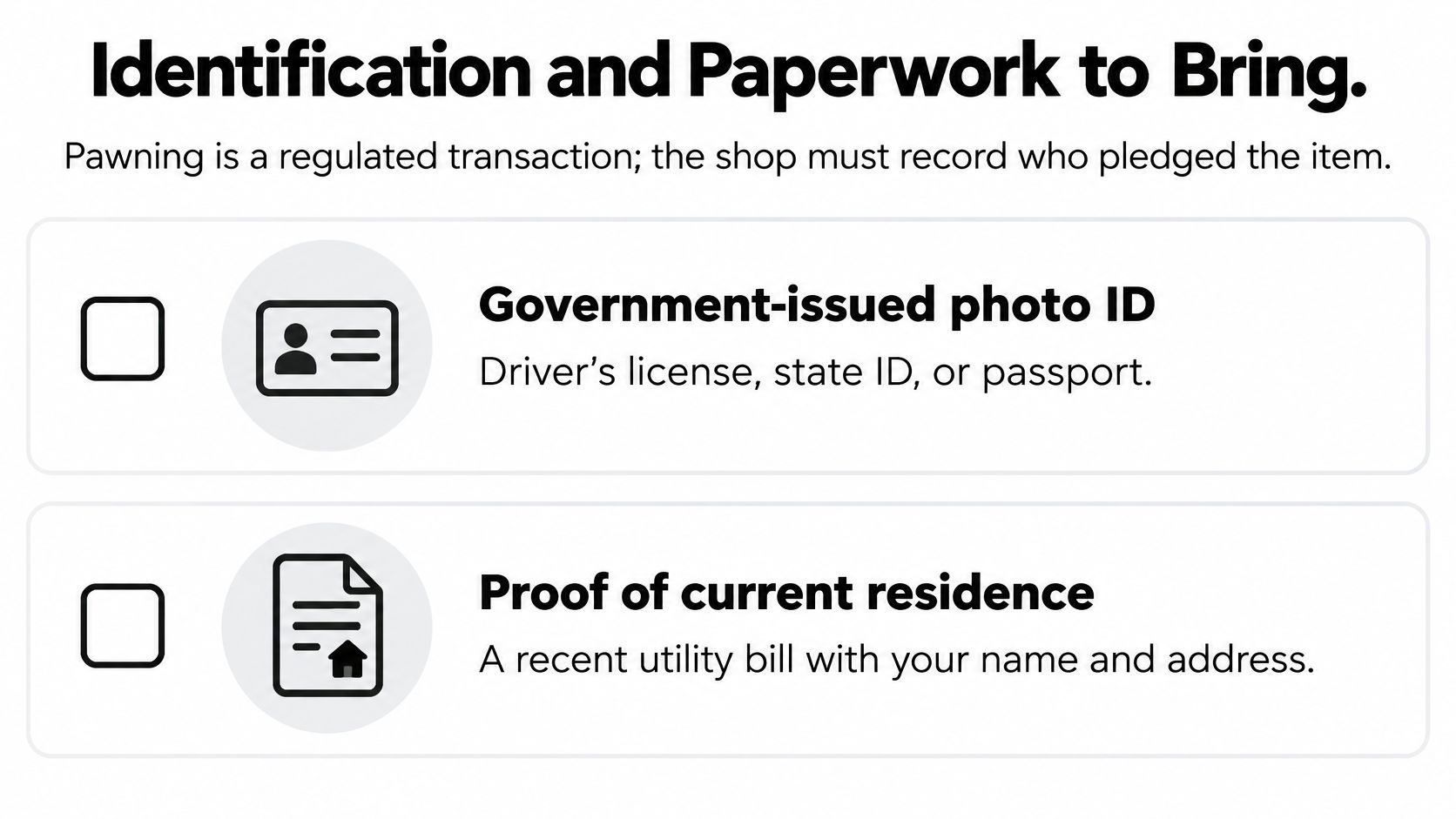
A valid government-issued photo ID (driver's license, state ID card, or passport) is required. Many shops also ask for proof of current residence, such as a recent utility bill or lease statement, whenever your ID address isn't up to date. Beyond identity, ownership evidence carries real financial weight on expensive items. Original sales receipts, branded boxes, warranty cards for Swiss watches, and independent laboratory reports verify provenance and give the lender confidence to stretch the offer higher.
If you're pledging a diamond, know what your certificate proves. As the Gemological Institute of America explains, a GIA grading report objectively documents the 4Cs (color, clarity, cut, and carat weight) and discloses known treatments, yet it isn't an appraisal and assigns no dollar value. The same GIA guidance notes that per-carat diamond prices generally jump at benchmark weights like 1.00, 1.50, and 2.00 carats, so bringing the report helps the counter confirm exact measurements near those thresholds instead of guessing conservatively.
Common Paperwork Snags at the Counter
Even prepared borrowers run into avoidable delays when ownership details don't line up neatly. Watch for these four situations before you drive over:
- Name mismatches: If your maiden name appears on an old receipt or diamond dossier while your driver's license shows your married name, bring a copy of your marriage certificate or an updated ID record.
- Inherited jewelry with no receipts: Estate rings and family chains rarely come with original store paperwork. Expect the shop to spend extra time authenticating the metal and stones, and be ready to sign a legal ownership declaration.
- Bringing a spouse's jewelry: Most states require the person signing the pawn ticket to be the legal owner of the collateral. If the ring belongs to your spouse, have them accompany you or call the store beforehand to verify local rules.
- Counter photos and holding periods: Shops routinely photograph both the jewelry and the borrower as part of compliance records, and municipal ordinances often require holding forfeited items for a set period before resale.
Before packing up your items, this quick video walks through what staff check when you arrive at the window.
Call the shop ahead of time and tell them specifically what you plan to bring so you don't waste a trip chasing a missing document. Pack this short kit in one folder:
- Current photo ID with an accurate expiration date.
- Recent proof of address if your ID shows an old street address.
- Receipts, watch boxes, warranty cards, and lab reports matched to each item.
- Clean, sorted jewelry separated by metal type so stones don't scratch against gold links.
- A small notebook and pen to write down each store's principal, fee schedule, and maturity date side by side.
How Pawn Shops Value Your Jewelry
An $8,000 insurance appraisal is a retail replacement ceiling, not the cash a pawn counter will hand you. I would ignore that figure as a loan target. The offer is built from two lower numbers, and the gap is usually large.
Every quote sits on a three-tier ladder. Scrap or melt value is what the recoverable precious metal is worth if the piece were refined. Secondary-market resale value is what a local buyer or pre-owned dealer will pay for the intact item. The insurance replacement appraisal sits on top and is priced to buy a new equivalent at full jeweler markup.
Pawn lenders advance a percentage of the bottom two tiers. They do not lend against the appraisal. A high gold spot price does not raise the loan on every piece. According to the World Gold Council 2025 Gold Demand Trends report, global gold-jewelry demand value hit a record $172 billion in 2025, up 18%, yet total consumption volume dropped to a five-year low of 1,542 tonnes. The scrap floor climbs with the metal. Fewer buyers can pay high pre-owned prices, resale slows, and the lender keeps a wider margin.
The Melt-Value Formula and Two Worked Examples
Read the purity stamp, then treat it as a claim, not proof. The Federal Trade Commission jewelry buying guide explains that karat measures pure gold out of 24 parts (so 14K is 14 parts gold and 10 parts alloy) and requires a quality mark beside a responsible maker's trademark. Sellers must represent metallic content, weight, quality, and treatment truthfully. Counterfeit stamps still circulate, so the shop tests the alloy physically or electronically before it names a price.
Fine gold grams = Gross metal weight (grams) x Karat / 24
Take a plain 10-gram 14K gold chain with no stones. Multiply 10 by 14 and divide by 24 to get 5.83 grams of fine gold. At a hypothetical $80 per gram, raw melt is about $467. The pawnbroker still covers refining spreads, capital tied up in the loan, and price swings before you redeem. A shop advancing 50% to 70% of melt would likely quote $230 to $325.
Now put a hypothetical 2-carat diamond engagement ring with an $8,000 insurance appraisal on the same counter. The loan can land at a fraction of that appraisal. Diamonds do not trade like liquid bullion. The shop pays for gemological checks, carries the ring for months if you default, and prices it low enough for a pre-owned buyer who expects a steep cut under retail.
| Karat | Fine gold share | Typical use |
| :--- | :--- | :--- |
| 24K | 100% (24 of 24 parts) | Bullion, coins |
| 18K | 18 of 24 parts pure gold | Fine and designer jewelry |
| 14K | 14 of 24 parts pure gold | Most U.S. jewelry |
| 10K | 10 of 24 parts pure gold | Durable everyday jewelry |
| 9K | 9 of 24 parts pure gold | Common in UK and imported pieces |
| Gold-filled and plated | Thin gold layer over base metal, negligible fine gold | Costume and fashion jewelry |
What Lifts an Offer Above Melt Value
Signed pieces from Cartier, Tiffany & Co., or Van Cleef & Arpels draw stronger secondary demand when the box, serial number, and receipt are still with the item. Undamaged settings, clean prongs, and well-matched diamond pairs can push a quote above scrap weight.
On antique sterling pins and heirloom brooches, heavy grime can hide hallmarks during inspection, and a missed mark pulls the quote back to metal weight. Gentle upkeep matters too, since heavy grime can hide hallmarks during inspection; this guide on caring for tarnished silver brooches shows how to lift surface tarnish safely without scratching delicate metalwork.
Gold-filled, gold-plated, and gold-tone costume jewelry hold negligible recoverable gold. Chipped melee, heavily abraded stones, and one earring missing its mate usually fall straight back to metal weight. Reading how gold prices work on live spot markets separates true metal value from retail markup before you leave home.
Your Pre-Visit Valuation Worksheet
Run each gold piece through these six lines before you ask for a quote:
- Gross metal weight: Weigh the item in grams on a digital kitchen or jeweler's scale, and subtract estimated stone weight so gems do not inflate the metal math.
- Verified karat: Note the stamp (10K, 14K, 18K) and whether a maker's mark sits beside it.
- Fine gold grams: Multiply gross metal weight by karat, then divide by 24.
- Estimated melt floor: Multiply fine gold grams by today's spot price per gram.
- Target advance range: Take 50% to 70% of that melt floor as a baseline for plain gold.
- Resale premium check: Note a designer name, a certified center stone, or intact packaging that supports a resale-based offer rather than a scrap quote.
> After the number, ask one question: "Is this offer based on melt collateral value, or are you factoring in resale demand for the stones and brand?" The answer shows whether a second shop might price the piece higher.
Loan Terms, Fees and Deadlines You Should Read Twice
A high principal offer means very little if the monthly fee structure traps you in repeat renewals. According to the Consumer Financial Protection Bureau Making Ends Meet research, 3.7% of U.S. consumers used a pawn loan in 2024, unchanged from 2023 and slightly higher than the 2.5% who took out a pawn loan during the six months before June 2019. Among those June 2019 pawn borrowers, 73% still owed money at the time of the survey, 56% took out another pawn loan over the following 12 months, and 60% of payday, auto-title, or pawn users reported being denied mainstream credit or receiving less than requested.
Repeat renewals happen fast when borrowers focus only on today's cash payout and ignore the redemption math. Always translate percentages into exact dollar amounts before you sign. Say a state-regulated lender charges a hypothetical 12% monthly rate (which equals 144% annualized). Ask the counter to write down the exact dollar payoff if you redeem in 30 days, in 60 days, and at maturity, since holding a loan for a second month doubles the monthly finance charge on top of your principal. Plugging your numbers into our pawn loan calculator lets you see those dollar totals before you commit.
Reading Your Pawn Contract Line by Line
Pawn interest caps, storage fees, and minimum loan terms are regulated at the state level, so check your state financial regulator's website if a fee looks unusual. Watch out for counters that advertise an easy low-principal loan while tacking on steep flat monthly service charges that push the effective cost through the roof. At our stores, a pawn is a collateral short-term loan where you leave an item as collateral, we offer a loan amount, and you get a 10-day grace period to repay the loan after maturity.
| Term | What it means | What to ask |
| :--- | :--- | :--- |
| Principal | Cash advanced, usually a fraction of resale value | Is this offer based on collateral value or expected resale value? |
| Interest and fees | State-regulated; can be quoted monthly or annualized | What is the exact dollar cost at 30 days, 60 days, and maturity? |
| Maturity date | The day the loan is due | What is the exact payoff amount on that date? |
| Grace period | Extra days before forfeiture; commonly 10 days | Exactly how many days do I have after the due date? |
| Renewal or extension | Option to roll the loan by paying interest | Can I renew, and does the principal stay the same? |
| Forfeiture | Item becomes the shop's property if unpaid | Will you contact me before selling or wholesaling the item? |
| Identification | Photo ID and proof of residence, varies by state | What documents do you require? |
Because your jewelry secures the loan, a pawn doesn't trigger a credit pull, and defaulting typically ends with forfeiture of the collateral rather than collections calls or lawsuits. That built-in cutoff protects your credit report, yet it also means missing the final grace day ends your legal right to reclaim the piece.
Four Questions to Ask Before Putting Pen to Paper
Before you sign the ticket and pocket the cash, get clear spoken and written answers to four questions:
- Exact payoff on the due date: Confirm the precise dollar sum required to walk out with your jewelry on maturity day, with every fee included.
- Exact length of the grace window: Verify the calendar date when the grace period closes and whether weekends or holidays shift that cutoff.
- Renewal rules: Ask if paying accrued interest alone resets the clock, and confirm that the original principal won't increase if you extend.
- Post-default handling: Find out what happens immediately after the final deadline passes so you aren't caught off guard if an unexpected bill delays your trip back.
How to Redeem Your Jewelry on Time
Redeeming a pawned piece is straightforward as long as you plan around the calendar instead of waiting for the final afternoon. Your pawned item is returned to you once the loan amount and accrued interest fees are paid. Don't assume the payoff matches the cash you originally walked out with; interest and applicable fees accumulate up to the exact day you settle the balance.
Call the counter on the morning you plan to redeem and ask for that day's exact payoff figure, along with which payment methods the shop accepts without extra processing charges. Bring your pawn ticket, the exact payoff amount, and your photo ID. If you already have an active loan with us and want to stay ahead of the schedule without driving across town, you can manage your payment online using the "Pay my pawn" option.
Handling Tight Cash or a Lost Ticket
Aim to settle your balance at least three to five days ahead of the maturity date. Leaving that buffer prevents a Saturday bank closure, a holiday weekend, or a flat tire from pushing your payment past the grace window.
> If money gets tight before maturity, call the shop while the loan is still active. Staying quiet until after the deadline removes options that a five-minute phone call beforehand can keep open.
When you communicate early, staff can walk you through paying accrued interest to renew the ticket or structuring a workable timeline. For an unpaid pawn after the deadline expires, we may put the item up for sale, offer a layaway term, or wholesale it to a dealer, depending on the item and your communication. Once a forfeited piece sells to a retail shopper or dealer, it's gone for good.
Misplaced your paper ticket? Don't panic. Bring your valid government photo ID along with the approximate date of the loan and a description of the jewelry so the staff can pull your original contract from the store's digital records and verify your identity before releasing the piece.
Live by one strict rule when choosing collateral: never pledge an heirloom you can't imagine losing, and set a phone calendar reminder for three days before your maturity date the moment you step out to your car.
Pawn or Sell Your Jewelry Outright
Pawning isn't always about sudden financial emergencies, and selling isn't automatically a mistake just because you like the piece. According to the BDO MarketVision Second-Hand Gold Market report, people part with jewelry for inheritance planning, lifestyle shifts, sustainability priorities, and opportunistic timing as much as cash crunches. Plenty of owners are actively cashing in on strong metal markets, too: World Gold Council 2025 supply figures show global recycled-gold supply reached 1,404.3 metric tonnes in 2025, up 3% from 1,365.3 tonnes in 2024.
Before you pick a path, understand why the number on your insurance paperwork won't match the number at the counter. An insurance appraisal prices what a retail jeweler would charge to replace the piece new, including design labor, brand markup, and store overhead. A buyer prices what the metal and stones recover. That gap is why a ring appraised for thousands can draw an offer anchored to its weight in gold. You can estimate your own floor before walking in: weigh the piece in grams, multiply by its purity fraction (18k is 75% pure, 14k is 58.3%), and you have the fine-metal content a buyer is really purchasing. Everything above that floor is craftsmanship value, and only recognizable pieces with strong resale demand recover much of it.
Each exit path trades speed, net cash, and ownership differently. Lining them up side by side makes the choice clear.
| Path | Speed | Net proceeds | Keep the item | Effort | Main risk |
| :--- | :--- | :--- | :--- | :--- | :--- |
| Pawn loan | Same day | Lowest of the three; you repay principal plus interest | Yes, if redeemed | Low | Losing the item if you cannot repay by the grace period |
| Sell to a shop | Same day | Higher than a loan advance, below retail | No | Low | Accepting a below-market offer |
| Private or online resale | Days to weeks | Potentially highest, minus fees and shipping | No | High | Authentication disputes and non-payment |
A shop pays more for an outright sale than it advances on a loan for a simple reason: a loan ties up the buyer's cash for the full term with storage and default risk attached, while a purchased piece can be processed or resold on the buyer's own schedule.
Three Real-World Scenarios
- Car repair due in three days, reliable paycheck landing next Friday: A pawn loan wins here. You solve an immediate cash gap the same afternoon, pay one short cycle of interest, and get your gold chain back next week without permanently sacrificing its value.
- Inherited pendant you aren't ready to let go of: If you have steady income to cover redemption, a pawn loan preserves your option to keep a sentimental piece. If your future income is uncertain, don't borrow against it at all; paying repeat renewal fees only to forfeit the pendant later is the worst possible outcome.
- Broken heavy bracelet sitting unworn for five years: Sell it outright to a reputable buyer or list it if you don't mind waiting. There's zero reason to pay monthly interest to reclaim scrap gold you never wear.
Notice what decides each case. It's never the piece alone. It's whether your income can realistically cover the payoff, and whether the jewelry still earns its place in your life.
Weighing pawning versus selling your jewelry comes down to matching total cost and risk to your real calendar. The smartest move isn't chasing the highest headline quote; it's choosing the option whose repayment terms or payout speed fit your finances. When a piece carries genuine sentimental weight and you can pay back the loan comfortably, borrowing keeps the door open. When it doesn't, take the higher cash payout and let the gold work for you once instead of costing you interest every month.
Your Next Move Before You Walk In
Before driving to a counter, run a five-minute test on one single piece from your jewelry box. If you aren't sure which pieces earn a spot in your rotation and which ones only collect dust, styling tools like WearView AI let you preview how accessories pair with your everyday outfits digitally so you can separate true staples from idle gold before deciding what to pledge or sell.
Take one piece you can live without for a month, weigh it in grams, calculate its fine-metal floor, and compare a realistic 50% to 70% advance against the exact 30-day dollar payoff from a written fee schedule. If that payoff exceeds what the piece means to you, or depends on income that isn't guaranteed, shrink the loan to one smaller item or sell outright instead.
Keep three habits tight on visit day:
- Confirm document rules by phone before leaving home so your ID and receipts match the item you're bringing.
- Verify metal purity accurately instead of guessing off a faded clasp stamp. At Idaho Pawn & Gold, we offer free precious metal scans, and no credit check is required to pawn or sell items.
- Collect at least two written offers before signing anything. Selling starts with an in-person evaluation at the store, and you always decide whether to accept the offer on the table.
---
Whether you need a short-term collateral loan with clear terms or want a straightforward cash offer on gold, diamonds, or luxury watches in Boise, Meridian, or Nampa, we evaluate every piece transparently right in front of you. Bring your jewelry in for a free precious metal scan and compare your loan and outright sale options side by side with no obligation. Plan your visit or check current store details at Idaho Pawn & Gold Exchange.