
Half a gram of gold. That's roughly what a 20 gram bracelet stamped 1/20 12K GF carries, according to the reference conversion for gold filled jewelry, and the other 19.5 grams are base metal wearing a gold jacket.
That one comparison explains most of what people get wrong about gold filled jewelry worth. The mark on the clasp is a composition disclosure. It tells you what share of the metal is gold alloy, and nothing at all about what a buyer will hand you across the counter.
Two numbers start every honest valuation: the exact stamp and the total weight in grams. Work those through the arithmetic below and you'll have a fine-gold figure you can defend. Then you'll see why the cash offer lands under it, and when a piece is worth more as jewelry than as metal.
How Much Gold Is in Gold-Filled Jewelry
A 10 gram piece stamped 1/20 14K GF holds about 0.29 gram of fine gold. That single figure explains why a gold filled item can carry real gold and still produce a modest scrap number: the stamp fixes only the minimum share of the metal that is gold alloy, and the fine gold inside that alloy is smaller again because the layer is not pure.
The table runs the arithmetic for the four stamps you are most likely to meet, all on a 10 gram piece so you can scale the result to whatever your scale reads.
| Stamp | Gold layer share of weight | Pure-gold share of total weight | Fine gold in a 10 gram piece |
|---|---|---|---|
| 1/20 10K GF | 5% | About 2.1% | About 0.21 g |
| 1/20 12K GF | 5% | 2.5% | About 0.25 g |
| 1/20 14K GF | 5% | About 2.9% | About 0.29 g |
| 1/40 12K overlay | 2.5% | About 1.25% | About 0.13 g |
Take the 1/20 14K row and work it by hand. Five percent of a 10 gram piece is 0.5 gram of 14 karat alloy. That alloy runs about 58.5 percent fine gold, so the piece holds roughly 0.29 gram of fine gold. Doubling the weight to 20 grams doubles the result to about 0.58 gram.
That 0.29 gram is a ceiling on the metal in the piece. It isn't an offer. Any cash figure starts from this metal content and moves down, never up.
Why the Karat of the Layer Changes the Answer
Karat is a plain ratio. 14 karat is nominally 14 parts gold out of 24 parts, and 24 karat is the pure-gold reference, so a 14K layer is a bit over half gold. The alloy figures that matter here are 50 percent for 12 karat and about 41.7 percent for 10 karat.
The same 5 percent weight share therefore delivers different gold. A 1/20 14K piece always edges out a 1/20 12K piece of identical weight, by roughly 0.04 gram of fine gold per 10 grams. That margin is small, and it matters when you compare two chains on the same scale.
The 1/40 Row and the Thinner Layer
The last row shows what a thinner bonded layer does. At 1/40, the gold share of the weight halves to 2.5 percent, and the fine gold in a 10 gram piece falls to about 0.13 gram. Same karat, same scale weight, half the gold.
> The number to remember: 0.29 gram of fine gold in a 10 gram 1/20 14K piece is a ceiling. Every deduction later in the process comes out of that ceiling, never above it.
Before you do anything else, copy the stamp exactly as it appears, punctuation included, and weigh the complete piece with nothing removed. Those two numbers drive every calculation that follows.
What Gold-Filled Means and How the Stamp Works
Gold filled starts with construction. A sheet of gold alloy is bonded to a base-metal core under heat and pressure, then rolled and formed into chain, bracelets, rings or watch cases. The bond is metallurgical, so the layer can survive years of wear that would strip plating. That layer is still a layer, not solid metal through the whole piece.
In the United States, the term is a legally defined category rather than a marketing description. Federal Trade Commission guidance requires the gold layer to be at least 10 karats and to make up at least 1/20 of the total weight of the metal in the article, which is a floor of 5 percent by weight. The practical consequence is easy to miss: the base-metal core can be as much as 95 percent of a qualifying piece. A stamp can describe a real bonded gold layer and still describe an item with limited scrap value.
Reading the Stamp
"1/20 14K GF" means at least 5 percent of the item's weight is 14 karat gold alloy. It does not mean 5 percent pure gold, and it does not mean 14 karat all the way through. "1/20 12K GF" means 5 percent of the weight is 12 karat alloy. Pieces carrying less than one-twentieth gold by weight generally have to disclose the lower fraction, such as 1/40 gold overlay, instead of calling themselves gold filled.
> A stamp tells you the gold share of the metal. It doesn't tell you the price.
The gap between promise and payout comes from the calculation. Take a 10 gram 1/20 14K piece. The stamp gives you 0.5 gram of 14K alloy, not 0.5 gram of pure gold. Since 14 karat is nominally 14 parts gold out of 24 parts, only part of that alloy is fine gold. The buyer then works from weight, tested purity and a market reference in the same units. Recovery, testing, refining, labor, condition, design and buyer demand can push the resale or loan figure below the theoretical metal value.
What to Check on the Piece
- The exact stamp on the clasp or tag. Photograph it rather than relying on memory, since fraction and karat both change the math.
- Whether every component carries a mark. Clasps, extenders and charm bails are often base metal even when the main chain is marked.
- Whether the stamp fits the item. A heavy watch case stamped 1/20 12K GF should look and feel like a bonded layer, not a thin wash of color.
- The nonmetal parts. Stones, enamel and steel spring clasps add weight that carries no gold at all.
A stamp is the opening fact, not the final number. It tells you what kind of layer is present, then the weight and tested metal content decide what can be recovered.
Seven Factors That Move Resale Value
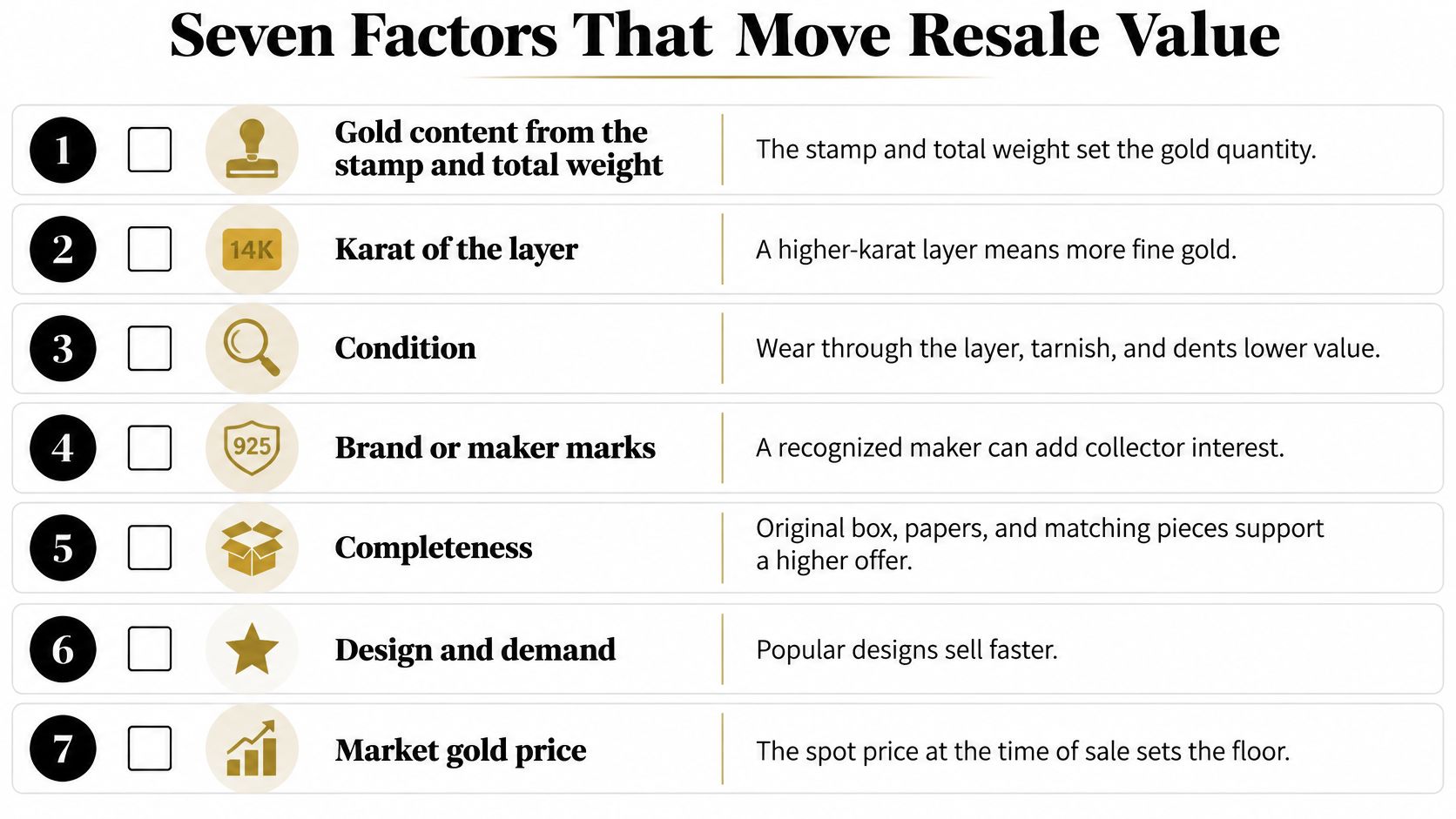
Seven things move the offer, and they do not carry equal weight. Two inputs set the metal ceiling: the gold content named by the stamp and the total weight. Four factors decide how much of that ceiling survives into an actual offer. The market price on the day of sale sets the floor under every metal-based number.
- Gold content from the stamp and the total weight. These are the only two inputs that matter at the start. A 20 gram 1/20 14K piece carries four times the fine gold of a 5 gram piece with the identical mark.
- The karat of the layer. A 14K layer beats a 12K layer on the same weight, and the gap widens as the piece gets heavier.
- Condition. Wear through the layer, tarnish, dents and missing clasps push a piece toward a scrap-only offer, which can wipe out any design premium entirely.
- Maker or brand marks. A recognized name draws collector interest that has nothing to do with the gold count.
- Completeness. Original box, papers and a matching pair all support a higher number than a lone piece.
- Stones and design demand. Gemstones are assessed apart from the metal, and a distinctive design can carry value no melt calculation will find.
- The market gold price on the day of sale. It sets the floor under every metal-based offer and moves daily.
Alloy composition is usually the first thing both buyers and sellers check when judging a piece's value. The stamp tells you what the maker claims about the layer, and the test or the scale tells you what is there. Neither one sets the price by itself.
The split that decides most cases is melt value against resale value. A signed, vintage or unusually designed piece can be worth more as jewelry than as metal. Two items with identical stamps can receive different offers because of maker, condition and demand. A heavier piece with the same stamp carries more gold, but wear, missing parts or a thin layer can pull the offer back toward scrap. If you want the mechanics behind a price move, this explanation of how gold prices work follows the chain from market quote to counter offer.
Before you take a piece anywhere, gather five things: the weight in grams, a clear photo of the stamp, the maker mark, stone details, and any receipt or provenance you still have.
How to Estimate Your Piece's Worth Step by Step
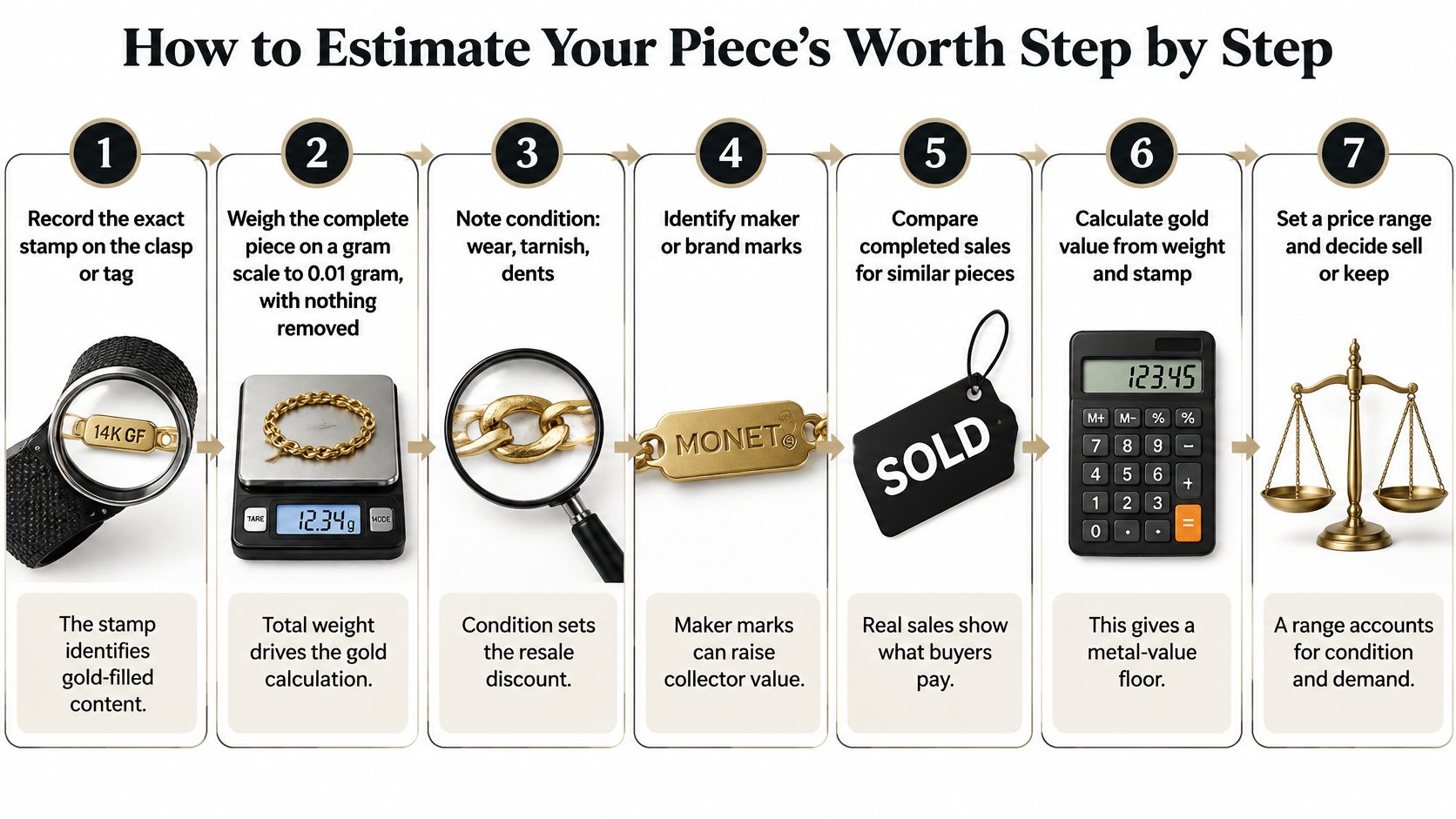
Work through these seven steps on paper before you accept any number. Each one exists to stop a specific mistake.
- Record the exact stamp from the clasp or tag. It identifies the fraction and the karat of the layer, which no other step can substitute for.
- Weigh the complete piece on a gram scale to 0.01 gram, with stones, clasps and all, because the stamped fraction applies to total weight.
- List the non-gold parts. Stones, solder joints, base-metal findings and steel springs add scale weight that carries no gold, so note them before you trust the total.
- Calculate the fine gold. Multiply the total weight by 5 percent for a 1/20 mark, then by the karat fraction: 58.5 percent for 14K, 50 percent for 12K, 41.7 percent for 10K. This gives the grams of fine gold the stamp promises.
- Convert the spot price to grams. Divide the per-ounce quote by 31.1035 grams per troy ounce, since buyers weigh in grams and never apply an ounce price to a full piece.
- Multiply fine-gold grams by the per-gram price, then subtract a deduction for testing, refining and labor. A refiner charges for separating the bonded layer, so the payout trails the raw figure.
- Get a design appraisal as well if the piece is signed, vintage or distinctive. Metal math can't see collector value, and jewelry math can't see gold content.
A Worked Example
Say a bracelet weighs 10 grams and reads 1/20 14K GF, with no stones and a magnetic clasp to account for. Fine gold is 10 × 5% × 58.5%, which is about 0.29 gram. At an illustrative $100 per gram, the raw metal figure is about $29 before any deduction.
Now run it from an ounce quote, because that's how the market publishes. At an illustrative $3,100 per troy ounce, dividing by 31.1035 gives about $99.67 per gram, and the same bracelet's 0.29 gram lands at roughly $29 again.
Why the Full Weight Never Gets the Spot Price
Jewelry is weighed in grams and is almost always an alloy, so a per-pure-ounce price can't be applied to the full weight of a ring or chain. Estimates rest on three things only: weight, tested purity, and a market reference quoted in the same units. Precious metal and diamond values come from current market dealer prices, which is why a dated calculation is worth more than a remembered one. A buyer who quotes you an ounce price against the entire 10 grams is either confused or hoping you are.
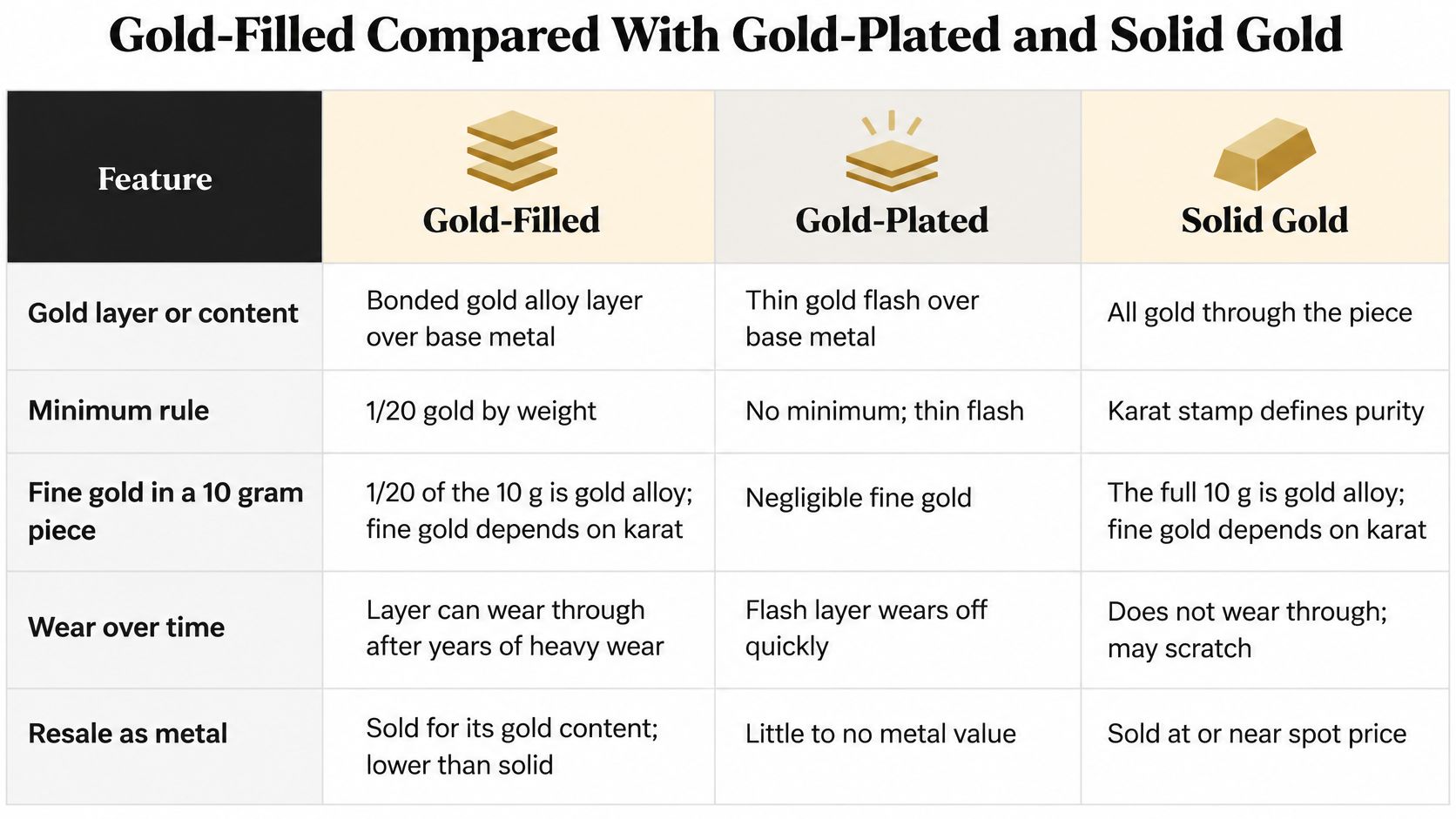
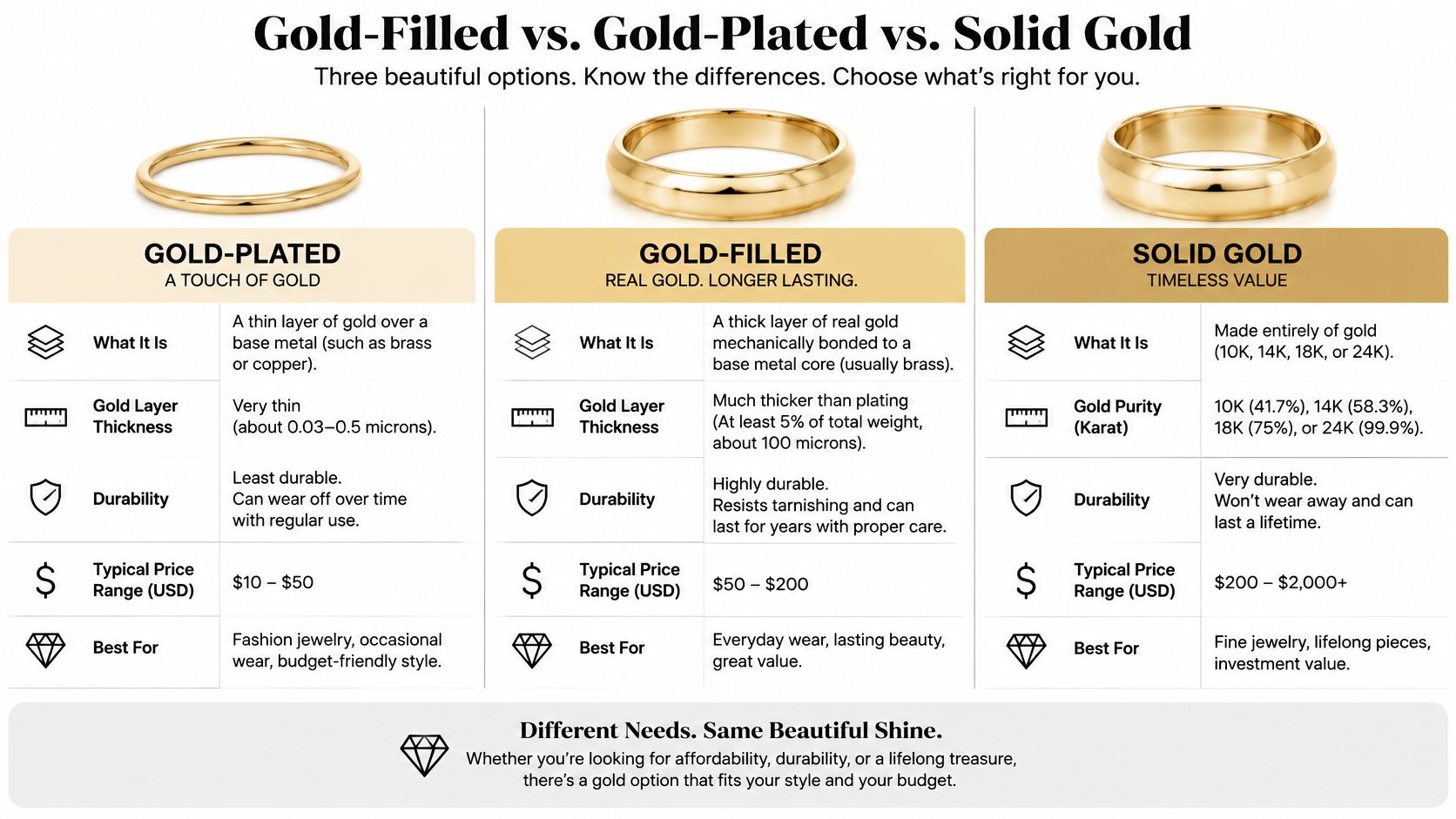
Gold-Filled Compared With Gold-Plated and Solid Gold
A 10 gram gold filled bracelet stamped 1/20 14K carries about 0.29 gram of fine gold. The same weight in solid 14K carries about 5.85 grams. That gap explains why the stamp describes construction, not a payout.
| Feature | Gold-Filled | Gold-Plated | Solid Gold |
|---|---|---|---|
| Gold layer or content | Bonded layer, at least 5% of total weight | Thin coating, microns thick | Gold throughout the piece |
| Minimum rule | US: at least 10K and 1/20 of weight | No gold-filled standard applies | Karat stamp defines purity |
| Fine gold in a 10 gram piece | About 0.29 g at 1/20 14K | Negligible | About 5.85 g at 14K |
| Wear over time | Layer lasts years with normal care | Can wear through with regular use | Does not wear through |
| Resale as metal | Small payout after the layer is separated | Almost none | Metal payout by karat weight |
The Rows That Change the Offer
The fine-gold row does most of the work. A 10 gram piece of solid 10 karat gold holds about 4.2 grams of fine gold, roughly twenty times what the same weight carries when it is gold filled and stamped 1/20 10K. Gold plating sits at the other end, with a gold layer measured in microns that leaves next to nothing to recover.
Those figures are raw metal, before any testing or refining deduction. They show why a gold filled piece can contain real gold and still produce a modest scrap offer. The calculation starts with weight and karat, then the buyer applies a market reference and a deduction for separating the layer from the core.
Wear separates the middle option from the cheap one. A bonded layer holds up for years of daily wear, while plating can wear through with regular use and expose the base metal beneath. That durability is a real reason to buy gold filled, and it is separate from resale.
The buyer's view is blunt. Solid gold gets a metal-based offer by karat weight. Gold filled gets a smaller offer once the layer is separated from the core, and plated jewelry gets little or nothing for its metal. That is why a gold filled bracelet should not be priced like solid 10K, 14K or 18K jewelry, and why a jeweler's full range of jewelry services is a useful place to ask about both.
> Rule of thumb: buy gold filled for the look and the wear. Value it as jewelry for its design, never as a stand-in for solid gold.
Selling or Pawning Gold-Filled Jewelry Without Losing Value
Rising gold prices don't automatically lift every offer. Demand moves too, and it can move the other way: climbing prices can coincide with weaker jewelry demand, so the pool of buyers willing to pay for jewelry thins out and turns more price-sensitive even as your theoretical metal value climbs. That gap is where gold filled pieces lose money, because the seller reads the headline price while the buyer prices the layer.
Pawn Loan or Outright Sale
A pawn loan keeps the piece yours if you repay, and a sale is final. Compare the two before you commit, because the loan amount is set against the same metal calculation as a purchase, only with your ownership preserved. When the piece has design value you might want back, the loan is the cheaper way to test the market.
The Sell-Now or Wait Rule
The decision turns on what the piece is.
- Damaged, lightweight or unbranded pieces lean toward selling now. Their value is mostly recoverable gold, and waiting adds market risk without adding design appeal.
- Signed, complete, vintage or distinctive pieces deserve a design appraisal before you sell, and may be worth holding for a buyer who wants the piece rather than the metal.
- Anything with a worn-through layer is scrap in practical terms, so treat a metal quote as the likely ceiling.
> Ask this before you agree: "What weight and karat basis is this offer built on?" A number stated in grams against tested purity is checkable. An offer quoted per ounce against the full weight of the piece is not, and it usually hides a much lower gold rate.
Bring the stamp, the gram weight, any receipts and the maker details with you. Two quotes, one metal-based and one design-based, are the cheapest insurance in this process, and reading up on selling scrap gold at a pawn shop helps you recognize which kind of offer you are being handed.
Whichever route you take, get the weight and karat basis in writing before anything changes hands. A gold filled piece can hold real gold and still pay little, and knowing which number the offer rests on is what separates a fair deal from an expensive lesson.
Get a Free Scan Before You Sell Gold-Filled Pieces
Confirm what the piece holds before you sell or pawn it. Idaho Pawn & Gold Exchange offers free precious metal scans, and the team tests gold and silver on an XRF analyzer that reads the alloy rather than guessing from a stamp.
Ask any buyer to state the weight in grams, the karat basis, and both the metal-based figure and any design-based figure in writing, so you can compare offers on the same terms. Bring the stamp details, the gram weight, and any maker or stone information.
Then make the call the evidence supports. Sell now if the piece is damaged, light or unbranded. Pawn it if you want cash and the option to redeem. Appraise it first if a signature, complete set or unusual design suggests the jewelry market will beat the metal market.