
Global demand for gold bars reached 1,068.2 metric tons in 2025, up 24% year on year, while combined bar-and-coin demand climbed 16% to a 12-year high of 1,374.1 tons, according to World Gold Council figures reported by Reuters. Bars absorbed roughly 77.7% of that tonnage. Coins took the rest.
That split runs against the retail conversation. Coins get the attention because they're the gift, the inheritance, the recognizable object in a drawer. The money moving through the physical market, though, is mostly moving into bars.
The choice between gold coins vs gold bars rarely turns on the metal itself. Both are priced off the same spot reference. What separates them is the cost of getting in, the cost of getting out, and how quickly you need the money when you get out. Comparing formats on the purchase premium alone answers half the question.
Gold Coins vs Gold Bars at a Glance
Gold coins and bars differ most at resale: coins divide into recognizable units, while bars generally concentrate more value in each item. The format that costs less to buy may be less convenient if you need to sell only part of your holding.
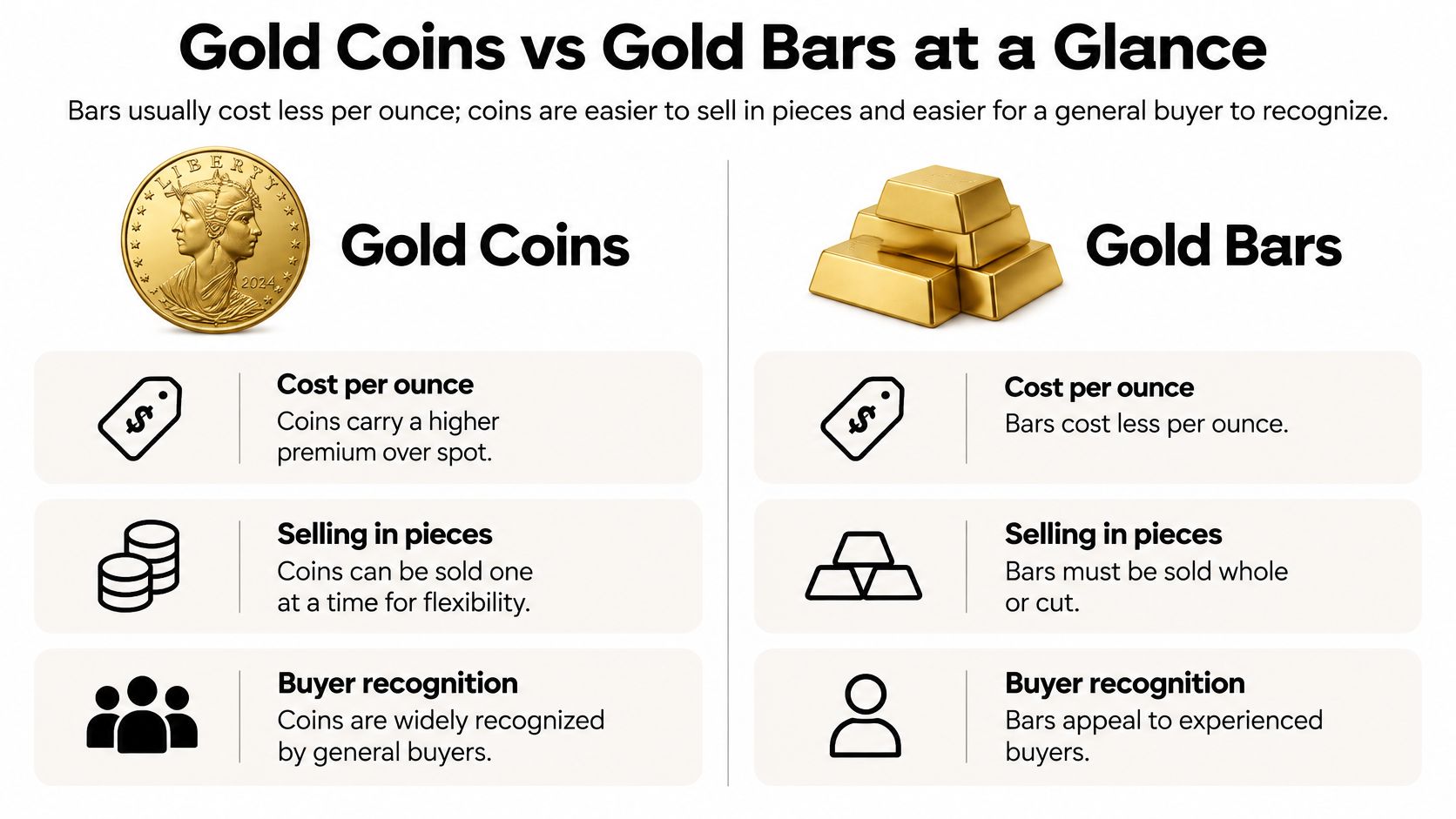
The short answer: bars usually have lower costs per ounce, while coins offer more flexibility for piece-by-piece sales and familiar designs that buyers can recognize.
| Criterion | Gold coins | Gold bars |
|---|---|---|
| Typical size | Fractional to one ounce in set denominations | Usually one ounce and larger, including very large bars |
| Recognition | Standard national designs; sovereign coins are legal tender | Recognized by refiner mark, stated weight and purity |
| Divisibility | Easy to sell one piece at a time | Sold as a whole bar or a smaller bar, with less flexibility |
| Storage | Many small pieces, handled and protected individually | Fewer, larger pieces holding more value each |
| Authentication | Judged by design, weight and mint specifications | Judged by refiner, serial number, assay certificate and weight |
The table captures a practical distinction: bars concentrate value, while coins let you choose how much to sell at once. Neither format guarantees a better resale price. The dealer's bid, verification requirements, shipping costs and applicable tax treatment all affect the amount you keep.
Sovereign coins have standardized national designs and legal-tender status. Bars are identified by their refiner, weight and purity, so buyer familiarity with the refiner can matter when selling. The American Eagle bullion program has operated since 1986, giving the coin a long-established place in the bullion market.
Four terms clarify the comparison. Spot price is the live market price of one troy ounce of fine gold. The premium over spot is the amount charged above that reference price. Fineness expresses purity in parts per thousand, so 0.999 fine means 99.9% gold. Round-trip cost includes the premium paid at purchase and the discount from spot accepted when selling, along with costs such as verification and shipping.
The exit scenario can change which format makes sense. A long-term holder may prioritize total cost per ounce; someone who could need a partial or urgent sale may value smaller, recognizable units. Compare both sides of the transaction before choosing: the purchase price is only the entry point.
Premiums and the Real Cost of Buying
A 6% coin premium and a dealer bid 2% below spot create an 8.2% break-even rise in gold's price. The purchase premium is only half the round trip; the bid, verification, shipping and any applicable tax treatment affect the final cost too.
| Format | Typical premium over spot | Trade-off |
|---|---|---|
| Very large bars | 1-2% | Lowest cost per ounce; hard to sell in small amounts |
| Common one-ounce bars | 2-4% | Good balance of cost and standard unit size |
| Sovereign one-ounce coins | 4-8% | Recognizable design and legal-tender status at a higher cost |
| Fractional coins | 12-20% or more | Most divisible; highest hurdle before break-even |
These are typical ranges, not fixed quotes. Dealer pricing can vary with demand, product and market conditions. The purchase premium matters, but the price a dealer will pay when you sell determines the other side of the calculation.
A worked break-even on one coin
Suppose spot is $2,000 per ounce and a sovereign one-ounce coin carries a 6% premium. The purchase price is $2,120. If the dealer's bid is 2% below spot, gold must rise to about $2,163 for the sale proceeds to match the purchase cost.
That requires an 8.2% increase from the original spot price. A large bar bought at a 2% premium and sold at a 2% discount needs a rise of about 4.1%, roughly half the coin's break-even move. The difference can matter to a patient holder, but it does not account for shipping, verification or tax treatment.
Where the spread shows up in practice
Idaho Pawn & Gold Exchange lists one-ounce Britannia and Eagle coins with a $7 difference between its buy and sell prices: $45.40 to $52.40 for a Britannia, and $45.90 to $52.90 for an Eagle. Those gaps are about 13% of each asking price. The figures show the spread between listed prices, not a guaranteed return or a fixed share of spot; current market prices change. How gold prices work explains why a quoted price is a snapshot rather than a lasting benchmark.
The costs that never reach the sticker
- Shipping and insurance: Sending metal to an online buyer adds expense and transit risk, which can reduce the net proceeds.
- Verification: If an item needs professional testing, any fee reduces the amount left after sale.
- Tax treatment: Sales tax and reporting rules depend on where you live and how the metal changes hands. Check the applicable rules before comparing quotes.
> Practical rule: Compare the full cost of buying and selling through the exit you expect to use. A low purchase premium alone does not show what you will recover in a quick sale or emergency pawn.
Liquidity and Resale Value Compared
Premiums get the attention. Depth of demand decides whether you can exit at all. Official figures put global bar demand at 860.0 metric tonnes in 2024, up 10% on 2023, while official-coin demand fell 31% to 201.0 tonnes, according to the World Gold Council's full-year 2024 demand data. The bar market is more than four times the size of the official-coin market, and the two moved in opposite directions.
Liquidity here means one thing: the ability to sell near spot without a large discount. A product can be valuable and still illiquid if the only buyer nearby wants a 15% cushion for the risk of holding it.
> A large bar is easy to sell and hard to sell part of. That distinction, not the metal, separates the two formats at resale.
Three factors that set your resale price
- Recognition. A buyer who can identify the product without research prices it closer to spot. Standard national designs and well-known refiners clear that bar; an unfamiliar stamp does not.
- Condition and completeness. A sealed bar with an intact assay card and an undamaged coin trade better than the same metal with a broken seal or a scratched face.
- Your exit market. A coin dealer, a pawn store, a bullion wholesaler and an online buyer each price differently, and the strongest bid for a sealed large bar often isn't the strongest bid for a single coin.
Two markets, two answers
In a rising market, the higher coin premium is a drag. Every extra point of entry cost is a point the gold price has to recover before the position is level, and a holder who bought fractional coins can wait a long while for that.
In a stressed market, the calculation flips. A sovereign coin that a general buyer recognizes and can price without an assay often moves faster than a bar that needs weighing, testing and a certificate the buyer has to trust.
Match the format to how quickly you might need the money. That single question does more work than any comparison of premiums.
Authenticity, Storage and Handling
Verification starts with the specification, not the look of the piece. A gold coin is checked against its mint's published weight and diameter, which is why a caliper and a precise scale catch more fakes than a loupe. A coin offered well under spot isn't a bargain, it's a warning.
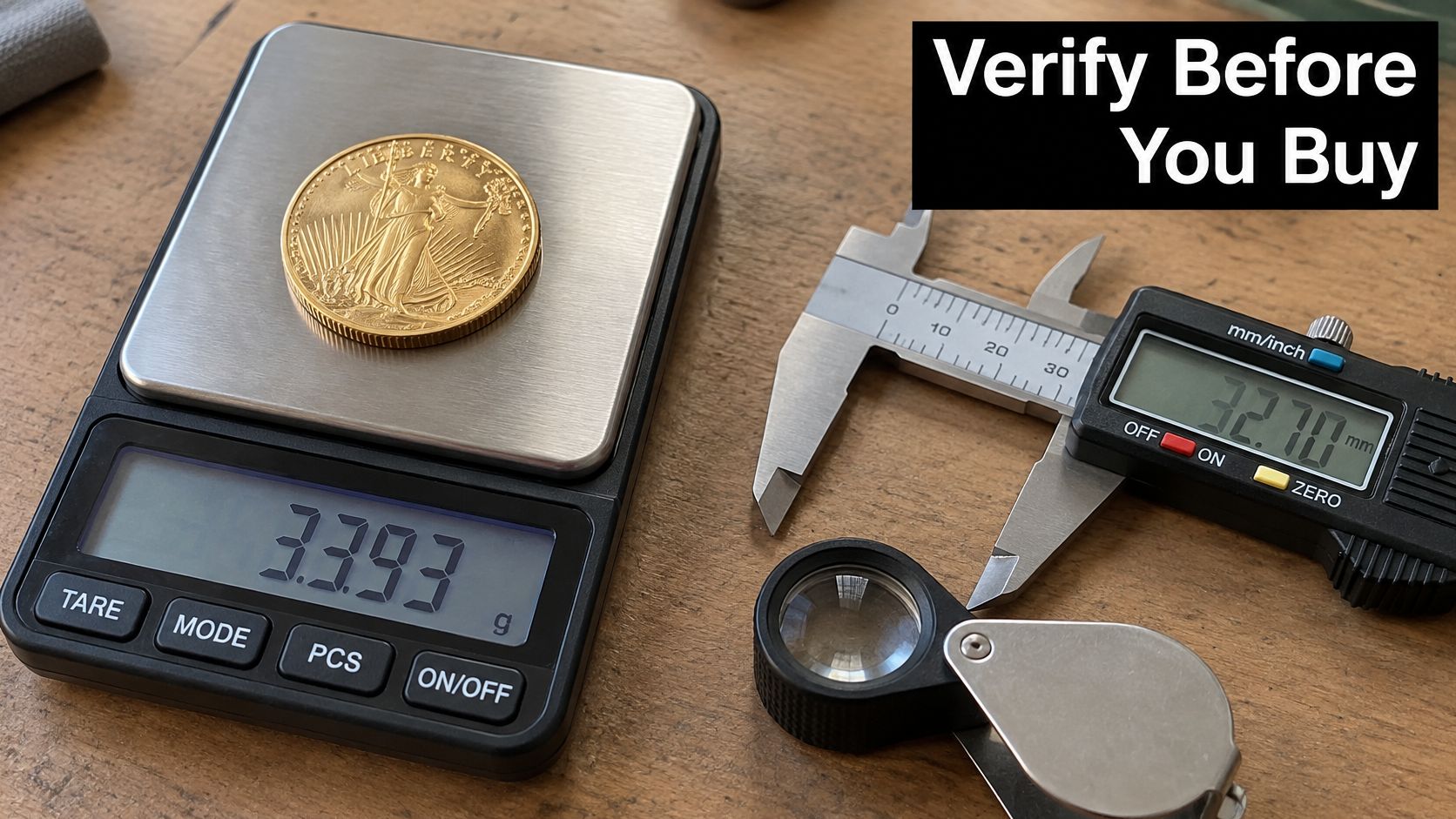
A bar is checked differently. The refiner's stamp, the serial number, the assay certificate and the sealed packaging are the evidence, and a bar missing any of them gets priced as a problem. Counterfeit bars exist in every size, including sealed ones with convincing paperwork, which is why the fake gold bar problem is worth understanding before you buy from anyone.
What testing can and can't tell you
An XRF analyzer screens metal without cutting, melting or damaging it, and it flags purity problems in seconds. Our gold and silver testing uses an XRF analyzer that gives lab quality results. It is a screening tool rather than a full assay, so a reading that matches the stated fineness supports a purchase without replacing the paperwork on a large bar.
Storage, protection and the cost of a broken seal
A single one-ounce coin or a small bar fits a home safe or a safe deposit box without much thought. A large holding is a different problem. It needs space, insurance cover that many homeowner policies exclude by default, and a location you're willing to leave for a week.
Keep coins in protective capsules so surfaces stay clean, and keep bars sealed and dry. Records matter as much as the metal, so photograph each piece, note the serial number, and store that file away from the item. The video below shows what a professional check looks like in practice.
A four-step buying check
- Confirm spot on the day. Ask the dealer to state the reference price before quoting a premium.
- Check the stamp or the specification. Weight, fineness, refiner and, for coins, the mint's stated diameter.
- Request an XRF reading or an independent assay. Insist on it for anything large, and don't accept a visual inspection as a substitute.
- Store it sealed, dry and recorded. Opening a sealed bar to inspect it can lower what a dealer will pay, so let a professional open it if opening is unavoidable.
Selling Quickly Without Losing Value
Two different transactions get called selling, and they cost different amounts. A pawn is a short-term cash loan in which you leave the item as collateral and can reclaim it later. A sale transfers ownership and ends your claim to the metal.
Idaho Pawn & Gold Exchange buys gold and silver in Boise, Meridian and Nampa, and every transaction begins with an in-person evaluation at the store. You decide whether to accept the offer after you hear it.
What happens at the counter
- Bring the item to a store. Loose coins, sealed bars, jewelry and scrap all start the same way.
- Get the metal weighed and tested in front of you. The estimate rests on weight, tested purity and a market reference stated in the same units, so you can follow the arithmetic.
- Decide whether to accept. Nothing obliges you to take the first number, and a written figure lets you compare elsewhere. Selling gold and diamonds at a pawn shop covers what to bring and what the process involves.
Coins price quickly because one piece carries a known denomination and a recognizable design. A large bar takes longer: it needs weighing, a purity check and, if the seal is broken, a fuller assay. Each of those steps adds time between walking in and walking out with cash.
The comparison most sellers get wrong
Sellers often measure an offer against the retail price they paid or the price a dealer is currently asking, and both figures include someone else's premium. The number you receive is a bid against spot, not against a retail sticker. If you're weighing a loan against a sale instead, the loan has its own cost, with pawn APR listed as low as 35%, and that belongs in the same comparison.
- Know the spot price before you walk in. Check it the same day and write it down.
- Ask for weight and purity in stated units. Troy ounces or grams, plus fineness, so two offers can be compared line by line.
- Convert every offer to a percentage of spot. A dollar figure hides the difference between two bids; a percentage doesn't.
Which Format Fits Your Buying Goal
The format question resolves fast once the goal is specific. Five common goals map to a clear answer.
| Buyer goal | Better fit | Why |
|---|---|---|
| Long-term stacking at the lowest cost | Bars | Lower premium per ounce in larger sizes |
| Small, regular purchases | Coins | Smaller denominations match smaller budgets |
| Gifting or inheritance | Coins | Recognizable designs make the value clear to heirs |
| Partial sale in an emergency | Coins | One small piece can be sold without breaking a larger bar |
| Large single position | Bars | The premium is spread across more ounces |
Why each row lands where it does
Long-term stacking belongs to bars because larger sizes carry the lowest premium per ounce and take up less space per dollar held. A holder who won't sell for years has little use for divisibility.
Small, regular purchases are a coin job. A tenth of an ounce bought monthly keeps purchases affordable and spreads them across different prices.
Gifting and inheritance favor coins for a reason that has nothing to do with cost. A stated weight and a design anyone recognizes let an heir identify the asset without hunting for an assay card.
Partial sales in an emergency are where a coin outperforms a large bar, since you can part with one piece and keep the rest. A large single position then swings back to bars, because the fabrication cost spreads across many ounces at once.
> A recognizable coin is not automatically the better coin. The format that fits is the one your likely buyer can price without a discount.
The aggregate market has been shifting. Bar demand reached 397.7 tonnes in the first quarter of 2026, up 50% year over year, while combined bar-and-coin demand rose 42% to 473.6 tonnes, according to the World Gold Council's Q1 2026 demand report. A crowd moving one way doesn't make that direction right for your exit.
Many holders end up with both, and the split is practical rather than clever: bars for the core position, coins for the portion they might need to touch. What doesn't work is fractional coins bought by someone who expects to sell near spot within a year, because the entry premium on those pieces is the hardest to recover.
Confirm Your Exit Before You Buy
An exit plan written after the purchase is a hope, not a plan. Run these checks before you pay.
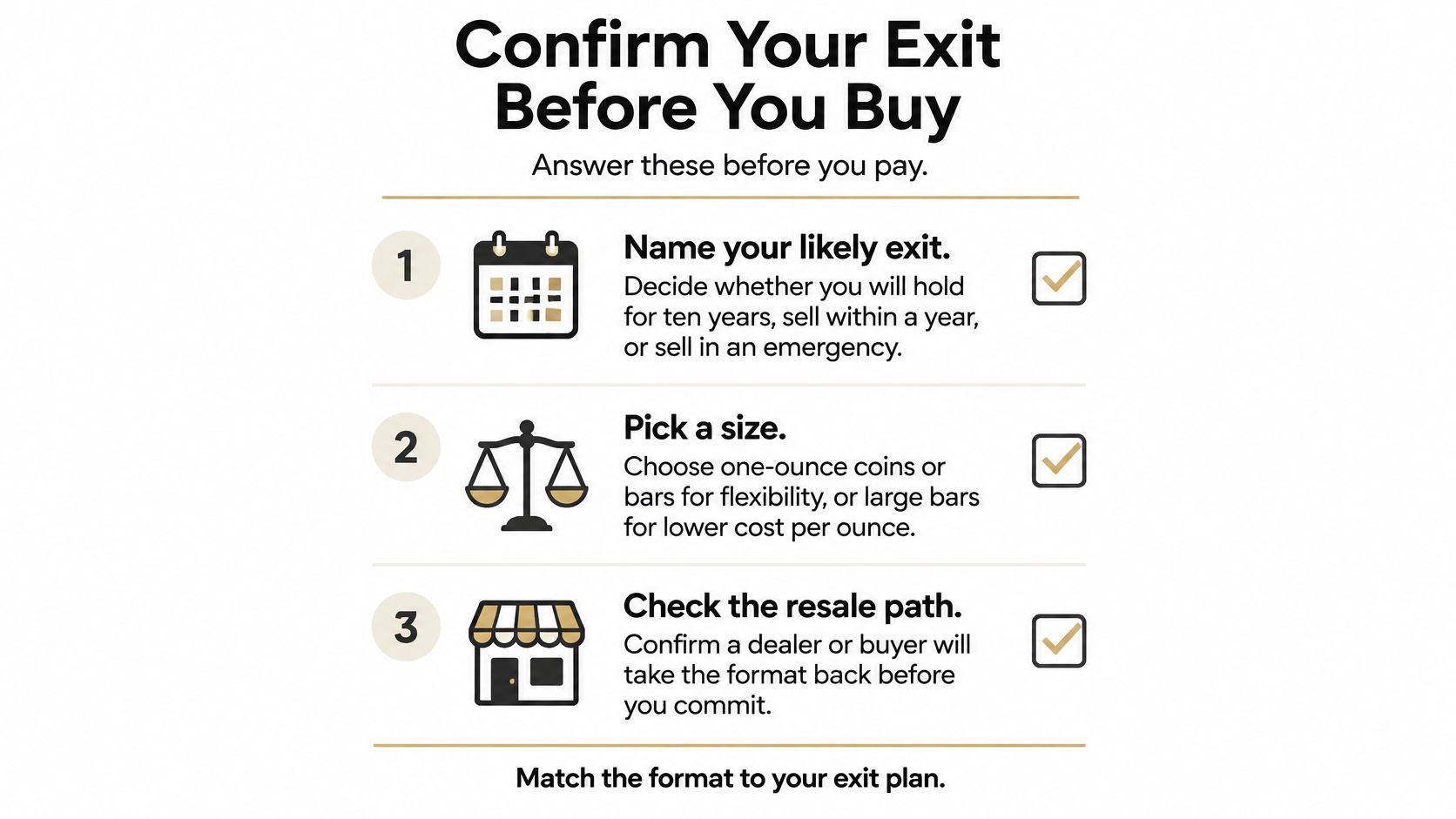
- Name your likely exit. Ten-year hold, sale within a year, or an emergency sale. Write down the answer, because it decides everything that follows.
- Pick a size. One-ounce coins or bars keep flexibility; large bars lower cost per ounce for a long hold.
- Calculate break-even. Add the premium for your format to the buy-back spread your dealer quotes, then add shipping and any applicable tax. If the gold price has to rise further than you expect, the format is wrong for you.
- Verify before paying. Check the stamp, the specification or the XRF reading on the spot. A seller who resists that check has told you something useful.
- Store sealed and record. Keep the packaging intact, photograph the piece, and file the purchase details separately from the metal.
The verdict is short. Coins buy flexibility, bars buy metal per dollar, and the premium you pay is the price of whichever one you chose.
One practical step remains. Idaho Pawn & Gold Exchange buys and sells gold, silver, jewelry, coins, rounds and bullion in Boise, Meridian and Nampa, so compare our listed buy and sell prices against today's spot before you commit to a format.
---
Idaho Pawn & Gold Exchange buys and sells both gold coins and gold bars across Boise, Meridian and Nampa, with free precious metal scans and lab quality XRF testing before any offer is made. Bring your coin or bar into a store and we'll show you the buy price and the sell price side by side against today's spot, so the full round trip is visible before you decide. Visit Idaho Pawn & Gold Exchange to see current prices or to find the store nearest you.