
You've pulled a broken chain, an old ring and a single earring out of a drawer. You need to know what they're worth, but a search for “gold buyers near me” brings up competing promises without much explanation of what you'll receive.
For sellers in Boise, Meridian and Nampa, the useful comparison isn't the biggest advertised percentage. It's the net payout after testing, weight adjustments and deductions. A fair comparison starts with choosing the right transaction, then asking each buyer to put the calculation on paper.
Pawn Shops, Dealers and Mail-In Buyers Compared
Gold selling routes at a glance
| Option | How you get paid | Speed | Best fit | Main trade-off |
|---|---|---|---|---|
| Pawn shop loan | Cash loan with the item as collateral | Potentially during your visit | Need cash but want the item back | Interest and a redemption deadline; the item can be sold if you miss it |
| Local gold dealer | Outright purchase at a melt-based offer | Potentially during your visit | Scrap, broken jewelry, single rings | Different buying margins make written comparisons important |
| Coin or bullion dealer | Outright purchase priced by fineness and piece count | Potentially during your visit | Coins, rounds and bars | Product premiums differ; confirm the exact product and fineness |
| Mail-in online buyer | Payment after shipping and testing | After delivery, evaluation and payment processing | Lots when visiting a suitable buyer is impractical | Shipping exposure and a final price established after testing |
A pawn is a short-term cash loan secured by an item you provide as collateral. You aren't selling it outright, but you don't keep physical possession during the loan. If you want the item back, compare the total redemption cost with what you can realistically repay. Our explanation of a pawn loan as an alternative for quick cash helps distinguish borrowing from selling.
A local gold dealer is a practical route for damaged or unwanted jewelry whose main value is its metal. A broken clasp doesn't remove the gold content. However, a buyer's operating margin and deductions affect what reaches your pocket, so convenience alone shouldn't settle the choice.
Match the buyer to the item
A coin or bullion dealer should identify the exact coin, round or bar before pricing it. Ask whether the purchase offer includes a product premium or treats the piece only as metal. Don't clean collectible coins to make them look more saleable, since altering their surfaces can hurt their appeal to collectors.
With a mail-in service, read the acceptance and return terms before shipping. Confirm who covers insurance, what happens if you reject the valuation and whether testing can alter the item. An online estimate isn't the same thing as a final purchase offer.
> Practical rule: Choose by your first priority, keeping the item, getting money promptly or maximizing the net sale proceeds. Then compare written offers for that same type of transaction.
A loan amount and an outright purchase price aren't competing versions of the same offer. Keep them in separate columns, or you risk choosing a larger immediate payment without understanding what you've agreed to.
Finding Gold Buyers Near You in the Treasure Valley
Search specifically for gold buyers in Boise, Meridian and Nampa, rather than relying only on the nearest map pin. Match the results to what you're selling: a scrap buyer for damaged chains, a bullion buyer for bars, or a jewelry buyer capable of considering a finished piece's resale potential.
Build a manageable shortlist. Record the address, posted hours, business name and transaction type so you don't drive across the valley to discover that a business doesn't handle your items.
Screen the business before making the trip
A permanent storefront gives you somewhere to return with questions, but it isn't proof of fair pricing. Read recent reviews for specific descriptions of the transaction, not just praise or complaints about the amount offered.
- Weighing complaints: Look for repeated concerns about unexplained weight changes or items being combined without explanation.
- Testing complaints: Pay attention when reviewers describe destructive testing they didn't authorize.
- Pressure complaints: Repeated accounts of rushed decisions deserve more attention than a seller disliking an offer.
- Business identity: Check the legal business name with the Idaho Secretary of State and reconcile it with the storefront name and receipt.
Registration helps establish who you're dealing with. It doesn't certify a buyer's valuation or replace comparing offers.
Idaho Pawn & Gold Exchange can be part of your shortlist alongside independent dealers and other pawn shops. Use our Treasure Valley store locations to plan a visit that fits your route.
Make the phone call useful
Ask whether you can watch the weighing and testing, whether the buyer provides an itemized written offer, and what any telephone estimate assumes. A responsible conversation should separate a provisional estimate from a price based on examining the item.
Instead of demanding that a phone quote remain unchanged, ask what could change it. An incorrect stamp, non-gold components or a different market reference can produce a legitimate adjustment. An unexplained adjustment is a different matter.
Keep the answers in a notes file under each business's name. Record whether an appointment is needed and whether the buyer evaluates stones or branded jewelry separately. That preparation helps you compare businesses by their process before comparing their money.
How Karat and Weight Set Your Gold's Value
A melt-based gold offer starts with weight, tested purity and a market reference expressed in matching units. That's how we base gold and silver estimates. The original retail price, sentimental importance and visual size of a piece don't establish its fine-gold content.
The wider market matters, but it doesn't determine your payout by itself. The World Gold Council's full-year investment report reports that investment demand reached 2,175.3 metric tons in 2025, illustrating the scale of the market behind a local transaction.
Calculate the metal before the offer
Karat describes the proportion of gold in an alloy. A fineness mark expresses that proportion in thousandths, but a mark is a starting point for identification, not a substitute for testing.
Fine-gold weight = eligible metal weight × tested fineness
For a hypothetical calculation, take a 10 g chain tested at 0.585 fineness. It contains 5.85 g of fine gold. At an expressly illustrative reference price of $100 per fine gram, its calculated melt value would be $585, before the buyer's margin or deductions.
That reference price is a teaching assumption, not a current quote.
Fine gold in a hypothetical 10 gram item by stamp
| Stamp (karat) | Typical item | Fine gold in 10 g |
|---|---|---:|
| 999 (approximately 24k) | High-fineness bullion | 9.99 g |
| 917 (approximately 22k) | High-karat jewelry | 9.17 g |
| 750 (18k) | Fine jewelry | 7.50 g |
| 585 (approximately 14k) | Everyday jewelry | 5.85 g |
| 417 (approximately 10k) | Lower-karat jewelry | 4.17 g |
These calculations assume the entire stated weight is metal of the listed fineness. Stones, steel springs and other non-gold components don't belong in that assumption.
Check what the stamp leaves out
A hollow chain can look substantial while weighing little. Plated pieces contain a surface layer rather than the same gold proportion throughout, and mixed-metal rings require the buyer to distinguish their components.
Our explanation of how gold prices work provides context for the relationship between metal content and the market reference. At the counter, keep the questions concrete:
> What weight and tested fineness did you use, and what reference price and unit did you apply?
If the reference is quoted per troy ounce but the item is weighed in grams, the buyer needs to show the conversion. Don't accept a calculation that combines unlike units.
Reading a Gold Offer Line by Line
Comparing headline percentages works only when buyers use the same metal weight, purity and price basis. A larger percentage can still produce less money if the buyer applies a lower valuation base or subtracts charges afterward.
The U.S. Commodity Futures Trading Commission's precious-metals guidance advises consumers to know the daily spot price, compare premiums and costs, and obtain fees in writing. Apply that discipline to your sale by requesting the complete calculation.
Net offer = calculated melt value × percentage paid − additional deductions
A worksheet you can repeat
The following is a hypothetical example, not a current market quote or a statement of our buying rates. Both buyers evaluate the same chain using identical assumptions, so only the payout percentage and deduction change.
Worked net-payout comparison for two buyers
| Line item | Buyer A | Buyer B |
|---|---:|---:|
| Item and purity | 12 g chain, tested at 0.585 fineness | 12 g chain, tested at 0.585 fineness |
| Fine gold content | 7.02 g | 7.02 g |
| Reference price per fine gram | $100, illustrative | $100, illustrative |
| Melt value | $702 | $702 |
| Percentage of melt offered | 90% | 85% |
| Offer before deductions | $631.80 | $596.70 |
| Refining, stone or other deduction | $0 | $25 |
| Net offer | $631.80 | $571.70 |
In this scenario, Buyer A's percentage is 5 percentage points higher, but its net payout is $60.10 greater. The difference includes both the percentage and Buyer B's separate charge.
Copy these row labels into a notes file or print them before visiting. If a buyer quotes only a final dollar amount, ask them to fill in the missing inputs.
Separate legitimate adjustments from double counting
Removing stone weight from the eligible metal weight is different from charging a stone-removal fee. Ask which adjustment the buyer made and why. If the buyer has already excluded the stones' weight, an additional deduction needs its own explanation.
Melt value measures the metal at the chosen reference price. Resale value concerns what someone might pay for the finished object, including condition, design, brand or collectibility.
Product pricing also has a buy-sell spread. Our listed Britannia - 1oz item is priced per item at 1 oz and 0.999 fineness, with a $45.40 buy price and $52.40 sell price. That product listing isn't the reference price for your gold chain.
Request an itemized quote without agreeing to sell. A clear worksheet lets you evaluate the offer rather than negotiate against an unexplained number.
Red Flags That Mean You Should Walk Away
A buyer who refuses to explain the calculation hasn't given you enough information to accept. A provisional estimate before inspection is reasonable. Presenting it as a firm valuation while avoiding weighing or testing isn't.
The CFTC's precious-metals fraud advisory warns about inflated prices, high commissions, unclear fees, cold calls, temporary dealers and easy-profit claims. Some warnings concern investment sales rather than scrap purchases, but the screening principle applies: verify who's handling your property and what you're signing.
Keep the item, scale reading and written notes within view during an evaluation.
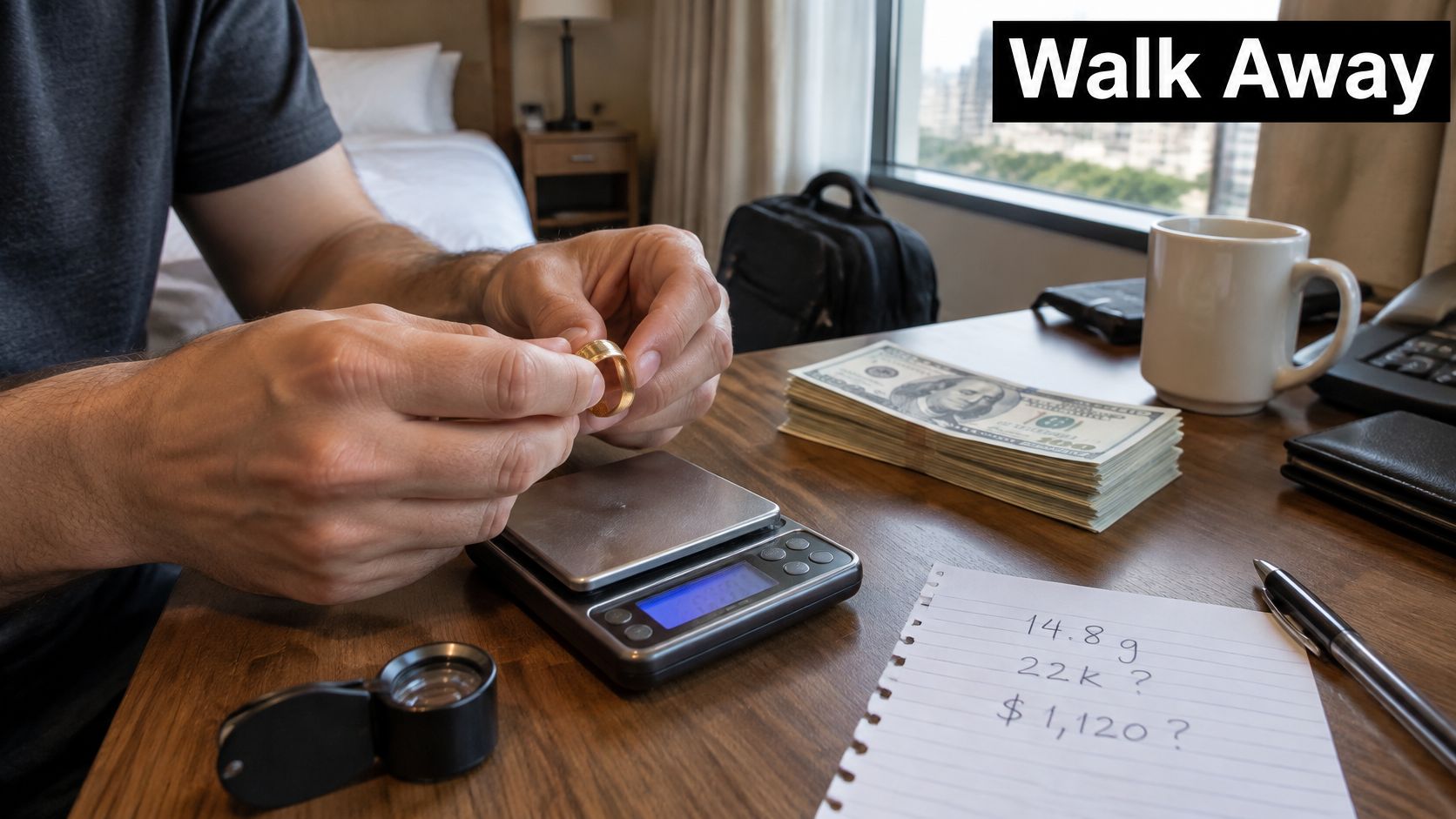
Protect the item before discussing acceptance
- Unexplained deadlines: Don't confuse a changing market quote with pressure to sign before you can read the terms.
- Unverifiable premises: A hotel room, pop-up table or unmarked vehicle makes follow-up harder. Prefer a business you can identify and revisit.
- Hidden procedures: Ask permission questions before testing, cutting or removing stones, not after.
- Missing paperwork: Require the transaction type, item description and agreed payment to be clear before surrendering ownership.
Ask how the buyer documents identity and ownership. Photograph valuable pieces beforehand, and don't allow items to leave your sight without understanding where they're going and receiving appropriate documentation.
A high market price doesn't tell you whether selling is right for you. If the item is an heirloom, separate its financial usefulness from whether you'd regret losing it.
> If the buyer won't show the weight, the test and the math on paper, the offer isn't ready to accept.
Urgent bills can make the first offer feel like the only offer. You can acknowledge that urgency without accepting unclear terms, and you can leave with your property if the transaction doesn't make sense.
Seven Steps from Home to the Counter
Use this process to arrive prepared rather than trying to reconstruct details while someone waits for your signature. The objective is a decision you can explain afterward.
Keep the preparation sequence handy as you organize your items.
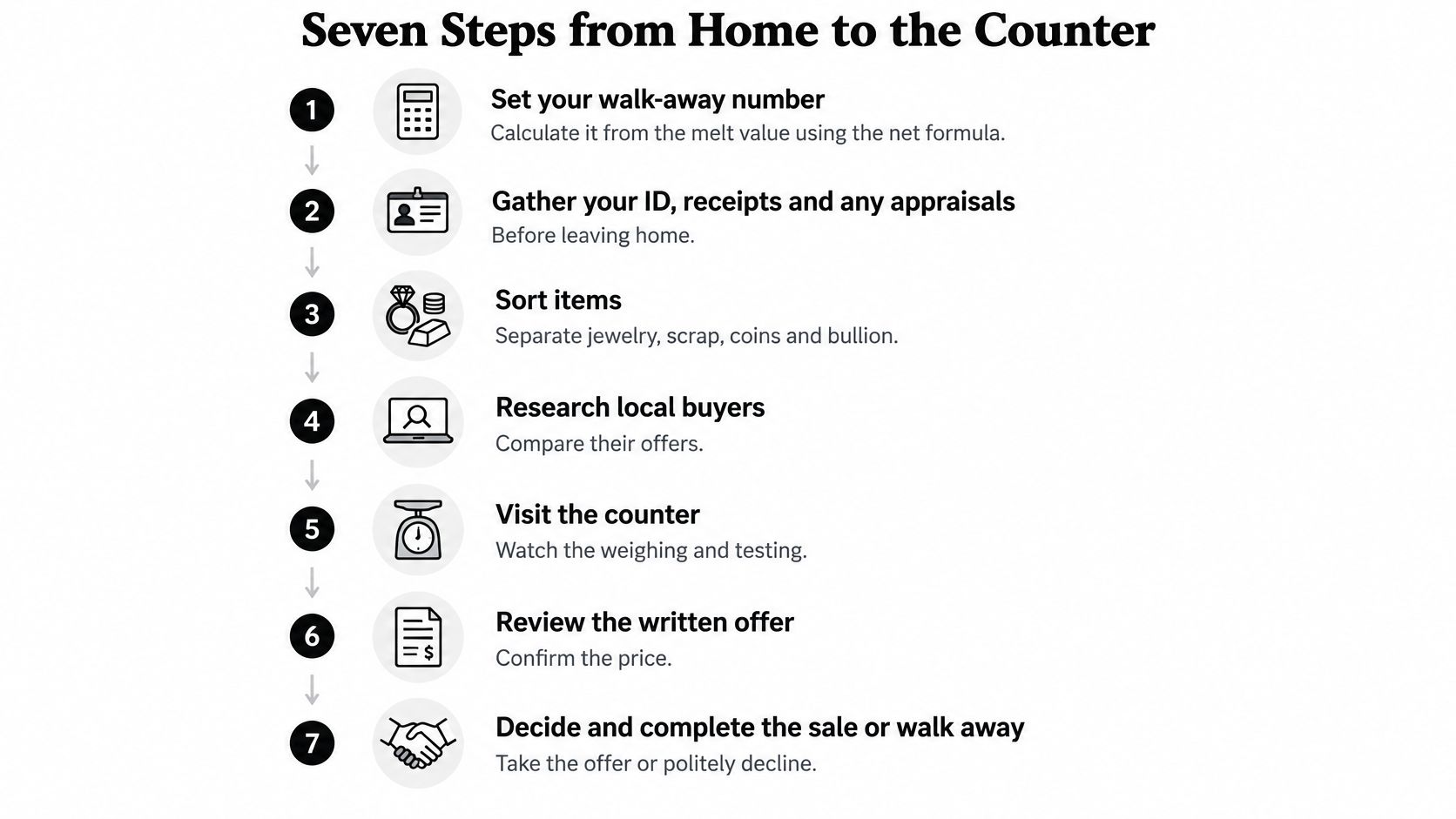
- Set your walk-away amount. Use a preliminary metal calculation and your financial needs to establish an acceptable net payment. Treat untested purity as provisional, and gather your ID, receipts and appraisals before leaving.
- Separate what you're selling. Group jewelry, scrap, coins and bullion so the evaluator can address each appropriately. Put anything you want to keep somewhere else, rather than including it in the counter discussion.
- Record home weights. Use a digital gram scale on a firm, level surface and weigh pieces separately. Your readings are a cross-check, not a replacement for the buyer's equipment or component adjustments.
- List markings and unknowns. Write down each visible stamp and keep unmarked pieces in a separate group. Don't turn a guessed marking into an assumed purity, and don't file or cut pieces yourself to investigate.
- Make a photo inventory. Photograph the pieces and their distinguishing features, then bring a matching paper list. Include certificates or packaging for collectible or branded items when available.
- Arrange comparable evaluations. Plan visits around Boise, Meridian or Nampa and request the same written inputs at each counter. At Idaho Pawn & Gold Exchange, selling begins with an in-person store evaluation; we offer free precious-metal scans and use an XRF Analyzer for lab-quality results.
- Choose deliberately and retain the paperwork. Compare the actual proceeds, confirm they meet your acceptable amount and decide whether to accept. Our customer decides whether to take the offer, and leaving without selling remains an option.
Keep the decision separate from the evaluation
A test tells you about the item. It doesn't obligate you to exchange it for money, and an appraisal document doesn't guarantee that a buyer will pay the appraised amount.
Keep the final receipt with your inventory and photographs. Those records help identify what changed hands and what payment you agreed to receive.
For another look at the process before visiting, watch the accompanying video.
Before every signature, confirm weight, fineness, reference price, deductions and the written quote in your hand.
---
Idaho Pawn & Gold Exchange offers in-person gold evaluations and free precious-metal scans in Boise, Meridian and Nampa. Bring your sorted items and comparison worksheet to Idaho Pawn & Gold Exchange, review the offer and decide whether the net payout works for you.