
A typical pawn loan doesn't lower or raise a traditional credit score because the shop approves it against the item's value rather than a credit review. But if borrowing doesn't affect your score, does that mean missing repayment has no consequences?
Not quite. Your credit file and your collateral are separate concerns. You can lose something valuable without receiving a negative credit entry, and you can repay a pawn loan successfully without building positive credit history.
The useful answer to “Does pawning affect your credit?” separates what happens when you apply, what the lender reports during repayment, and what happens if you don't redeem your item.
Whether Pawning Affects Your Credit Score
A typical pawn loan is credit-neutral, meaning it generally neither improves nor damages a traditional credit score. The item secures the loan, so the lender usually doesn't need a credit review or furnish monthly payment information.
The Federal Reserve's discussion of household credit describes pawn borrowing as small, non-recourse lending secured by tangible personal property. Non-recourse means the lender generally relies on the pledged property, rather than pursuing the borrower for an unpaid shortfall.
How a pawn loan and a card or installment loan affect credit
| Credit event | Pawn loan | Credit card or installment loan |
|---|---|---|
| Credit check at application | No, approval is based on item value | Usually yes |
| Hard inquiry on credit file | Generally no | Usually yes |
| New account on credit file | Generally no | Usually yes |
| Repayments reported monthly | Generally no | Usually reported |
| Late payment reported after the reporting threshold | Generally no | Can be reported |
| Unpaid balance after default | Item forfeited, generally no deficiency balance | Balance remains owed and may go to collections |
| Effect on FICO or VantageScore | Usually none | Can lower or raise the score |
Reporting depends on the individual lender, the product, and state rules. Confirm the reporting policy in writing before signing rather than treating this comparison as a guarantee.
Why the collateral changes approval
For a conventional loan, the lender needs to judge whether you'll repay. A pawnshop instead evaluates what it can recover from the item if you don't. That distinction explains why someone with a thin or damaged credit file may qualify for a pawn even when a bank application isn't practical.
At Idaho Pawn & Gold Exchange, we don't require a credit check to pawn or sell items. That answers the application question, but borrowers should still distinguish a credit check from account reporting and default procedures.
A sale also isn't the same as a pawn. Selling transfers the item outright, while pawning gives you an opportunity to recover it under the written loan terms. Decide whether keeping the item matters before choosing between those transactions.
How a Pawn Loan Works Without Your Credit File
A pawn loan is a little like leaving a valuable deposit that you can reclaim, except the valuable also determines how much cash the lender offers. It isn't a sale followed by a guaranteed repurchase. It's a loan secured by your property, with conditions for getting that property back.
Keep the repayment stages in mind while reviewing the process. The timeline below illustrates a typical collateral-forfeiture path, not a guarantee about every lender's reporting policy.
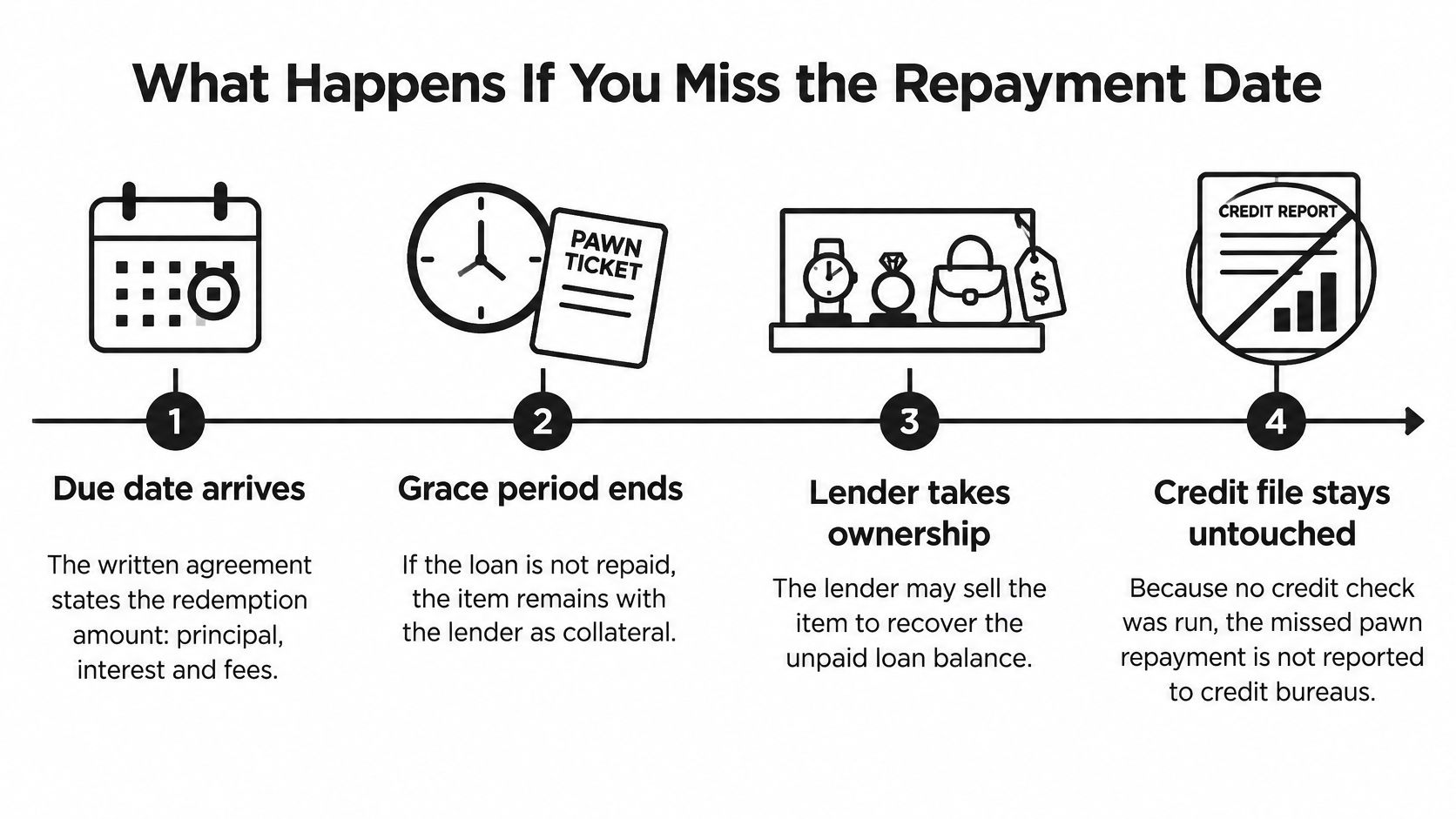
From evaluation to redemption
- Bring an item you own. Jewelry, gold, electronics, and tools are familiar examples. Choose something you could tolerate losing if your repayment plan fails.
- Let the store evaluate it. Staff consider the item's condition and potential resale value when making an offer. Your original purchase receipt may provide context, but the amount you paid isn't the same as its current collateral value.
- Review the agreement before accepting. Our team reviews the loan amount, costs, and due date with you before you decide. Match the repayment date to money you reasonably expect to have, not income you're only hoping will arrive.
- Accept the cash and keep your paperwork. For our pawn process, there's no credit application or credit check. Keep the pawn ticket somewhere accessible because it records the transaction and its terms.
- Prepare to repay before the deadline. Confirm the amount needed to recover the item and how payment must be made. Don't assume that making a partial payment automatically extends the agreement.
- Complete redemption. Pay the principal, interest, and applicable fees required by the agreement. Keep the receipt when the item is returned.
This video offers another way to follow the pawn-loan process.
Redemption isn't the same as renewal
Redemption ends the loan and returns the item. Renewal keeps the borrowing arrangement active. Where renewal is available, paying the required charges may buy more time without paying off the principal, so repeated extensions can increase your total cost.
If your underlying need is furniture rather than unrestricted cash, compare purchase arrangements separately. Gates Home Furnishings' resource on lease-to-own furniture in Grants Pass provides a useful comparison point, but a lease-to-own agreement shouldn't be treated as having the same ownership or reporting terms as a pawn.
What Happens If You Miss the Repayment Date
Say you pledge a gold chain to cover an urgent expense and expect to redeem it after payday. Then your paycheck arrives short. The immediate risk is losing the chain, not necessarily receiving a conventional loan-default entry.
The missed-payment sequence should come from the agreement, not from assumptions about how another pawnshop operates.
The path from due date to forfeiture
The due date arrives. Your agreement identifies the redemption obligation, including principal, interest, and fees. At Idaho Pawn & Gold Exchange, we send a text and make a phone call when a pawn is due.
The applicable grace period runs. We provide a 10-day grace period to repay the loan. Contact us promptly if you're having trouble, rather than assuming an unanswered notice means you have an extension.
The item may become available for sale. For an unpaid pawn, we may put the item up for sale, offer a layaway term, or wholesale it to a dealer, depending on the item and your communication. Don't assume a particular arrangement will be available without discussing it.
Forfeiture resolves the typical non-recourse obligation. The Texas Office of Consumer Credit Commissioner's consumer loan report explains that, under the Texas pawn framework it describes, the borrower has no further obligation after forfeiture and the pawnbroker cannot seek a deficiency, sue, or report the default on the borrower's credit history. That's a specific state framework, not a substitute for checking an Idaho agreement.
The timeline makes the collateral consequence easier to follow.
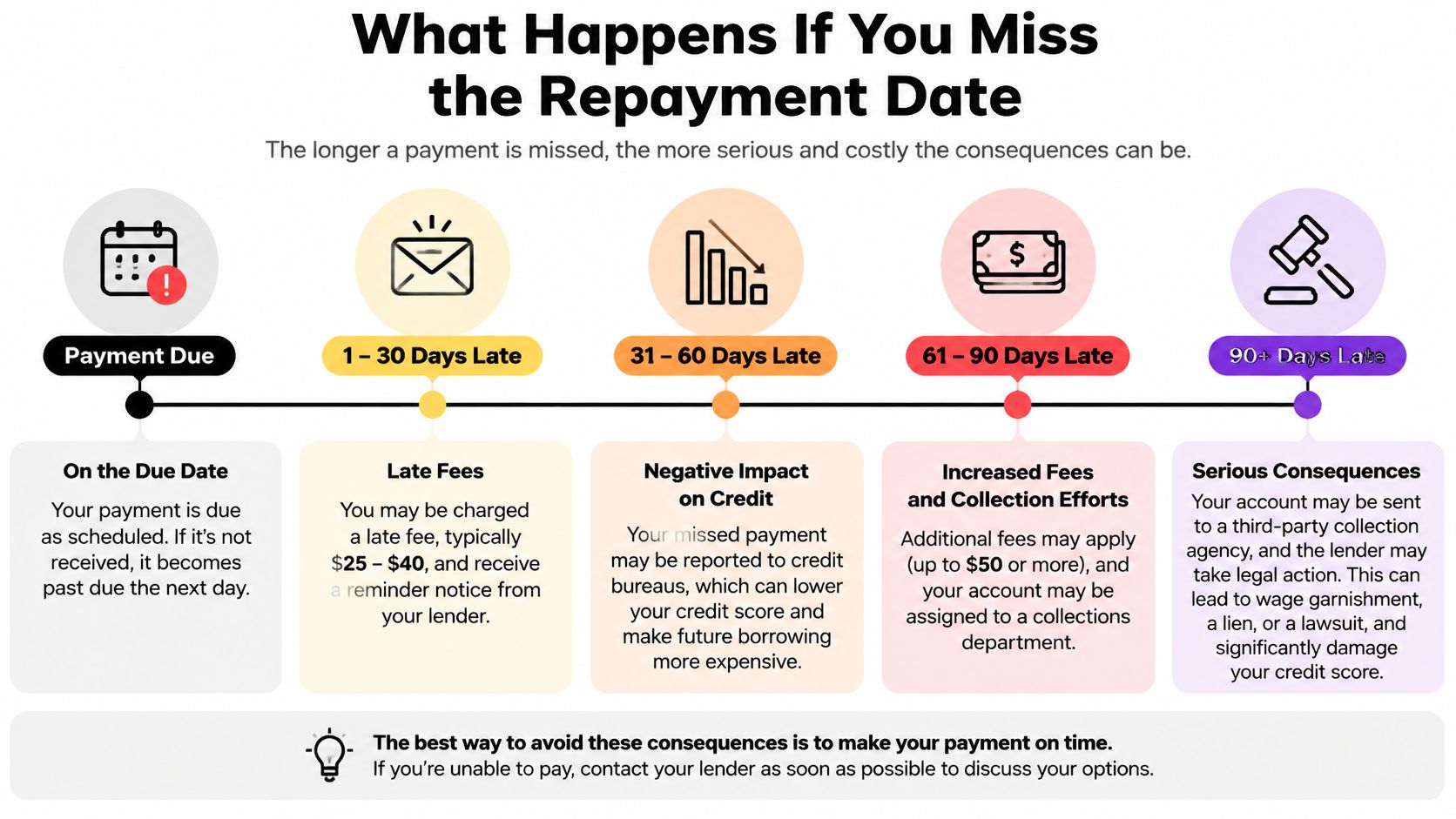
What losing the chain really costs
In this hypothetical scenario, forfeiting the chain may end the loan obligation, but it doesn't undo your financial loss. You received a loan against the item, not necessarily its full resale value, and replacing it could be difficult.
Compare these considerations before pledging it:
- Resale value: What could you reasonably receive by selling the item instead?
- Redemption cost: What must you pay to recover it under the agreement?
- Personal importance: Would losing it cause a problem that money couldn't easily fix?
> A clean credit report doesn't make losing a family heirloom an affordable outcome.
Our responsible borrowing and pawning guidance can help you evaluate the repayment decision before an urgent expense becomes a rushed borrowing choice.
Situations Where Pawning Can Still Hurt Your Credit
The general rule has limits. Credit damage can arise from how you fund redemption, a different product you sign for, or information a lender furnishes. It doesn't have to come from the standard pawn transaction itself.
The Consumer Financial Protection Bureau's complaint categories expressly include credit-report and credit-score issues for pawn loans. Those categories don't establish that ordinary pawns routinely report, but they show why an absolute promise of invisibility is too broad.
Scenarios that can change the credit outcome
| Scenario | Likely credit impact | What to check |
|---|---|---|
| Pawn redeemed on time with cash | Generally no credit change | Keep the redemption receipt |
| Rent or utilities missed to fund redemption | Possible negative reporting or collection activity from those creditors | Budget redemption around other due dates |
| Redemption paid by credit card, then card payment late | The card issuer may report a qualifying delinquency | Confirm the card due date and repayment funds |
| Same shop offers an installment or payday product | That separate product may be reported to bureaus | Identify the product and its reporting terms |
| Payment portal fails and fees accrue | Fees, with possible negative reporting if the lender furnishes information | Save confirmations and request the reporting policy in writing |
Paying cash on time avoids adding another borrowing account to the redemption decision. By contrast, moving the cost onto a credit card creates a separate obligation with its own reporting consequences.
Rent and utility situations require care, too. A missed payment doesn't automatically appear on every credit report, but an account sent to collections can create problems. Don't protect a pawned item by leaving essential bills unpaid without understanding the consequences.
For purchase financing, even a no-credit-check offer needs its own review. Lucas Furniture & Mattress's information about furniture payment plans in Lafayette is a reminder to examine the actual agreement rather than assuming that all alternative financing works like a pawn.
Separate the reporting questions
Ask the lender these questions independently:
- Application inquiry: Will you make a hard inquiry when I apply?
- Account reporting: Will you furnish the account, balances, or payment history to a credit bureau?
- Default treatment: If I don't redeem the item, will you only retain the collateral, or does another obligation remain?
A no-credit-check answer addresses only the first question. Request the remaining answers in writing, save payment records, and review your credit reports if you suspect an error. If inaccurate information appears, dispute it with the reporting bureau and the business that furnished it, including copies of supporting documents.
Pawn Loans Compared With Bank and Card Borrowing
The basis for approval is the clearest difference. A pawnshop evaluates an item. A personal-loan lender usually evaluates your ability and history of repayment, while a card issuer considers creditworthiness when approving an account or setting its limit.
That difference changes more than access to cash. It changes what you must surrender temporarily, how much repayment flexibility you have, and what the lender can do if you don't pay.
Pawn loan versus personal loan and credit card
| Feature | Pawn loan | Personal loan | Credit card |
|---|---|---|---|
| Basis for approval | Value of the item | Income, repayment history, and credit profile | Creditworthiness for approval and limit; available credit for use |
| Term and cost | Short repayment window, with interest and fees that can be substantial relative to the amount borrowed | Usually scheduled installments with interest under the agreement | Ongoing interest on carried balances, subject to account terms |
| What you lose if unpaid | The pledged item | Secured collateral may be seized; unpaid debt may enter collections | Account may be closed or charged off, and debt may enter collections |
A pawn can be useful when you need cash promptly and have suitable collateral. You can bring the item for evaluation without waiting for a lender to assess a conventional credit application. The amount available, however, is limited by the item and the offer, not by how much you need.
A personal loan may offer a repayment schedule that fits several paychecks. Many personal loans are unsecured, while secured versions put specified property at risk. Read the agreement rather than assuming that a bank loan always has collateral or that it never does.
An existing credit card may be convenient, but available credit isn't the same as affordable borrowing. Carrying a balance creates interest obligations, and using more of an account's limit can affect the credit information a card issuer reports.
Compare the exit plan, not just access to cash
The most useful comparison begins with the day you expect to finish paying. Ask what must happen for each option to end cleanly.
For a pawn, you need enough money to meet the redemption terms. For an installment loan, you need a budget that supports the scheduled payments. For a card, you need a payoff plan rather than relying indefinitely on minimum payments.
Use these decision criteria:
- Timing: Will reliable income arrive before the repayment obligation?
- Total dollars: What will you pay if you complete repayment as planned?
- Delay costs: What happens if the expected income arrives late?
- Property risk: Could you manage without the pledged item?
- Credit objective: Are you seeking cash, positive payment history, or both?
Our explanation of getting a pawn loan instead of a personal loan for quick cash can help you think through that choice. For a purchase-specific alternative, the Guynn Furniture & Mattress financing guide offers another agreement type to evaluate on its own terms.
Credit-neutral doesn't mean credit-building
According to Experian's pawnshop-loan explanation, standard pawn transactions generally aren't reported to the major credit bureaus, so successful repayment generally doesn't build credit. If establishing payment history is your goal, ask whether an alternative account furnishes positive payment information before applying.
> Repaying an unreported obligation can be financially responsible without adding anything to your credit file.
Two other assumptions deserve correction. First, no credit check doesn't mean no transaction record. The shop still has an agreement and payment records, even when the bureaus receive no account information.
Second, a high rate doesn't automatically tell you which option costs the most in actual dollars. A short borrowing period, a fixed fee elsewhere, or an avoidable overdraft can change the comparison. Don't assume a pawn is cheapest or most expensive without comparing the full charges and the consequences of delayed repayment.
Confirm the Reporting Terms Before You Pawn
Before signing, turn the reporting discussion into a written checklist. A clear answer about the application isn't enough if you're still unsure about payment reporting or forfeiture.
- Request the reporting policy in writing. Ask whether the account, successful payments, or defaults are furnished to any credit bureau. Keep the answer with your agreement rather than relying on a general advertising statement.
- Confirm the inquiry type. Identify whether the lender makes a hard inquiry, a soft inquiry, or no inquiry. Make sure the answer applies to the exact product you're accepting.
- Calculate the complete redemption obligation. Include principal, interest, applicable fees, and any charges associated with renewal. Compare that amount with the item's resale value and the money you'll have available after essential bills.
- Record the deadline and notice process. Know when payment is due, what grace terms apply, and how the lender contacts you. Make sure your contact details are correct.
- Keep evidence and check for errors. Save the agreement, payment confirmations, and redemption receipt. If unexpected information appears on your credit reports, use those records to support a dispute.
Make the repayment plan concrete
At Idaho Pawn & Gold Exchange, we return your pawned item after the loan amount and interest fees are paid. You can renew a pawn loan as many times as you need, but permission to renew isn't proof that repeated renewal fits your budget. Ask what each extension requires and how much principal will remain afterward.
Our app lets you pay and monitor your pawn loans and balance. Use that visibility to track the obligation, while keeping your own payment confirmations and calendar reminders.
Our staff can review the loan amount, costs, and due date with you before a loan is made. Bring the checklist and use our guide to preparing for a pawnshop loan offer to organize your questions before visiting.
The safest decision is one you can explain plainly: what you're borrowing, what you'll pay, when you'll pay it, and what happens if you can't.
---
Idaho Pawn & Gold Exchange offers collateral-backed cash loans without requiring a credit check, and our staff reviews the amount, costs, and due date before you decide. Visit Idaho Pawn & Gold Exchange with your item and this checklist so you can understand the written terms and protect both your budget and the property you're pledging.