
A single resale percentage is the wrong tool for a diamond. Published advice still offers half the receipt, or a third, as if every stone cleared the same counter.
That figure is a blur. It folds an insurance replacement estimate, a private sale, an auction hammer price, a dealer buy, and a pawn loan into one average of deals nobody published, then pastes the average onto a stone nobody has examined.
A one-carat round with strong proportions, no fluorescence and a current laboratory report does not share a cash price with a shallow-cut, milky, strongly fluorescent stone of the same weight. A chart cannot see either stone.
Natural diamonds often come back as a fraction of the original purchase price. Use that idea only as a starting point for an ordinary stone, then ask which of those prices the buyer across the counter is quoting.
What Cash Buyers Mean by Resale Value
Three numbers get called "the value of the diamond," and blurring them is where sellers lose money.
- What you paid is a retail price. It carries the jeweler's markup, the mounting design, the display case, the sales staff and whatever name is on the box.
- Replacement value is what a comparable new stone would cost in a store today. It is the figure an insurance appraisal is built to support, and it is normally the highest of the three.
- Liquidation value is what a ready buyer will hand over this week, after examining the stone, tying up money in inventory and planning to resell it at a margin.
The gap between the last two is the whole story. Picture a new car. The window sticker says one number, and the trade-in offer on the same afternoon says another. Nobody accuses the dealer of lying. The sticker prices a retail transaction with warranty and financing attached. The offer prices a car the dealer must clean, certify, floor and sell again.
In 2025, natural diamonds were reported to resell for approximately 25% to 50% of their original purchase price, according to CaratX's analysis of the natural diamond market. Read that as a band for an ordinary natural stone, never as a quote on yours.
> The rule that matters: an appraisal tells your insurer what it costs to replace the ring. It tells a buyer nothing about what they should pay for yours.
There's no public exchange where used diamonds trade at visible prices, so generic percentages survive. Offers come from private bids, auctions and dealer experience rather than transparent sale records, as this breakdown of diamond resale value points out. The same logic shows up whenever an asset is sold quickly: a Cyber Homes fast cash sale guide walks a homeowner through the distance between an asking price and a same-week cash offer. Swap the house for a ring and the arithmetic is familiar. A strong appraisal can sit right next to a modest cash bid.
Five distinct prices are in play, and each answers a different question.
Five Prices a Diamond Can Carry
One percentage cannot price a diamond. A receipt, an insurance schedule, a private buyer, an auction house, a dealer and a pawn counter are answering different questions, and they will not land on the same number.
| Value type | What it measures | How it relates to price | When it fits |
|---|---|---|---|
| Insurance replacement | Cost of a comparable new stone | Near current retail; not a cash bid | You are insuring, not selling |
| Private sale | Price another consumer pays | Often above a dealer bid, after fees and time | You can wait and handle buyers |
| Auction proceeds | Hammer price minus seller costs | Wide range; stronger for rare or branded pieces | The stone or jewel is unusual |
| Dealer buy price | What a reseller can pay today | Below a wholesale list, with the gap set by the stone and current stock | You want a direct cash sale |
| Pawn loan | Credit secured by resale value | Based on secondhand value, below an outright sale | You may want the item back |
A retail receipt works like a new-car window sticker. It bundles the stone with a store, a warranty and the time it took to sell that piece once. Cash buyers strip those extras off before they name a figure.
The figure an appraisal actually supports
Replacement value prices a comparable new stone at current store prices. That number is built for a claim: if the ring is lost, the insurer has to buy another one from a jeweler. An appraiser is not pricing a bid from someone who must resell the stone this month. The paperwork can sit in the same folder as a cash offer and still describe a different transaction.
What a private buyer or an auction can add
A private sale often clears more than a dealer bid because you keep the spread a reseller needs between buying and selling. You also take on the work: photos, listings, questions, meetings and the risk of a return or a payment dispute. Part of what a private buyer will not repay is the store portion of a retail diamond price, and this look at jewelry-store diamond pricing shows how much of that ticket is the shop rather than the stone.
Auction fits a piece other buyers already want by name: a signed jewel, an antique cut, a fancy-color stone with a documented hue. For an ordinary commercial round, hammer price minus the seller's commission often finishes no higher than a direct dealer offer, and the seller waits weeks to find out.
The dealer bid and the pawn advance
Dealers start from wholesale benchmarks, not from your receipt. The Rapaport Diamond Price List is an international dealer benchmark sorted by carat weight, color and clarity. Offers commonly sit below that list. How far below depends on cut quality, fluorescence, the lab report, shape, how easily the stone will sell and what the buyer already has in inventory. That gap is measured against a wholesale number. Subtracting it again from what you originally paid stacks a second discount on the first.
A pawn loan sits under an outright sale because it is credit, not a purchase. The amount is based on the wholesale, resale or secondhand value of the item, not its new price. Repay the loan and the piece comes back.
> Ask one question of anybody who quotes you a number: which of the five is this?
How Color Cut Clarity and Carat Move the Offer
Two stones of identical weight can draw offers thousands of dollars apart. The four Cs explain much of that gap, and the traits outside the four Cs explain the rest.
Think of the grades as tiers of buyer interest rather than a school report.
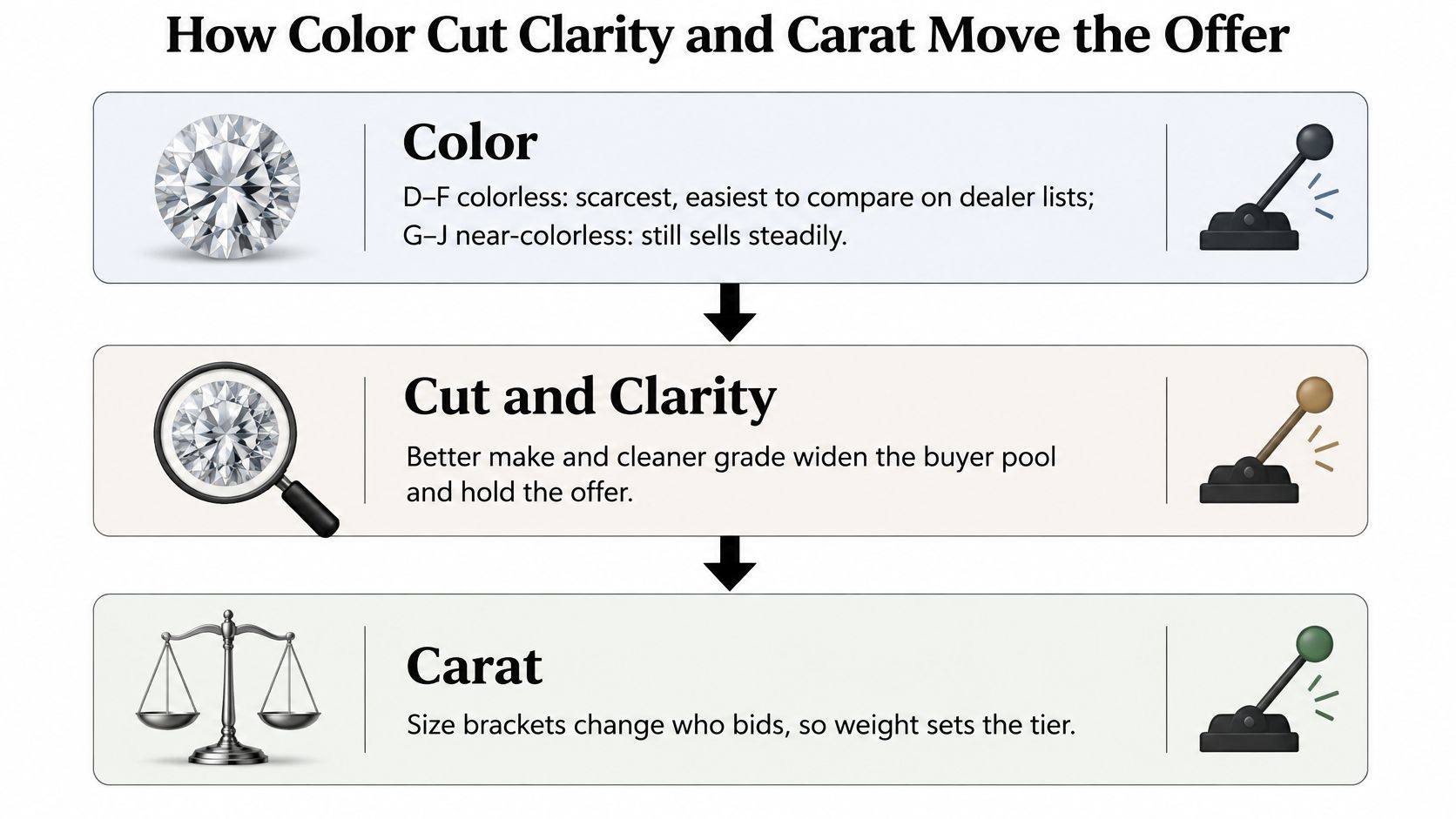
Color drives comparability. D through F is the scarce colorless range and sits in neat rows on every dealer list. G through J, near-colorless, still sells steadily into finished jewelry. Below J, expect a wider discount unless the stone is fancy color, which is a separate market with its own buyers and its own price logic.
| Trait | Scarce or visible | Effect on offer | Watch for |
|---|---|---|---|
| Color D to F | Scarcest colorless range | Easiest to compare on dealer lists | Lower colors need a larger discount unless fancy color |
| Clarity VVS or internally flawless | Premium grades | Carries a premium | Many mounted stones look alike once clarity reaches VS |
| Eye-visible inclusions or clouds | Visible to the next buyer | Wider discount | Cavities or clouds that hurt brilliance |
| Cut proportions and symmetry | Visible in the first second | Often moves the offer more than one clarity step | Light return decides how alive a round looks |
| Round brilliant shape | Most liquid shape | Holds the widest buyer pool; ovals, cushions and pears follow fashion cycles | Check shape demand before pricing |
| Blue fluorescence | Medium to strong | Can discount colorless stones and occasionally helps a lower color | Confirm fluorescence on the report |
Cut decides whether the stone sells at all
Proportions, symmetry and light return determine whether a round looks alive across the table. A poorly made one-carat is harder to place than a well-made 0.90-carat, because the next owner has to like looking at it. This is the grade sellers underweight most.
Carat cliffs and the 0.96 problem
Weight isn't a smooth slope. Buyers shop in brackets: half carat, one carat, one and a half, two. A 0.96-carat stone misses the one-carat bracket by four points and can lag a true 1.00-carat with the same color and clarity, even though the two look identical once set. Before you order a custom cut or recut, check which side of a bracket the finished weight lands on.
Three traits the four Cs leave out
Shape, fluorescence and form all move money. Rounds are the most liquid. Medium to strong blue fluorescence can discount a colorless stone and occasionally helps a warmer one. A loose stone is simpler to price than a finished ring, and the mounting should be valued separately as metal or as wearable jewelry rather than folded into the stone's grade.
A quick self-check before you accept anything: which trait is scarce, which trait a buyer can see, and which weight bracket the stone just missed.
Reports, Treatments and What to Bring
A grading report lowers the cost of checking the stone, and that is the whole of its financial value. It reduces verification risk. It doesn't promise appreciation.
Federal Trade Commission jewelry guidance requires a seller who states a grade to name the grading system used, and it requires disclosure of gemstone treatments, which puts report provenance and treatment status squarely into the commercial picture, per the FTC jewelry guides.
A recognized report that records the 4Cs and states whether the stone is natural or laboratory-grown lets a buyer price it without first paying for independent testing. A missing, damaged or little-known report does the opposite: it forces re-examination, delays settlement and widens the discount the buyer needs to feel safe.
Four steps that protect the file
- Keep the original report and the receipt. A laminated card in a drawer beats a photo of a card that no longer exists.
- Match the girdle inscription. When the report carries a laser inscription number, confirm it on the stone's girdle under magnification.
- Disclose every treatment. Fracture filling, HPHT color treatment, irradiation and coatings all get disclosed. A buyer who discovers a treatment later will reprice the whole transaction.
- Price the stone and the setting separately. A pretty mounting can hide a treated stone, and a plain one can erase the advantage of a strong report.
> A report tells a buyer what the stone is. Only the market tells them what it's worth.
Branded jewelry adds demand when the brand, the papers and the condition agree. When one of the three is missing, the brand premium shrinks fast.
Before any of that paperwork matters, the stone has to be confirmed as a diamond at all, and this guide to telling a real diamond by eye covers the at-home checks that come before a laboratory test.
For a seller who needs cash in a day, expect in-house testing and a wider discount than a seller who can wait a week for a report to be verified. Bring the report, the receipt, the piece exactly as it is, and an honest account of repairs or treatments.
Market Cycles Behind Today's Comparable Sales
A receipt records one moment in a moving market. During the late 1970s the typical price of a one-carat, D-color, internally flawless diamond rose about 733%, from roughly $7,200 per carat in 1977 to about $60,000 in 1980, as Edahn Golan's De Beers timeline records.
Credit then tightened and inventory backed up. Prices fell sharply, and highly graded natural diamonds gave back most of that three-year gain once the boom broke. A seller still quoting the 1980 receipt was naming a market that had already left.
When quality and rough split apart
Segments do not travel together. A top one-carat stone and a parcel of rough can share an industry and still move like a certified pre-owned watch and a bin of unsorted movements: related goods, separate bids.
During the 2020 pandemic disruption, prices for high-quality one-carat diamonds on the RapNet trading platform ran about 12% higher than at the start of that year, while rough-diamond prices in some sales fell about 15% to 27%, as Reuters reported. Premium, well-documented stones held a bid. Less liquid material slid.
More recently, IDEX data cited by Wealthysinglemommy put diamond prices more than 30% below their April 2022 peak by February 2024.
A local cash offer can also sit apart from an online or overseas bid once authentication, shipping, taxes and the dealer's own margin are counted. Rarity helps a superb stone find the right buyer. It does not cancel cycle risk, and it does not freeze yesterday's number.
Insurance replacement, a private sale, an auction hammer, a dealer buy and a pawn loan are different cash outcomes on the same stone. They do not rise and fall by one shared percentage. A cycle that supports polished goods can still cut what a dealer can resell this month, and a loan follows that resale figure rather than the original receipt.
> Judge every offer against current like-for-like stones. The 1980 peak, the 2022 peak and the year the ring was bought are history, not the bid in front of you.
Comparable sales beat a single resale percentage for that reason. You look at what similar certified stones are moving for now, adjust for cut, fluorescence and report, then decide whether the number in front of you makes sense.
Natural Diamonds Versus Lab-Grown Stones
Here's the question buyers now bring into the shop. If a lab-grown diamond is visually and chemically a diamond, why would its resale value keep sliding while a natural stone holds a bid?
The answer is supply, not sparkle. Wholesale lab-grown prices fell 26% during 2025, and the index Edahn Golan tracks was reported 96% below its 2018 starting point, with one-carat wholesale moving from $105 in the first quarter to $75 in the third before ending near $96, per this analysis of lab-grown diamond resale value.
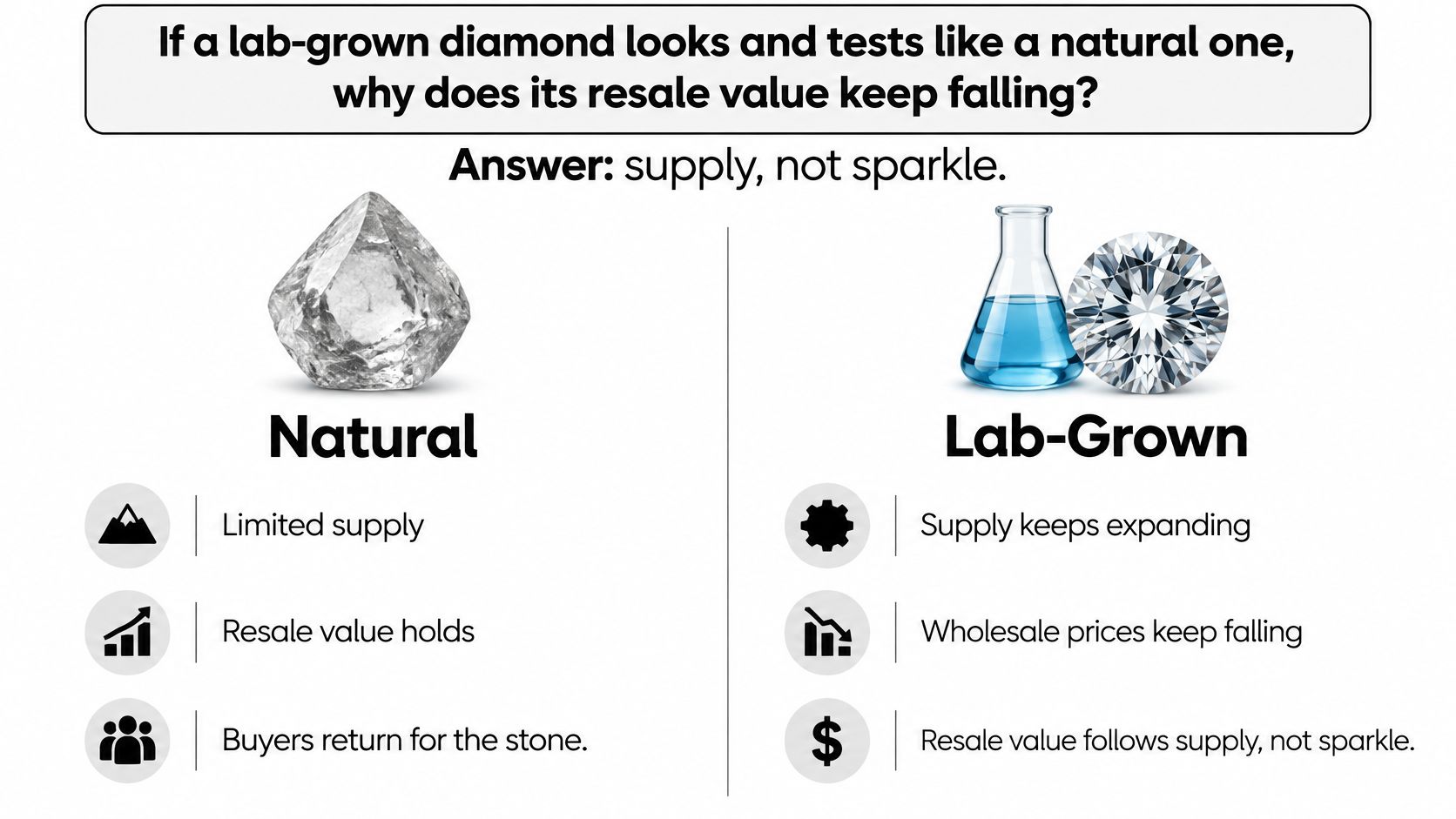
Hardness and appearance don't create scarcity once factories can add supply. Every new production run resets what a replacement stone costs, and a buyer who can purchase new at a falling price won't pay near your original receipt.
What you can actually recover
For a lab-grown piece, the recoverable value may be mostly the gold or platinum setting, weighed and priced as metal, while the stone draws little premium. A natural stone still has a scarcity bid and a certified resale market, though that bid moves with the cycles above and never protects the original receipt. Either way, the purchase price carried retail markup the next buyer has no reason to repay.
If you're weighing a lab-grown ring as a future financial fallback, the honest framing is this: expect its replacement price to keep resetting downward as supply grows.
The video below walks through how the two markets are priced against each other in practice.
| Measure | Laboratory-grown | Natural |
|---|---|---|
| Supply story | Factories expanded output quickly | Mine supply stays limited but demand still cycles |
| Recent wholesale move | Down 26% during 2025 | Quality stones and rough can move in opposite directions |
| Longer track | Tracked index down 96% from 2018 | No comparable flood of identical new supply |
| Late-2025 one-carat wholesale | About $75 to $105, ending near $96 | Set by rarity, cut, report and current comps |
| What is easier to recover | Often the gold or platinum setting | The certified stone can still find a trade buyer |
One thing doesn't change: the report has to tell a buyer which stone they're pricing. Mix the two markets in a single estimate and you get a fantasy number.
Choose Speed, Proceeds, Privacy or a Loan
Rank one goal before you shop the stone around, because the four goals point to four different routes.
- Speed. A same-day evaluation and an offer based on what that buyer can resell for this week. That means a dealer buy or a pawn advance, and it means accepting the dealer's margin.
- Maximum proceeds. A private sale or a selective auction keeps more of the retail-to-wholesale gap, and costs you weeks of listing, messages, platform or payment fees, and return risk.
- Privacy. An in-person shop beats a public listing with photos of an engagement ring attached to your name.
- Keeping the option. A pawn loan is sized off secondhand value and repaid to reclaim the item. It isn't a sale you hope to undo later.
If all you need is a number for an insurance policy, order a replacement appraisal instead of accepting a liquidation figure. Those are different products, and confusing them is the most common expensive mistake in this whole process. If you're selling rather than borrowing, these tips for selling a diamond cover the preparation that keeps an offer from being discounted on inspection.
For a documented local offer, an in-person evaluation at Idaho Pawn & Gold Exchange prices each stone against current dealer prices, condition, completeness and resale demand, and walks through the appraisal before any sale. Bring the report and the ring, say whether you want a loan or an outright purchase, and write down which of the five prices the offer represents. Compare that figure with any online estimate before you commit to anything.
---
Idaho Pawn & Gold Exchange evaluates diamonds across Boise, Meridian and Nampa, testing each stone free of charge and reviewing color, cut, clarity and carat with you before any offer is made. Bring your report, your receipt and the ring as it is, and the team will explain which of the five prices the number represents and why it differs from your insurance appraisal. Visit Idaho Pawn & Gold Exchange to start with a free diamond authentication test and a documented offer.