
You're holding a ring over a pawn counter, and the letter on the old report doesn't match what you see. The paper says H. Under the case lights the stone looks crisp. Near the window it looks a little warm. The clerk asks whether you want a loan or a sale, and the color grade suddenly feels like the whole price.
That gap is normal. A diamond color grade chart records body color the way a lab sees it, not the way a mounted stone looks on a hand. Lighting, metal, and shape all change the picture. Learn the letters first, then judge the stone where it will be worn or sold.
The Full D to Z Color Grade Chart at a Glance
The Federal Trade Commission consumer guide on gemstones describes the GIA scale as 23 letter grades, from D through Z, sorted into five bands. Colorless is D–F. Near colorless is G–J. Faint is K–M. Very light is N–R. Light is S–Z. The chart scores body color only. It does not score brilliance, fire, cut, clarity, or carat weight, so two stones with the same letter can still look and sell very differently.
D is the top of the scale: no body color a grader can detect. Z is the other end: the most visible light yellow or brown in this system. Each letter is a range, not one exact shade. Neighboring grades often look alike, especially in smaller stones.
| Grade | Category | Typical body color |
| --- | --- | --- |
| D | Colorless | No body color detectable, highest grade |
| E | Colorless | Trace of color seen only by experts |
| F | Colorless | Trace of color seen only by experts |
| G | Near colorless | Looks colorless to most in face-up view |
| H | Near colorless | Slight warmth visible side by side |
| I | Near colorless | Slight warmth visible side by side |
| J | Near colorless | Noticeable warmth in some settings |
| K | Faint | Light yellow tint visible face-up |
| L | Faint | Light yellow tint visible face-up |
| M | Faint | Clear yellow tint visible face-up |
| N | Very light | Yellow tint visible to most people |
| O | Very light | Yellow tint visible to most people |
| P | Very light | Stronger yellow tint |
| Q | Very light | Stronger yellow tint |
| R | Very light | Strong yellow tint |
| S | Light | Obvious yellow or brown body color |
| T | Light | Obvious yellow or brown body color |
| U | Light | Obvious yellow or brown body color |
| V | Light | Strong yellow or brown body color |
| W | Light | Strong yellow or brown body color |
| X | Light | Very strong yellow or brown body color |
| Y | Light | Very strong yellow or brown body color |
| Z | Light | Most visible yellow or brown body color |
How to read the color line
Find the color line on the grading report. Match the letter to its band in the table. Then decide whether a colorless premium is worth it, or whether near colorless already looks right once the stone is set.
Stones with strong or unusual hues, such as pink or blue, are not stretched along D–Z. They use a separate fancy-color system. Keep this chart beside any listing, report, or offer so you compare the same language, not a seller's private words like "white" or "near white."
How Graders Set Color Under Controlled Light
Before this scale existed, sellers used loose words such as "white," "blue white," and "AAAA." The Gemological Institute of America introduced the D-to-Z system in 1953 and issued its first diamond grading reports in 1955.
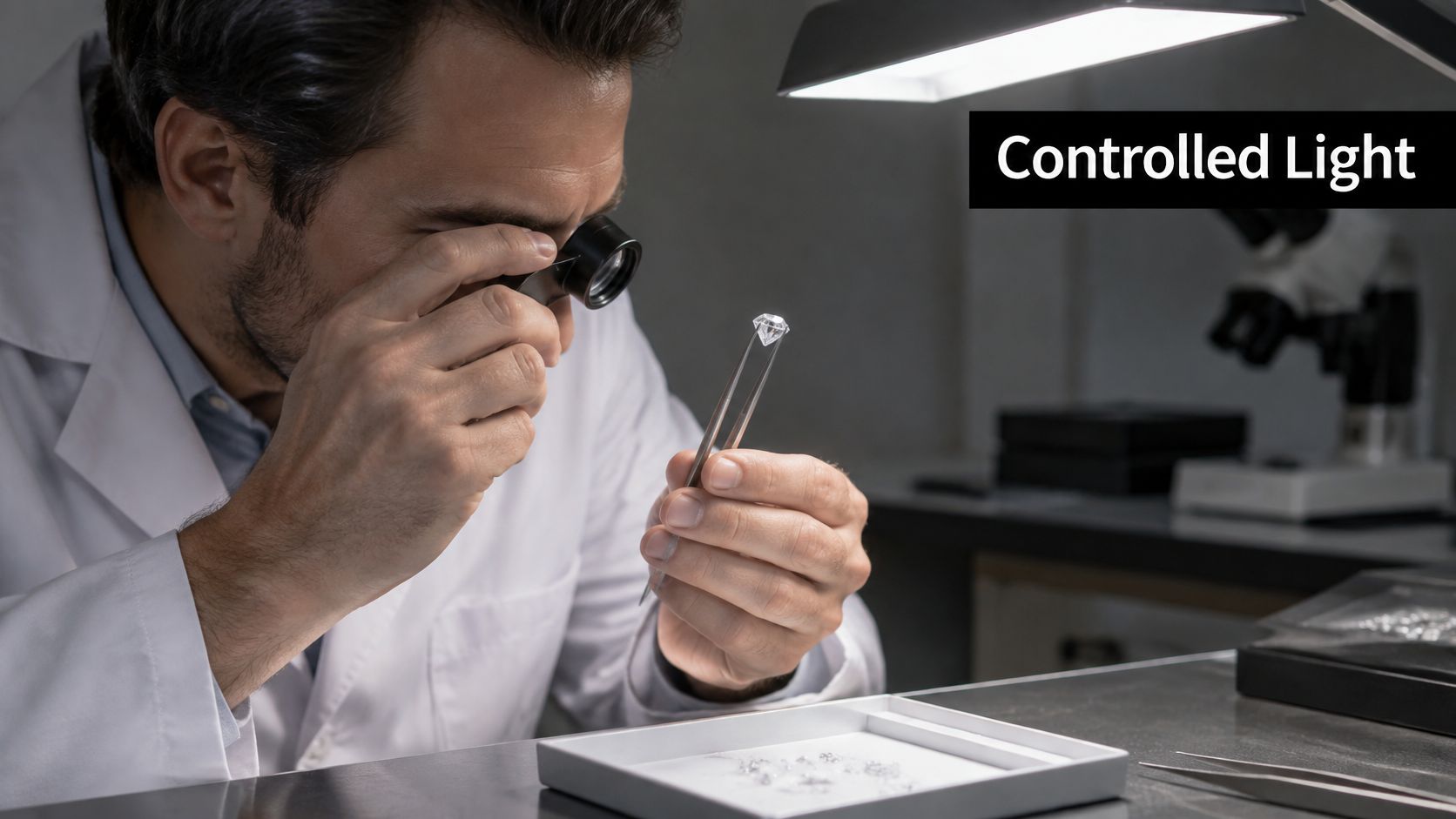
GIA treats color as a comparison, not a meter reading. As GIA's color overview explains, the stone is viewed table-down under controlled light, against a neutral background, at a fixed angle, and matched to master stones set at the least-colored edge of each grade.
Think of paint swatches. The grader holds the diamond next to known samples and picks the nearest match. There is no single number a machine prints and calls final. Because each letter is a range, two careful graders can land one step apart at the edge of a grade. That one-step difference is a boundary call, not proof that one report is fake.
What to trust at the counter
A grade is only as useful as the report that names that stone. Other labs may print their own color scales, so the letters are not automatically interchangeable.
- Check the laboratory. Confirm the report is from the lab you think it is.
- Check the report number. It should match the stone in front of you.
- Read the printed grade. A verbal "it's about an H" is not the same document.
> Practical rule: The grade is a comparison, the edges of a range can differ by one step, and the report is the proof.
Why a Diamond Looks Different Than Its Grade Suggests
Two G diamonds sit side by side in a case. One looks icy. The other looks faintly warm. The letters match. The settings don't.
GIA's guide to reading a color grade notes that lighting and background can change perceived color, while the lab process is built to separate color from brightness and scintillation. A chart can't answer "what will look colorless on my hand?" by itself. You can't settle that question by trying to judge a diamond by eye alone either.
| Setting | Effect on perceived color | What to do |
| --- | --- | --- |
| Daylight near a window | Shows warmth most clearly | View loose stone against white paper |
| Warm household lighting | Adds yellow and can mask faint warmth | Recheck under neutral light |
| Jewelry case spotlights | Emphasizes sparkle over body color | Ask to see the stone out of the case |
| Yellow gold setting | Reflects warmth into the stone | Compare loose and mounted stone |
| White gold or platinum setting | Can make near-colorless stones look whiter | Judge the mounted stone in both metals |
| Elongated shapes such as marquise or emerald cut | Shows more color because of greater body depth | Check the color at the face and in daylight |
A simple three-look check
Look loose first. Set the stone on white paper in daylight so metal isn't coloring the picture.
Look at it mounted. Put it in the metal you would wear or resell. Yellow gold throws warmth back into the stone. White metals can make a near-colorless grade look whiter.
Look indoors. Warm bulbs add yellow. Case spotlights sell sparkle and hide tint. Round brilliants generally hide body color better than elongated or step cuts, which show more of the stone's body.
> A well-cut near-colorless diamond can look as white as a higher grade once it's mounted. A poorly cut higher grade can look dull.
Judge the stone where it will be worn. Paying for the top of the chart is a poor trade when you can't see the difference in that setting.
How Color Shapes Price and Resale Value
Color is one of the four Cs, and prices generally rise as grades move toward D. The steps are not equal. The jump from D to E can cost more than a move inside the near-colorless band, even when your eye barely sees it.
In 2024, G-to-I grades accounted for 52% of the U.S. market, according to a 2025 survey published by Mills Jewelers. Most buyers already shop that near-colorless stretch instead of paying for the top letters.
Say you're choosing between a G with an excellent cut and a D with a weak cut, similar size and shape. The G can look livelier in a ring and cost less. The D wins on the report and loses on the finger. That trade only works when the stones match in cut, size, shape, and fluorescence. Mix those and you aren't comparing color. You're comparing four different products. Paying retail for a top letter, then selling later into a dealer market, is one reason buying a diamond at a jewelry store can be a weak financial move.
White diamond prices declined 13.3% in 2024, according to the Fancy Color Research Foundation's annual index as reported by IDEX Online. Any offer you compare should be dated. Last year's asking price is not today's bid.
A short decision guide
We build offers from condition, completeness, resale demand, and comparable prices, not from a letter alone.
- Color shows in the setting: Pay for the higher band if you can see the warmth and you dislike it.
- Yellow gold or a darker mount: Near colorless often gives the better value, because the metal already carries warmth.
- You're selling or pawning: Bring the report, but expect the offer to follow current dealer demand, not the original retail ticket.
Fluorescence, Origin and Why Color Alone Misleads
GIA prints fluorescence on its own line. The color grade and the glow are two facts on one report. Treating "no fluorescence" as automatically best is a habit, not a rule.
| Fluorescence level | Visible effect | Practical note |
| --- | --- | --- |
| None | No glow under ultraviolet light | Baseline, no effect on color |
| Faint | Glow barely noticeable | Usually no practical change |
| Medium | Visible glow under ultraviolet or some daylight | Can make a lower-color stone look whiter in sunlight |
| Strong | Clear blue glow | Can improve appearance of lower-color stones, check in daylight |
| Very strong | Intense glow | Can cause a hazy or oily look, judge carefully |
GIA's diamond quality factors note that blue fluorescence can make some lower-color diamonds appear closer to colorless in sunlight, while very strong fluorescence can occasionally create a hazy or oily look. Fluorescence is visible in about 35% of gem diamonds, so it shows up on a large share of pre-owned stones.
Origin is a separate line too
A D-to-Z chart does not say whether a diamond was mined or grown in a lab. Both can share the same optical, physical, and chemical properties. The FTC requires laboratory-created diamonds to be clearly disclosed as not mined. A missing disclosure is a pricing problem, not a paperwork detail.
For a pawn, resale, or estate piece, the useful question is how color, fluorescence, origin disclosure, report quality, and current buyer demand change liquidity and price. A color grade alone cannot predict resale value. The checks at the counter are what tie those facts to an actual offer.
What to Check When Pawning or Selling a Diamond
At the counter, color, fluorescence, and origin land in one conversation. Work through them in order so a verbal grade doesn't stand in for a document.
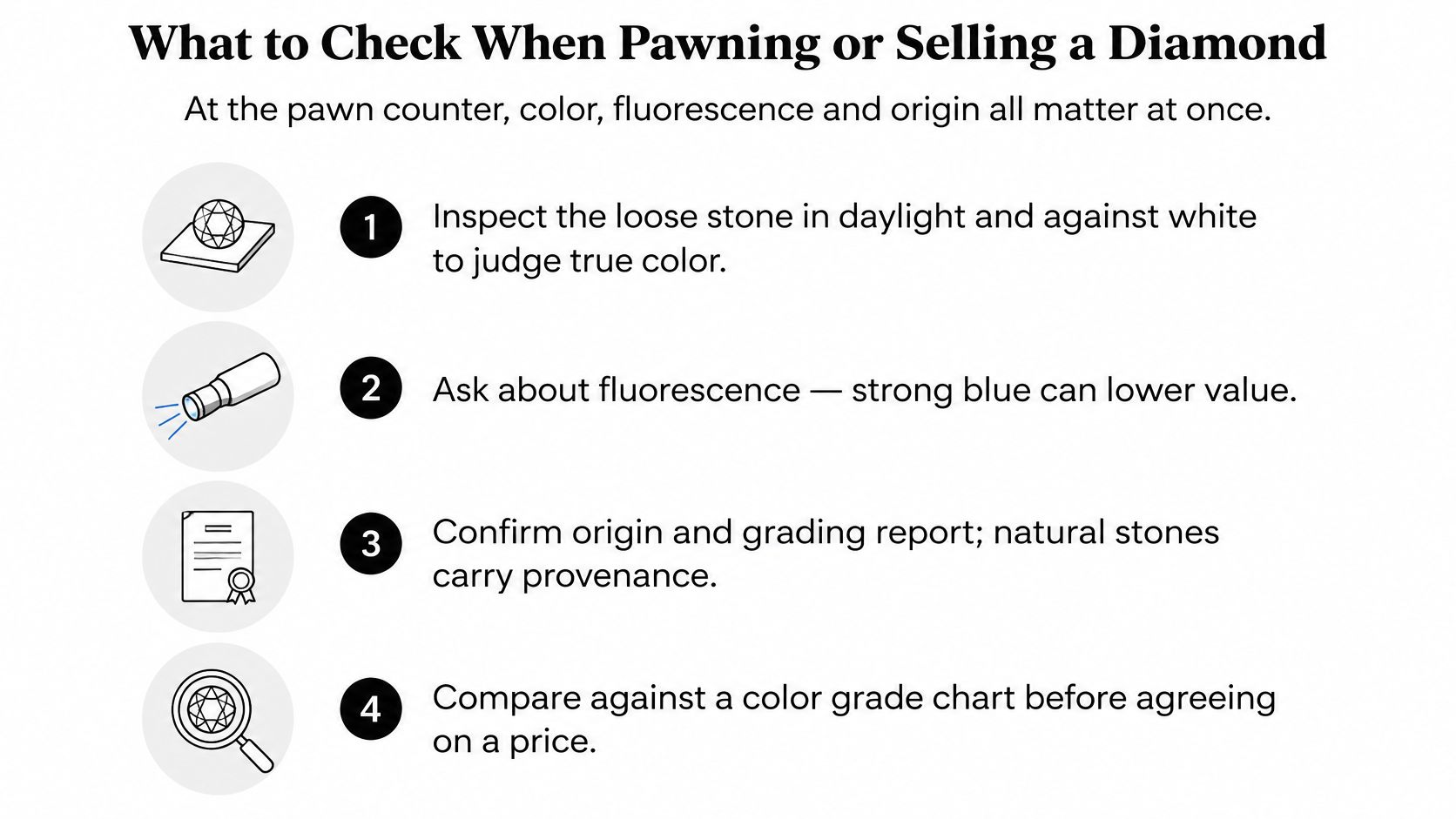
- See the stone loose. Ask for daylight and a white background. A warm bulb or a yellow mounting can make an H look like a K. The slip is judging color only inside the case.
- Get the grade in writing. Ask whether it comes from a GIA report, and note the report number and date. A spoken grade with no paper is easy to misremember.
- Ask for fluorescence and origin. You want both in writing. Strong blue glow and a lab-grown disclosure change who will buy the stone later.
- Ask how the offer was built. Color, cut, clarity, carat, condition, and comparable prices should all be on the table. A single letter is not a price.
- Talk through the appraisal before you agree. Don't sign a sale or a loan until someone has walked the numbers with you.
- Allow time if you need a new report. A certified diamond report takes 10 days. Rushing a sale without one is the usual slip when the paperwork is missing.
These tips for selling a diamond pair well with that routine. On our side, each diamond is reviewed for color, cut, clarity, and carat, and the appraisal is discussed with you before a sale. Certified GIA gemologists inspect and appraise diamonds.
A short walk-through of how body color is judged under controlled light makes the report easier to read before you agree to a number.
A complete appraisal names the stone, the lab, the color letter, the fluorescence, the origin disclosure, and the figures behind the offer. If any of those lines are blank, pause.
Confirm Your Diamond's Grade With Idaho Pawn & Gold
A grading report is easiest to read in the lab where it was written. The diamond in your hand lives somewhere else: under shop lamps, in daylight, set against yellow or white metal that tints how its color reads on any given day. That distance between the letter and the stone is what an in-person visit is for. Authentication testing is free at Idaho Pawn & Gold Exchange, and a diamond evaluation lets you talk through the stone's color, cut, clarity, and carat while the report sits right next to it.
Three ways to use that visit
Keep it. Confirm the stone matches the paperwork before you decide anything. Ask first: does this report describe this diamond?
Sell it. Have the characteristics explained, then weigh the offer against what the report says. Ask first: what is driving this number, the grade on paper or the look in the mounting?
Pawn it. The same evaluation supports a loan instead of a sale. Ask first: what color grade goes on the loan paperwork, and what happens to the stone when I repay?
> Bring the report and the stone together. A letter without the diamond, or a diamond without the letter, leaves the offer half-built.
Stop by the Boise, Meridian, or Nampa shop with both in hand. Visit Idaho Pawn & Gold Exchange and ask for a diamond evaluation before you agree to a price.