
You're standing at the kitchen counter with a small bag of old crowns, a bridge removed years ago, and a few heavy fillings that came out of a back molar. You suspect the pieces contain gold, but you don't know whether they're valuable, who buys dental gold, or how to tell a fair offer from a quick lowball.
The right approach is simple: identify the material, separate the lot, understand the testing, compare buyer types, and ask for the offer in writing. Dental alloys can contain gold, silver, platinum, and palladium, so the visible color or the number of crowns in the bag doesn't tell the full story. Use the checklist below before you walk into a shop or mail anything to a refiner.
What You Are Holding in That Envelope
At a buyer's counter, an envelope of old dental work rarely looks uniform. It may contain crowns, bridges, inlays, onlays, dentures, and porcelain-fused-to-metal restorations, with yellow, white, gray, or nearly silver surfaces. Color helps with sorting, but it does not establish value. A white bridge may contain palladium or platinum, while a yellow piece may contain less gold than its appearance suggests.
Treating the entire envelope as one grade creates pricing problems. A specialized dental refiner separates the material, screens its composition, and settles the recoverable metals individually. Dental alloys may combine gold with palladium, silver, and platinum, not gold alone. Specialized dental refiners describe these restorations as multi-metal material, so a buyer should account for the full alloy rather than apply an assumed gold percentage.
> Practical rule: Price dental work by the recoverable precious metals after testing, not by appearance, tooth count, or the gross weight of an unsorted restoration.
Make four decisions before contacting buyers of dental gold:
- Keep sentimental pieces: Refining permanently destroys a crown or bridge. Set aside anything with personal significance before requesting an offer.
- Separate uncertain material: Group yellow, white, silvery, porcelain-covered, and visibly non-precious pieces separately. This gives the buyer a cleaner lot to inspect.
- Record what you have: Weigh each group with a reliable gram scale and photograph the pieces before handing them over.
- Ask how the buyer tests: Look for XRF screening, a confirmatory fire assay when needed, and a clear multi-metal settlement. An offer based only on an unexplained estimate is not enough.
A 10-gram bridge may hold several times the recoverable metal of a 1-gram inlay, so buyers should separate them instead of pricing the bag as one unit. You do not need to identify every metal at home. Organize the material, request the testing method in writing, and compare how each buyer credits gold, silver, platinum, and palladium. That process makes a fair offer easier to recognize and gives a buyer less room to hide the lot inside one unexplained category.
What Counts as Dental Gold and Why It Is Worth Real Money
You may be holding a crown, bridge, inlay, onlay, gold tooth, or the metal framework beneath porcelain-fused-to-metal work. Dental gold is a precious-metal alloy used in these restorations. Manufacturers combine gold with other metals to improve strength, wear resistance, and performance in the mouth.
Karat indicates the alloy's gold proportion. An 18-karat dental item has a higher gold content than a lower-karat restoration, while many crowns and bridges also contain valuable platinum-group metals. A 16-karat alloy contains more than 60% gold, but the exact mix cannot be confirmed by appearance or karat labels alone. Dental refining guidance explains why alloy composition matters.
Color helps you sort a lot, not price it. Yellow pieces may contain substantial gold. White or gray restorations may contain palladium, platinum, silver, or white-gold alloys. Some silvery material contains little precious metal. Only testing can separate those possibilities.
The buyer's valuation should follow a clear workflow. First, XRF screening identifies the likely metals in the lot. If the result is uncertain or the lot warrants confirmation, the buyer can use fire assay to verify the precious-metal content. The final settlement should credit gold, silver, platinum, and palladium, rather than treating every restoration as gold alone.
Use each restoration as its own small refining lot when comparing offers. A dental refining guide describes an average item as weighing about 3.5 grams and often being around 18 karats. The same guidance places a 3-gram 16K dental tooth at about $300 and a 10-gram 16K bridge at more than $1,000, before commissions. Dental refining guidance explains why alloy composition matters Those figures are examples, not promises for your pieces.
Ask buyers what the XRF showed, whether fire assay was used, and how each recovered metal affects the settlement. A fair offer explains the test, the payable metals, and the deductions. An unexplained single figure leaves you unable to compare buyers properly.
Sorting, Cleaning, and Prepping Dental Gold for Sale
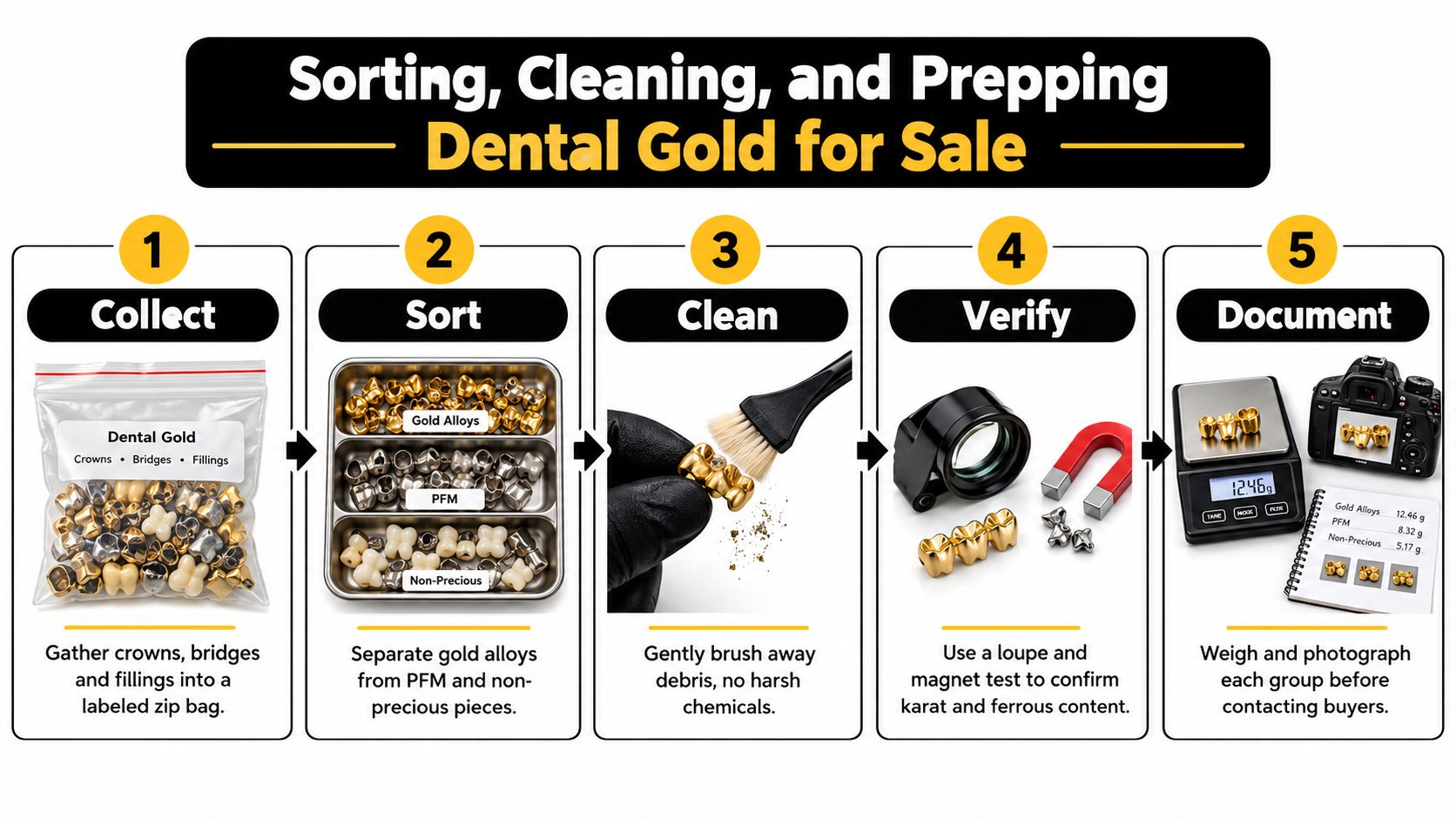
Start with collection, not aggressive cleaning. Put crowns, bridges, fillings, inlays, and onlays into a labeled zip bag, and keep extracted teeth or root remnants separate from loose metal. If the restoration is still attached to tooth material, don't assume you need to remove it yourself.
A gentle warm-water rinse and soft brush can remove loose debris. Let the pieces air-dry completely. Don't use home acids, bleach, abrasive compounds, or a torch. Those methods can damage the material, create hazardous fumes, or make the buyer's testing less straightforward.
Separate the lot before weighing it
Group pieces by what you can see:
- Yellow metal: Keep visibly yellow pieces together.
- White or gray metal: Place white, silver-colored, or gray restorations in a second group.
- Porcelain-fused pieces: Keep restorations with visible porcelain separate from clean metal.
- Amalgam-looking material: Set aside pieces that appear gray and unlike gold or white precious-metal alloys.
- Tooth remnants and cement: Store them apart from loose metal so the buyer can identify the net material.
Removing porcelain or cement can make the metal easier to inspect, but don't use force if the restoration is difficult to separate. A professional refiner has the equipment and process to remove non-metal material. Your job is to avoid mixing obviously different items and to preserve the lot in a condition that can be inspected.
Document what you're handing over
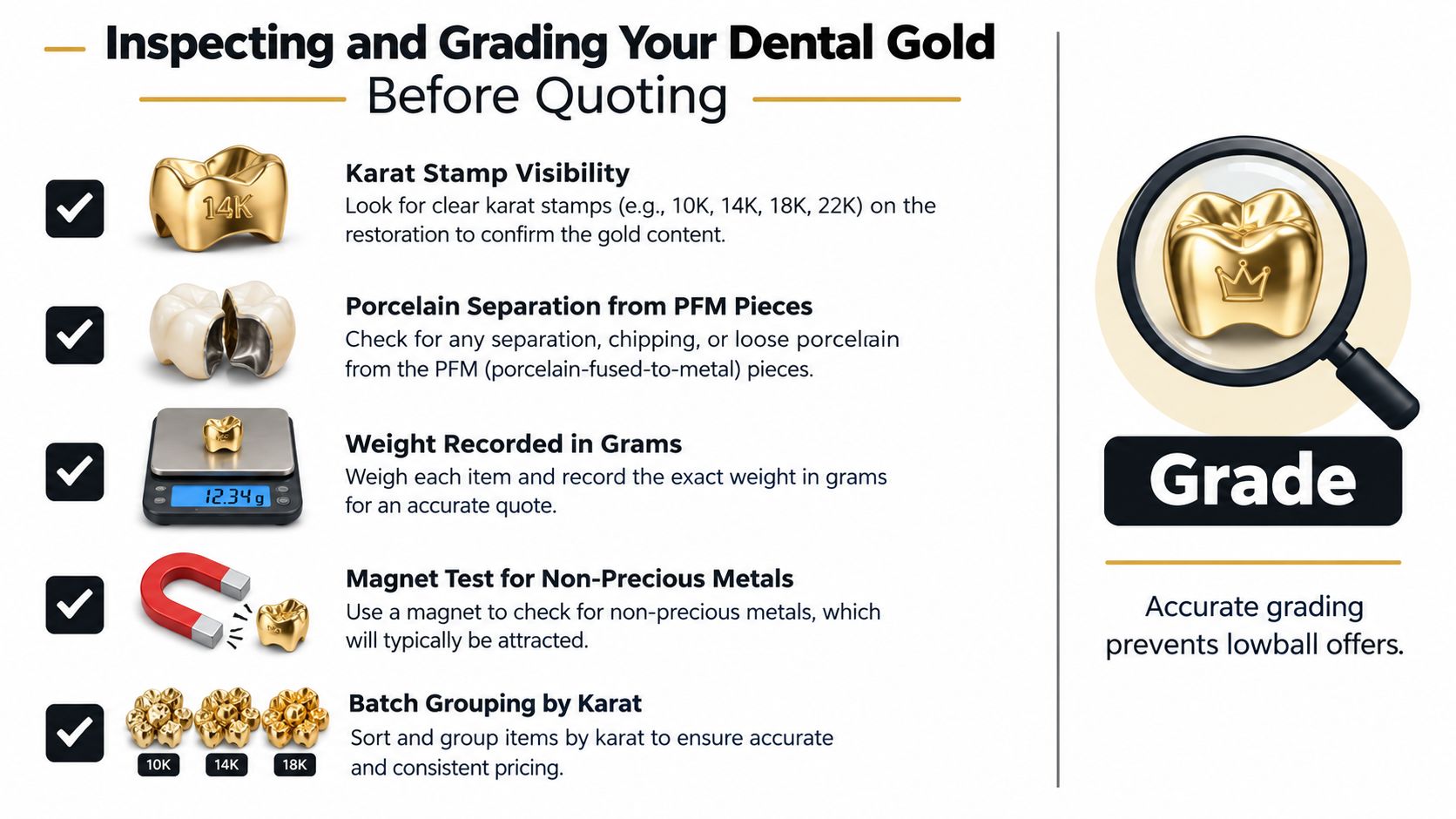
Photograph each group beside a ruler or scale if possible. Record the gross weight, but understand that the full weight can include porcelain, cement, tooth material, or base metals. That number is a reference for your records, not the final payable precious-metal weight.
A magnet can help identify ferrous contamination, but it cannot prove karat or confirm the presence of gold, palladium, or platinum. Don't scratch, melt, or chemically test the pieces at home. A clean, separated, documented lot gives you a better basis for comparing offers and makes it harder for a buyer to blend valuable material into an unexplained category.
How Buyers Put a Number on Your Dental Gold
A fair offer begins with testing, not a flat price per crown. The buyer first separates the lot by material type, then screens each group with X-ray fluorescence, or XRF. XRF is fast and non-destructive, making it useful for checking individual pieces and identifying gold, silver, platinum, palladium, or mostly base metals.
Larger or more complex lots may require a confirmatory fire assay. Fire assay destroys the sample, but it provides a reliable measure of gold content. An ICP analysis can also measure gold, platinum, palladium, and silver separately after the sample is dissolved. Ask how the buyer will account for every recoverable metal, especially in mixed or white dental alloys.
The basic valuation equation
The gross value comes from four parts:
1. The payable alloy weight after porcelain, cement, tooth material, and other non-metal material are removed.
2. The tested proportion of gold and other precious metals.
3. The current market price for each metal.
4. Refining, assay, handling, and buyer-margin deductions.
An 18K alloy is about 75% gold, so one gram of tested 18K alloy contains about three-quarters of a gram of gold before other metals and deductions are considered. A 16K alloy contains more than 60% gold. These figures explain the calculation, but only testing your actual pieces establishes the payable composition.
| Karat | Gold Purity | Grams of Gold per 1g of Alloy | Typical Use in Dental Work |
|---|---:|---:|---|
| 16K | More than 60% | More than 0.60g | Commonly described for crowns and bridges |
| 18K | About 75% | About 0.75g | Dental gold items and selected restorations |
Here is the workflow in plain English. Suppose the buyer receives a 10-gram 16K bridge. The gross weight is 10 grams, but the payable alloy weight may be lower if porcelain or cement remains. The assay then establishes the actual gold content, rather than relying on the stamped or assumed karat. The buyer applies the current spot reference to the measured gold and any payable silver, palladium, or platinum. Finally, the settlement shows separate deductions for refining, assay, handling, and the buyer's margin.
That itemized path matters more than a headline percentage. A white restoration can contain palladium or platinum, and a gold-only quote may leave that value out. Ask whether the offer reflects a single-metal reading or a multi-metal assay.
The dental refining reference explains how spot pricing and dental-metal recovery factor into the valuation. Use that reference to understand the formula, then require your buyer to show the weights, tested percentages, market references, and deductions used for your lot.
The included video provides a visual introduction. Use it as background, not as a substitute for an itemized assay.
<iframe width="100%" style="aspect-ratio: 16 / 9;" src="https://www.youtube.com/embed/YrUp_-tgtbY" frameborder="0" allow="autoplay; encrypted-media" allowfullscreen></iframe>
The Four Main Types of Buyers and How They Compare
You have one small crown, a mixed dental-office lot, or several restorations with unknown alloys. The right buyer depends on the lot, the testing offered, and whether the settlement includes every payable metal. Convenience matters, but a clear assay and itemized deductions matter more.
| Buyer Type | Typical % of Melt Paid | Payout Speed | Minimum Lot Size |
|---|---:|---|---|
| Local pawn or general precious-metal buyer | About 20% to 50% | Usually fast, often in person | Small lots accepted |
| Specialized dental or precious-metal refiner | About 70% to 92% | Slower when testing and refining are required | Small lots may be accepted, larger lots receive closer review |
| Mail-in dental refiner | About 70% to 92%, less shipping and stated fees | Usually slower than an in-person sale | Minimums vary by company |
| Jeweler or dental-lab buyer | About 20% to 50% when treated as general scrap | Often convenient for local sellers | Usually negotiable |
These ranges provide a comparison framework, not a guaranteed quote. General buyers often pay less because they may outsource sorting and refining, estimate conservatively, or sell the material to another intermediary. Ask what percentage applies to your tested precious-metal value, not just to the gross weight or a gold-only estimate.
A specialized refiner should explain its testing path in plain English. XRF screening can identify the likely metal mix, while fire assay or another confirmatory method may establish payable content. The final settlement should account for gold, silver, palladium, and platinum when present, then list refining, assay, handling, shipping, and other deductions separately. A strong offer is easy to recalculate from the weights, test results, market references, and fees.
Mail-in services can suit sellers who want a documented process and are willing to wait. Confirm insurance, chain of custody, minimums, return terms, and the exact fee schedule before shipping. Local buyers provide speed and the chance to ask questions face to face. The seller guidance on local versus mail-in channels outlines those practical trade-offs.
My recommendation is direct. For one clean, uncomplicated piece, compare a local specialist with a documented mail-in refiner. For a mixed dental-office lot, choose the buyer that can test the alloy mix, perform or arrange a confirmatory assay, include payable non-gold metals, and show every deduction in writing.
Vetting a Buyer and Spotting Lowball Offers

A buyer offers you a firm amount before examining the lot. That is a warning sign. Dental scrap contains mixed alloys and non-metal material, so a fair quote depends on testing, sorting, and a clear settlement method. A low offer can reflect real processing costs, but a buyer must show how those costs affect your payment.
Specialized payouts can fall around 40% to 70% of spot in some cases, while other guidance places specialized refining offers closer to 70% to 90%, depending on the buyer, lot, and processing model. General-purpose or pawn buyers may pay closer to 40% or even 20%. A dental-gold pricing guide discusses why processing and buyer type can create this gap.
Ask what the percentage applies to. Gross alloy weight, tested precious-metal value, and a gold-only estimate produce different results. A reliable buyer explains whether XRF screening is used, whether fire assay or another confirmatory test establishes payable content, and whether the settlement includes gold, silver, palladium, and platinum.
Run this five-minute check
- Confirm the test: Ask whether the buyer uses XRF, fire assay, ICP, or only visual inspection. The method should match the lot and the certainty promised.
- Confirm the payable basis: Ask whether porcelain, cement, and other non-metal material are removed before payment is calculated.
- Demand an itemized settlement: Refining, assay, handling, shipping, and other deductions should appear separately.
- Watch the weighing: At a local counter, see the scale and confirm exactly which pieces are included.
- Check the business: Review independent feedback, verify applicable licensing, and confirm insurance and return terms for mail-in material.
A fair offer leaves a trail from your pieces to the test result, payable metal, market reference, deductions, and final payment. You should be able to recalculate it without guessing.
Walk away if the buyer hides the scale, refuses to explain the testing, quotes a guaranteed amount without seeing the material, or pressures you to accept immediately. A premium claim means little unless the buyer states whether it is calculated before or after fees.
Compare buyers on the same basis. For a mixed dental lot, choose the one that documents its testing, settles every payable precious metal, and lists deductions in writing.
Negotiation, Paperwork, and Selling Locally in the Treasure Valley
Bring the dental pieces, a government-issued photo ID, and any documentation that helps establish ownership or origin. If the material came from a dental practice, keep the practice's records and chain-of-custody paperwork with the lot. Personal dental work usually needs less documentation, but a buyer can still ask questions before completing a purchase.
At the counter, don't argue from guesswork. Ask for the numbers:
> “Please show me the tested metal composition, the payable weight, the market reference, and every deduction before I decide.”
If the offer feels low, say, “Is this a gold-only quote, or does it include palladium, platinum, and silver?” Then ask whether the buyer can provide the result in writing. A second quote is useful only when both buyers are pricing the same basis, such as tested precious-metal value after non-metal material and stated fees.
Keep tax and reporting questions separate
Cash, check, and electronic payment can all create recordkeeping and reporting questions. Whether a transaction triggers an IRS form depends on the facts, the buyer, and current federal rules, so don't rely on a sales clerk for tax advice. Keep your receipt, the written offer, payment record, and notes about what you sold, and ask a qualified tax professional about your specific situation.
Don't use language about hiding income, avoiding records, or structuring payments. Be accurate about what you're selling and answer ordinary identity and ownership questions directly. A legitimate buyer should be comfortable documenting a lawful transaction.
Local options in the Treasure Valley
If you prefer face-to-face service, compare established precious-metal buyers in Boise, Meridian, and Nampa. Call before driving over and ask whether the location can perform XRF screening, whether it buys dental gold in both yellow and white alloys, and whether it issues an itemized quote. A shop may accept a small one-off crown, while a refiner may be more suitable for a separated dental-office lot.
Ask about payment timing, whether porcelain remains acceptable, and whether the buyer sends complex lots for additional assay. You'll save a wasted trip by confirming those details first, especially if your material is white, porcelain-covered, or mixed with suspected palladium or platinum.
---
Idaho Pawn & Gold Exchange buys unwanted dental gold, including yellow and white dental gold, and can provide a local option for sellers who want to discuss their pieces in person. Visit Idaho Pawn & Gold Exchange with your separated, documented lot and ask how the material will be tested and priced before accepting an offer.