
An 18kt HGE ring is not solid 18-karat gold. The 18kt describes the plating alloy, while HGE means an electrolytic gold coating applied over a base metal.
You may have found the ring while sorting inherited jewelry, checking an online listing, or deciding whether an old favorite is worth selling. The stamp looks official, and the 18kt marking naturally creates an expectation of high gold value. That assumption is understandable, but it can lead to a disappointing offer if you price the whole ring as though it were solid gold.
The useful question isn't, "Is this real gold?" The better questions are: What is underneath the coating? How much plating remains? Is the design worth anything beyond its metal content? Those answers determine whether the ring is a wearable fashion piece, a collectible, or an item with limited resale value.
What You Are Really Looking At When You See 18kt HGE
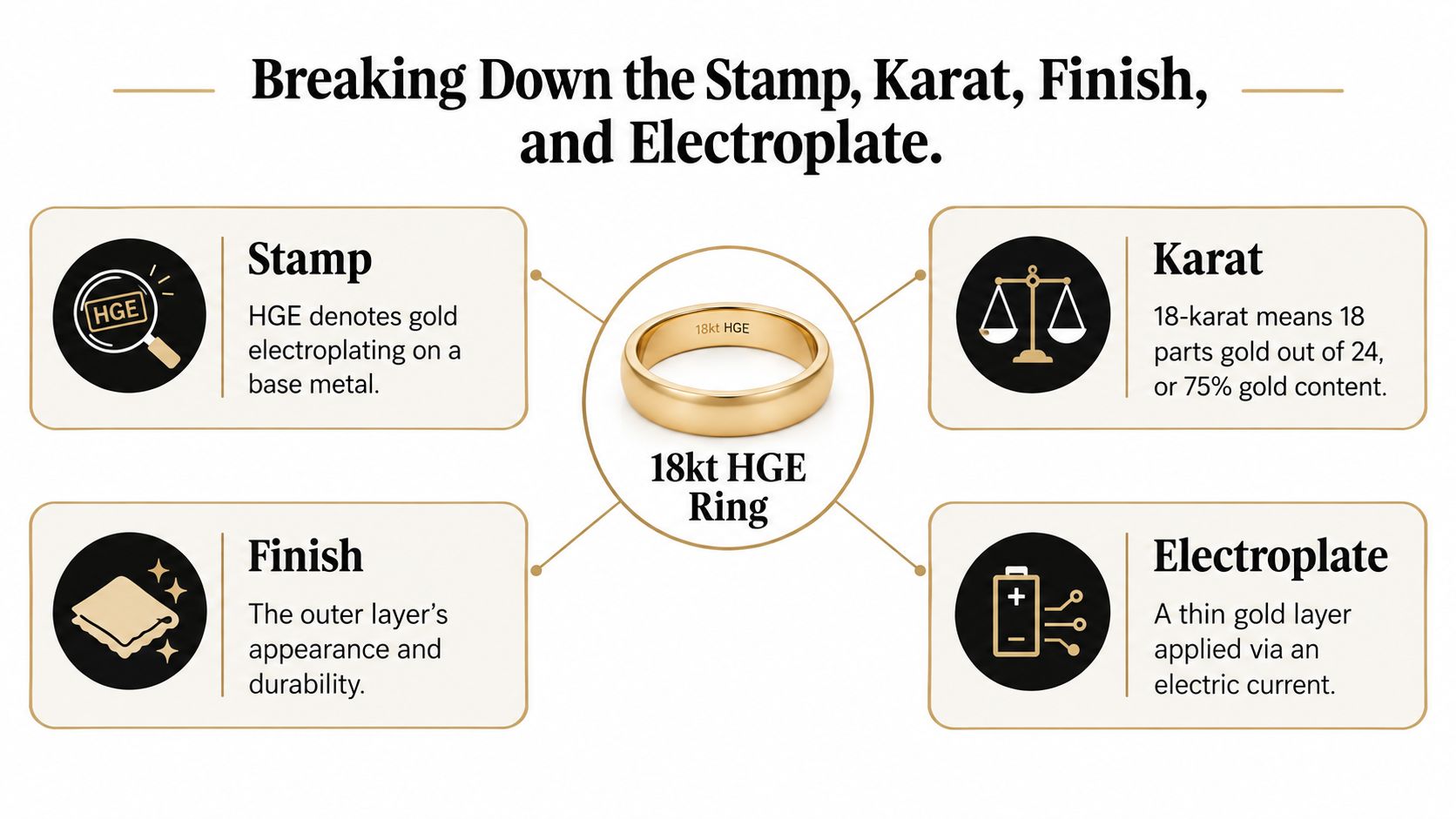
An 18kt HGE ring has two separate descriptions stamped into one short marking. “18kt” identifies the fineness of the gold used in the exterior coating. “HGE” identifies the manufacturing method, Heavy Gold Electroplate. Together, the stamp describes a gold-plated surface, not a ring made entirely from 18-karat alloy.
That distinction matters most when you're deciding whether to buy, sell, pawn, insure, or pass the ring to someone else. A solid 18-karat ring contains its gold alloy throughout the object. An HGE ring has a different metal beneath the gold surface, so its total gold content is limited to the plated layer.
> Practical rule: Read the complete stamp, not just the most impressive part of it. “18kt” and “18kt HGE” don't communicate the same construction.
Start with a close inspection under bright light. Use a loupe or phone magnifier to record every mark, including letters that may be worn or separated from the karat number. A ring marked only with a karat designation requires a different evaluation from one marked HGE, HGP, GF, or another plating-related abbreviation.
Next, inspect the ring itself. Look at the underside of the shank, the inner band, the prongs, and sharp edges. These areas receive repeated contact and may reveal a gray, coppery, or otherwise different metal beneath the gold-colored surface. Wear doesn't prove the ring's exact base metal, but it does tell you that appearance and recoverable gold value may not be the same thing.
This guide won't identify an undisclosed alloy with certainty from a photograph or stamp alone. It will help you understand the marking, perform sensible preliminary checks, recognize when professional testing is justified, and prepare for a realistic conversation with a jeweler or buyer.
Breaking Down the Stamp Karat Finish and Electroplate
Karat is a purity scale based on twenty-four parts. Eighteen-karat gold contains 18 parts gold out of 24, or 75% pure gold, with the remaining 25% made from other metals commonly including copper or silver, as explained by the World Gold Council's guide to gold jewelry.
That percentage applies to the gold alloy being described. On an 18kt HGE ring, the alloy is used for the exterior coating. It doesn't mean that the ring's base, center, or entire weight has the same composition.
HGE stands for Heavy Gold Electroplate. The Federal Trade Commission describes electroplating as an electrolytic process. An electric current deposits metal onto an underlying object, allowing a manufacturer to place a layer of gold over a different material. The ring may therefore have a base-metal structure with an 18-karat gold-alloy surface.
A finish is not the structure
Think of the coating like a premium finish on a wooden door. The stain may have a particular color and quality, but it doesn't turn the wood into a door made from the stain itself. In the same way, the 18-karat layer can provide a convincing gold appearance without making the entire ring an 18-karat object.
The FTC's guidance describes HGE-level electroplating as having a minimum coating thickness equivalent to 2.5 microns of fine gold, as detailed in its statement of basis and purpose for the jewelry guides. A micron is one-millionth of a meter, so 2.5 microns equals 0.0025 millimeters. That is substantial compared with ordinary flash plating, but it remains a surface layer compared with the ring's full thickness.
The coating thickness also isn't the same as the total quantity or dollar value of gold. Surface area, geometry, coating uniformity, alloy fineness, and wear all affect how much gold is present. That's why multiplying the ring's gross weight by 75% produces a false estimate. The calculation treats the base metal as though it were part of an 18-karat solid alloy.
The stamp is accurate when it describes the coating correctly. It isn't proof of solid-gold construction.
How HGE Compares to Solid Gold Filled and Vermeil
HGE becomes easier to understand when you place it beside other gold jewelry categories. The important differences are the material underneath, the way gold is attached, and whether gold exists throughout the item or only at its surface.
| Category | Base Metal | Min Thickness | Gold Purity |
|---|---|---:|---|
| Solid 18-karat gold | Gold alloy throughout | Not a coating | 75% gold throughout the alloy |
| Gold-filled | Base metal with a mechanically bonded gold layer | Varies by product standard | Gold layer is mechanically bonded |
| Vermeil | Sterling silver | At least 2.5 microns under FTC guidance | Gold coating over sterling silver |
| HGE | Base metal | At least 2.5 microns of fine gold for HGE-level electroplate | Gold coating may use an 18-karat alloy |
The table gives you the central distinction. Solid gold is an alloy throughout the ring, so a scratch or worn area still exposes gold alloy. HGE concentrates the gold at the exterior. The underlying metal remains central to the ring's construction and later evaluation.
Gold-filled jewelry uses heat and pressure to mechanically bond gold to another metal. That process differs from electroplating, which uses an electrolytic bath and electric current. Vermeil also uses a different base, sterling silver, under a gold coating. The FTC's jewelry guidance distinguishes these mechanical and electrolytic applications, so the terms shouldn't be treated as interchangeable.
Why thickness doesn't make HGE solid gold
A thicker coating can improve resistance to wear compared with a very thin plating layer. It still doesn't change the category into solid gold or create gold alloy throughout the ring. The layer remains concentrated on the surface, where friction can eventually remove it.
This distinction also affects repair. Resizing, polishing, filing, or replacing a prong can disturb the coating and expose the base metal. A jeweler needs to know the piece is plated before performing work that would be routine on solid gold.
> A thicker surface may last longer, but it doesn't turn a plated ring into a solid-gold ring.
For a buyer, the practical order is simple. First determine whether the ring is solid, filled, vermeil, or plated. Then assess condition, design, brand, stones, and documentation. The karat number helps describe the gold layer, but it doesn't settle the ring's overall value.
At-Home Checks and When to Bring in an Expert
You can learn a great deal at home without cutting, scratching, or damaging the ring. Begin with the stamp, then move to simple observations that help you decide whether professional testing is worthwhile.
Start with the least invasive checks
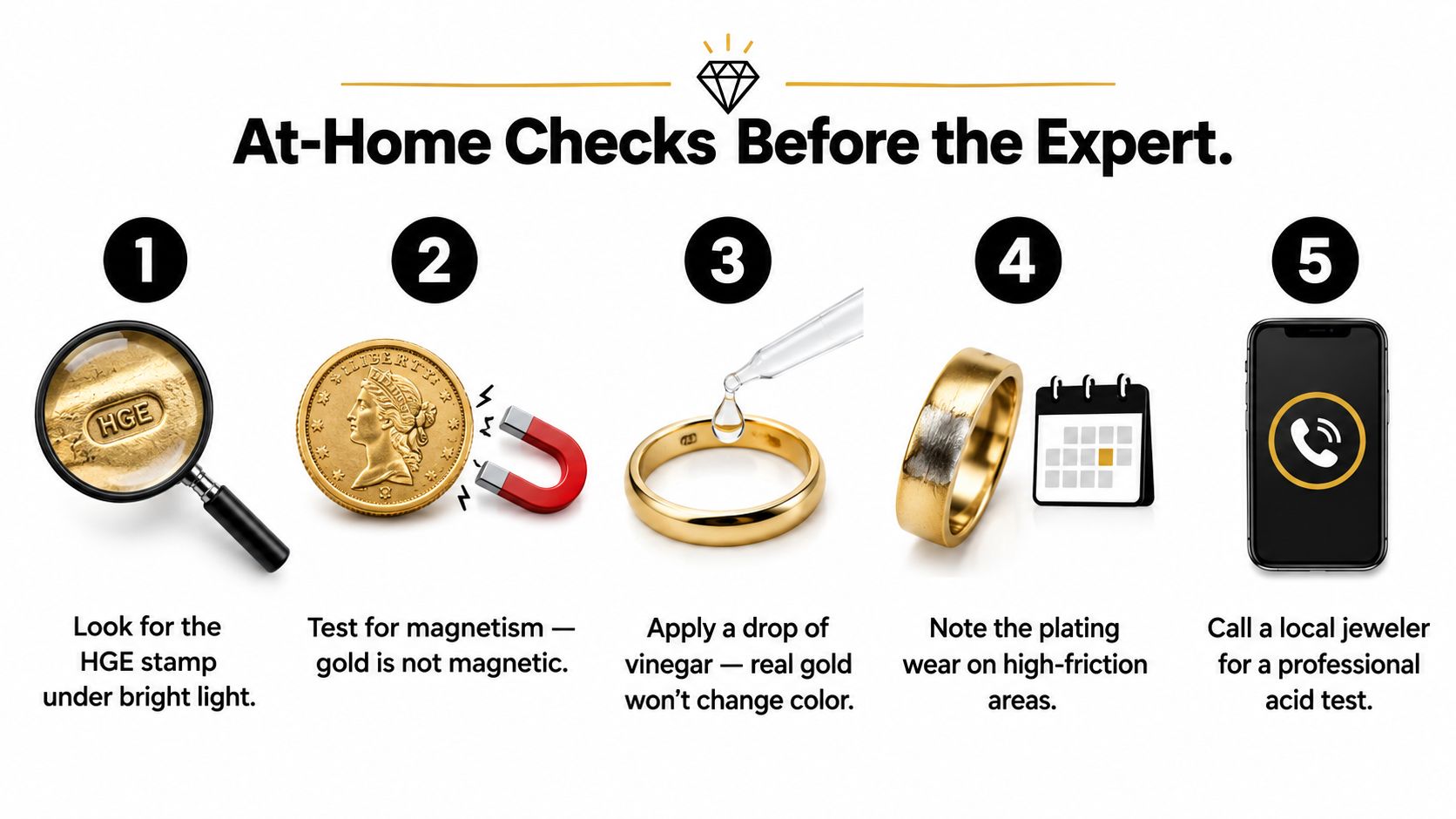
- Read every mark. Use bright light and magnification. Record whether the ring says 18kt alone or includes HGE, HGP, GF, or another designation. A karat number paired with HGE should be treated as a plating description, not as proof of a solid-gold ring.
- Try a magnet carefully. Gold isn't magnetic, so strong attraction can suggest a ferrous component. No attraction doesn't prove the ring is gold because many base metals are also nonmagnetic. Use this as a clue, not a verdict.
- Compare the weight by feel. Place the ring beside a known solid-gold piece of a similar size. A noticeable difference can raise questions, but gemstones, hollow construction, ring dimensions, and base metals make a hand comparison inconclusive.
- Inspect high-friction areas. Check the lower shank, inner band, prong tips, and sharp edges. A change from gold color to gray, copper, or another shade indicates plating loss or a construction difference that needs further evaluation.
- Notice skin changes. Greenish or grayish discoloration after wearing the ring may indicate contact with exposed base metal. It isn't definitive because sweat, lotions, and individual skin chemistry can also affect discoloration.
Know when home tests stop being useful
Don't rely on vinegar, filing, or an improvised acid test to establish a value for an HGE ring. These approaches can damage the coating, produce ambiguous results, or reveal only the surface rather than the full construction. A magnet can help identify one clue, but it can't measure coating thickness or confirm the base metal.
Professional testing becomes sensible when the ring's result could materially change an offer, appraisal, insurance record, or family decision. Ask for disclosure of the base metal and coating thickness documentation when available. An independent X-ray fluorescence, or XRF, test can analyze the material without the same kind of surface damage associated with rough testing, although the tester must interpret the reading in context.
The jewelry hallmark identification guidance also recommends requesting base-metal information, coating documentation, and independent XRF testing when financial value matters. Take the ring to a qualified jeweler, appraiser, or testing buyer rather than trying to make the ring appear more valuable yourself.
How Long HGE Plating Actually Lasts on a Ring
Rings lose plating faster than jewelry that sits away from constant contact. Every time you grip a handle, wash your hands, move objects, or rub your fingers together, the shank and edges encounter friction. The coating's performance depends on thickness, the underlying metal, surface preparation, sweat, lotions, water, and chemicals, not merely on the 18kt label.
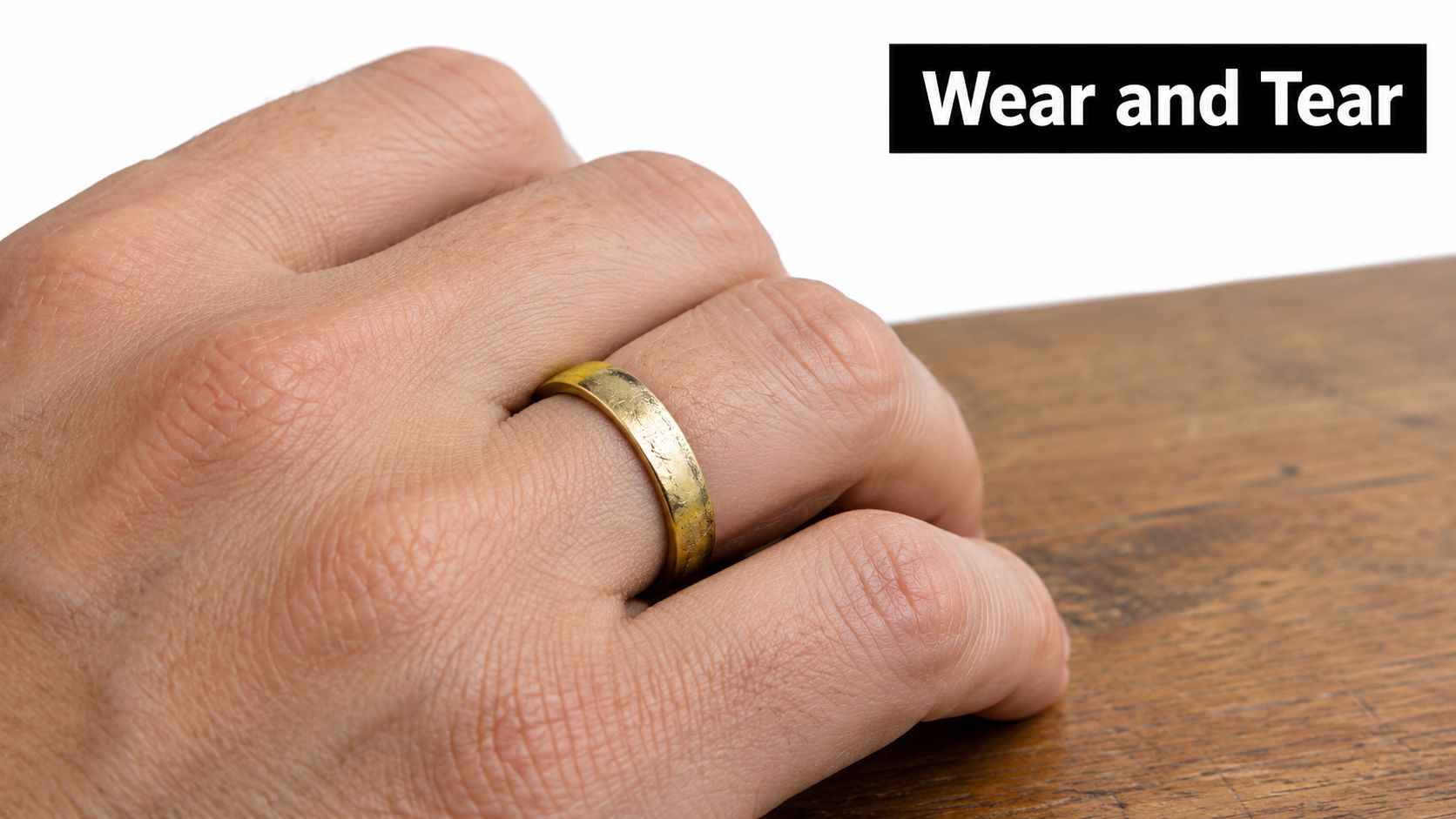
Some coverage reports visible wear from regular ring use within roughly 6 to 12 months, while thicker or better-engineered coatings may last longer. The discussion of gold-plated jewelry durability emphasizes that these are not guarantees. Finger contact, handwashing, cleaning products, and friction vary substantially from person to person.
Where wear appears first
The underside of the shank often shows wear before the top of the ring because it contacts the finger, surfaces, and neighboring objects. The inside of the band can also lose color, especially if moisture and residue remain trapped between the ring and skin. Prong tips and sharp edges have less coating protection because they receive repeated contact.
A dull patch doesn't automatically make the ring worthless. It does, however, change how a buyer sees the item. A worn HGE ring has less appeal as a ready-to-wear fashion piece, and the exposed base metal can reduce the likelihood that anyone will pay for the piece as though its bright finish were intact.
Once the coating thins, copper, nickel, or another base-metal component may touch the skin. Some people notice discoloration, while others experience irritation or discomfort. Stop wearing the ring if it causes a reaction and have the construction assessed before wearing it again.
Watch this visual guide for a practical look at plated jewelry and wear patterns:
Slowing the wear
Remove the ring before showering, swimming, cleaning, exercising, or applying lotions and perfumes. Wipe it gently with a soft cloth, avoid abrasive cleaners, and store it dry in a soft pouch away from pieces that could scratch the surface.
These habits won't make plating permanent. They can reduce unnecessary friction and chemical exposure, which helps preserve the appearance you paid for and makes later condition assessment more straightforward.
Selling or Pawning an 18kt HGE Ring in Idaho
The most common pricing mistake is multiplying the ring's total weight by 75% and treating the result as gold content. That calculation belongs to a solid 18-karat alloy, not to an HGE ring with a base-metal interior. The recoverable gold is primarily the plated surface, so the ring shouldn't be priced like solid 18-karat jewelry.
A buyer will usually separate the evaluation into three questions:
- Is the marking accurate? The full stamp, construction, and testing should agree.
- What sits under the coating? The base metal affects material value and may explain wear or skin discoloration.
- Does the item have value beyond its metal? Brand, design, gemstones, condition, provenance, and fashion appeal can matter independently of melt value.
Prepare before visiting a buyer
Bring any original box, receipt, appraisal, manufacturer documentation, or paperwork that identifies the maker and materials. These records may help establish design or provenance, but they don't replace physical testing when the marking and condition raise questions.
Photograph the ring in good light. Include the stamp, top design, underside of the shank, prongs, and any areas where the gold color has worn away. Showing plating loss openly gives the buyer a clearer picture and prevents an offer from changing because a hidden worn area appears during inspection.
> Before an appraisal: Bring the complete history you have, photograph wear honestly, and don't base your expectation on the 18kt number alone.
For an Idaho seller, Idaho Pawn & Gold Exchange is one option for bringing in gold jewelry for evaluation, including an HGE ring. Its appraisal process can consider testing, physical condition, design, and current precious-metal markets rather than assuming the stamp represents the composition of the entire ring. Ask what the test measures and whether the offer reflects the ring's plated construction.
You may receive a different result from a jeweler, a private buyer, or a pawn transaction because each evaluates risk, resale plans, condition, and customer demand differently. Arriving with an accurate understanding of HGE makes the conversation faster and helps you compare offers without confusing a plating mark with a solid-gold hallmark.
Rethinking What an 18kt HGE Ring Is Worth
“Heavy” in Heavy Gold Electroplate doesn't mean nearly solid. It means a comparatively substantial plated coating, and even that coating remains a surface treatment that can wear through with use.
An 18kt HGE ring can still be attractive and worthwhile as a lower-cost fashion piece. A signed maker, recognizable design, accent stones, sentimental history, or strong condition may create value separate from the amount of gold that could be recovered. The sensible model is condition plus design, not gross weight multiplied by karat.
Keep these points with you when buying or selling:
- Read the complete stamp, including HGE.
- Ask what base metal lies underneath.
- Request coating information and independent XRF testing when the financial decision matters.
- Inspect wear on the shank, edges, and prongs.
- Treat the ring as plated jewelry whose strongest value may come from design and condition.
---
If you have an 18kt HGE ring in Boise, Meridian, or Nampa, bring it to Idaho Pawn & Gold Exchange for an in-person evaluation of its marking, condition, construction, and jewelry value. The team can discuss whether selling or seeking a pawn loan makes sense after the ring has been examined rather than priced from the 18kt stamp alone.