
An 1853 half dime can be worth about $25 in a common circulated variety or more than $16,000 in a rare mint variety in top condition. The first question isn't the grade, however, it's whether you have an Arrows, No Arrows, or 1853-O No Arrows coin.
That distinction overturns the most popular advice about 1853 half dime value. Many price guides begin with Good, Very Fine, or Mint State grades, but a grade only helps after you've identified the issue. Two coins carrying the same date can have completely different scarcity, demand, and market value.
Why 1853 Half Dime Value Is Not What You Think
An 1853 half dime date is only an entry point. Variety is the diagnosis that determines which market you are entering. Collectors separate these coins by arrows, mintmark, and production history, and those details can matter more than visible wear during the first stage of evaluation.
That distinction overturns the most popular advice about 1853 half dime value. Many price guides begin with Good, Very Fine, or Mint State grades, but grade becomes useful only after the issue has been identified. Two coins can share the same date while having very different scarcity, collector demand, and market value.
The three major categories are the Philadelphia 1853 With Arrows, the Philadelphia 1853 No Arrows, and the scarce 1853-O No Arrows struck at the New Orleans Mint. A coin showing “1853” may therefore match several very different price expectations. The variety determines which range deserves attention.
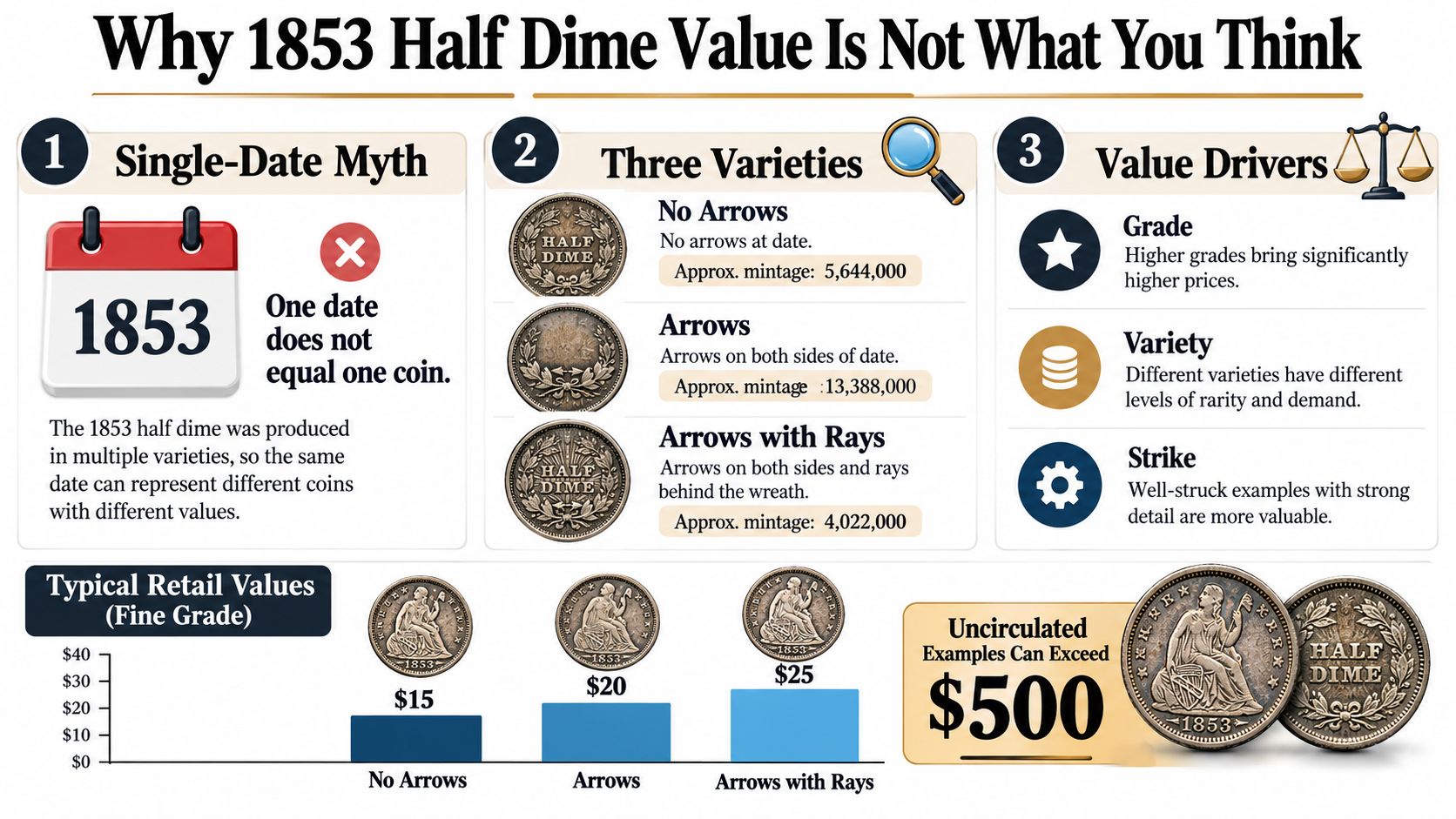
The date hides three different markets
The With Arrows issue reflects a major change in American coinage and was produced in large numbers at Philadelphia. The Philadelphia No Arrows issue had a much lower official mintage, while the 1853-O No Arrows belongs to a scarce New Orleans issue. Those production differences explain why a worn example of one variety may attract more interest than a sharper example of another.
A half dime variety reference from JMBullion illustrates the practical gap. Its market ranges place a common 1853 With Arrows piece around $20 to $140, depending on grade, while the 1853-O No Arrows ranges from roughly $439 in Good to more than $16,581 in MS63. These figures are guide ranges rather than guaranteed offers, yet they show why a search for “1853 half dime” alone gives an incomplete answer.
> Practical rule: Identify the arrows and mintmark before comparing grades, prices, or selling options.
Why grade comes second
Grade still matters greatly. A lightly worn, original coin generally attracts more interest than a heavily worn or cleaned example of the same variety. Even an excellent grade, however, cannot change a common Philadelphia With Arrows coin into a scarce 1853-O No Arrows issue.
Establish the coin's identity first, then assess wear, luster, marks, and eye appeal. This order keeps a collector from applying a rare-issue price to an ordinary coin that happens to share the same date.
How to Identify Each 1853 Half Dime Variety
Begin on the date side of the coin. Use a bright lamp, hold the half dime by its edge, and rotate it slowly rather than relying on one glare-filled view. A basic magnifier can help, but don't mistake scratches or dents for design elements.
The arrows are the fastest diagnostic feature. The Mint placed arrows beside the date on the lighter 1853 issue after the Coinage Act history described by Stack's Bowers changed the weight of silver coins from 1.34 grams to 1.24 grams, a reduction of about 7.5%. The arrows identified the new lighter coin.
!A close-up view of an 1853 Seated Liberty silver coin featuring arrows next to the date.
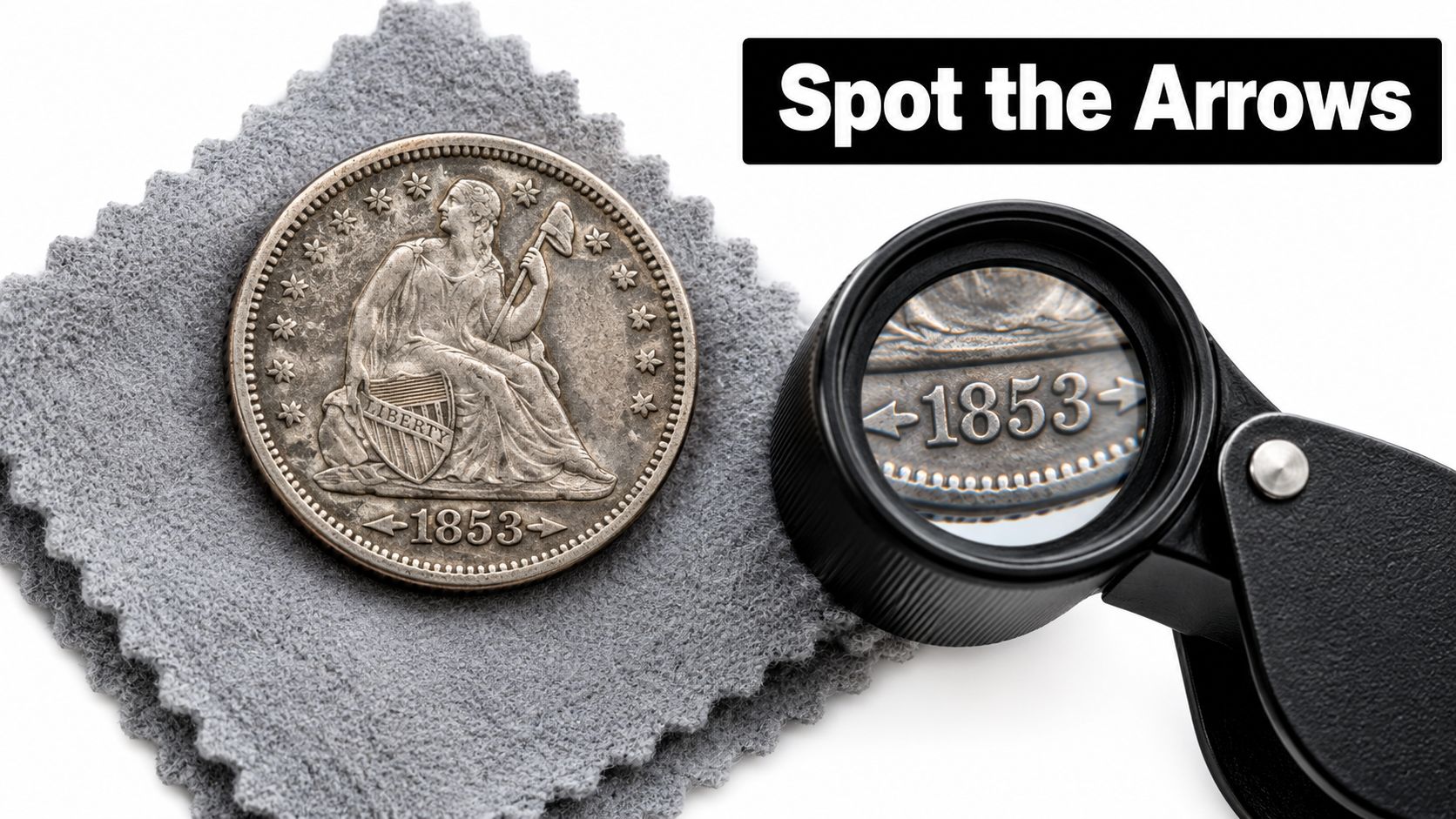
Check the date area first
Look immediately to the left and right of the date.
- With Arrows: You should see an arrow on each side of the date. The arrows are part of the original design, not marks added after striking.
- No Arrows: The date appears without the paired arrows. This identifies a different Philadelphia issue when there is no mintmark.
- 1853-O No Arrows: The date also lacks arrows, but the reverse carries a small O mintmark, identifying New Orleans production.
The absence of arrows doesn't automatically make a coin the valuable New Orleans variety. You must inspect the reverse for the mintmark. On a worn coin, the O may be faint, flattened, or obscured by dirt, so clean lighting and careful rotation matter.
Avoid false positives
Damage can create shapes that look like arrows. A scratch usually has an irregular edge and may cut across surrounding design details. A genuine arrow has the consistent placement and recognizable outline expected from a struck design element.
Don't polish the coin to make the date or mintmark easier to see. Cleaning can leave hairlines, unnatural brightness, or dull patches that reduce collector appeal. Photograph both sides before seeking opinions, and include close views of the date and reverse mintmark area.
Philadelphia coins don't carry an O mintmark. If your coin has no arrows and no O, classify it provisionally as the Philadelphia No Arrows issue. If it has an O, treat it as a possible 1853-O No Arrows coin and get a closer evaluation before relying on a general price listing.
Current Market Values by Type and Grade
Once the variety is identified, grade becomes the main pricing variable. Circulated coins lose detail first on Liberty, the shield, lettering, and other raised areas. Mint-state coins retain original luster, but contact marks and strike quality can separate one grade from another.
The NGC 1853 Arrows half dime guide lists circulated With Arrows examples at approximately $25 to $180. Pristine uncirculated pieces can reach as much as $24,000. For the scarcer No Arrows issue, the guide records an official mintage of 135,000, with examples around $40 in G4, $850 in MS60, and $2,850 in MS65.
Comparison by variety
The figures below combine the supplied market references for the three principal issues. “Not quoted” means the guide does not state a figure for that specific variety and grade combination. It does not mean the coin lacks value.
| Variety | Good-4 | VF-20 | MS-60 | MS-63+ |
|---|---:|---:|---:|---:|
| 1853 Philadelphia With Arrows | About $25 to $180 circulated | About $25 to $180 circulated range | About $251 | About $408, with pristine uncirculated examples reaching as much as $24,000 |
| 1853 Philadelphia No Arrows | About $40 | Not quoted in the cited guide | About $850 | About $2,850 in MS65 |
| 1853-O No Arrows | About $439 | About $1,816 | Not quoted in the cited guide | About $16,581 in MS63 |
These ranges explain why a single search for “1853 half dime value” can produce such conflicting results. A circulated With Arrows coin may be relatively accessible, while a sharply preserved example becomes far more expensive. The Philadelphia No Arrows issue has a much smaller production figure, so grade premiums appear earlier. The 1853-O No Arrows shows the broadest spread in the table, where scarcity and the limited supply of well-preserved survivors work together.
What the numbers mean in practice
Guide prices are reference figures, not guaranteed offers. A dealer factors in demand, selling costs, authentication risk, and the coin's exact appearance when making an offer. Two coins carrying the same written grade can still differ in originality, strike strength, toning, and surface quality.
Proof examples require separate treatment because they sit outside the normal circulated-to-Mint State pricing ladder. One cited guide indicates that Proof examples can exceed $74,994. A suspected proof, unusual strike, or certified high-grade coin therefore deserves specialist attention instead of a casual comparison with a worn pocket-piece example.
Grading and Authentication Essentials
Once the variety is identified, assess condition without forcing the coin into a desirable grade. Good means substantial wear has flattened much of the design. Very Fine retains more detail, although friction remains on the highest points. About Uncirculated shows limited wear, often on the raised portions of Liberty and the shield. Mint State means the half dime has not circulated, but contact marks, weak strike areas, and unattractive surfaces can still affect its value.
Grade works like a measurement of remaining detail, while originality and surface quality determine how appealing that grade is to collectors. Tilt the coin under one light source and watch how brightness changes across the fields. Natural luster shifts as the coin moves. Uniform brightness from edge to edge may indicate cleaning, while gray or softly toned surfaces can remain original.
Wear and damage tell different stories
Wear gradually removes detail from exposed design elements, while damage tends to be localized. Scratches, rim knocks, digs, and deep lines can reduce desirability even when much of the design remains sharp. A sharply detailed coin with one severe mark may sell for less than a more evenly worn example with clean surfaces.
Cleaning creates another problem. Parallel hairlines, harsh brightness, cloudy patches, or an unnatural orange-gray color may indicate rubbing or chemical treatment. A cleaned coin still holds value, but compare it with other cleaned examples rather than with problem-free coins carrying the same grade.
The USA Coin Book guide for the 1853 Philadelphia No Arrows half dime estimates about $75 in Good-4, $283 in VF20, $614 in AU50, and $1,447 in MS63. The progression shows why preserved luster and limited marks matter. At higher grades, minor flaws stand out because collectors are choosing from a much smaller group of attractive survivors.
Authentication precautions
An 1853-O No Arrows half dime that appears valuable deserves close examination. Check the date style, the spacing and relationship of the design elements, the mintmark, the edge, and the surfaces. Counterfeits may show soft lettering, unnatural depressions, casting bubbles, or a texture unlike that of a struck coin.
Use a reputable dealer or professional grading service when the possible value justifies the expense. Certification can support conclusions about authenticity and condition, particularly for a scarce mintmarked issue, but a holder does not replace personal inspection. Keep the coin in its current state, avoid abrasive materials, and photograph both sides before giving it to anyone for review.
> Careful identification prevents a costlier mistake than an imperfect grade estimate.
Selling Your 1853 Half Dime Best Options for Idaho Collectors
Selling starts with deciding what matters most to you. A pawn shop may provide a convenient local evaluation and a fast transaction. A specialist coin dealer may offer deeper numismatic knowledge. An auction can expose a scarce, certified coin to dedicated bidders, while a private sale gives you more control but also more responsibility.
Bring the coin as you found it. Include any holder, old receipt, inheritance note, or prior appraisal, but don't clean or repackage it to make it look newer. Clear photographs of the obverse, reverse, date, mintmark, and edge can help a buyer understand what they're examining.
!A professional coin dealer examining a gold coin with a magnifying glass for a customer.
Choosing a sales channel
A local pawn shop suits someone who values speed, convenience, and an in-person explanation. Ask how the evaluator distinguishes collectible coins from ordinary silver and whether the offer reflects the coin's variety and condition, not only its metal value.
A local coin dealer may be more appropriate for a scarce 1853-O No Arrows piece or a potentially high-grade example. A dealer can compare the coin with current inventory and may explain whether certification would strengthen the sale.
A national auction house can make sense for a certified rarity, particularly when the coin has strong eye appeal and a specialist audience. Auctions involve timing, terms, seller charges, and uncertainty, so read the agreement before consigning.
A private sale lets you set the presentation and negotiate directly. It also requires you to handle photography, buyer questions, payment security, shipping, and the risk of an inaccurate attribution.
For Idaho residents, an in-store appraisal can be useful when you want to ask questions face to face. Staff should explain what they tested, how they considered the coin's condition and collectible status, and why the proposed value differs from a published retail guide.
> Before accepting an offer: Ask whether the evaluator identified the arrows, checked for an O mintmark, and considered the coin as a collectible rather than treating it as generic silver.
You can use the following video as a visual reminder to inspect a coin carefully before discussing a sale.
<iframe width="100%" style="aspect-ratio: 16 / 9;" src="https://www.youtube.com/embed/wtz16YfjK4c" frameborder="0" allow="autoplay; encrypted-media" allowfullscreen></iframe>
The 1853-O issue needs particular care because the market spread is broad and high-grade survivors are difficult to assess. A USA Coin Book reference for the 1853-O No Arrows half dime places examples around $439 in Good-4, $1,816 in VF20, $4,943 in AU50, and roughly $16,581 in MS63. The same reference notes that condition-census examples can bring $15,000 or more, while circulated high-grade pieces may sell in the $3,000 to $5,000 range. Those figures make authentication and honest grade assessment essential before choosing a quick-sale route.
Your Next Steps for Evaluating an 1853 Half Dime
Use a short sequence instead of starting with a price search. The order matters because each step narrows the possibilities before you make a financial decision.
1. Identify the variety. Look for arrows beside the date. If they aren't present, inspect the reverse for an O mintmark. Record whether the coin appears to be Philadelphia No Arrows or a possible 1853-O No Arrows issue.
2. Record the condition accurately. Note obvious wear, remaining detail, luster, scratches, rim damage, discoloration, and signs of cleaning. Don't assign Mint State just because the coin looks bright.
3. Compare the correct guide. Search for the full description, such as “1853 Philadelphia With Arrows” or “1853-O No Arrows,” rather than using the date by itself. Match the variety and approximate grade before interpreting any price.
4. Separate guide value from an offer. Published figures help establish a market reference, but an actual buyer also considers demand, authentication, selling costs, and the coin's originality.
5. Get another opinion. A second evaluation is sensible for a suspected 1853-O, a sharply preserved No Arrows example, or any coin with an unusually high guide estimate. Professional certification may be appropriate when authenticity and grade will materially affect the transaction.
The central lesson is simple: variety identification comes before grade, and grade comes before price. A photograph can start the process, but a clear view of the date, arrows, mintmark, and surfaces gives an evaluator the information needed to discuss the coin responsibly.
If you're in Idaho, bring the coin to Idaho Pawn & Gold Exchange for an in-person evaluation of collectible and silver coins, including an explanation of testing, condition, and market considerations. Visit Idaho Pawn & Gold Exchange to learn about its appraisal, buying, and pawn services before you decide how to proceed.
---
Idaho Pawn & Gold Exchange can evaluate gold and silver coins, including collectible or graded pieces that need more than a bullion assessment. Visit Idaho Pawn & Gold Exchange to discuss your 1853 half dime in person and receive guidance on the next step.