
An 1847 penny can be worth anywhere from about $30 to $900, depending on which coin you have and its condition. Identifying whether it's a U.S. large cent or a British Victorian penny is the first step.
What would a local buyer pay if an online guide says your 1847 penny is worth hundreds? That question exposes the biggest mistake in coin pricing: treating a catalog estimate as though it were a guaranteed cash offer.
The date alone doesn't answer the question. Two major copper coins carry the 1847 date, and they come from different countries, have different designs, and trade in different collector markets. Once you identify the coin, you can assess its grade, surface quality, authenticity, and the selling channel that fits it.
Which 1847 Penny Do You Actually Have
The first surprise is that an “1847 penny” may refer to either a U.S. Braided Hair large cent or a British Queen Victoria Young Head penny. They aren't interchangeable, and applying the price guide for one to the other can lead to a badly misleading valuation.
Start with the portrait. The U.S. coin shows Liberty facing left, wearing a coronet inscribed with “LIBERTY,” with braided hair surrounding the head. The British coin shows a young Queen Victoria in profile, facing left. The reverse design also differs, so turn the coin over rather than relying on the date side alone.
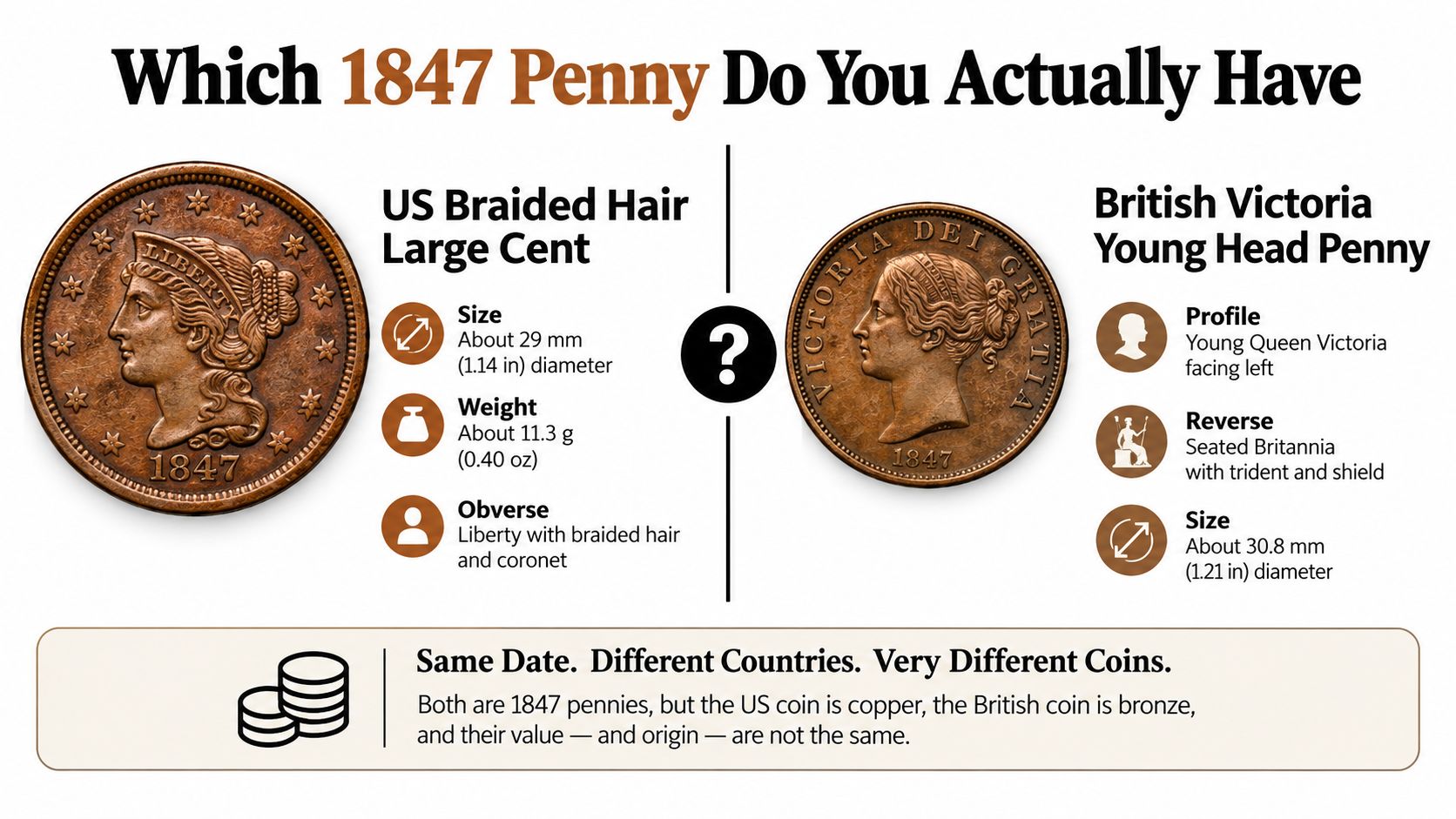
A quick identification path
Use this order:
1. Look at the portrait. Liberty with braided hair points to the United States. A young royal profile points to Britain.
2. Read the reverse. The lettering, wreath, and denomination help confirm the country of issue.
3. Check the size and weight. The U.S. large cent measures about 28.5 millimeters and weighs 10.89 grams, while the British penny measures about 34 millimeters and weighs approximately 18.8 grams, according to the American Numismatic Association's 1847 penny overview and British penny catalog information.
4. Record the country before looking at prices. Tell a buyer, “1847 U.S. Braided Hair large cent” or “1847 British Victoria Young Head penny,” not just “old 1847 penny.”
The U.S. issue had approximately 6,183,669 pieces struck, while the British issue had a reported mintage of about 430,000. Those production figures provide historical context, but neither one creates an automatic price. A lower mintage can make the British coin more notable, while the U.S. coin's value still depends heavily on condition, color, and variety.
> Practical rule: Never begin with “How much is an 1847 penny worth?” Begin with “Which 1847 coin is this?”
Identifying Features of Each Coin
The U.S. and British pieces feel different in the hand because they're different formats. The U.S. Braided Hair cent is a large copper coin, but the British Victorian penny is larger still. Size can be a useful first check, although a scale and calipers are more reliable than visual comparison.
The U.S. Braided Hair large cent
The U.S. coin is a 100% copper piece with Liberty on the obverse. Its reverse carries the denomination within a wreath. The date is important, but specialists also study die varieties, including the Newcomb varieties identified for the 1847 issue.
Surface appearance matters greatly. Original copper color may be described as brown, red-brown, or red, and those designations can separate an ordinary circulated coin from a much more desirable example. A coin that has been polished may look bright to a beginner but lose the original surface that collectors want.
The U.S. cent's original face value was one cent. Its collectible value comes primarily from preservation, surface quality, color, and variety, not from the copper content alone. The normal date is historically interesting, but its mintage means that an 1847 U.S. cent isn't automatically rare just because it's old.
The British Victoria Young Head penny
The British coin carries the young profile portrait of Queen Victoria. It was a pre-decimal penny valued at 1/240 of a pound, or 1/12 of a shilling, as documented by the British 1847 penny reference. The reverse design and lettering distinguish it from the U.S. large cent, so the denomination side deserves careful attention.
The large Victorian copper format weighs approximately 18.8 grams and measures about 34 millimeters. The Royal Mint's large copper penny design was replaced by smaller bronze pennies in 1860, giving the 1847 piece a clear place in the transition of British coinage.
Look closely at the details collectors use to judge preservation. On the portrait side, inspect Victoria's hair and the surrounding lettering. On the reverse, examine the wreath, denomination, and smaller design elements. A coin with smooth surfaces, scratches, green corrosion, or unnatural color may be genuine but still worth much less than a problem-free example.
For a first description, note four things: country, denomination, portrait, and size. That vocabulary gives a dealer or grading service enough information to start the conversation accurately.
How to Grade Your 1847 Penny Before Pricing It
Condition is the engine behind 1847 penny value. Two coins with the same date can occupy very different price brackets because one retains sharp design detail while the other has been worn smooth, cleaned, scratched, or exposed to corrosion.
Think of grading as a staircase. Each step down represents lost detail. Collectors pay for the detail that remains, but they also discount damage that makes the surface less original or less attractive.
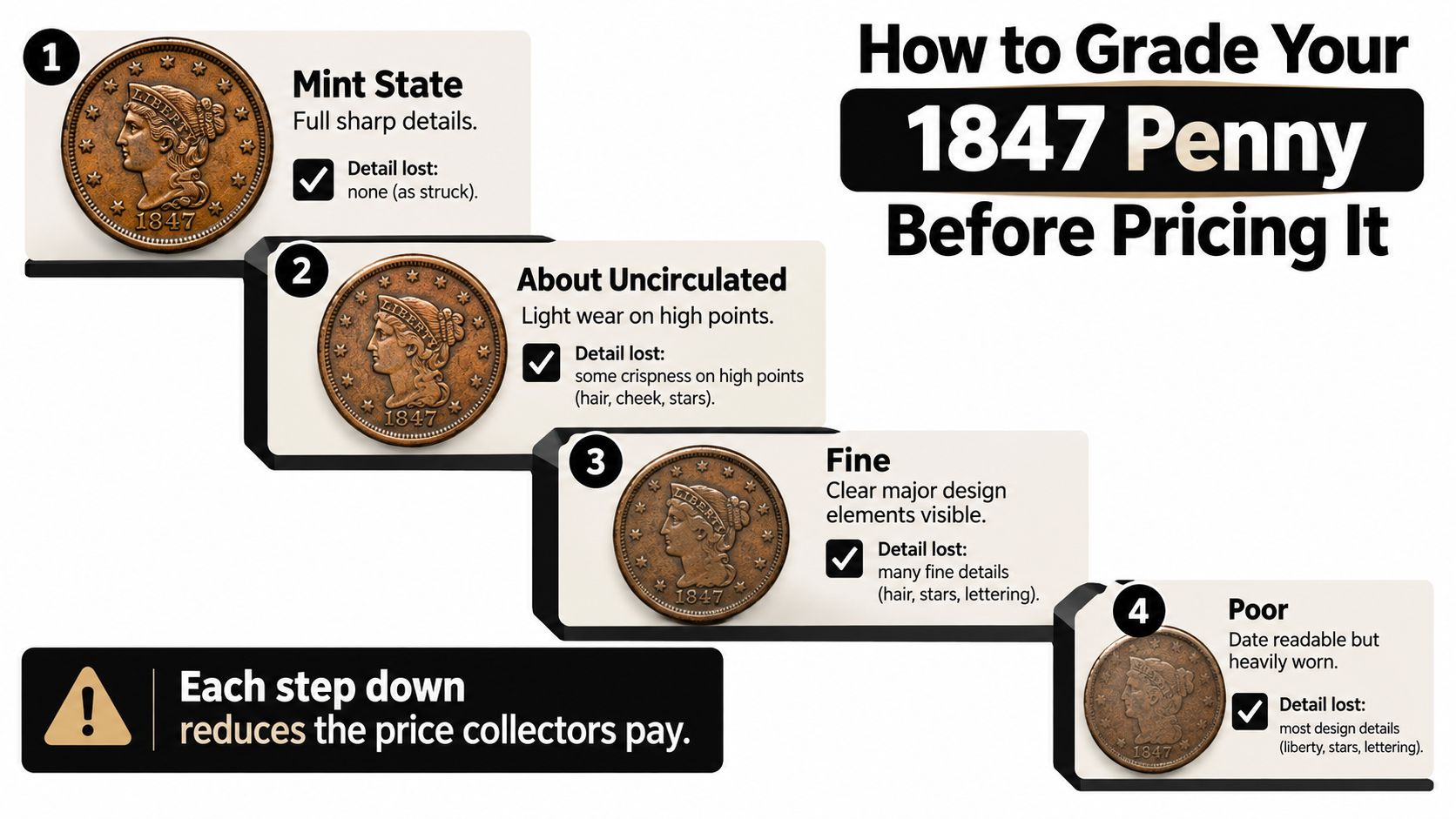
A practical condition checklist
- Start with the date. If the date is readable but much of the surrounding design has disappeared, the coin is heavily worn. Don't let a clear date persuade you that the coin is high grade.
- Inspect the highest points. On the U.S. cent, check Liberty's hair and the wreath. On the British penny, examine Victoria's hair, the wreath, lettering, and raised reverse features.
- Compare the major design elements. A Fine coin should retain clear major details. A Very Fine or Extremely Fine piece preserves more separation in the hair, wreath, and lettering.
- Look for remaining mint detail. About Uncirculated material shows only light wear on the high points. Mint State material should retain sharp detail without circulation wear.
- Separate wear from damage. Scratches, tooling, corrosion, verdigris, rim damage, and cleaning are not normal grade steps. They're surface problems that can reduce the buyer's confidence.
- Describe the copper color. PCGS separates brown, red-brown, and red surfaces for U.S. copper coins, as reflected in the 1847 Braided Hair cent market and variety guide. Original red color can carry a premium, but a bright appearance caused by cleaning doesn't qualify.
A conservative self-assessment is better than an optimistic one. If you're unsure whether a smooth patch is wear or cleaning, describe the uncertainty to the buyer rather than assigning an uncirculated grade.
> A cleaned coin is not an uncirculated coin. Never use a high-grade price simply because the penny looks bright.
Typical Price Ranges by Grade for Both Coins
Published values are useful for establishing a starting point, but they aren't promises. The U.S. figures below come from a market guide that lists approximate grade levels and an auction benchmark. The British figures combine indicative specialist guide values, and the sources themselves show why estimates vary by market, grading system, and coin quality.
For the U.S. cent, the guide lists approximately $42.52 in VG, $45 in Fine, $93 in VF, $102.90 in XF, $281.65 in AU, and $350 in MS60. It also lists an MS66 benchmark of $14,578.46, while an XF45 auction example realized $109. For the British penny, published estimates range from about $15 in Good to $825 in AU or Uncirculated-quality material, while another guide places a mid-grade example around £112.50. These figures are drawn from the U.S. cent price and auction data, the British specialist price table, and the British catalog estimate.
1847 Penny Value by Grade
| Grade | 1847 U.S. Large Cent | 1847 British Penny |
|---|---:|---:|
| Good | Guide levels vary by surface and variety | About $15 |
| Fine | About $45 | About $105 |
| Very Fine | About $93 | About $300 |
| Extremely Fine | About $102.90 | About $495 |
| About Uncirculated | About $281.65 | About $825 for AU or Uncirculated-quality material |
| Mint State | About $350 at MS60, with exceptional MS66 material listed at $14,578.46 | High-grade guide estimates vary by source |
The table shows a nonlinear market. The difference between a worn example and a sharply preserved example can be an order of magnitude, especially when original color and certification enter the discussion. A coin doesn't gain value evenly with every small improvement in appearance.
The U.S. MS66 figure is a useful warning, not a price target. A coin must genuinely meet that grade, retain desirable surfaces, and find the right buyer. A cleaned, recolored, corroded, or damaged coin shouldn't be compared with a premium example merely because both have the same date.
For the British penny, the wide spread reflects the same principle. Collectors pay for surviving portrait detail, lettering, wreath definition, and original surfaces. Scarcity helps attract attention, but grade determines how much of that attention becomes value.
Why Guide Prices Differ From Real Cash Offers
A printed value and a cash offer answer different questions. Confusing them is the main reason sellers feel disappointed at a pawn counter or coin shop.
Four numbers that sellers often mix together
Catalog estimate is a reference figure published for a particular grade and assumed condition. It may represent a retail expectation, a midpoint, or an indicative value. It doesn't necessarily account for your coin's cleaning, damage, uncertain authenticity, or the local market.
Auction realization is what a specific coin brought in a particular sale. The result depends on the coin's certification, photographs, description, buyer competition, venue, and fees. The listed $109 sale for an XF45 U.S. example is a useful benchmark, but it isn't a universal price for every XF-looking 1847 cent.
Dealer buy price is what a shop can pay while leaving room for authentication, handling, overhead, and resale. The dealer must also judge how quickly the coin can find a buyer. A niche British copper penny may attract less immediate demand in a U.S. market than a widely recognized bullion item.
Pawn-loan advance is secured lending, not a final sale price. The shop advances money against collateral and must protect itself if the loan isn't repaid. That risk, along with verification and resale uncertainty, can make the loan amount lower than a direct purchase offer.
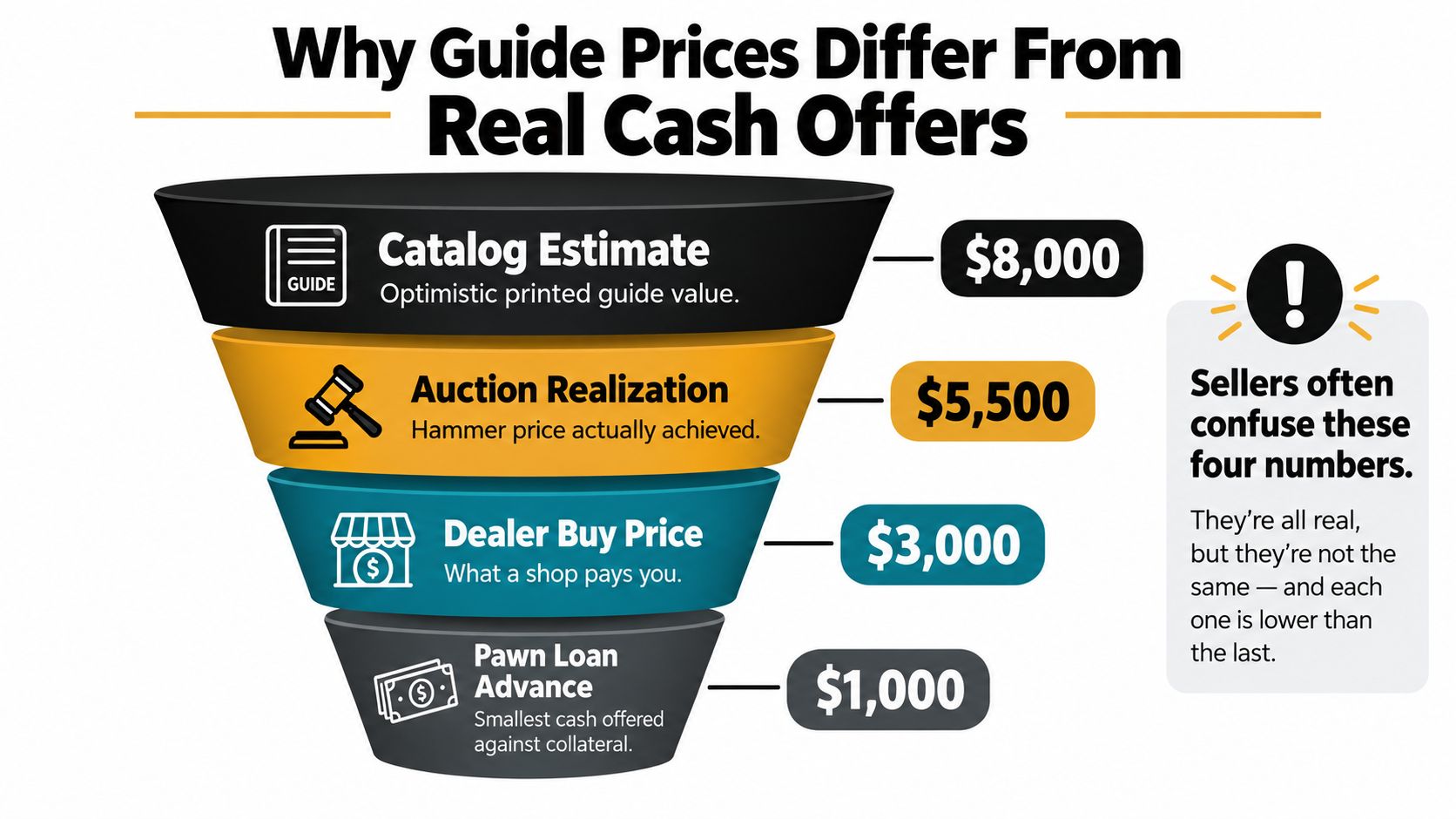
Why the gap can be wide
A guide may assume a problem-free coin at a stated grade. A local buyer sees the actual object and must account for uncertainty. Cleaning, corrosion, scratches, environmental damage, questionable color, and an unclear variety can all reduce the amount a buyer can responsibly offer.
Auction selling has its own deductions and delays. Authentication, shipping, listing preparation, auction fees, and the possibility of a weak sale affect the seller's net result. A strong headline realization doesn't automatically equal the amount that reaches the owner.
> A low offer isn't automatically proof that the buyer is undervaluing the coin. Ask which assumptions differ between the guide and the offer, then compare the net amount, speed, risk, and effort involved.
Ask a local buyer whether the number is for an outright purchase, a loan, or a consignment arrangement. Also ask whether the coin has been examined for authenticity and surface problems. Those questions turn an emotional negotiation into a useful comparison.
Authentication and Red Flags to Check First
Before discussing price, establish that the coin is genuine and intact. A date that looks right isn't enough. Counterfeits, altered surfaces, plugged holes, filed edges, and heavy cleaning can all make a coin appear more valuable than it is.
!A vintage 1847 large cent coin sitting on a digital scale next to calipers and a magnifying glass.
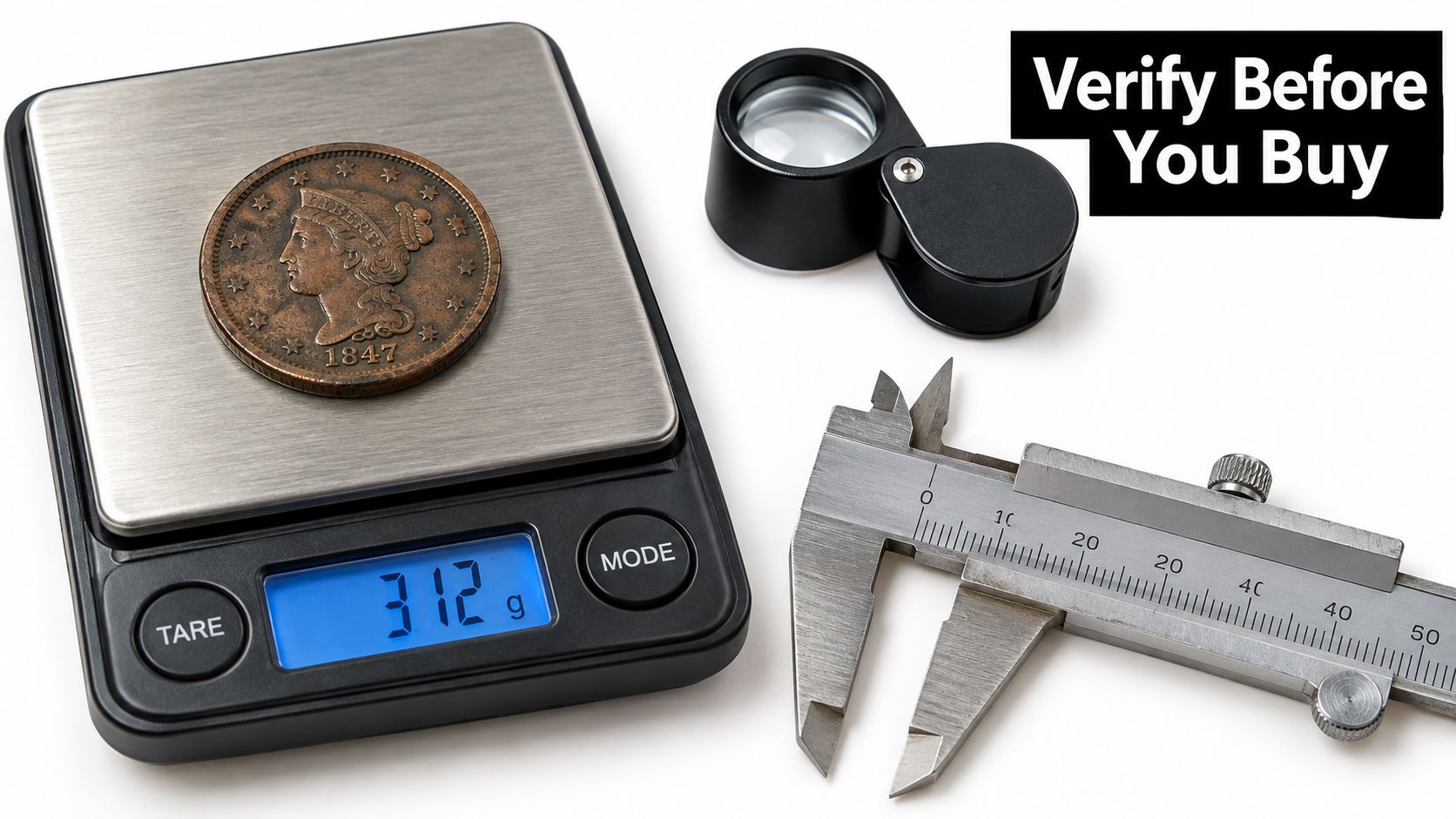
A basic verification routine
1. Weigh the coin. Compare the result with the expected specification for the identified country and denomination. A meaningful discrepancy deserves further examination.
2. Measure the diameter. Use calipers rather than estimating with a ruler. The U.S. and British pieces have different dimensions, so this check can also expose a mistaken attribution.
3. Inspect the edge. Look for filing, seams, casting texture, plugs, holes, or unusual distortion. Edge damage can also affect value even when the coin is genuine.
4. Study the lettering and date. On the British piece, check the date style and colon placement against a reliable reference specimen.
5. Use angled light. Tilt the coin under a lamp to reveal hairlines from cleaning, raised tooling, scratches, and unnatural smoothing.
6. Don't clean it. Abrasive cleaning or chemical treatment can permanently alter the surface and remove the premium associated with original color.
A professional grading service becomes more sensible when the coin appears high grade, has valuable original color, or may represent a significant die variety. Certification doesn't make a damaged coin problem-free, but it gives buyers a consistent opinion about authenticity and grade.
For a closer look at the inspection process, this video can help you understand why weight, dimensions, and surface examination belong before pricing:
<iframe width="100%" style="aspect-ratio: 16 / 9;" src="https://www.youtube.com/embed/jchVPmV4uNQ" frameborder="0" allow="autoplay; encrypted-media" allowfullscreen></iframe>
Bring the coin as found. Put it in a suitable holder if you have one, but don't polish it in preparation for an appointment. If you have an old receipt, prior appraisal, grading information, or purchase documentation, bring that too. Documentation can support the conversation, but the buyer still needs to inspect the coin itself.
Selling or Pawning Your 1847 Penny Locally
Choose the selling route based on the coin's condition and your goal.
An outright sale to a local shop usually suits someone who wants a clear transaction without waiting for an auction. A pawn loan may suit someone who needs temporary cash and wants the possibility of reclaiming the coin. Consignment or auction may be worth considering for a high-grade, certified, or unusual variety, especially when the potential audience matters more than immediate payment.
Bring the uncleaned coin, any grading or purchase paperwork, and identification required by the buyer. Ask the shop to identify the country and denomination, explain the condition assessment, and state whether the offer is for purchase or collateral.
For a local evaluation in Boise, Meridian, or Nampa, Idaho Pawn & Gold Exchange offers coin evaluations and assesses collectible or graded coins, including rare coins and other estate collectibles. Visit Idaho Pawn & Gold Exchange with the coin and any supporting information so the staff can examine the actual piece before you decide whether to sell or seek a loan.
The sensible order is simple: identify the coin, assess its grade, inspect its surfaces, verify authenticity, then choose the channel that matches its real market position.
---
Bring your 1847 penny to Idaho Pawn & Gold Exchange for an in-person evaluation of its identity, condition, and potential selling or loan options. Visit Idaho Pawn & Gold Exchange in the Boise, Meridian, or Nampa area and ask the team to review any grading or purchase information you have.