
“0.5 carat” almost always means the combined weight of both earrings, not one half-carat stone in each ear. The FTC allows a decimal listing such as “.5 carat” to cover .495–.504 carat, while a fractional “1/2 carat” description can cover .45–.54 carat under its jewelry guidance.
That difference is why the popular advice to start with the Four Cs misses the first buying risk. Before comparing sparkle or price, find out what the number on the tag describes. A pair with one 0.50-carat diamond in each earring weighs about twice as much as a pair totaling 0.50 carat, and a vague listing can leave you comparing unlike products.
Why the Term 0.5 Carat Diamond Earrings Is Slippery
A decimal and a fraction don't promise the same precision, and sellers know it. As noted earlier, FTC guidance holds a decimal claim like ".5 carat" to the second decimal place, so the actual weight should land between .495 and .504 carat. A fractional "1/2 carat" description gets far more slack: .45–.54 carat under the business guidance, with the FTC's consumer advice citing .47–.54 carat as a reasonable range for a fraction.
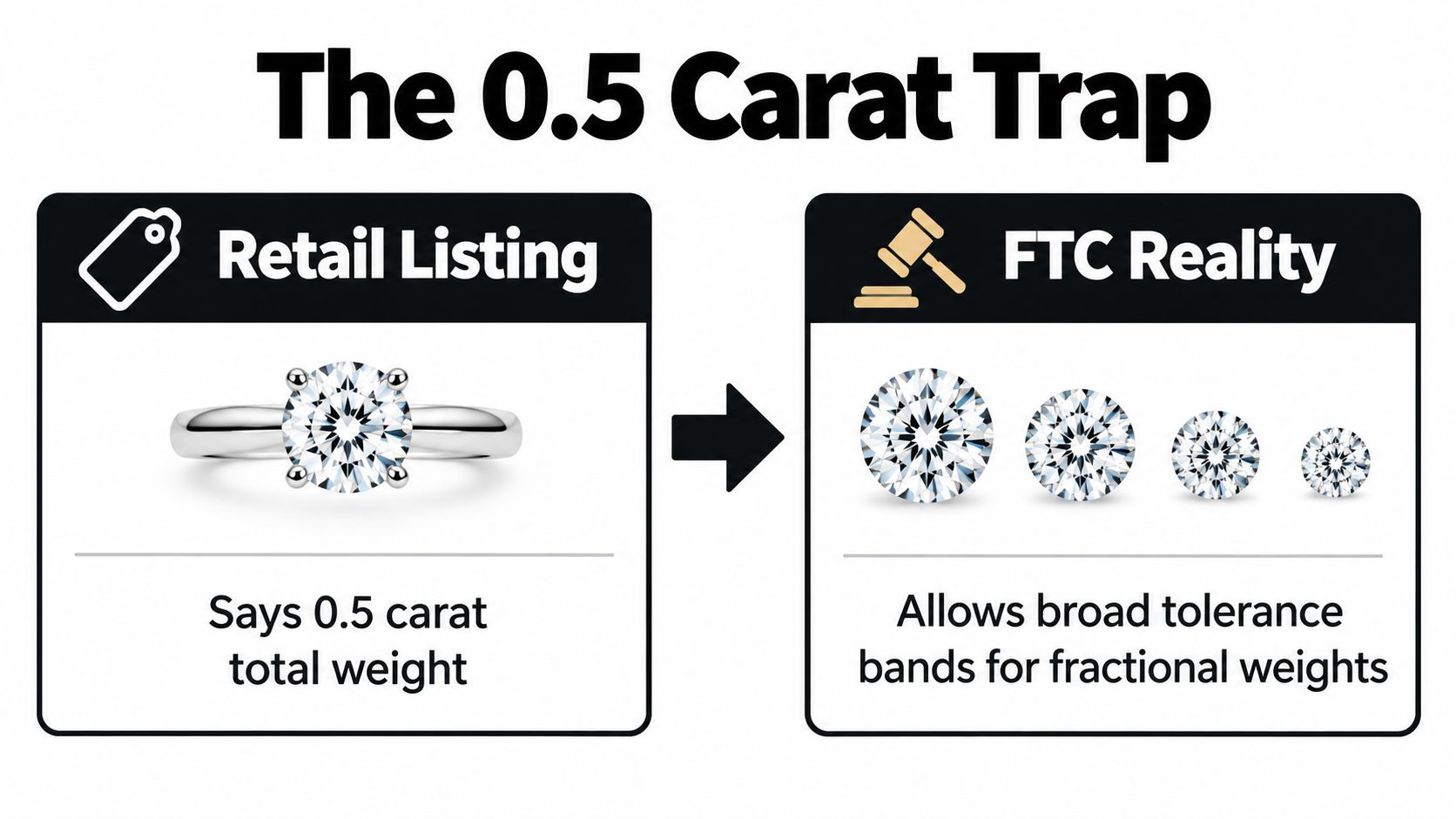
Careless listings live in that gap. A pair labeled "1/2 carat" can carry stones weighing noticeably less than half a carat each and still sit inside the allowed range, and I've watched shoppers pay half-carat prices for diamonds that weigh in at the bottom of that tolerance. Neither wording, decimal or fraction, answers the bigger question of whether the figure covers one stone or the whole pair.
One number can describe three different products.
Read the tag like a buyer, not a browser
A dependable listing states total carat weight or weight per stone. It says whether the diamonds are natural or laboratory-grown, and it discloses treatments and origin when those details are represented. When a listing reads only "0.5 carat diamond earrings," ask for the individual weights and any grading documents before you discuss whether the price is fair. A seller who answers in thirty seconds weighed the stones. A seller who pivots to sparkle and styling is telling you something too.
> Practical rule: Don't pay a premium for a precise-sounding number until the seller states what was weighed and how the pair's weight is calculated.
A sales tag is not a grading report, and a rounded weight is not documentation. On a pawn counter the tag gets ignored within the first minute; the appraisal starts with the scale, the paperwork if it exists, and a close look at each stone and its setting. That same order of operations works for you in a retail store. For secondhand pairs especially, the stones' condition and the quality of the setting do more to set a fair price than anything printed on the card.
Per Stone vs Total Carat Weight in a Pair
Ask the only question that matters before price enters the conversation: “Is that 0.50 carat total for both earrings, or 0.50 carat in each earring?” Make the seller answer with numbers. If the reply drifts to brilliance, fire, or how “substantial” the studs look, you still do not know what is being sold.
Carat measures weight, and trade descriptions break that weight into points rather than face-up size. As noted earlier, a responsible description separates one stone's weight from the pair's combined weight.
Three common pair descriptions
The same casual phrase can cover very different pairs. For example:
| What the listing means | Weight in each earring | Combined pair weight |
|---|---:|---:|
| 0.50 carat per stone | 0.50 carat | 1.00 carat total |
| 0.50 carat total | 0.25 carat | 0.50 carat total |
| 0.40 carat total | 0.20 carat | 0.40 carat total |
Those three rows are why “half-carat studs” can mean a pair carrying twice as much diamond weight as another pair with a similar tag. Price should follow the actual weights and grading, not a rounded phrase in the headline.
Matched does not mean identical. I have seen pairs sold as matched where one stone was a touch heavier, one showed more warmth, or one carried a cleaner table under the loupe. Balance on the ear matters, and the combined figure hides that balance.
Ask for each stone's weight, then compare them side by side in the same light. The description should say plainly whether the pair is two approximately 0.50-carat stones or 0.50 carat total, such as two approximately 0.25-carat stones. That answer is the difference between paying for one pair and accidentally shopping for another.
What Half a Carat Actually Looks Like On and Off the Ear
Carat weight won't tell you exactly how large a diamond looks. It measures weight, not face-up diameter, so two diamonds with the same carat weight can present differently depending on their proportions and cut. The setting also changes how much of the stone you see.
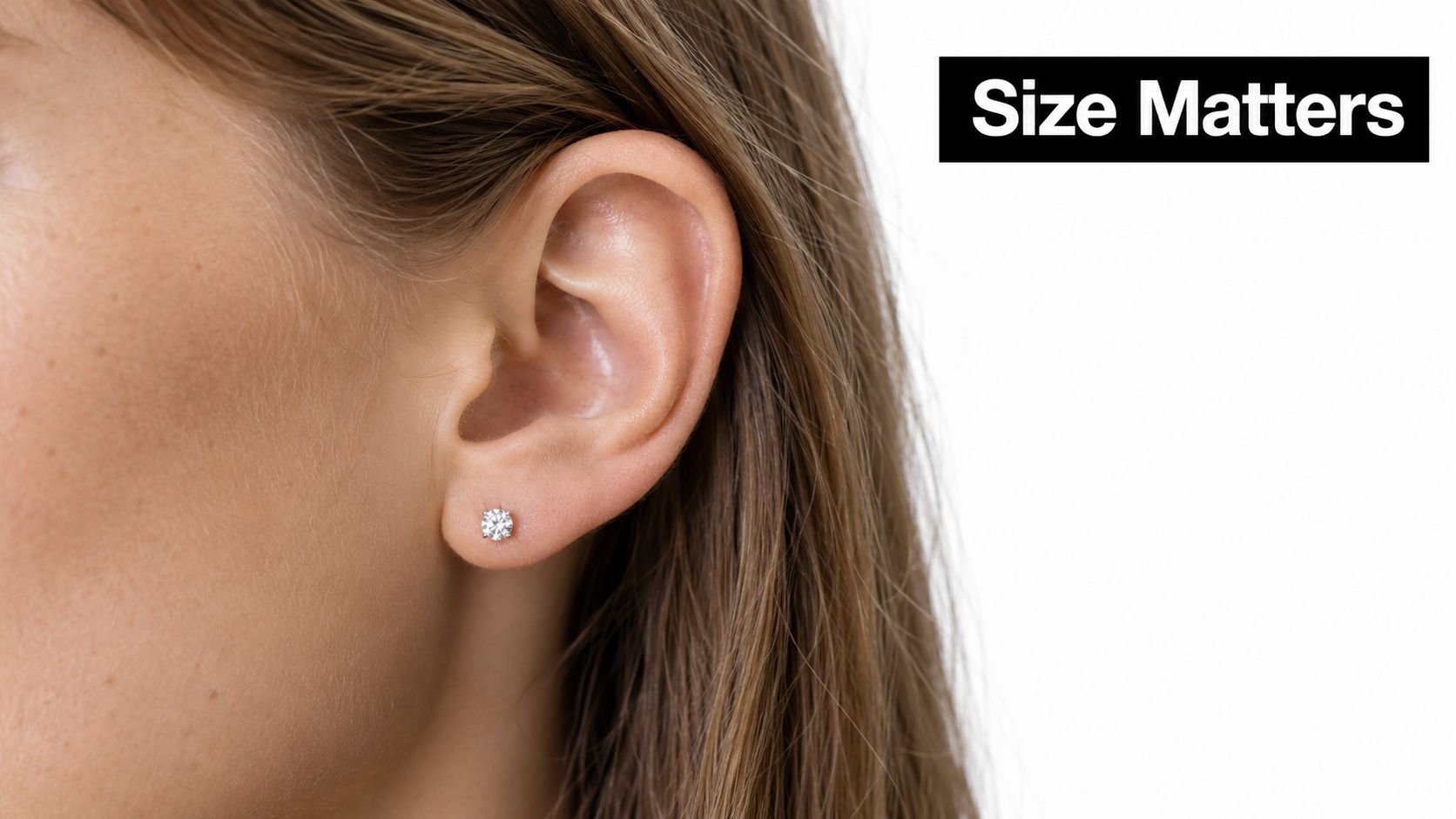
A single 0.50-carat diamond is a modest stud, not a large statement stone. It may look similar in scale to a small pea or the head of a pushpin, but those are loose visual comparisons, not measurement standards. If the pair is 0.50 carat total, each stone is about 0.25 carat when the weights are evenly split, so each earring will look smaller than a single 0.50-carat stone.
Why the same weight can look different
A lively cut can make a stone draw the eye through sparkle, while a poorly performing stone may look dull despite carrying the same weight. A prong setting generally exposes more of the diamond; a bezel's metal rim can give the earring a more framed, protected appearance. White metal can create a bright contrast, while yellow or rose gold adds warmth.
Your ear changes the impression, too. A small lobe can make a modest stone look prominent, while a larger lobe may make it seem discreet. Hair worn up puts studs on display; longer hair can partially cover them. Try on the actual pair, or compare it against your ear in a mirror, rather than judging by the carat number alone.
How Cut Color and Clarity Change the Stone
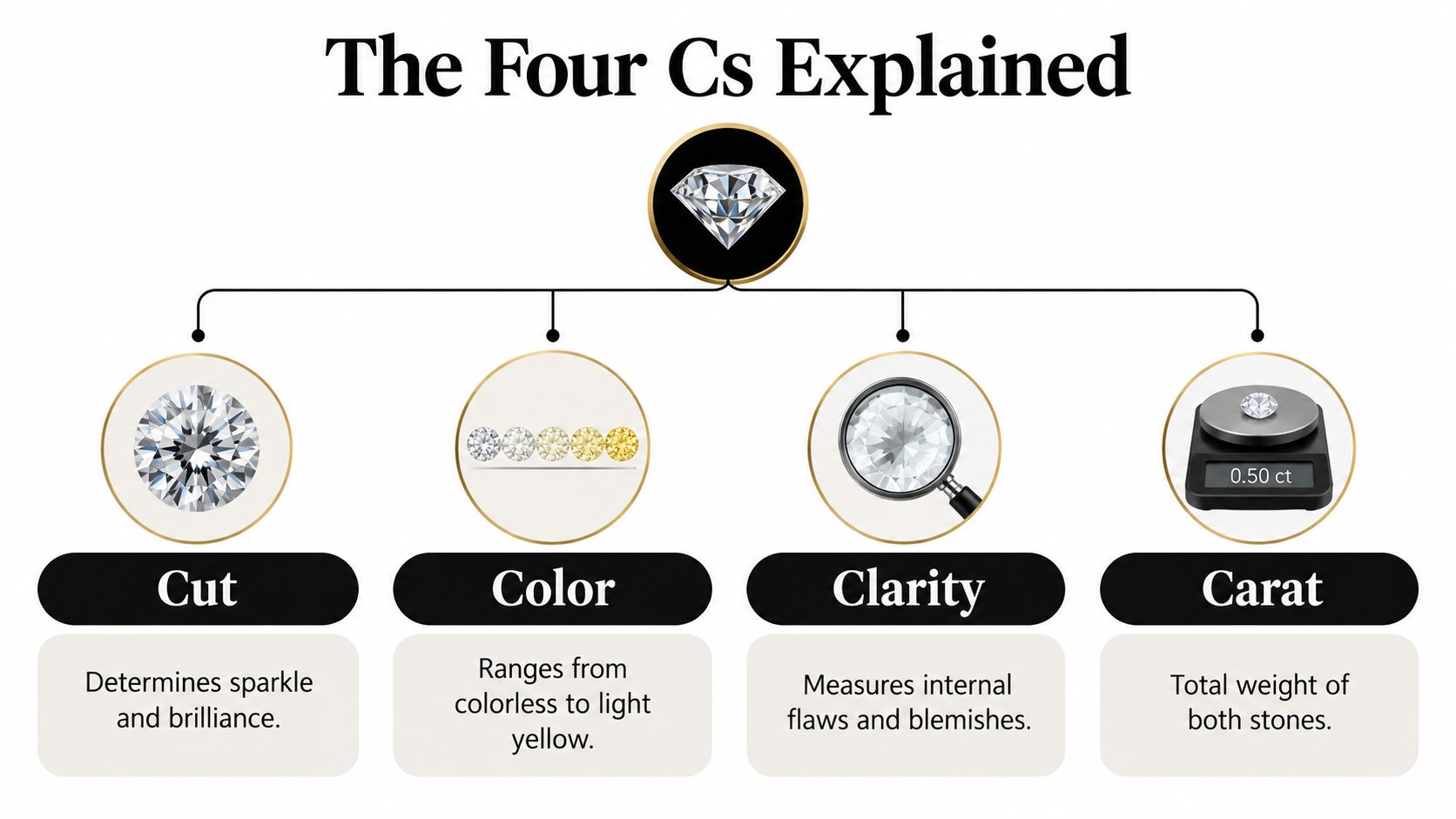
Carat weight is only one part of the description. The Gemological Institute of America treats carat as a measured property alongside the other quality factors, cut, color, and clarity. Two pairs with the same stated weight can differ sharply in brightness, visible characteristics, rarity, and price. GIA's overview of diamond grading
Start with what you can see
Cut deserves close attention because it affects how the diamond handles light. Look at both earrings under more than one kind of lighting. If one stone appears lively and the other seems flat, don't dismiss the mismatch because the paperwork lists similar weights.
Color is easier to judge side by side than in isolation. Compare the stones against a neutral background and then in their settings. The surrounding metal can affect the overall impression, so assess the pair as you'll wear it, not just loose under a jeweler's brightest lamp.
Clarity concerns internal inclusions and surface blemishes. On a small earring, some characteristics may be difficult to notice during ordinary wear, but inclusions can still affect appearance or durability. Don't spend extra for a grade you can't see without first checking that both stones look clean and balanced to your eye.
Don't mistake a weight threshold for a beauty upgrade
GIA identifies 0.50 carat, along with other standard weights, as a “magic size” in diamond pricing. A stone just below a threshold can look little different from one at the threshold while receiving a different price treatment. GIA also says its laboratories weigh diamonds with high-precision digital microbalances to the fifth decimal place and report weight to the hundredths place. That's why a stated weight should be treated as a measured property, not proof that the stone looks better.
Buy the appearance you want, then check the documentation. A clean-looking, well-matched pair may be a better purchase than a pair with higher grades that don't produce a visible improvement on the ear.
Realistic Price Ranges From Retail to Pawn
There isn't a defensible universal price range for every 0.5-carat pair. The price depends on whether the weight is total or per stone, whether the diamonds are natural or laboratory-grown, the quality and match of the stones, the setting, the brand, and the condition. Without those details, a price table with dollar bands would imply a precision that the listing doesn't support.
| Source | Typical Range (USD) | Key Drivers |
|---|---|---|
| New, natural diamonds | No reliable range without stone and setting details | Individual weights, cut, color, clarity, matching, metal, brand |
| New, laboratory-grown diamonds | No reliable range without stone and setting details | Pair weight, grading, setting, seller, current retail pricing |
| Pre-owned or pawn-channel | No reliable range without inspection | Condition, documentation, resale demand, precious-metal content, match |
Industry reporting gives context for lab-grown pricing, but it doesn't set a fair price for a specific pair. A report on the trade said unmounted laboratory-grown diamond unit sales rose 14% in 2025 while average prices fell 13%. Separate market reporting estimated a comparable one-carat lab-grown diamond at about USD 845 in Q1 2025, versus USD 3,895 for a natural diamond. Those figures describe market reporting on loose stones, not a guaranteed price or resale outcome for earrings. JCK's industry reporting on jewelers and the 2025 market
“Value” means different things
A retail replacement value is used for insurance and may not resemble what a buyer would pay you. An immediate cash or pawn offer reflects what a shop can responsibly lend or pay based on the item and its resale prospects. A private-party resale price depends on finding a buyer who wants that particular pair.
A lower-priced lab-grown pair can be an excellent choice for appearance and everyday wear. It shouldn't be sold to you as an investment or reliable store of value. In a secondhand assessment, documentation, a matched pair, the setting's metal, brand, and condition can matter independently of the original retail price.
How Idaho Pawn and Gold Authenticates and Values Diamonds
A careful buyer doesn't make an offer from a carat number alone. The first step is to inspect the actual earrings, check that the stones and setting are consistent with the description, and review any paperwork the owner brings.
What a sound inspection should establish
A loupe helps a buyer inspect the stones' visible inclusions, condition, and setting details. A tester may provide additional information, but it shouldn't replace careful examination or documentation. Natural and laboratory-grown diamonds can't be distinguished reliably by casual visual inspection alone, so a shop should explain what its testing can establish and where it relies on other evidence.
Idaho Pawn & Gold Exchange buys and sells diamond jewelry, offers natural-versus-lab-grown testing, and provides pawn loans using diamond jewelry as collateral. Its published services also include diamond evaluation using the Four Cs and appraisal assistance through GIA-trained professionals. Ask what the assessment covers, and request a clear explanation of how the shop distinguishes a cash offer from a loan offer.
A transparent valuation separates the components. The setting's precious-metal content can be assessed apart from the diamonds, while the stones are considered for quality, condition, matching, documentation, and resaleability. A shop should tell you how those factors affect its offer rather than presenting a single figure as though it were an appraisal of every possible market value.
The company's video provides another way to understand its jewelry services.
Bring any grading reports, receipts, and prior appraisals, but don't assume an old retail appraisal predicts a current offer. Compare the written terms if you're deciding between a sale and a loan, and ask whether you'll receive the same earrings back if you repay a pawn loan under its terms. A careful buyer should be able to explain the process plainly, even if the final offer is lower than the original retail price.
Buying Smart Selling Smart and Caring for What You Own
A good purchase starts with specific questions and ends with documentation you can keep. Ask the seller to identify the pair's total weight, each stone's weight if available, whether the diamonds are natural or lab-grown, and what grading paperwork comes with them. If the seller can't answer clearly, treat the listing as incomplete.
Before you buy or sell
For a purchase, compare the actual earrings in person when possible. Request an independent grading report when available, and confirm that any report matches the stone being sold. A report on one diamond doesn't automatically certify the other, so check that both stones look balanced as a pair.
If you're selling, bring paperwork and disclose known repairs or damage. Decide whether you need a pawn loan or want to sell outright: a loan may suit someone who wants the opportunity to reclaim the earrings, while a sale transfers ownership. Ask the shop to explain the offer and the terms before you agree.
> A retail receipt tells you what you paid. It doesn't guarantee what a secondhand buyer will pay.
Keep the earrings secure and documented
Store each earring so it won't rub against other jewelry, and remove studs before activities that could snag or damage the setting. Clean gently with mild soap, water, and a soft brush when appropriate. Skip ultrasonic cleaning if you don't know whether the diamonds have treatments, have damage, or sit in a setting that can loosen.
Keep receipts, grading reports, and any insurance appraisal together. If a stone moves, a prong catches, or a backing no longer feels secure, stop wearing the earring until a jeweler checks it. Good records and intact settings make future insurance, repair, and resale conversations easier.
Quick Answers and Your Decision Checklist
- Confirm total versus per-stone weight.
- Check natural or lab-grown disclosure.
- Compare the pair side by side.
- Review grading documents and condition.
- Separate insurance value from cash or resale value.
- Get written terms before selling or borrowing.
Do lab-grown earrings hold value? Don't assume they'll retain retail value or act as an investment. Are 0.5-carat-total studs too small for daily wear? They're a discreet option for many people. Can a pawn shop authenticate diamonds? A shop can test and inspect them, but ask what its process can confirm and what documentation supports the result.
---
Visit Idaho Pawn & Gold Exchange to ask about diamond testing, jewelry sales, or pawn loans using diamond earrings as collateral. Bring any grading reports you have and ask for a clear explanation of how the shop assesses the stones, setting, and offer.