
The popular advice is simple: if an 1884 Carson City silver dollar has a “CC” mintmark, it must be rare and extraordinarily valuable. That shortcut causes trouble at the counter. The mintmark matters, but the coin's grade, surface quality, strike, certification, and prooflike designation usually matter more than the letters alone.
An 1884-CC Morgan dollar can be a desirable collector coin without being a rarity in every grade. Its value starts with its silver content, then rises according to preservation and eye appeal. The practical question isn't just whether you own a Carson City dollar. It's where your coin sits on the rarity ladder, from an ordinary circulated example to a scarce gem or unusually reflective DMPL coin.
Carson City Rarity: What Actually Drives Value
The CC mintmark attracts attention, but it does not settle the price. Carson City connects the coin to the Nevada facility and the western mining economy, which gives Morgan dollars strong collector appeal. For an 1884 Carson City silver dollar, however, the grade and surface often matter more than the mintmark alone.
The 1884-CC issue is relatively available compared with many other Carson City Morgan dollars. PCGS describes the regular-strike issue as common in lower Mint State grades and estimates about 980,000 surviving examples across all grades, including approximately 26,000 at MS65 or higher, in its 1884-CC Morgan dollar data. That supply keeps an ordinary example from being automatically rare, even though the date and mintmark still support collector demand.
The rarity ladder matters more than the headline
Value rises in steps:
- Circulated and lower-grade coins are generally obtainable because wear is common and many examples survive.
- Problem-free Mint State coins bring stronger interest when they retain lively luster and avoid distracting marks.
- Gem MS65 and MS66 examples require better surface preservation, so attractive pieces become more selective.
- Premium MS67 pieces sit near the top of the regular-strike ladder and can be very scarce.
- PL and DMPL coins occupy a separate surface category. Mirrored fields and contrasting devices can create a substantial premium.
At the counter, inspect the cheek, fields, lettering, eagle's breast, luster, toning, and any signs of cleaning. A genuine coin with polishing hairlines may sell for far less than an equally genuine example with original surfaces. Certification can support confidence, but the holder does not replace a careful look at the coin.
> Practical rule: The “CC” gets the coin noticed. The condition determines how far it climbs.
Silver content provides a baseline, while collector value depends mainly on grade, surface quality, authentication, and special designations. An appraisal based only on silver weight or the mintmark can therefore miss the coin's position on the rarity ladder. The useful question is whether the specific dollar is ordinary, carefully preserved, or an unusually reflective and scarce example.
Mintage Numbers and Survival Estimates
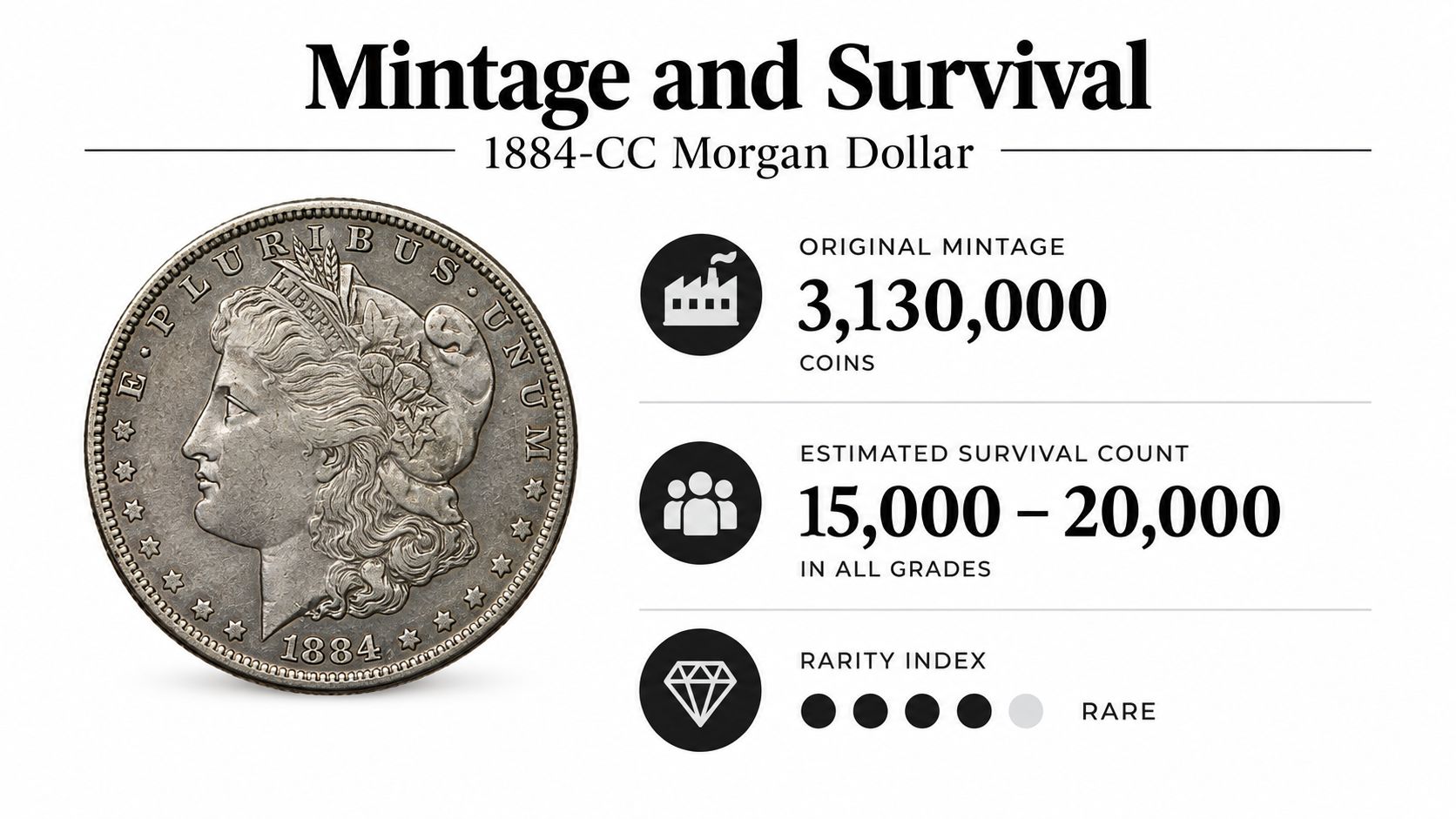
The Carson City Mint struck 1,136,000 1884-CC Morgan dollars, according to PCGS's issue overview. That figure creates interest, but it does not establish the value of the coin across the counter. Survival, grade, surface quality, and collector demand determine where an individual dollar belongs on the rarity ladder.
PCGS estimates roughly 980,000 surviving coins overall, including about 975,000 grading MS60 or better. A large surviving population means a regular 1884-CC is not automatically a rare fortune. Buyers can usually compare examples, reject damaged pieces, and wait for a coin with better preservation.
Reading the population correctly
A survival estimate does not mean every coin is available today. Collectors hold attractive pieces, certified dollars can remain in collections for years, and other examples have been cleaned, damaged, or incorrectly identified. The population describes the broad supply, not the number of coins a seller can buy immediately.
At a pawn counter, a typical circulated 1884-CC may show wear on Liberty's cheek, the eagle's breast, and the highest lettering. It can still carry historical and collector interest above its silver value, but heavy marks, dull surfaces, or cleaning limit the premium. An MS65 example is a different proposition. It should retain stronger luster, cleaner fields, and fewer distracting contact marks, making it harder to replace even though the date itself is familiar.
The upper grades narrow the field further. PCGS estimates roughly 26,000 survivors at MS65 or higher, so attractive coins at that level deserve closer comparison than ordinary Mint State pieces. A technically high-grade dollar may still underperform if haze, scratches, or unnatural toning hurt its eye appeal.
The practical distinction is availability versus condition rarity. The date may be obtainable, while a problem-free, well-preserved example commands attention. Price the coin in hand, not the “CC” mintmark alone.
Identifying Prooflike and Mirror Surfaces
Surface quality can move an 1884-CC Morgan dollar up the rarity ladder, but a bright appearance alone proves little. A standard Mint State coin shows cartwheel luster as it turns under light. A Prooflike, or PL, 1884-CC has reflective fields that resemble a proof, while a Deep Mirror Prooflike, or DMPL, coin shows deeper mirrored fields and frosted-looking devices that stand out against them.
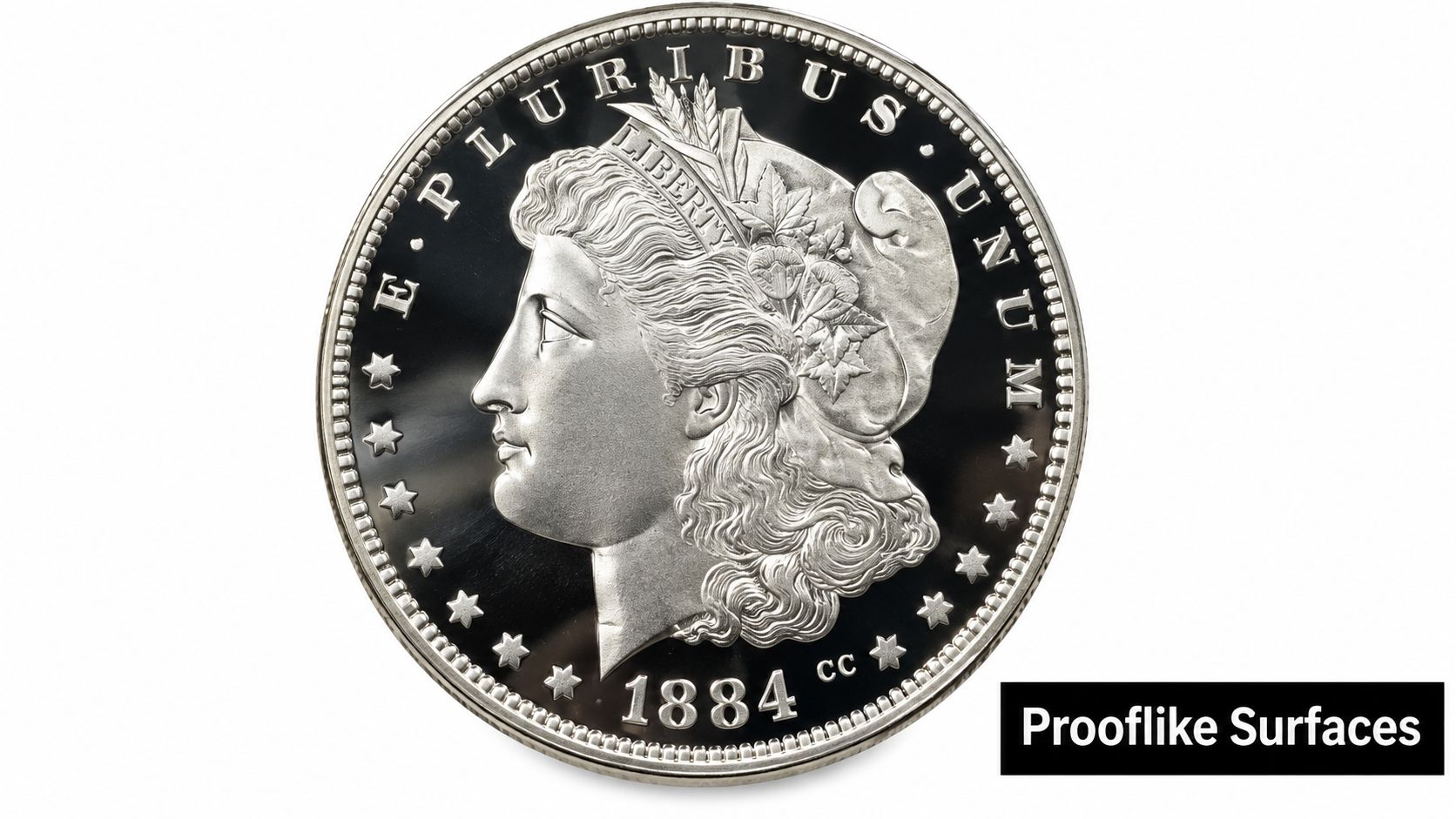
A polished or aggressively cleaned dollar may shine more than an original PL coin, yet cleaning leaves a different surface character. Use one angled light source and move it across the fields. Look for broad, continuous reflection with visible depth and contrast, not raw glare.
Hold the coin by its edge and rotate it slowly. Inspect the open fields around Liberty, then examine the reverse lettering. Natural mirror surfaces should remain broad and reflective as the coin moves. Wiping, scratches, or altered areas often interrupt that appearance.
Check these details:
- Hairlines, especially parallel lines from wiping or polishing.
- Haze or fingerprints crossing the mirrored fields.
- Uneven reflectivity, which can indicate damage or surface alteration.
- Strong device contrast, expected on a genuine DMPL candidate.
- Contact marks, which may keep a reflective coin from earning a high grade.
PCGS estimates approximately 15,000 surviving PL examples and about 10,000 DMPL examples, with only around 2,000 in either category at MS65 or better, as documented in its 1884-CC DMPL reference. These population figures explain why a mirror-surface dollar deserves separate attention from an ordinary Mint State example.
Older descriptions create another trap. Some 1884-CC dollars once called “Branch Mint Proofs” are better classified as DMPL coins rather than true proofs. That distinction affects expectations and can change an offer substantially.
The following video provides a visual reference for the reflective surface collectors examine:
A grading service can determine whether the coin belongs in the regular-strike, PL, or DMPL category. Until then, treat mirrorlike fields as evidence of potential, not a guaranteed premium.
Grading Tiers and Market Value Ranges
The CC mintmark creates interest, but condition determines where an 1884-CC dollar sits on the rarity ladder. Its 90% silver alloy and approximately 0.77344 to 0.77346 troy ounce specified silver content provide a bullion floor linked to the spot price, according to PCGS's 1884-CC PL specifications. The premium above that floor comes from preservation, originality, scarcity, and the coin's designation.
A heavily circulated example may have flattened hair, wear across Liberty's cheek, and softened eagle feathers. About Uncirculated coins retain stronger detail and some luster, while Mint State pieces show no circulation wear. At that level, contact marks, luster quality, color, and surface originality can separate an ordinary coin from a desirable one.
| Grade Range | Condition Description | Approximate Market Value Range |
|---|---|---|
| Circulated grades | Noticeable wear, reduced detail, and possible marks from use | Near bullion value to a modest collector premium |
| About Uncirculated | Light wear, stronger detail, and remaining luster | Low hundreds, depending on appearance |
| Lower Mint State | No circulation wear, though marks or muted luster may limit appeal | Mid-hundreds |
| MS65 to MS66 | Gem preservation, stronger luster, cleaner fields, and attractive eye appeal | Four figures, with the upper end depending on designation |
| MS67 | Exceptional regular-strike preservation and limited availability | Several thousand dollars and higher for notable examples |
| PL or DMPL | Reflective fields, with DMPL showing deeper mirrors and stronger device contrast | Specialized premium range, potentially far above regular-strike prices |
These ranges are working categories, not promises. A problem-free coin with original surfaces can outperform a technically similar example with distracting marks, haze, or cleaning. A buyer also considers certification, holder, eye appeal, provenance, and current demand.
Why one grade point can change the conversation
The largest premiums usually belong to coins combining a high technical grade with strong visual appeal. Brightness alone does not establish quality. Balanced toning, clean fields, and lively luster can help a coin, while harsh cleaning can reduce its value regardless of grade.
Reported transactions show how wide the upper end can be. PCGS lists approximately $2,600 for a PCGS MS67 example and more than $8,400 for a GSA-hoard NGC MS67 example in its 1884-CC market information. Those are individual results, not guaranteed appraisals.
A separate reported auction result reached $184,000 for a coin cataloged as PR66, documented in the PCGS DMPL reference. That exceptional result reflects unusual attribution and surfaces, not the normal value of an 1884-CC dollar.
For a realistic estimate, identify the tier occupied by the exact coin in hand. The CC mintmark starts the conversation. Grade, surface quality, and authentication determine the offer.
Preserving the Surface and Avoiding Damage
A bright 1884-CC Morgan dollar is not necessarily a better coin. Rubbing silver with a cloth, applying polish, or using a dip can leave hairlines, strip away original surface character, and create an artificial appearance that buyers recognize quickly. Cleaning often moves a coin down the rarity ladder, even when the date and CC mintmark remain desirable.
Handle the coin only by its edges. Finger oils leave residue, while reflective PL or DMPL fields show handling marks that ordinary circulation surfaces may hide. If the coin must be moved, set it on a clean, soft surface and never slide it across paper, fabric, or plastic.
Storage choices that protect value
Use a stable, inert holder made for collectible coins. Soft plastic containing PVC can leave damaging residue over time. A rigid capsule or inert plastic 2x2 offers safer storage than a loose pocket, jewelry box, or unmarked flexible flip.
Keep dust and grit out of the holder because particles can scratch the coin as it shifts. Cotton gloves may reduce direct contact, but clean, dry hands and edge-only handling are often safer than gloves that snag. Keep the stored coin away from moisture, heat, chemicals, and abrupt environmental changes.
Do not polish a possible mirror-surface coin in pursuit of brightness. A buyer evaluates the remaining surface, not just how reflective it looks after treatment.
Natural toning is not automatically a defect. Collectors often prefer original silver over artificially brightened surfaces, especially when the color is stable and balanced. A dark spot or residue may need professional review, but home treatment usually creates more risk than benefit.
> Surface warning: A cloth may make a coin look cleaner to its owner while making it less acceptable to a serious buyer.
Authentication and the Counterfeit Threat
The CC mintmark attracts counterfeiters because it can add a collector premium. A convincing copy may pass a quick photo review, particularly when lighting conceals texture, edge detail, or altered surfaces. An online seller's assurance does not establish authenticity.
Start with the published specifications. A genuine 1884-CC Morgan dollar should measure 38.10 mm in diameter and weigh 26.73 g, with a 90% silver alloy, according to PCGS's technical reference. Weight and diameter can expose an obvious mismatch, but they cannot prove a coin is genuine. Counterfeiters can reproduce the basic dimensions.
What a preliminary check can and can't tell you
A scale and caliper provide a useful first screen. Examine the reeded edge, date, lettering, relief, and Carson City mintmark under strong light. A magnet can identify some non-silver imitations, but it is only a limited check and cannot authenticate a silver coin by itself.
Pay closer attention as the apparent grade rises. A worn example priced near its metal value presents less financial risk than a raw coin with sharp detail and reflective fields. Prooflike or deep mirror surfaces can attract a substantial premium, but they also make surface alterations and counterfeit work more consequential. Certification provides a standardized grade description and a record that buyers can verify through the grading service's database.
For a pawn or sale evaluation, bring the coin as found. Do not remove toning, scrape residue, or try to brighten the surface before inspection. A reputable buyer can assess its measurements, relief, surfaces, and authenticity together, then determine whether professional grading or further testing is justified.
> Buyer's rule: Preliminary measurements are evidence, not a verdict.
That distinction matters on both sides of the counter. Sellers avoid presenting a counterfeit or damaged coin as a premium rarity, while buyers can price the actual authentication risk alongside the coin's condition and collector appeal.
Selling Your Coin at Idaho Pawn and Gold
A fair appraisal starts with separating the coin's components. The evaluator should identify the date and mintmark, inspect wear and contact marks, look for cleaning, assess luster and toning, and determine whether the fields appear PL or DMPL. Certification, if present, should be checked against the grading service's database rather than accepted solely because a slab is visible.
For an ungraded coin, expect a preliminary intake process that may include weighing and measuring. Those checks help confirm that the piece is consistent with the published specifications, but the buyer still needs to examine relief, edge details, surfaces, and possible alterations. A coin that appears ordinary may receive a collector offer above its silver floor, while a high-grade or prooflike candidate may require more specialized evaluation.
What to bring to an appraisal
Bring the coin in its existing holder, if it has one, along with any purchase records, estate paperwork, old auction descriptions, or certification information. Don't clean it before arriving. Documentation can help establish provenance, but the coin's current condition remains central to the offer.
Idaho Pawn & Gold Exchange evaluates silver coins, including Morgan dollars, and offers authentication, testing, buying, and pawn-loan services through its locations in Boise, Meridian, and Nampa. Its stated approach combines current market pricing with in-person examination, which is useful when a seller needs to distinguish bullion value from numismatic value.
The practical choice between a sale and a loan depends on your objective. An outright sale provides a direct exit, while a pawn loan lets you use the coin as collateral without immediately transferring ownership, subject to the shop's terms. In either case, ask how the evaluator arrived at the offer and whether the coin's grade, certification, surface quality, or special designation affected it.
An 1884-CC isn't valuable just because it says Carson City. It becomes more valuable when the coin is genuine, original, well preserved, properly attributed, and presented to a buyer who recognizes the difference.
---
Bring your 1884 Carson City silver dollar to Idaho Pawn & Gold Exchange for an in-person evaluation, authentication, and current-market offer. The team can assess whether your coin belongs near its silver floor or on a higher collector tier, and you can choose between a direct sale and a pawn-loan option.