
Most advice about a 10 carat emerald cut diamond ring starts with glamour and ends with the Four Cs. That's incomplete advice. The hard question isn't whether the ring looks impressive in a boutique. It's what happens when you need a pawn loan, an insurance replacement, or a cash sale and discover that retail pricing, laboratory paperwork, and actual buyer demand are three different things.
A massive diamond can be visually extraordinary and financially difficult to move. The stone's origin, proportions, eye-visible condition, documentation, and current secondary-market demand matter more than the headline carat weight. If you're considering buying, pawning, or selling one, judge it like a high-value asset, not a trophy.
The Reality of Owning a Massive Diamond
The popular assumption is simple: a very large diamond must be an investment. That assumption is misleading. Natural-diamond prices have weakened from earlier peaks, and the gap between retail replacement value and secondary-market liquidity remains wide, as discussed in Rapaport's market coverage of lab-grown diamonds and natural-diamond disruption.
A jeweler's retail price can include design work, branding, overhead, marketing, financing costs, and a margin for the original sale. A pawn broker or secondary-market buyer evaluates a different question: how confidently can this exact ring be authenticated, priced against current comparables, and sold to the next buyer? Those answers rarely produce the same number.
> Practical rule: Never confuse an insurance replacement figure with the amount you can collect quickly from a buyer.
A 10-carat emerald-cut ring also has a narrower buyer pool than a conventional engagement ring. The stone is expensive to acquire, expensive to insure, and difficult to replace. A buyer who wants that size and shape may care a great deal about natural versus laboratory-grown origin, color, clarity, symmetry, fluorescence, treatments, setting quality, and report credibility. A buyer who doesn't care about those details won't pay a premium just because the ring weighs 10 carats.
What actually creates liquidity
Liquidity comes from confidence. A professional buyer needs to establish what the stone is, whether its condition matches its paperwork, and whether a realistic exit exists after the purchase. The strongest file includes:
- Independent documentation: A laboratory report identifies the stone's stated characteristics and helps separate verified facts from seller descriptions.
- Clear provenance: Natural and laboratory-grown diamonds occupy different market categories. The distinction affects pricing expectations and resale strategy.
- Visible beauty: A clean, bright emerald cut with balanced reflections is easier to explain and resell than a technically impressive stone with a dark center or obvious inclusion.
- Protected construction: Chipped corners, loose prongs, and damaged mounting reduce confidence before a buyer even debates the stone's grade.
- A realistic transaction goal: A pawn loan, an outright sale, and an insurance appraisal require different valuations.
The right mindset is blunt: carat weight gets attention, but visual performance and verifiable identity create value. If the ring needs to produce cash, the person evaluating it will inspect the stone itself, not admire the original receipt.
Anatomy and Proportions of the Emerald Cut
An emerald cut is a rectangular step-cut design with broad, linear facets. Its parallel rows create a reflective hall-of-mirrors effect, with broad flashes instead of the rapid scintillation associated with brilliant cuts. The name describes the cutting style and its historical connection to emeralds. It does not mean the diamond is green or that the ring contains an emerald.
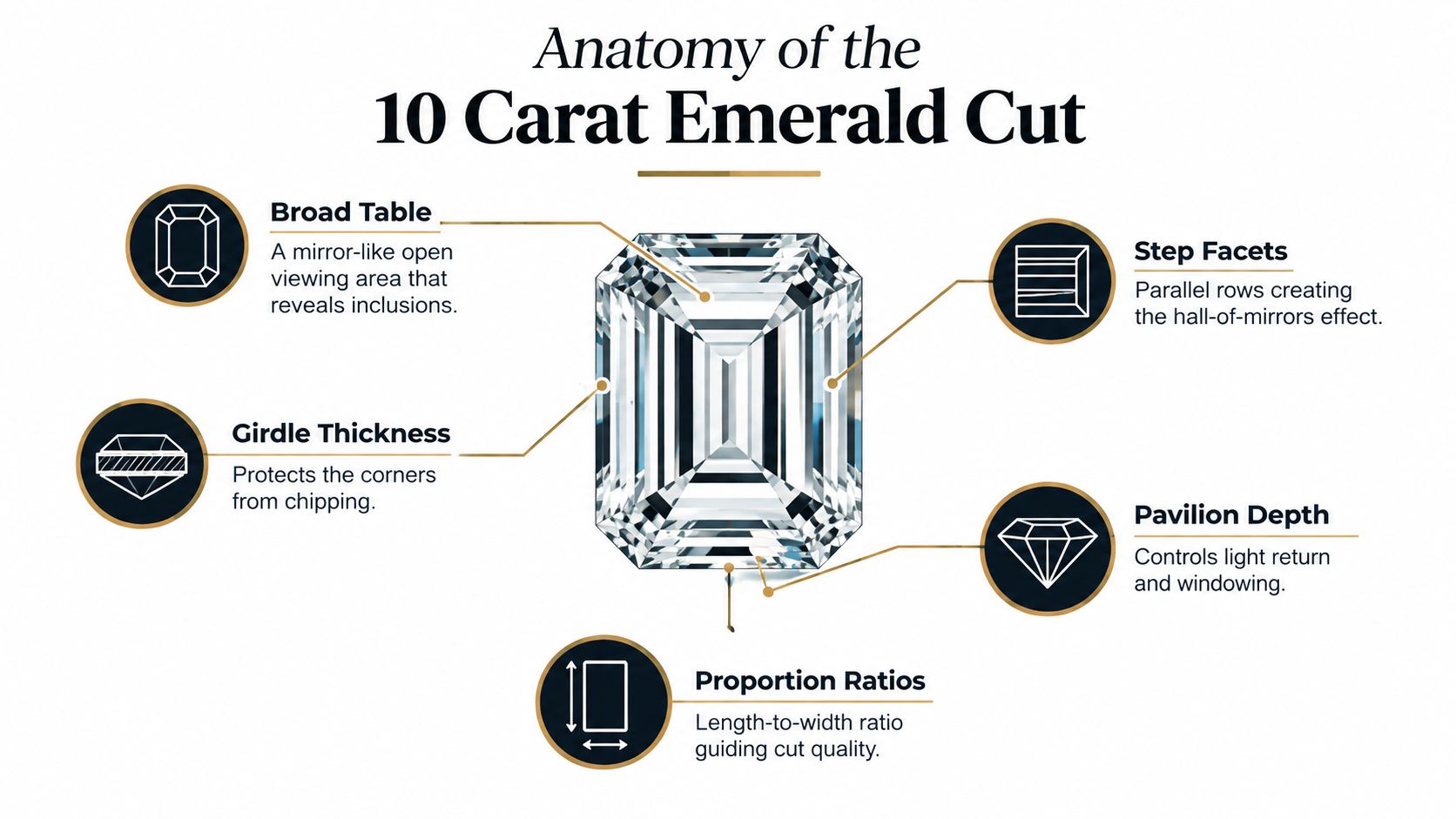
On a stone this large, the open table acts like a broad viewing surface. It gives the diamond its architectural appearance, but it also exposes inclusions, body color, windowing, extinction, and uneven facet reflections. Brilliant cuts use many angled facets to scatter light and disguise some imperfections. Emerald cuts offer fewer visual distractions, so the observer sees the stone's structure more directly.
Weight is not face-up size
A 10-carat diamond weighs 2.0 grams, because one metric carat equals 0.2 grams. A documented 10.00-carat center stone therefore represents 2,000 milligrams of diamond, according to GIA's explanation of diamond carat weight and quality factors.
That weight doesn't tell you how large the stone looks from above. Length-to-width ratio, total depth, and pavilion geometry determine how much material sits below the girdle and how much remains visible face-up. Two stones with the same carat weight can have noticeably different outlines and visual coverage.
| Feature | What it controls | Why it matters at 10 carats |
|---|---|---|
| Length-to-width ratio | The outline and degree of elongation | Affects finger coverage and the ring's overall presence |
| Total depth | How much weight sits below the girdle | Can make the stone look smaller than expected |
| Pavilion geometry | Light return and leakage | Influences windowing, darkness, and brightness |
| Symmetry | Alignment of the step facets and outline | Uneven reflections become obvious across the broad table |
| Girdle thickness | Edge durability and setting security | Thin areas and exposed corners deserve close inspection |
GIA's framework evaluates Color, Clarity, Cut, and Carat Weight, but emerald-shaped diamonds don't receive a standard overall cut grade in the same way round brilliants do. That makes direct visual assessment essential. The report provides measurements, polish, symmetry, and other facts. Your eyes determine whether the step pattern looks balanced.
A strong emerald cut doesn't need to glitter like a round brilliant. It should return clean, broad flashes without a washed-out center or distracting black zones. Reject the idea that the heaviest stone automatically looks the biggest or best. In this shape, proportions can make a lighter stone look more effective from across the room.
Physical Inspection Checklist for Large Stones
Generic advice to “prioritize clarity” isn't enough. A 10-carat emerald cut must be inspected as a physical object, under controlled conditions, with the report beside it. A high clarity grade can still accompany unattractive light behavior, while a lower grade may be acceptable if the inclusion is unobtrusive and the stone looks clean at normal viewing distance.
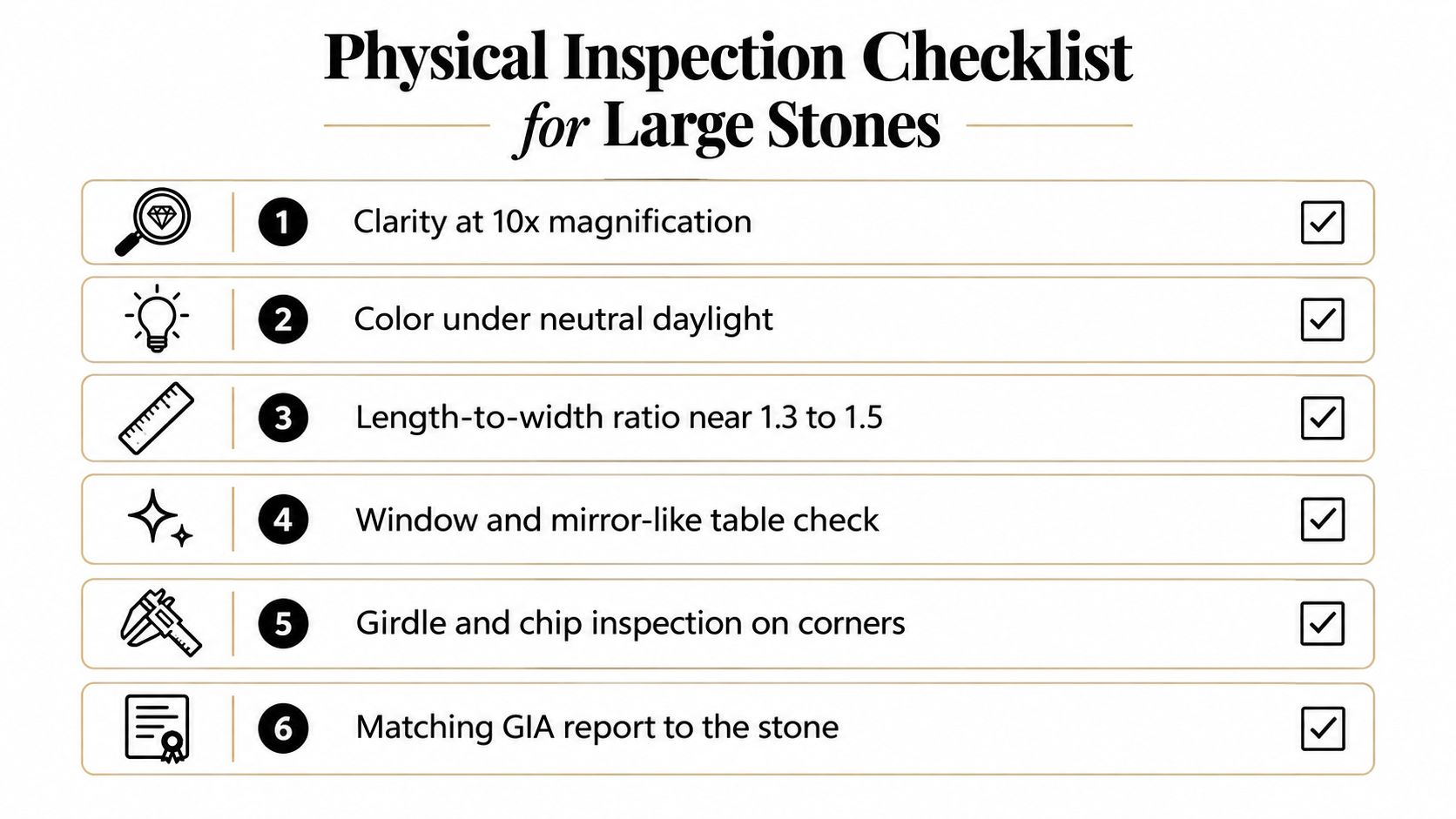
Inspect the stone in a fixed order
1. Start with the report, not the sales pitch. Confirm the stated carat weight, measurements, color, clarity, polish, symmetry, fluorescence, treatments, and origin designation where applicable. Then compare the report number with the stone or its documentation. If the seller can't explain a mismatch, stop the transaction.
2. Look through the table at normal distance. Examine the center without relying only on a loupe. Search for dark crystals, clouds, feathers, or other inclusions near the table. A characteristic placed in an exposed central area can affect both appearance and buyer confidence more than one hidden near the edge.
3. Use magnification for confirmation. A loupe or microscope helps you locate the clarity characteristics plotted or described in the report. Magnification isn't a substitute for face-up viewing. The question is whether the reported feature remains distracting when the ring is viewed normally.
4. Test color under neutral light. Emerald cuts reveal body color readily because the table is broad and open. View the ring under neutral daylight and indoor lighting. Don't judge the stone solely under warm boutique lights, which can flatter a tinted diamond and conceal unevenness.
5. Check for windowing and extinction. Tilt the ring slowly from the face-up position and then inspect it from the side. A washed-out transparent area can indicate windowing, while persistent dark zones can indicate extinction. The stone should show organized, balanced reflections rather than a dead center surrounded by bright edges.
6. Examine corners and the girdle. Emerald cuts have clipped corners, but those areas remain vulnerable to chips. Inspect each corner, the girdle, prongs, and any bezel or halo elements. A chip isn't a cosmetic footnote. It can affect durability, insurance, repair cost, and resale negotiations.
> Inspection standard: If the stone looks poor under neutral light, don't let a favorable paper grade talk you into buying it.
The National Jeweler discussion of natural-diamond market conditions supports a practical inspection approach: review clarity characteristics, symmetry, polish, proportions, and fluorescence, then view the diamond face-up and from the side under multiple lighting conditions.
For a large transaction, record what you observe. Photograph the ring beside its report, note any visible inclusion or damage, and ask whether treatments have been disclosed. Seller descriptions are useful leads, not proof. The physical stone and its independent documentation must agree.
Natural Versus Lab-Grown Market Realities
Origin determines which buyer pool your ring enters and how lenders, dealers, and future owners judge its price. Natural and laboratory-grown diamonds can look equally impressive, but their scarcity stories, pricing histories, and secondary-market expectations differ sharply. For a 10-carat emerald cut, visual quality still matters most when you need cash, yet origin determines how difficult that cash may be to obtain.
In 2025, laboratory-grown diamonds represented 61% of engagement-ring center stones in one cited industry study. Finished natural engagement-ring sales fell 4%, while laboratory-grown sales rose 31%, according to National Jeweler's report on the direction of the diamond market. Those figures describe the broader engagement-ring market, not a guaranteed value for one 10-carat emerald cut. They show why you must establish origin before judging liquidity.
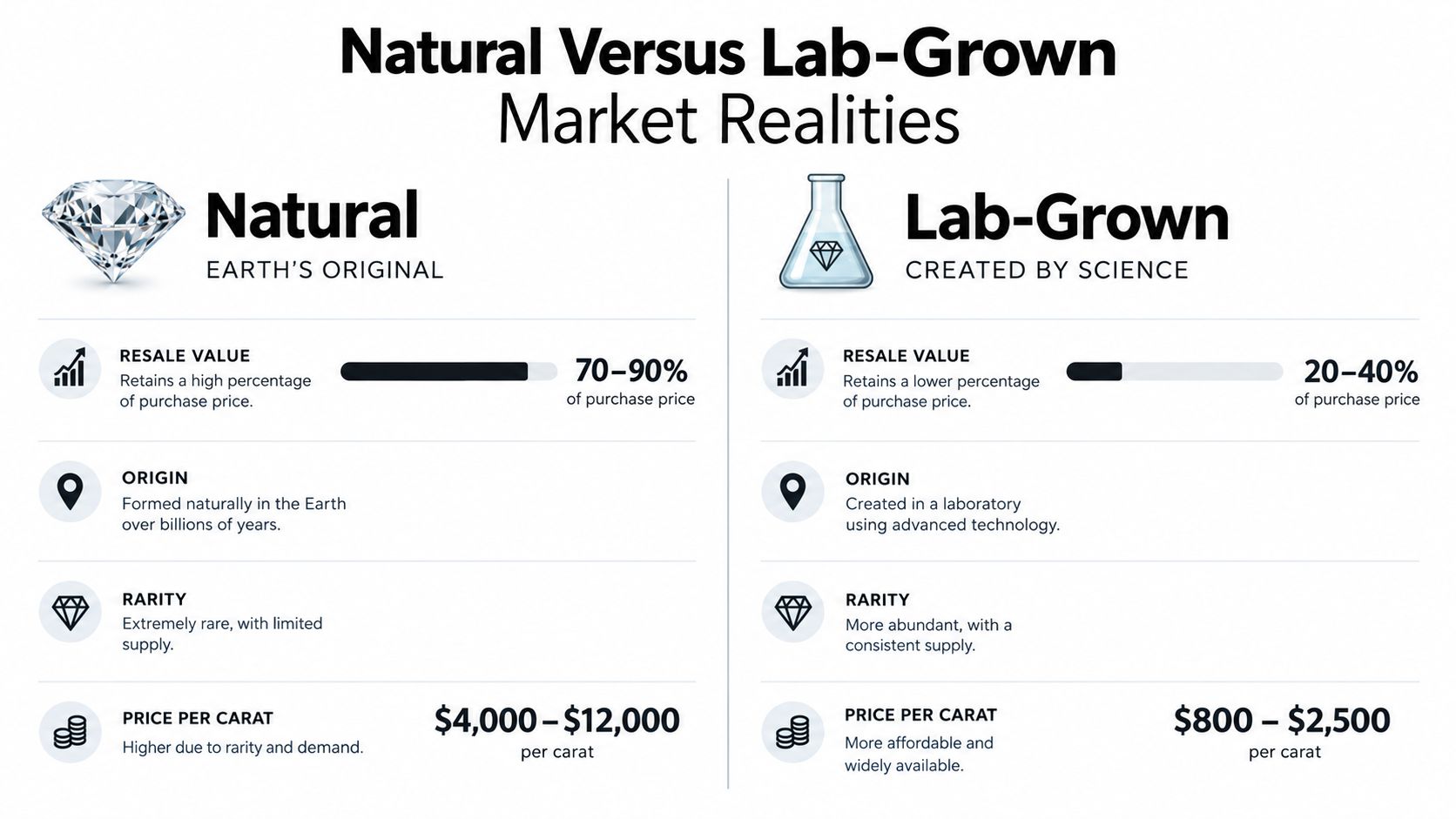
Size per dollar is not the same as retained value
A laboratory-grown diamond can provide impressive size at a lower purchase cost than a comparable natural stone. That makes sense for appearance and personal enjoyment. It does not make the stone an investment.
The resale calculation is harsher. Recent market reporting placed average natural one-carat prices in 2025 at about $4,200, compared with roughly $1,000 or less for laboratory-grown stones. The same reporting cited a 14% wholesale decline in the first quarter of 2026 and a 28% decline for three-carat rounds in laboratory-grown pricing. Those figures do not establish a value for a 10-carat emerald cut, as explained in Rapaport's coverage of continuing laboratory-grown disruption.
| Question | Natural diamond | Laboratory-grown diamond |
|---|---|---|
| What must be verified | Natural origin, grading, treatments, and condition | Laboratory-grown origin, grading, treatments, and condition |
| What drives buyer confidence | Report quality, visual appeal, scarcity, and demand | Visual quality, disclosed origin, current pricing, and demand |
| Main liquidity risk | Retail-to-secondary-market spread and softer natural pricing | Faster price depreciation and changing replacement comparables |
| Best buying rationale | Personal ownership with realistic resale expectations | Size and appearance at a lower entry cost, without assuming investment value |
For a pawn loan, origin changes the lender's risk assessment. A laboratory-grown stone may cost less to buy but provide weaker collateral if comparable prices keep falling. A natural diamond may receive stronger recognition, yet no lender should treat retail pricing as loan value. Idaho Pawn & Gold will still focus on the actual stone, documentation, condition, and current demand.
Get the origin designation in writing. “High quality” says nothing about whether the stone is natural or laboratory-grown. If future liquidity matters, require current comparable transactions and an independent opinion before committing funds. In a distressed sale, a clean, bright, eye-catching stone can outperform a higher paper grade that looks flat or heavily included.
Authentication and the Appraisal Process
A laboratory report is the diamond's passport, but a passport is useful only when it belongs to the traveler standing in front of you. A professional appraisal begins by matching the document to the physical ring, then separates report facts from assumptions about market value.
The first check is identity. Compare the report number with the inscription on the girdle when one is present, and confirm that the measurements and characteristics correspond to the stone. The Federal Trade Commission's consumer guidance on buying diamonds and gemstones recommends retaining documentation and ensuring that paperwork states represented weight, size, treatments, origin claims, and care requirements.
Build a transaction file
Bring more than the ring. A clean file can shorten the evaluation and reduce disputes.
- Original laboratory report: Prefer an independent report that identifies the exact stone.
- Purchase records: Receipts, invoices, and prior ownership documentation establish a useful history.
- Insurance appraisal: Helpful for coverage, but it may reflect replacement cost rather than a likely cash-sale figure.
- Repair records: Disclose any resetting, polishing, prong work, or corner repair.
- Treatment disclosures: Undisclosed treatments can change both value and buyer interest.
- Photographs: Prior images can help document condition, but they don't replace current inspection.
The key distinction is between replacement value and fair market value. An insurance replacement appraisal estimates what it may cost to obtain a comparable replacement through a retail channel. A buyer or pawn broker considers what the item can reasonably support in a secondary transaction after authentication, risk, holding costs, and resale time.
How the valuation conversation works
A professional evaluator examines the report, verifies the stone, inspects the setting, and considers the current buyer pool. The evaluator may then discuss two separate outcomes: an outright purchase price and a collateral-based loan amount. Those figures answer different financial needs and shouldn't be treated as interchangeable.
Don't lead with what you paid. Lead with what can be verified. If a seller's description says “investment grade” but the report doesn't support that language, the description has little negotiating power.
A high-value appraisal should also identify the stone as natural or laboratory-grown where applicable. That classification isn't merely administrative. It determines which comparable stones belong in the discussion and prevents a buyer from pricing the ring against the wrong market.
Pawn Loans and Selling Strategies in Idaho
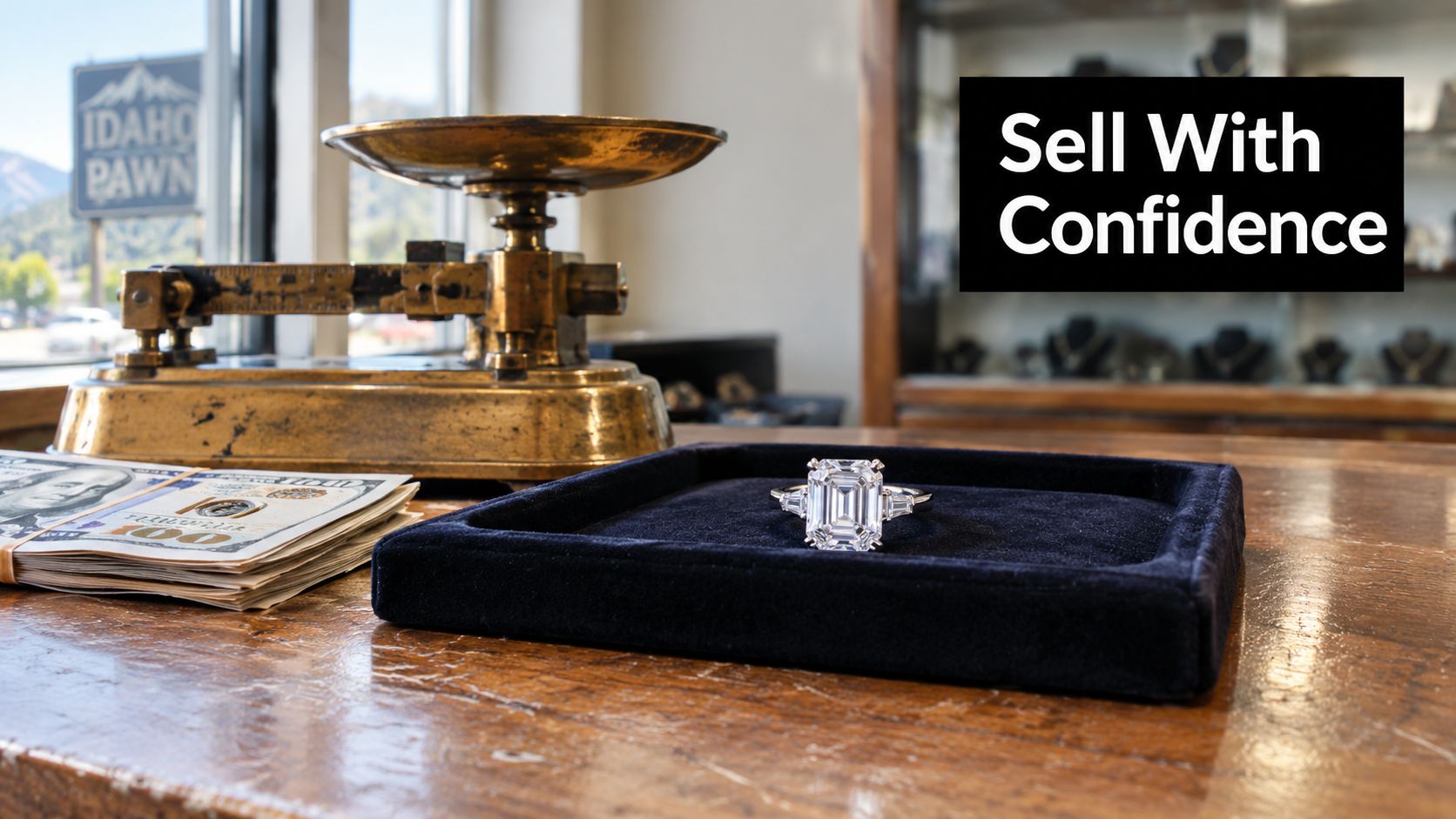
When you need liquidity, choose the transaction type before you negotiate the number. A pawn loan lets you use the ring as collateral while retaining the possibility of redemption. An outright sale transfers ownership and removes the repayment obligation. Neither option should be evaluated from the retail price alone.
Prepare before visiting a buyer
Bring the ring, report, identification, purchase documents, and any prior appraisal. Clean the piece gently, but don't pay for a cosmetic alteration immediately before evaluation. A buyer needs to see the stone and mounting as-is, including loose prongs, chips, worn settings, or repairs.
Ask the evaluator to separate four figures:
- Retail replacement value, if available.
- Likely secondary-market sale value.
- Proposed loan amount, if you're seeking collateral financing.
- Total repayment obligation, including the stated interest and fees.
The loan amount reflects risk and recoverability, not the emotional importance of the ring. The lender must protect against authentication problems, market movement, storage, and the possibility that the item won't be redeemed. Read the written agreement carefully, including the interest rate, fees, maturity date, renewal terms, and redemption requirements.
For an outright sale, obtain more than one qualified opinion when practical. Compare the explanation behind each offer, not just the headline amount. One buyer may identify a report mismatch or condition concern that another overlooked. Another may have a stronger local buyer for a natural emerald cut and therefore offer more confidently.
Use local expertise without surrendering judgment
Idaho Pawn & Gold Exchange offers diamond testing, evaluates jewelry using the Four Cs, and handles pawn loans and purchases of luxury items through its Idaho locations. If you use a local buyer, ask whether testing is available, what documentation the evaluator needs, and whether a certified report can be obtained when the stone lacks adequate paperwork.
The same discipline applies whether you visit a pawn shop, private buyer, or jeweler. Don't hide a lab-grown origin, treatment, repair, or report problem. Disclosure protects the transaction and gives the buyer a reason to trust the information that remains.
If you need cash quickly, speed has a cost. A rushed sale can narrow your choices, but delaying a loan payment or ignoring a redemption deadline can cost more. Set the financial objective first, then choose the transaction that matches it.
Long-Term Care and Asset Protection
A 10-carat emerald-cut ring deserves a maintenance plan because its value depends on both the stone's identity and its physical condition. The broad table makes visual defects obvious, while the clipped corners and exposed setting areas demand protection. A damaged corner can turn a remarkable asset into a repair negotiation.
Choose a setting that shields the corners without obscuring the reportable features of the stone. Protective prongs or a bezel-style design can reduce exposure, but the setting still needs to be inspected for movement and wear. Don't wait for a diamond to fall out before checking the prongs.
Treat maintenance as financial protection
Have a qualified professional inspect the ring periodically, especially if it receives frequent wear. Ask for attention to:
- Corner security: Look for chips, abrasions, and pressure marks.
- Prong condition: Confirm that every prong sits firmly over the stone.
- Girdle exposure: Check for thin areas or contact damage.
- Mounting alignment: A shifted stone can signal looseness or impact.
- Report consistency: Keep updated records if repairs materially change the ring.
Store the ring separately from harder jewelry and avoid wearing it during activities that expose the setting to impact. Clean it according to professional guidance, and don't use an aggressive tool that could catch a prong or worsen a weakened corner.
Insurance also requires precision. Ask whether the policy covers replacement cost, actual cash value, theft, loss, mysterious disappearance, and travel. Keep the independent report, appraisal, purchase records, photographs, and repair history together in a secure location. A policy is only useful when its terms match the risk you think you're covering.
The ownership lifecycle is straightforward but unforgiving. You buy for appearance, maintain for durability, document for authentication, insure for protection, and appraise again before borrowing or selling. A 10-carat emerald cut diamond ring can deliver exceptional presence, but it won't protect your finances by itself. Your records, inspection habits, and willingness to price the ring against the actual secondary market do that.
---
If you're considering a pawn loan or sale, bring your 10-carat ring and documentation to Idaho Pawn & Gold Exchange for diamond testing, Four Cs evaluation, and a discussion of available cash or collateral options. Visit a Boise, Meridian, or Nampa location before accepting an offer, and ask for the valuation basis and loan terms in writing.